Conservation vs. Irreversibility: Understanding Piaget’s Concepts
“`html
Jean Piaget, a Swiss psychologist, is one of the most influential figures in developmental psychology. Among his many contributions to the field, the concepts of conservation and irreversibility stand out as crucial for understanding how children perceive and interact with the world around them. These concepts not only shape our understanding of cognitive development but also have far-reaching implications for education, parenting, and even our everyday interactions with children. In this article, we’ll explore the intricacies of Piaget’s conservation theory, diving deep into how these principles manifest in childhood development, their implications in practical settings, and their ongoing relevance in contemporary psychology.
1. Understanding Piaget’s Conservation Theory: Foundations of Cognitive Development
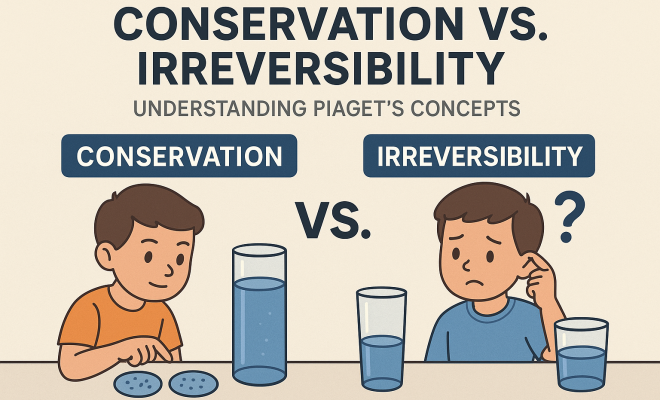
At its core, Piaget conservation theory revolves around the ability to understand that certain properties of objects remain constant despite changes in their form or appearance. For example, when liquid is poured from a short, wide glass into a tall, narrow one, a child with a firm grasp of conservation will recognize that the amount of liquid remains the same, despite its altered appearance. Piaget proposed that children typically develop this understanding between the ages of 7 and 11, during the concrete operational stage of cognitive development.
The theory consists of various types of conservation, including volume, mass, and number. Each type represents a different aspect of a child’s cognitive development. Piaget’s work emphasizes that this understanding is not instinctual; rather, it is acquired through experience and interaction with the environment. Children engage in active learning, testing their hypotheses about the world and refining their understanding through trial and error.
2. The Key Stages of Cognitive Development: The Role of Conservation
Piaget’s view of cognitive development is segmented into four stages: sensorimotor, preoperational, concrete operational, and formal operational. Conservation primarily emerges during the concrete operational stage. Here, children begin to think logically and understand the concept of reversibility, which is essential for grasping conservation. In contrast, children in the preoperational stage often struggle with this understanding.
In the preoperational stage, which spans roughly ages 2 to 7, children are characterized by symbolic play and egocentric thinking. They may not grasp that changing the shape of clay does not change its mass, leading to a misunderstanding of conservation. This developmental trajectory underscores the importance of educational strategies tailored to children’s cognitive levels, emphasizing hands-on experiences that foster understanding through exploration.
3. Irreversibility: The Counterpart of Conservation
Irreversibility is another pivotal concept in Piaget’s conservation theory, referring to a child’s inability to mentally reverse a sequence of events or actions. For instance, a child who sees a lump of clay flattened into a pancake may not comprehend that it can be reshaped back into its original form. This limitation highlights a significant aspect of cognitive development, where children often struggle with understanding processes that can be reversed.
This lack of reversibility is particularly pronounced in the preoperational stage, making it a critical area for educators and parents to address. Understanding that children may perceive changes as permanent can help adults tailor their interactions and explanations, fostering a more supportive learning environment. Encouraging children to explore reversibility through hands-on activities can significantly aid in the development of this cognitive skill.
4. Practical Applications of Piaget’s Concepts: In Education and Parenting
The implications of Piaget’s conservation theory extend far beyond theoretical discussions; they have practical applications in education and parenting. For educators, understanding when children grasp conservation can inform teaching methods and the design of curriculum. For instance, using concrete materials—like blocks or measuring cups—can help children visualize and understand the principles of conservation.
In parenting, recognizing that children may not yet understand conservation can guide how we frame discussions about changes in their environment. Instead of assuming children will intuitively grasp these concepts, parents can facilitate learning through questions and activities that promote exploration and reasoning. This approach enhances cognitive development while also strengthening parent-child interactions.
5. Real-World Examples of Conservation: Observing Development in Action
To truly grasp Piaget’s conservation theory, one can observe real-world examples that illustrate its principles. Take the classic experiment with water displacement: a child watches as water is poured from a tall glass to a shorter, wider one. A child who understands conservation will assert that the amount of water has remained the same. Those who do not may insist that the taller glass holds more because it appears larger.
These experiments are not just academic; they mirror everyday experiences. Parents can engage their children in activities that involve measuring ingredients for cooking or filling different shapes of containers with water. Such experiences reinforce the concept of conservation in a tangible way, allowing children to see and understand the principles at work. (See: Jean Piaget's contributions to psychology.)
6. The Connection to Current Educational Practices: Relevance Today
Today, Piaget’s conservation theory remains highly relevant, particularly as educational paradigms shift towards more child-centered and experiential learning. Modern classrooms often incorporate project-based learning strategies that align with Piaget’s ideas about active learning and cognitive development. By engaging children in activities that promote exploration and discovery, educators can foster a deeper understanding of conservation principles.
Additionally, the rise of STEM (science, technology, engineering, and mathematics) education reflects an understanding of the need for hands-on experiences that resonate with Piaget’s theories. Teachers are increasingly encouraged to create learning environments where experimentation and inquiry drive understanding, further solidifying the importance of conservation and irreversibility in contemporary education.
7. Challenges in Teaching Conservation: Addressing Misconceptions
While Piaget’s conservation theory provides a robust framework for understanding cognitive development, educators often face challenges when teaching these concepts. Misconceptions can arise when children apply what they believe to be true about the physical world, making it difficult to grasp conservation. For example, children might believe that a taller container always holds more liquid, regardless of width.
To address these misconceptions, educators can use targeted questioning strategies that prompt children to think critically about their assumptions. By guiding students through thought experiments and discussions, teachers can help children articulate their reasoning and gradually arrive at a more nuanced understanding of conservation. This process not only reinforces the concept but also develops critical thinking skills that are essential for lifelong learning.
8. Research Insights and Developments: Expanding Piaget’s Theory
Since Piaget’s initial work, numerous studies have expanded our understanding of cognitive development, particularly in relation to conservation. Researchers like Lev Vygotsky have introduced the concept of the Zone of Proximal Development, emphasizing the role of social interaction in cognitive growth. Vygotsky’s ideas complement Piaget’s, suggesting that while children may reach certain cognitive milestones independently, social interactions play a critical role in enhancing understanding.
Moreover, recent studies have explored how cultural factors influence the development of conservation skills. For instance, children from different cultures may show varying developmental timelines regarding conservation, suggesting that cognitive development is not solely a biological process but is also shaped by environmental contexts. These insights encourage educators and parents to adopt culturally responsive teaching practices that honor and incorporate children’s diverse experiences.
9. Looking Ahead: The Future of Cognitive Development Theories
As we look to the future, Piaget’s conservation theory will likely continue to influence our understanding of cognitive development. The integration of technology in education, such as virtual and augmented reality, offers new avenues for children to explore and engage with concepts of conservation in innovative ways. These technologies can create immersive experiences that deepen understanding and retention.
Furthermore, ongoing research in neuroscience is shedding light on the cognitive processes behind conservation and irreversibility. Understanding the brain mechanisms that underlie these concepts may provide educators with new strategies for teaching and fostering cognitive growth. Overall, Piaget’s conservation theory remains a foundational element in the psychology of learning and will evolve alongside advancements in educational practices and our understanding of human cognition.
10. Common Misunderstandings About Conservation: Clearing the Confusion
Many people, including educators and parents, can fall victim to misconceptions about Piaget’s conservation theory. Understanding these misunderstandings can help in effectively teaching children. One common misconception is that children demonstrate conservation at an earlier age than Piaget proposed. While it may seem intuitive that children grasp conservation concepts earlier during their play, research consistently supports Piaget’s timeline of conservation development emerging during the concrete operational stage.
Another misunderstanding is the belief that conservation is a singular concept. In reality, there are several types of conservation, including conservation of number, length, and mass, each requiring different cognitive skills. Recognizing these distinctions can help in crafting better learning experiences. For instance, while a child may grasp conservation of number sooner, they may struggle with conservation of volume until they have more experience with measurement.
11. FAQs About Piaget’s Conservation Theory: Answering Your Questions
What is the significance of Piaget’s conservation theory?
Piaget’s conservation theory is significant because it highlights a critical stage in cognitive development. Understanding conservation is essential for children as it indicates their ability to think logically about quantities, shapes, and sizes, which is foundational for more complex mathematical and scientific concepts later on.
At what age do children typically understand conservation?
According to Piaget, children generally begin to understand conservation between the ages of 7 and 11, during the concrete operational stage. However, some aspects of conservation may be evident earlier in certain contexts, such as during play or guided activities.
How can parents help children grasp conservation concepts?
Parents can help children grasp conservation concepts through hands-on activities that involve measuring, sorting, and comparing different materials. Simple games, like filling various containers with the same amount of water or using different shapes to build structures, can significantly enhance a child’s understanding of conservation. (See: Child development and learning.)
What role does culture play in the development of conservation skills?
Cultural factors can greatly influence the development of conservation skills. Children raised in environments that emphasize practical experiences, such as cooking or craft-making, may develop conservation skills earlier than those who do not engage in such activities. By incorporating culturally relevant materials and experiences, educators can support diverse learners in understanding these concepts.
Can conservation skills improve with age and experience?
Yes, conservation skills typically improve with age and experience. As children encounter more complex tasks and engage in discussions and activities that challenge their understanding, they refine their cognitive abilities and develop a stronger grasp of conservation concepts.
12. Case Studies and Examples: Real-World Applications
To see Piaget’s conservation theory in action, let’s consider a few case studies. In a classroom setting, a teacher may introduce a set of activities designed to illustrate the conservation of volume. Children are given three different shaped containers and are asked to pour water from one to another. The teacher observes which children accurately identify that the amount of water remains constant, regardless of the container’s shape. This hands-on experience allows children to visualize and better understand the principle of conservation.
Another example can be drawn from a family setting. A parent might engage their child in a baking project where they measure flour and sugar using different cups. As they compare the measurements, the child learns that two smaller cups can contain the same amount as one large cup, reinforcing their understanding of conservation of mass. Through these real-world applications, children not only learn concepts but also see their relevance in daily life.
13. Implications for Future Research and Practice: Directions to Explore
The future of research surrounding Piaget’s conservation theory is likely to explore the intersections of technology, diversity, and cognitive psychology. With advancements in educational technology, there is potential to develop innovative teaching tools that can cater to various learning styles and demonstrate conservation principles more vividly. Using virtual reality could enable children to visualize changes in a controlled environment where they can experiment with different scenarios without the constraints of physical materials.
Additionally, as our understanding of cognitive diversity grows, future research should focus on how different learning environments and cultural contexts affect the development of conservation skills. This can lead to curriculum developments that are more inclusive and effective for diverse population groups.
Overall, the implications for future research in this area are vast and can lead to meaningful changes in how we approach education and parenting, ensuring that the lessons derived from Piaget’s conservation theory can be applied effectively in various settings.
14. Comparative Theories: Understanding Other Cognitive Models
While Piaget’s conservation theory is foundational, other cognitive theories provide different insights into child development. For example, Vygotsky’s sociocultural theory emphasizes the importance of social interaction and cultural context, which contrasts with Piaget’s focus on individual exploration. Vygotsky believed that cognitive development is heavily influenced by language and collaborative learning, suggesting that children learn best in social settings where they can discuss and interact with peers.
Another framework, the information processing theory, looks at how children encode, store, and retrieve knowledge, likening the mind to a computer. This perspective can complement Piaget’s theory by providing a more detailed understanding of how children process information related to conservation, particularly in terms of memory, attention, and problem-solving skills.
By integrating insights from these various theories, educators can create a more comprehensive approach to teaching conservation and cognitive development, acknowledging both the individual and social aspects of learning.
15. Expert Perspectives: Insights from Developmental Psychologists
Experts in developmental psychology continue to explore and validate Piaget’s conservation theory through various research studies. Dr. Susan Johnson, a child psychologist, emphasizes that understanding conservation is crucial for later academic success, particularly in mathematics and sciences. She notes that children who have a solid grasp of conservation are often more adept at understanding complex mathematical concepts, such as fractions and ratios.
Similarly, Dr. Mark Thompson, an educational theorist, points out that Piaget’s stages of cognitive development still play a significant role in shaping curriculum design. He advocates for experiential learning that aligns with children’s cognitive capabilities, suggesting that when educators acknowledge where students are in their developmental journey, they can tailor lessons that resonate more deeply with learners.
These expert insights reinforce the importance of Piaget’s work while also highlighting the potential for continued evolution in educational practices that embrace a broader understanding of cognitive development.
16. Practical Exercises for Parents and Educators: Engaging Children with Conservation
To effectively teach conservation concepts, parents and educators can employ various practical exercises that make learning engaging. For example, a simple activity involves using two identical containers to pour different materials, such as rice or sand, allowing children to see that the quantity remains the same despite the shape of the container.
Another fun exercise is creating a “conservation scavenger hunt” where children find objects around the house that exhibit different types of conservation, like a ball of playdough for mass or a stack of coins for number conservation. This activity encourages exploration and reinforces the idea that conservation is present in many aspects of their environment.
By incorporating these hands-on activities, children actively participate in their learning and develop a solid conceptual understanding of conservation principles that will benefit them in future learning endeavors.
17. Final Thoughts: The Enduring Legacy of Piaget’s Conservation Theory
Piaget’s conservation theory has left an indelible mark on the field of developmental psychology and education. By recognizing that children undergo specific stages of cognitive development, educators and parents can better support their learning journeys. The insights provided by Piaget’s work encourage us to create environments that foster exploration, reasoning, and critical thinking in children.
As we continue to explore cognitive development, integrating Piaget’s principles with insights from contemporary research and educational practices will be crucial. The journey of understanding and teaching conservation is ongoing, and embracing this legacy is a pathway to nurturing the next generation of thinkers and innovators.
“`
Trending Now
Frequently Asked Questions
What is Piaget's conservation theory?
Piaget's conservation theory refers to the understanding that certain properties of objects, such as volume, mass, and number, remain constant despite changes in their form or appearance. This cognitive ability typically develops in children between the ages of 7 and 11 during the concrete operational stage of development.
At what age do children understand conservation?
Children generally develop an understanding of conservation between the ages of 7 and 11. This is during Piaget's concrete operational stage, where they begin to grasp that quantities remain the same despite changes in shape or appearance.
What are the types of conservation in Piaget's theory?
Piaget identified several types of conservation, including volume, mass, and number. Each type reflects different aspects of cognitive development, showing how children learn to recognize that certain properties remain unchanged despite alterations in form.
How does Piaget's theory apply to education?
Piaget's theory of conservation has significant implications for education, as it informs teaching strategies that encourage active learning. Understanding that children learn through experience helps educators design activities that foster cognitive development and enhance problem-solving skills.
What is the significance of Piaget's concepts in parenting?
Piaget's concepts of conservation and irreversibility are essential for parenting, as they guide parents in understanding their children's cognitive development. Recognizing when children are likely to grasp these concepts can help parents create supportive learning environments that promote exploration and understanding.
Have you experienced this yourself? We’d love to hear your story in the comments.