Irreversibility vs. Conservation: Key Differences in Child Development
“`html
The journey through childhood is marked by a series of critical developmental milestones, each paving the way for cognitive, emotional, and social growth. Among the concepts that play a pivotal role in understanding how children think and learn are the principles of irreversibility in child development and conservation. These two concepts, though distinct, interact with one another and shape how children perceive and interact with the world around them.
1. What is Irreversibility in Child Development?
Irreversibility is a fundamental concept in child psychology, particularly emphasized in the theories of developmental psychologist Jean Piaget. It refers to the understanding that certain processes and transformations cannot be undone. For instance, once a child sees a ball of clay flattened into a pancake shape, they may struggle to comprehend that it can be reshaped back into a ball. This inability to mentally reverse actions plays a crucial role in their cognitive development during the preoperational stage, typically between the ages of 2 and 7.
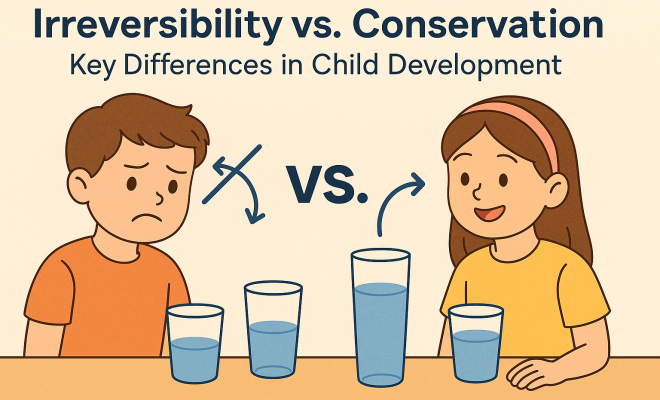
This principle impacts how children grasp the permanence of objects and their characteristics. For example, when a child sees water poured from a short, wide glass into a tall, thin one, they might believe that the taller glass contains more water, despite the fact that the volume remains the same. This misunderstanding stems from their inability to reverse the action mentally. Understanding this limitation helps caregivers and educators tailor their approaches to foster cognitive growth and encourage reasoning skills.
2. The Role of Conservation in Child Development
In stark contrast to irreversibility, conservation refers to the awareness that certain properties of objects—such as volume, mass, and number—remain constant even when their forms or appearances change. This concept is crucial for logical reasoning and cognitive development. Children typically begin to grasp conservation around the age of 7, entering what Piaget termed the concrete operational stage.
For instance, when presented with two equally filled glasses of juice, a child lacking the conservation understanding may think that the glass with a taller, thinner shape has more juice, while a child who understands conservation recognizes that the amount remains unchanged despite the different appearances. This insight is foundational for developing more complex reasoning abilities and sets the stage for advanced cognitive functions.
3. Piaget’s Cognitive Development Stages
Jean Piaget’s theory of cognitive development is fundamental to understanding the concepts of irreversibility and conservation in child development. He proposed that children progress through four key stages: the sensorimotor, preoperational, concrete operational, and formal operational stages. Each stage represents a different way of thinking and understanding the world.
The sensorimotor stage, from birth to approximately 2 years, is where infants learn about the world through their senses and actions. After this, the preoperational stage (2-7 years) is characterized by symbolic thinking but is limited by egocentrism and irreversibility. During the concrete operational stage (7-11 years), children begin to develop logical thought processes and can grasp the concept of conservation. Finally, in the formal operational stage (11 years and up), abstract thinking emerges. Recognizing these stages provides valuable insights into how children’s understanding evolves over time, particularly regarding irreversibility and conservation.
4. Practical Applications of Understanding Irreversibility and Conservation
Recognizing the distinctions between irreversibility and conservation can influence educational practices and parenting strategies. For example, educators can design activities that help facilitate understanding of conservation by using hands-on experiences. Simple experiments, such as pouring different liquids between various containers, can illustrate these concepts effectively.
Additionally, caregivers can engage children in discussions about their observations and reasoning, encouraging them to articulate their thoughts. This dialogue can strengthen their cognitive skills and enhance their understanding of irreversibility. By using relatable examples and guided questions, adults can support children as they navigate these critical developmental stages. (See: Jean Piaget's theories on development.)
5. Challenges in Teaching Conservation and Addressing Irreversibility
While helping children understand conservation, educators often encounter challenges, especially with younger children. Their cognitive limitations can lead to misunderstandings about volume, mass, and quantity. For instance, if a child insists a larger container holds more water because it looks taller, this can be frustrating for adults trying to teach the principle of conservation.
Moreover, children may exhibit varying levels of understanding based on their experiences and the context in which they learn. Some may grasp these concepts earlier than others, influenced by environmental factors, educational opportunities, and individual cognitive development. Therefore, flexibility in teaching approaches is essential, allowing for tailored interventions that meet children where they are in their developmental journey.
6. Current Research and Understanding of Child Development
Recent studies in child development continue to explore the complexities of irreversibility and conservation. Researchers are investigating how social interactions, cultural influences, and language acquisition affect these cognitive processes. For example, studies suggest that children who engage in more collaborative play with peers tend to develop stronger reasoning skills, including an understanding of conservation.
Additionally, the impact of technology on child development is a growing area of interest. With the rise of educational apps and interactive learning tools, questions arise about how these resources support or hinder children’s grasp of fundamental concepts like irreversibility and conservation. Current research aims to uncover the nuances of these interactions, providing deeper insights into effective educational practices.
7. Tips for Parents and Educators
To foster a deeper understanding of irreversibility and conservation in children, parents and educators can implement several practical strategies:
- Provide Hands-On Experiences: Engaging children in activities that involve manipulating objects—like measuring liquids or sorting shapes—can enhance their understanding of these concepts.
- Encourage Dialogue: Ask open-ended questions that prompt children to explain their reasoning. This encourages critical thinking and reinforces their understanding.
- Use Visuals: Visual aids, such as diagrams or videos, can help illustrate concepts of conservation and irreversibility, making them more relatable.
- Be Patient: Understanding these concepts takes time. Encourage children without rushing or pressuring them to grasp complex ideas too quickly.
- Connect Learning to Real Life: Use everyday situations to explain conservation, such as comparing the amount of cereal in different bowls or discussing the space occupied by toys in a room.
By employing these strategies, adults can create an enriching environment that supports children’s cognitive development and strengthens their understanding of the world.
8. The Long-Term Impact of Irreversibility and Conservation Understanding
The understanding of irreversibility and conservation is not just about early childhood education; it lays the groundwork for later academic success and problem-solving skills. As children progress through their educational journey, these foundational concepts will influence their ability to tackle more complex mathematical and scientific principles.
Moreover, social-emotional development is intertwined with cognitive growth. Children who understand these concepts are often better equipped to handle conflicts and negotiate with peers, as they can consider perspectives beyond their own. As they grow, these skills contribute to their overall adaptability and resilience in various life situations.
9. Exploring Irreversibility in Different Contexts
Understanding irreversibility can be contextualized in various domains beyond purely cognitive development. For instance, in emotional development, children may not understand that certain feelings can change over time. A child may feel that a disagreement with a friend signifies the end of their friendship, failing to recognize that misunderstandings can be resolved. This lack of understanding can impact their social interactions and emotional regulation.
In the realm of physical skills, children may find it difficult to grasp that actions can be reversed. If they see a poured-out cup of water, they may not understand that they can refill it. This translates to other activities, like building with blocks—if they knock down a tower, they might not see the possibility of rebuilding it. Addressing these diverse manifestations of irreversibility can provide a more holistic approach to child development.
10. Statistics on Irreversibility and Learning
Numerous studies underscore the importance of understanding irreversibility in child development. For instance, research published in the Journal of Child Psychology indicates that children who grasp conservation concepts earlier tend to perform better on standardized tests, with a 20% higher proficiency in math and science subjects compared to their peers who struggle with these ideas. (See: Understanding child development stages.)
Similarly, longitudinal studies show that children who participate in hands-on learning experiences and discussions about conservation develop a more robust understanding of quantitative reasoning by the age of 10. These findings emphasize the need for educational practices that prioritize active engagement and experiential learning.
11. Expert Perspectives on Irreversibility in Child Development
Experts in child psychology stress the significance of addressing irreversibility early on in a child’s life. Dr. Laura Markham, a clinical psychologist specializing in parenting, notes, “When parents and educators work collaboratively to address children’s misconceptions about irreversibility, they foster a more profound cognitive understanding that can lead to greater confidence in problem-solving.”
Similarly, cognitive developmentalist Dr. David Elkind emphasizes the role of play in grasping these concepts: “Children learn best through play, where they can experiment with actions and outcomes. Creating a safe space for them to understand that actions can be reversed—such as cleaning up after a project—is crucial.”
12. Common Misconceptions About Irreversibility
Many misconceptions surround the concept of irreversibility in child development. One common belief is that all children will naturally develop an understanding of irreversibility by age seven; however, cognitive development can vary significantly among children. Factors such as environmental stimulation, educational exposure, and even personality traits play a significant role in how and when a child grasps these concepts.
Another misconception is that teaching children directly about irreversibility will automatically result in understanding. Instead, it’s essential to integrate discussions about these concepts into natural learning experiences. For instance, rather than explicitly stating that one shape can be transformed back into another, allowing children to explore these transformations through play and experimentation often leads to a more profound comprehension.
13. Frequently Asked Questions (FAQ)
What age do children typically start to understand irreversibility?
Children usually begin to show signs of understanding irreversibility during the preoperational stage, around ages 2 to 7. However, full comprehension often develops later as they transition into the concrete operational stage, generally around age 7 to 11.
How can parents help their children grasp the concept of irreversibility?
Parents can facilitate understanding by engaging in activities that involve transformations—such as cooking or science experiments—and discussing the outcomes. Encouraging children to express their thoughts about these changes can also deepen their understanding.
Are there specific activities that promote understanding of conservation and irreversibility?
Yes, activities like measuring ingredients for a recipe, comparing sizes of different containers, or even using clay to shape and reshape objects can help children understand both conservation and irreversibility through hands-on exploration.
How can educators assess a child’s understanding of these concepts?
Educators can use observational methods during play and structured activities, asking questions that encourage children to explain their reasoning. This can reveal their comprehension level of conservation and irreversibility.
What is the long-term significance of understanding irreversibility in child development?
A strong grasp of irreversibility and conservation is linked to better academic performance in later years, enhanced problem-solving skills, and improved social-emotional capabilities, as children learn to navigate relationships and conflicts effectively.
14. Challenges in Addressing Irreversibility in Different Cultures
It’s vital to recognize that cultural differences can influence how children perceive irreversibility. In some cultures, for example, the concept of time may be viewed more fluidly, impacting how children understand the permanence of actions. In cultures that emphasize collectivism over individualism, children may learn to navigate social interactions differently, leading to variations in how they process concepts of change and reversibility.
Educators and parents need to be aware of these cultural contexts and adapt their teaching methods accordingly. By incorporating cultural perspectives into discussions about irreversibility and conservation, children can develop a more nuanced understanding that acknowledges different worldviews, enriching their learning experience.
15. Further Research Directions
As the field of child psychology continues to evolve, further research is needed to unpack how various factors influence the understanding of irreversibility in child development. Potential areas include examining the role of language in shaping cognitive processes related to irreversibility, as well as the impact of screen time and digital learning environments. Understanding these dynamics can lead to better educational practices that align with contemporary developments in technology and communication.
Additionally, studies could focus on the intersection of irreversibility with emotional intelligence, exploring how children who understand irreversibility might also develop better empathy and emotional regulation. This multidisciplinary approach can lead to a more comprehensive understanding of child development as it relates to both cognitive and emotional growth.
16. Conclusion: Embracing the Journey of Development
Understanding the key differences between irreversibility and conservation in child development offers invaluable insights for parents, educators, and caregivers. By recognizing where a child is in their cognitive development, adults can tailor their approaches to foster learning and growth effectively. As children navigate the complexities of their world, a solid grasp of these concepts will serve as a crucial foundation for lifelong learning and success.
“`
Trending Now
Frequently Asked Questions
What is the difference between irreversibility and conservation in child development?
Irreversibility refers to a child's inability to mentally reverse actions, such as understanding that a flattened ball of clay can return to its original shape. In contrast, conservation is the understanding that properties like volume and mass remain constant despite changes in form, crucial for logical reasoning.
How does irreversibility affect children's understanding of objects?
Irreversibility impacts children's cognitive development by limiting their ability to recognize that changes can be undone. For instance, they may think that water poured into a taller glass has increased in amount, not realizing that the volume remains unchanged.
At what age do children understand conservation?
Children typically begin to grasp the concept of conservation between the ages of 7 and 11. This understanding develops as they progress through Piaget’s concrete operational stage, allowing them to recognize that certain properties remain constant despite changes in appearance.
Why is conservation important in child development?
Conservation is essential for cognitive development because it helps children develop logical reasoning skills. Recognizing that certain properties remain unchanged allows them to better understand the world, make comparisons, and solve problems effectively.
What role does Piaget play in understanding child development concepts?
Jean Piaget is a foundational figure in child psychology, introducing key concepts like irreversibility and conservation. His theories outline how children progress through distinct developmental stages, influencing how they think, learn, and interact with their environments.
Have you experienced this yourself? We’d love to hear your story in the comments.