Using Bloom’s Taxonomy to Write Better Test Questions
“`html
Creating effective test questions is a cornerstone of educational assessment, yet many educators struggle with crafting questions that truly evaluate students’ understanding. Enter Bloom’s Taxonomy, a framework that not only categorizes educational objectives but also provides a structured approach to writing test questions that can assess various levels of understanding. By leveraging Bloom’s Taxonomy, educators can write better test questions that not only challenge students but also help them retain knowledge. Let’s explore how to effectively use this taxonomy in your assessments.
Understanding Bloom’s Taxonomy
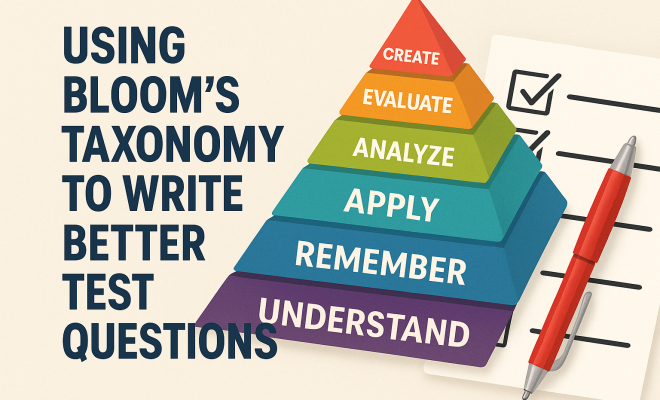
Developed in 1956 by educational psychologist Benjamin Bloom, Bloom’s Taxonomy is a hierarchical classification of cognitive skills that educators aim to develop through learning. At its core, the taxonomy categorizes cognitive processes into six levels, each representing a different type of thinking. The original levels included:
- Knowledge
- Comprehension
- Application
- Analysis
- Synthesis
- Evaluation
In 2001, a revised version of the taxonomy was introduced, updating the levels to:
- Remembering
- Understanding
- Applying
- Analyzing
- Evaluating
- Creating
This revised taxonomy emphasizes active verbs and a clearer progression towards higher-order thinking skills, which are essential in modern education.
The Importance of Writing Effective Test Questions
Effective test questions do more than just assess rote memorization; they measure students’ understanding, analytical skills, and ability to apply knowledge in real-world scenarios. Poorly designed questions can lead to misunderstandings of students’ true capabilities, ultimately impacting their learning journey. Educators must strive to create questions that:
- Test various cognitive levels as outlined in Bloom’s Taxonomy.
- Encourage critical thinking.
- Provide insight into students’ understanding.
By using Bloom’s Taxonomy, educators can expand the depth and breadth of their assessments, ensuring that they align with the desired learning outcomes.
Aligning Questions with Bloom’s Levels
When crafting Bloom’s Taxonomy test questions, it’s crucial to align each question with the appropriate level of cognitive demand. Here’s how you can frame your questions based on each level:
Remembering
At the base level, questions should focus on recall of facts and basic concepts. Examples include:
- What is the capital of France?
- Name the three branches of government.
Understanding
Moving up the taxonomy, questions should ask students to explain concepts or interpret information. Examples include:
- Explain the significance of the capital in the context of French history.
- Describe how the branches of government interact.
Applying
These questions require students to use information in new situations. For example:
- How would you apply the concept of democracy to a new nation?
- Using the three branches of government, analyze how a bill becomes a law.
Analyzing
At this stage, students should break down information into parts and explore relationships. Examples include: (See: Bloom's Taxonomy overview.)
- Compare and contrast the political systems of France and the United States.
- Identify the different roles each branch of government plays in lawmaking.
Evaluating
These questions prompt students to make judgments based on criteria. Examples include:
- Evaluate the effectiveness of the French government during the Revolution.
- Assess the balance of power among the branches of government.
Creating
At the highest level, questions should encourage students to produce new ideas or products. Examples include:
- Design a new government system combining elements from various countries.
- Create a presentation advocating for a specific policy change based on historical events.
By structuring questions this way, you ensure a comprehensive assessment that challenges students at various levels.
Examples of Bloom’s Taxonomy Test Questions
To illustrate how to apply Bloom’s Taxonomy in various subjects, let’s examine a few examples:
Science
- Remembering: What are the stages of the water cycle?
- Understanding: Why is photosynthesis crucial for plant life?
- Applying: How would you simulate an ecosystem in a classroom setting?
- Analyzing: Compare and contrast the roles of producers and consumers in an ecosystem.
- Evaluating: Assess the impact of deforestation on local biodiversity.
- Creating: Design an experiment to test the effects of sunlight on plant growth.
History
- Remembering: Who was the first president of the United States?
- Understanding: Summarize the causes of World War I.
- Applying: How would you apply lessons from the Civil Rights Movement to today’s social issues?
- Analyzing: Analyze the differences between the North and South during the Civil War.
- Evaluating: Evaluate the effectiveness of the New Deal in addressing the Great Depression.
- Creating: Create a documentary script about a significant event in American history.
Mathematics
- Remembering: What is the formula for the area of a circle?
- Understanding: Explain why the Pythagorean theorem is important in geometry.
- Applying: If a triangle has side lengths of 3, 4, and 5, how would you confirm it is a right triangle?
- Analyzing: Analyze a graph to determine trends in data over time.
- Evaluating: Compare different methods for solving quadratic equations and discuss their merits.
- Creating: Propose a new model for predicting the outcomes of dice rolls.
These examples demonstrate how you can use Bloom’s Taxonomy to create a variety of test questions across different subjects, promoting critical thinking and deeper learning.
Practical Tips for Writing Bloom’s Taxonomy Test Questions
Writing effective test questions can be daunting, but following these tips can streamline the process:
- Use Action Verbs: Focus on using precise action verbs that correspond to each level of Bloom’s Taxonomy. Words like “describe,” “analyze,” “evaluate,” and “create” can help clarify what you expect from students.
- Vary Question Types: Incorporate multiple-choice, short answer, and essay questions to assess various cognitive levels and learning styles.
- Align with Learning Objectives: Ensure that your test questions align with your course learning objectives. This alignment guarantees that you’re evaluating the knowledge and skills you intended to teach.
- Provide Context: Whenever possible, frame questions in real-world contexts. This approach not only engages students but also helps them see the relevance of their learning.
- Review and Revise: Regularly review your test questions after each assessment to identify which ones effectively gauged student understanding and which ones did not. Use this feedback to refine your questions for future assessments.
By implementing these practical strategies, you can create Bloom’s Taxonomy test questions that are not only effective but also informative in assessing student learning.
The Current Relevance of Bloom’s Taxonomy
In today’s educational landscape, where critical thinking and problem-solving skills are more valuable than ever, Bloom’s Taxonomy remains highly relevant. The framework serves as a guide for educators seeking to prepare students for real-world challenges. In an era where standardized tests often emphasize rote memorization, using Bloom’s Taxonomy helps shift the focus back to meaningful learning and understanding.
Furthermore, with the rise of technology in education, the application of Bloom’s Taxonomy can be expanded to include digital literacy skills. Educators can create questions that assess students’ ability to analyze and evaluate digital information, a critical skill in today’s information-saturated world.
Common Misconceptions About Bloom’s Taxonomy
Despite its widespread use, there are several misconceptions about Bloom’s Taxonomy that can hinder its effectiveness. Here are a few:
1. It’s Just About Lower and Higher Order Thinking
Many educators mistakenly categorize questions strictly into “lower-order” and “higher-order” thinking, overlooking that each level is essential for a comprehensive understanding. All levels serve a purpose in the learning process, and students should be encouraged to engage with all levels to build a robust foundation.
2. All Questions Need to Be Higher Order
While higher-order questions are crucial for developing critical thinking skills, students also need to solidify their understanding at the foundational levels. A balanced assessment should include a mix of question types so that students can demonstrate their knowledge at all levels. (See: U.S. Department of Education on Bloom's Taxonomy.)
3. It’s Only Useful for Assessment
Bloom’s Taxonomy is not solely a tool for assessment; it can also guide instructional design. Educators can use it to structure lessons, inform teaching strategies, and develop learning outcomes that align with cognitive development.
The Role of Technology in Bloom’s Taxonomy
As technology continues to evolve, so does the application of Bloom’s Taxonomy in the classroom. Digital tools offer new opportunities to create interactive assessments that align with the taxonomy. For example:
- Online Quizzes: Educators can use platforms that allow for varied question types, including multiple choice, short answer, and interactive scenarios, making it easier to assess different cognitive levels.
- Collaborative Projects: Tools like Google Docs or collaborative platforms enable students to work together on projects that require them to analyze, evaluate, and create collectively.
- Digital Portfolios: Students can curate their work over time, reflecting higher-order thinking as they choose pieces that best showcase their learning journey and understanding.
Frequently Asked Questions About Bloom’s Taxonomy Test Questions
1. What are some common mistakes when creating Bloom’s Taxonomy test questions?
Common mistakes include not varying the question types, failing to align questions with learning objectives, and neglecting to cover all levels of the taxonomy. It’s essential to create a well-rounded assessment that reflects students’ understanding across the taxonomy.
2. How can educators ensure they are using Bloom’s Taxonomy effectively?
Educators can ensure effective use by regularly reviewing their assessments, soliciting feedback from peers, and staying informed about best practices. Workshops and professional development can also enhance understanding and application of the taxonomy.
3. Can Bloom’s Taxonomy be applied to non-academic subjects?
Absolutely! Bloom’s Taxonomy can be applied to any subject, including arts and physical education. It provides a framework for assessing skills and understandings across various disciplines.
4. How do you create a balanced assessment using Bloom’s Taxonomy?
A balanced assessment includes a range of question types across all taxonomy levels. Start by identifying your learning objectives, then create questions that cover all levels from remembering to creating to ensure a comprehensive understanding of the material.
5. How can technology facilitate Bloom’s Taxonomy in education?
Technology can facilitate the application of Bloom’s Taxonomy by enabling innovative assessment methods, such as interactive quizzes, digital portfolios, and collaborative online projects, that engage students and promote critical thinking.
Strategies for Effective Implementation of Bloom’s Taxonomy
Implementing Bloom’s Taxonomy effectively requires careful planning and consideration of various factors. Here are some strategies that can help educators integrate this framework into their teaching and assessment practices:
1. Professional Development
Investing in professional development can help educators better understand Bloom’s Taxonomy and its applications. Workshops and training sessions can provide hands-on experiences, allowing teachers to create and assess Bloom’s Taxonomy test questions in collaborative settings.
2. Collaborative Planning
Educators can benefit from collaborating with colleagues to design assessments that align with Bloom’s Taxonomy. Working together fosters a shared understanding and encourages the exchange of ideas on how to formulate effective test questions. This collaboration can also lead to the creation of interdisciplinary assessments that reflect the interconnectedness of subjects. (See: Harvard University educational resources.)
3. Use of Rubrics
Developing rubrics based on Bloom’s Taxonomy can help clarify expectations for both educators and students. Rubrics provide a detailed breakdown of what constitutes successful performance at each taxonomy level, ensuring transparency in assessment criteria. They can also guide students in understanding how to elevate their responses to higher cognitive levels.
4. Feedback Mechanisms
Incorporate feedback mechanisms that allow students to reflect on their performance based on Bloom’s Taxonomy. This can include peer evaluations, self-assessments, or teacher feedback that highlights which cognitive levels were successfully addressed and which need further development. Such practices encourage students to take ownership of their learning and identify areas for growth.
Expanding Bloom’s Taxonomy into Diverse Learning Environments
Bloom’s Taxonomy isn’t just for the traditional classroom. Its principles can be applied in online learning, blended environments, and even informal education settings. Adapting Bloom’s Taxonomy for various contexts helps maintain educational rigor regardless of the format.
1. Online Learning
In online courses, educators can use discussion forums, quizzes, and assignment submissions to gauge understanding at different levels of Bloom’s Taxonomy. For instance, students can post reflections (Understanding), participate in debates (Analyzing), or create video presentations (Creating) based on course content.
2. Blended Learning
Blended learning environments, which combine face-to-face and online elements, can benefit from Bloom’s framework by encouraging students to engage with materials in multiple ways. Educators can design activities that require students to remember information through online quizzes, understand concepts through group discussions, and apply knowledge via project-based tasks.
3. Informal Education
In informal settings, such as workshops or community programs, Bloom’s Taxonomy can aid facilitators in assessing participants’ engagement and learning. For example, after a workshop, facilitators can ask participants to evaluate what they learned and create action plans to apply this knowledge in their personal or professional lives.
Conclusion: The Power of Thoughtful Assessment
Effective assessment is a critical component of effective teaching. By utilizing Bloom’s Taxonomy to write better test questions, educators can ensure that their assessments reflect not just what students know but how well they can apply, analyze, and create based on that knowledge. This structured approach not only enhances educational outcomes but also fosters a learning environment that values deep understanding and critical thinking. As you craft your next set of test questions, remember: it’s not just about what students can recall; it’s about how they can use what they’ve learned to make sense of the world around them.
“`
Trending Now
Frequently Asked Questions
What is Bloom's Taxonomy?
Bloom's Taxonomy is a hierarchical classification of cognitive skills developed by educational psychologist Benjamin Bloom in 1956. It categorizes cognitive processes into six levels: Knowledge, Comprehension, Application, Analysis, Synthesis, and Evaluation, which help educators assess and promote various levels of understanding in students.
How can Bloom's Taxonomy improve test questions?
By using Bloom's Taxonomy, educators can create effective test questions that assess different cognitive levels, encourage critical thinking, and provide insights into students' understanding. This structured approach helps ensure questions challenge students and measure their true capabilities.
What are the levels of Bloom's Taxonomy?
The levels of Bloom's Taxonomy, as revised in 2001, include: Remembering, Understanding, Applying, Analyzing, Evaluating, and Creating. Each level represents a different type of cognitive skill, progressing from basic recall to higher-order thinking.
Why is it important to write effective test questions?
Effective test questions are crucial because they assess not just memorization but also students' understanding and analytical skills. Poorly designed questions can misrepresent students' capabilities, negatively affecting their learning journey and educational outcomes.
What are some tips for writing test questions using Bloom's Taxonomy?
To write effective test questions using Bloom's Taxonomy, educators should focus on varying cognitive levels, use active verbs, and design questions that encourage critical thinking. This approach helps assess students' understanding and ability to apply knowledge in real-world situations.
Agree or disagree? Drop a comment and tell us what you think.