
Bloom’s Taxonomy in the Digital Age: Enhance Higher-Order Thinking
“`html
Introduction to Bloom’s Taxonomy
Bloom’s Taxonomy has long stood as a beacon in the educational landscape, guiding teachers and learners alike in understanding and fostering higher-order thinking skills. Developed in 1956 by Benjamin Bloom and his colleagues, this framework categorizes learning objectives into a hierarchy that ranges from basic knowledge acquisition to complex synthesis and evaluation. In the context of the Digital Age, integrating technology with Bloom’s Taxonomy offers exciting opportunities for enhancing learning experiences and promoting critical thinking.
This article delves into the crucial intersection between Bloom’s Taxonomy and digital tools, providing educators with insights and practical strategies for fostering higher-order thinking in their classrooms. We’ll explore the evolution of Bloom’s taxonomy, its application in the digital era, and how technology can be used to enrich learning outcomes.
The Evolution of Bloom’s Taxonomy
Originally, Bloom’s Taxonomy was structured with six levels: Knowledge, Comprehension, Application, Analysis, Synthesis, and Evaluation. This taxonomy provided a clear framework for educators to design curricula and assessments, ensuring that learning was not just rote memorization but involved deeper understanding and application.
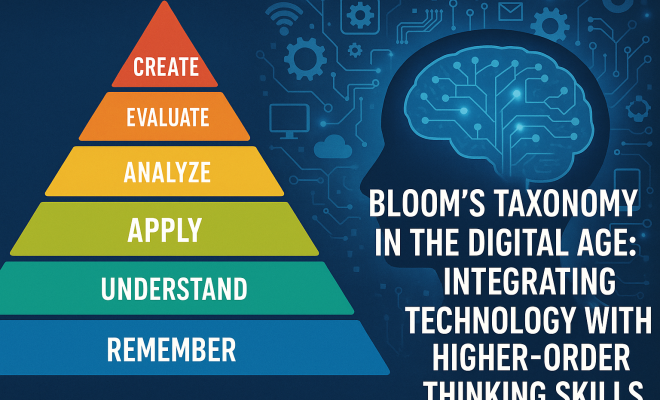
In 2001, a group of cognitive psychologists, led by Lorin Anderson (a former student of Bloom), revised the taxonomy to reflect a more dynamic conception of classification. The revised taxonomy replaced the nouns of the original with verbs, transforming it into a more actionable model: Remembering, Understanding, Applying, Analyzing, Evaluating, and Creating. This shift emphasizes the active processes involved in learning, making it highly relevant in the context of current educational practices, particularly in the Digital Age.
Understanding the Digital Age
The Digital Age is characterized by the proliferation of technology and the internet, which have transformed how we access, share, and engage with information. In classrooms, this means that students are no longer passive recipients of knowledge but active participants in learning experiences. Digital tools such as online collaboration platforms, educational apps, and virtual simulations provide avenues for deeper engagement and exploration.
Moreover, the Digital Age has brought about significant shifts in pedagogical approaches. Traditional teaching methods are increasingly being supplemented or replaced by innovative practices that leverage technology to enhance learning outcomes. In this environment, the principles of Bloom’s Taxonomy remain critical, as they provide a structured way to integrate digital tools effectively.
Integrating Technology with Bloom’s Taxonomy
To fully harness the potential of technology within the framework of Bloom’s Taxonomy, educators need to focus on how digital tools can facilitate each level of learning. Here are some examples:
- Remembering: Use multimedia resources like videos and podcasts to help students recall key information. Tools such as Quizlet can support memorization through interactive flashcards.
- Understanding: Platforms like Edpuzzle allow teachers to embed questions into videos, promoting comprehension through active engagement.
- Applying: Online simulations and virtual labs, such as PhET Interactive Simulations, enable students to apply their knowledge in real-world scenarios.
- Analyzing: Data analysis tools like Google Sheets or Excel can help students dissect and interpret data sets, fostering analytical skills.
- Evaluating: Collaboration tools such as Google Docs or Microsoft Teams encourage peer review and feedback, allowing students to assess the quality of each other’s work.
- Creating: Digital storytelling platforms like Adobe Spark or video editing tools such as WeVideo empower students to create original content, synthesizing their learning in innovative ways.
By thoughtfully integrating technology at each level of Bloom’s Taxonomy, educators can enhance engagement and encourage deeper learning experiences.
Practical Insights for Educators
Implementing Bloom’s Taxonomy in the Digital Age requires strategic planning and a willingness to experiment with new tools. Here are some practical insights to help educators get started:
- Set Clear Learning Objectives: Define what you want your students to achieve at each level of Bloom’s Taxonomy. This clarity will guide your choice of digital tools and activities.
- Choose the Right Tools: Consider the specific needs of your students and select digital resources that align with your objectives. Not all tools will fit every learning goal.
- Encourage Collaboration: Use digital tools to facilitate group work and discussions, fostering a collaborative learning environment that encourages shared exploration and critical thinking.
- Assess and Adapt: Regularly evaluate the effectiveness of the digital tools you are using. Gather feedback from students on their experiences and be prepared to adjust your approach as needed.
These insights can help educators navigate the integration of technology with Bloom’s Taxonomy, ensuring that learning remains focused and impactful.
Current Relevance of Bloom’s Taxonomy in the Digital Age
(See: Bloom's Taxonomy overview.)
As educational institutions increasingly adopt technology-driven approaches, the relevance of Bloom’s Taxonomy becomes even more pronounced. Higher-order thinking skills are crucial for preparing students for a technology-rich future. Employers often emphasize the importance of critical thinking, problem-solving, and creativity—skills that align seamlessly with the upper levels of Bloom’s Taxonomy.
Furthermore, the rise of online education platforms and remote learning emphasizes the need for adaptable teaching strategies. Bloom’s Taxonomy helps educators create structured learning pathways, guiding students through the complexities of online learning environments.
Additionally, the growing importance of social-emotional learning (SEL) can also be integrated with Bloom’s framework. By fostering higher-order thinking skills, educators can create a more holistic approach to student development, focusing not only on academic success but also on emotional and interpersonal growth.
Case Studies: Success Stories in Implementation
To illustrate the effective integration of Bloom’s Taxonomy in the Digital Age, let’s explore some case studies that highlight successful implementations:
Case Study 1: Flipped Classroom Model
At a high school in California, teachers implemented a flipped classroom model that utilized Bloom’s Taxonomy as its foundation. Students engaged with video lectures at home (Remembering) and participated in hands-on activities during class time (Applying and Analyzing). By shifting the traditional model, teachers were able to foster deeper engagement and understanding, leading to improved test scores and overall student satisfaction.
Case Study 2: Project-Based Learning with Technology
A middle school in New York incorporated project-based learning that emphasized collaboration and creativity. Using tools like Google Slides and Canva, students created presentations on environmental issues (Analyzing and Creating). The project encouraged them to evaluate different perspectives and solutions, ultimately culminating in a class debate. This approach not only made learning relevant but also helped students develop critical thinking skills that will serve them in the future.
Challenges in Implementation
While the integration of Bloom’s Taxonomy and technology offers immense potential, it is not without challenges. Some educators may encounter obstacles such as:
- Access and Equity: Not all students have equal access to technology, creating disparities in learning experiences.
- Professional Development: Educators may require training and support to effectively utilize digital tools within the framework of Bloom’s Taxonomy.
- Resistance to Change: Traditional teaching methods can be deeply ingrained, leading to reluctance in adopting new approaches.
Addressing these challenges requires a collaborative effort from educational institutions, policymakers, and communities. By prioritizing equity in access to technology and providing ongoing professional development, we can create an environment conducive to innovative teaching practices.
The Future of Bloom’s Taxonomy in Education
Looking ahead, the future of education will likely continue to be shaped by the rapid advancement of technology. As artificial intelligence, virtual reality, and adaptive learning systems emerge, the principles of Bloom’s Taxonomy will remain vital for guiding curriculum development and assessment practices.
Educators will need to continually adapt to new tools and modalities, ensuring that they foster higher-order thinking skills in their students. By embracing the integration of technology with Bloom’s Taxonomy, teachers can facilitate learning experiences that prepare students for the complexities of the modern world.
Deeper Analysis of Bloom’s Taxonomy in the Digital Age
To further understand the profound impact Bloom’s Taxonomy has in the Digital Age, it’s essential to analyze how each level can be expanded with technology. This not only clarifies the educational objectives but also provides insights into how technology can enhance learning outcomes.
Remembering: In the Digital Age, remembering isn’t just about recalling facts but also about quickly accessing information from diverse sources. Tools like Evernote and Notion can help students organize their notes and create knowledge bases. This allows them to build connections between concepts, enhancing long-term retention.
Understanding: Understanding has evolved with the interactive nature of digital tools. For instance, platforms like Nearpod provide interactive lessons where students can engage with content in real-time, making the process of understanding more dynamic. Educators can also utilize tools like Padlet to create collaborative boards where students can express their understanding through various media.
Applying: Applying knowledge is crucial, and technology gives students a vast playground to experiment. For example, coding platforms like Scratch allow students to apply mathematical concepts in creative programming projects. This approach helps bridge the gap between theoretical knowledge and practical application.
Analyzing: Technology enables students to analyze data on a scale previously unimagined. Using platforms like Tableau or Google Data Studio, students can visualize complex data sets to derive insights. This capability not only enhances their analytical skills but also prepares them for data-driven decision-making in their future careers. (See: Research on Bloom's Taxonomy.)
Evaluating: With access to global information, students can evaluate the credibility of sources and arguments. Integrating fact-checking tools and critical analysis frameworks into lessons can empower students to discern quality information, a skill that is increasingly important in today’s digital landscape.
Creating: The creation level of Bloom’s Taxonomy has transformed into a collaborative effort thanks to digital platforms. Online forums and social networks can serve as spaces for students to share their creative outputs, receive feedback, and iterate on their work. This community-oriented approach fosters a deeper sense of connection and relevance in their learning experiences.
Statistics on Technology Integration in Education
Understanding the impact of technology integration in education can be highlighted through various statistics. According to a report by the U.S. Department of Education, 90% of teachers believe that technology enhances student engagement, and 75% report that it improves learning outcomes. Furthermore, a study by Educause found that students engaged with technology in their learning process have a 30% higher retention rate compared to traditional methods.
Moreover, research by the Pew Research Center indicates that 54% of teachers are using digital tools for collaborative projects, reinforcing the idea that technology fosters communication and teamwork among students. These statistics showcase the undeniable benefits of integrating digital tools into the learning process, supporting the claims around Bloom’s Taxonomy in the Digital Age.
Expert Perspectives on Bloom’s Taxonomy and Technology
Educational experts advocate for the thoughtful integration of Bloom’s Taxonomy with technology, emphasizing the importance of intentional design in educational experiences. Dr. Barbara Means, a leading researcher in educational technology, argues that “using technology effectively requires understanding the potential of each tool and aligning it with learning objectives.”
Another expert, Dr. Tony Bates, highlights that “the Digital Age demands a shift from traditional instructional methods to more dynamic and interactive approaches.” This perspective reinforces the idea that Bloom’s Taxonomy serves as an essential guide for educators navigating this shift.
FAQ: Common Questions About Bloom’s Taxonomy in the Digital Age
Q: How can I start incorporating Bloom’s Taxonomy into my digital lesson plans?
A: Begin by identifying specific learning objectives at each level of Bloom’s Taxonomy and then select appropriate digital tools that support these objectives. For instance, use quizzes for Remembering, simulations for Applying, and collaborative platforms for Creating.
Q: What are some examples of digital tools for each level of Bloom’s Taxonomy?
A: Examples include Quizlet for Remembering, Edpuzzle for Understanding, PhET for Applying, Google Sheets for Analyzing, Google Docs for Evaluating, and Adobe Spark for Creating.
Q: How does technology enhance higher-order thinking skills?
A: Technology provides interactive and engaging environments where students can practice higher-order thinking skills, like critical analysis and creativity, through real-world applications and collaborative projects.
Q: What challenges should I expect when implementing these strategies?
A: Some challenges may include ensuring equal access to technology, managing classroom dynamics in collaborative settings, and gaining comfort and proficiency with new tools.
Q: Are there professional development resources for teachers to learn more about this integration?
A: Yes, many organizations offer workshops and online courses focused on integrating Bloom’s Taxonomy with technology. Websites like Edutopia and the International Society for Technology in Education (ISTE) are great starting points.
Conclusion: The Necessity of Bloom’s Taxonomy in Modern Education
As we move further into the Digital Age, the principles of Bloom’s Taxonomy offer vital guidance for educators seeking to enhance learning experiences. By effectively integrating technology across all levels of the taxonomy, teachers can foster higher-order thinking skills that are essential for student success. The combination of Bloom’s framework and digital tools prepares students not just for academic achievement but for the challenges and opportunities of the future.
Additional Resources for Educators
For educators looking to deepen their understanding of Bloom’s Taxonomy and its applications in the Digital Age, numerous resources are available:
- Books: Titles like “A Taxonomy for Learning, Teaching, and Assessing” by Lorin Anderson and David Krathwohl provide comprehensive insights into the taxonomy’s evolution and practical applications.
- Online Courses: Platforms such as Coursera and edX offer courses on educational psychology and effective teaching strategies that incorporate Bloom’s Taxonomy.
- Webinars and Workshops: Professional organizations often host webinars focused on innovative teaching practices and the integration of technology in the classroom.
- Blogs and Articles: Websites like Edutopia and TeachThought frequently publish articles that provide tips and case studies on using technology in alignment with Bloom’s Taxonomy.
These resources can help educators stay informed about best practices and enhance their teaching strategies in the ever-evolving educational landscape.
Personalizing Learning Experiences
One of the most significant benefits of integrating Bloom’s Taxonomy in the Digital Age is the ability to personalize learning experiences. With various digital tools at their disposal, educators can tailor lessons to meet the unique needs and interests of individual students. For instance, platforms like Google Classroom allow teachers to assign different tasks to different students based on their learning levels, ensuring that all students can engage with the material at their own pace.
Adaptive learning technologies, such as DreamBox or IXL, can assess a student’s understanding in real-time and adjust the difficulty and type of problems presented. This personalized approach not only keeps students motivated but also ensures they are receiving the support they need to succeed.
Global Collaborations and Learning
The Digital Age has also opened doors for global collaborations, allowing students from different parts of the world to work together on projects. Utilizing platforms like PenPal Schools or ePals, students can engage in cross-cultural exchanges that foster understanding and broaden their perspectives. This collaborative spirit aligns with the higher-order thinking skills emphasized in Bloom’s Taxonomy, as students must analyze, evaluate, and create in partnership with their peers.
For example, a project focused on climate change could involve students from various countries conducting research and then synthesizing their findings into a shared presentation. Such experiences enrich their learning and prepare them for a globally interconnected future.
The Role of Social Media in Learning
Social media has become an influential tool in education, serving as a platform for collaboration, feedback, and creativity. Educators can harness platforms like Twitter or Instagram to create professional learning communities where teachers share resources, strategies, and insights about Bloom’s Taxonomy and technology integration.
For students, social media offers a unique opportunity to showcase their work and engage with a broader audience. For instance, students can create blogs or YouTube channels to share their learning experiences and projects, tapping into the creating level of Bloom’s Taxonomy. This visibility can inspire students and build their confidence as they receive feedback from peers and experts outside their immediate classroom environment.
“`
Trending Now
- this guide on how mindfulness practices improve executive function and emotional regulation
- read the full story
- How ADHD Affects Executive Function and Emotional Regulation in High School
- The Role of Nonverbal Communication in…
- this guide on how scaffolding supports english language learners in elementary school
Frequently Asked Questions
What is Bloom's Taxonomy?
Bloom's Taxonomy is a framework developed in 1956 that categorizes learning objectives into a hierarchy, ranging from basic knowledge acquisition to higher-order thinking skills like synthesis and evaluation. It helps educators design curricula that promote deeper understanding and application of knowledge.
How has Bloom's Taxonomy evolved?
In 2001, Bloom's Taxonomy was revised by cognitive psychologists, transforming it from a static model with nouns to a dynamic one using verbs: Remembering, Understanding, Applying, Analyzing, Evaluating, and Creating. This change emphasizes active learning processes and aligns with modern educational practices.
What is the significance of Bloom's Taxonomy in education?
Bloom's Taxonomy provides a structured approach for educators to create learning objectives and assessments that foster critical thinking and deeper understanding, moving beyond rote memorization to encourage application and synthesis of knowledge.
How can technology enhance Bloom's Taxonomy?
Integrating technology with Bloom's Taxonomy enhances learning experiences by providing tools that facilitate higher-order thinking. Digital resources can support activities that encourage analyzing, evaluating, and creating, making learning more interactive and engaging for students.
What are higher-order thinking skills?
Higher-order thinking skills involve complex cognitive processes such as analyzing, evaluating, and creating. These skills go beyond simple recall of facts, enabling students to apply knowledge in new contexts, solve problems, and think critically, which is essential in today's Digital Age.
Have you experienced this yourself? We’d love to hear your story in the comments.


