Mastering Bloom’s Taxonomy: Craft Effective Learning Objectives
“`html
When it comes to education, crafting effective lesson plans is crucial for fostering student engagement and learning. One of the most valuable tools in a teacher’s arsenal for achieving this goal is Bloom’s Taxonomy. This framework not only provides a structured approach to creating Bloom’s Taxonomy Learning Objectives but also enhances the overall teaching and learning experience. In this article, we’ll explore the ins and outs of Bloom’s Taxonomy, including its history, practical applications, and how it can elevate your lesson plans.
Understanding Bloom’s Taxonomy: A Brief Overview
Created in 1956 by a group of educational psychologists led by Benjamin Bloom, Bloom’s Taxonomy was designed to classify educational goals. The original framework consisted of three domains: cognitive, affective, and psychomotor, with the cognitive domain receiving the most attention. Within the cognitive domain, Bloom identified six levels of learning: knowledge, comprehension, application, analysis, synthesis, and evaluation. This hierarchy allows educators to tailor their learning objectives according to the complexity of the material and the intended learning outcomes.
The Revised Bloom’s Taxonomy
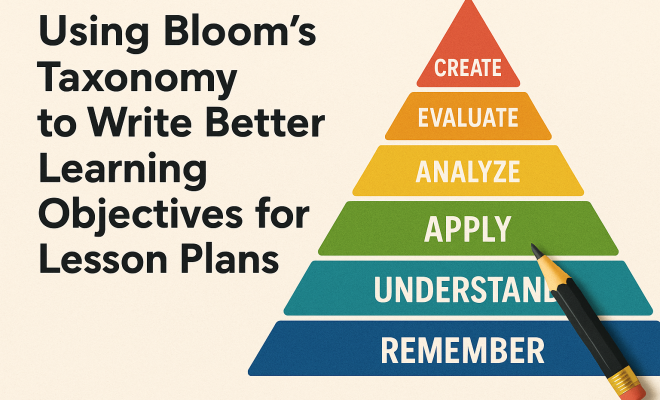
In 2001, a group of cognitive psychologists led by Lorin Anderson, a former student of Bloom, updated the taxonomy to better reflect the realities of modern education. The revised version maintains the hierarchical structure but alters the names of the categories and rearranges them slightly. The new levels are: remembering, understanding, applying, analyzing, evaluating, and creating. This shift recognizes the importance of creativity in learning and provides a more dynamic framework for educators.
Why Learning Objectives Matter
Learning objectives serve as roadmaps for both teachers and students. They outline clear expectations and goals for a lesson, providing an essential guide for assessing student progress. Well-defined objectives help educators determine the appropriate teaching methods, materials, and assessments needed to achieve desired outcomes. Additionally, they enable students to take ownership of their learning by understanding what is expected of them.
Characteristics of Effective Learning Objectives
Effective learning objectives possess several key characteristics:
- Specific: Objectives should clearly articulate what students will learn and be able to do by the end of the lesson.
- Measurable: They should be framed in a way that allows for assessment and evaluation of student progress.
- Achievable: Objectives need to be realistic and attainable within the given timeframe and resources.
- Relevant: Learning objectives should be aligned with curricular goals and student needs.
- Time-bound: They should specify when the learning is expected to occur, ensuring a structured timeframe for completion.
By adhering to these characteristics, educators can craft powerful Bloom’s Taxonomy Learning Objectives that drive student success.
Incorporating Bloom’s Taxonomy into Learning Objectives
Using Bloom’s Taxonomy as a guide, teachers can develop learning objectives that encompass a wide range of cognitive skills. Each of the six levels of the taxonomy encourages different types of thinking and ensures that students engage with the material at varying depths. Let’s explore how to write effective learning objectives for each level.
1. Remembering
The first level of Bloom’s Taxonomy focuses on the ability to recall information. Objectives at this level might include:
- Students will be able to list the main events of World War II.
- Students will identify the key components of the scientific method.
These objectives require students to retrieve previously learned information, laying a foundation for deeper understanding.
2. Understanding
Once students can recall information, the next step is to ensure they understand it. Objectives here might be:
- Students will explain the significance of the Bill of Rights.
- Students will summarize the main themes of a novel.
These objectives assess comprehension and encourage students to interpret and represent knowledge in their own words.
3. Applying
This level involves using knowledge in new situations. Some objectives might include:
- Students will solve algebraic equations using learned methods.
- Students will demonstrate how to use a map to find directions.
Here, students take what they’ve learned and apply it practically, reinforcing their understanding through usage.
4. Analyzing
At this level, students are expected to break down information and explore relationships. Examples of objectives might be: (See: Bloom's Taxonomy overview.)
- Students will compare and contrast two different ecosystems.
- Students will analyze the motives behind a historical figure’s actions.
These objectives encourage critical thinking, requiring students to look beyond surface details.
5. Evaluating
This level encourages students to make judgments based on criteria. Some objectives could be:
- Students will assess the effectiveness of different advertising strategies.
- Students will critique the arguments in a persuasive essay.
Objectives at this stage foster higher-order thinking, pushing students to formulate their own opinions backed by evidence.
6. Creating
Finally, the highest level focuses on synthesizing information to produce new ideas. Objectives may include:
- Students will design an experiment to test a hypothesis.
- Students will compose an original poem using specific literary devices.
These objectives encourage creativity and innovation, prompting students to generate fresh perspectives.
Practical Insights for Writing Bloom’s Taxonomy Learning Objectives
Writing effective Bloom’s Taxonomy Learning Objectives can seem daunting, but with some strategies, it becomes much more manageable. Here are some practical insights to help you along the way:
1. Start with the End in Mind
Before crafting your objectives, consider what you want your students to achieve by the end of the lesson. Visualizing the desired outcome helps you frame your objectives effectively, making it easier to align your teaching methods and assessments.
2. Use Action Verbs
When writing your objectives, opt for clear, action-oriented verbs that correspond with each level of Bloom’s Taxonomy. For instance, instead of saying “understand,” use “explain” or “describe.” This specificity makes it easier to assess whether your students have met the objectives.
3. Keep It Simple
Avoid overly complicated language when writing your objectives. Clarity is key, as you want both students and other educators to easily grasp what is expected. A simple, straightforward objective is often more effective than a complex one.
4. Align with Standards
Ensure that your learning objectives align with relevant educational standards. This alignment not only strengthens the validity of your objectives but also helps maintain consistency across your curriculum.
Current Relevance of Bloom’s Taxonomy
In today’s rapidly changing educational landscape, the principles of Bloom’s Taxonomy remain relevant. As teaching methods evolve, the need for well-structured learning objectives only grows. Educators are increasingly incorporating technology and active learning strategies into their classrooms, making it more essential than ever to define clear objectives that guide student engagement.
Integrating Technology
With tools like online learning platforms and educational apps, educators have access to a wealth of resources to support their teaching. By integrating Bloom’s Taxonomy into their objectives, teachers can leverage technology to facilitate active learning experiences. For example, using a program that allows students to create digital presentations can align with the ‘creating’ level of the taxonomy.
Emphasizing Critical Thinking
As society increasingly values critical thinking and problem-solving skills, the importance of writing effective learning objectives cannot be overstated. Bloom’s Taxonomy encourages educators to cultivate these skills by crafting objectives that challenge students to think deeply and critically.
Examples of Effective Learning Objectives
To illustrate how to implement Bloom’s Taxonomy in your lesson plans, here are some examples of effective learning objectives across various subjects:
1. Mathematics
For a lesson on fractions:
- Remembering: Students will define fractions.
- Understanding: Students will explain how to add fractions.
- Applying: Students will solve word problems involving fractions.
- Analyzing: Students will compare different methods for adding fractions.
- Evaluating: Students will assess the accuracy of their calculations.
- Creating: Students will design a recipe that uses fractions in measurements.
2. Science
For a lesson on ecosystems: (See: CDC on Bloom's Taxonomy.)
- Remembering: Students will list the components of an ecosystem.
- Understanding: Students will describe the relationship between producers, consumers, and decomposers.
- Applying: Students will conduct an experiment to observe food chains.
- Analyzing: Students will classify organisms in a given ecosystem based on their roles.
- Evaluating: Students will debate the importance of biodiversity in ecosystems.
- Creating: Students will develop a model of an ecosystem including various interactions.
3. History
For a lesson on the American Revolution:
- Remembering: Students will identify key figures in the American Revolution.
- Understanding: Students will explain the causes of the American Revolution.
- Applying: Students will role-play a historical event from that period.
- Analyzing: Students will compare the perspectives of Loyalists and Patriots.
- Evaluating: Students will assess the effectiveness of different strategies used in the revolution.
- Creating: Students will write a letter from the perspective of a historical figure during the American Revolution.
Challenges in Implementing Bloom’s Taxonomy
While Bloom’s Taxonomy is a robust framework for creating learning objectives, it isn’t without challenges in implementation. Some common issues educators may face include:
1. Lack of Training
Many educators may not have received formal training on how to effectively use Bloom’s Taxonomy in crafting learning objectives. Professional development sessions focused on this framework can help bridge that gap, providing teachers with the necessary tools and knowledge.
2. Overly Complicated Objectives
Sometimes, teachers might create objectives that are too complex or vague. This can lead to confusion among students about what is expected of them. Simplifying objectives and using precise language can alleviate this issue.
3. Resistance to Change
Some educators may be hesitant to adopt new frameworks like Bloom’s Taxonomy. They may feel comfortable with their current methods and fear that changing their approach could be disruptive. Encouraging a culture of continuous improvement and collaboration among educators can help ease this transition.
Bloom’s Taxonomy in Different Educational Contexts
The versatility of Bloom’s Taxonomy allows it to be adapted across various educational contexts, including K-12 education, higher education, and professional training. Let’s look at how this framework can be tailored for different environments.
K-12 Education
In K-12 settings, teachers can use Bloom’s Taxonomy to create objectives that are developmentally appropriate for various age groups. For younger students, objectives may focus on foundational skills like memorization and comprehension. As students progress to higher grades, objectives can shift towards critical thinking and creativity.
Higher Education
In colleges and universities, Bloom’s Taxonomy can be employed to develop more complex objectives that challenge students to synthesize and evaluate information critically. Professors can design assessments that require students to engage with material at higher cognitive levels, encouraging deeper learning and engagement.
Professional Training
In professional development and training programs, Bloom’s Taxonomy can help trainers create objectives that align with specific job competencies. For instance, training sessions can focus on not only understanding new systems but also applying this knowledge in real-world scenarios, analyzing outcomes, and creating innovative solutions to workplace challenges.
Statistics on the Effectiveness of Bloom’s Taxonomy
Research supports the effectiveness of Bloom’s Taxonomy in improving educational outcomes. A study conducted by the Educational Testing Service found that students whose learning objectives were aligned with Bloom’s Taxonomy performed significantly better on assessments compared to those without structured objectives. For instance, students showed a 20% increase in retention and application of knowledge when taught using this framework.
Expert Perspectives on Bloom’s Taxonomy
Experts in the field of education often highlight the value of Bloom’s Taxonomy in fostering a more meaningful learning experience. Dr. Patricia Cross, an educational researcher, notes that “Bloom’s Taxonomy not only helps clarify learning goals but also encourages educators to think critically about how they assess student learning.” This perspective underscores the importance of aligning teaching with assessment using this framework.
Frequently Asked Questions About Bloom’s Taxonomy Learning Objectives
1. How can I incorporate Bloom’s Taxonomy into my existing lesson plans?
Start by identifying your current objectives and then map them onto the levels of Bloom’s Taxonomy. You can modify your objectives to encompass higher-order thinking skills or incorporate specific action verbs from each level to enhance clarity.
2. What are some resources for learning more about Bloom’s Taxonomy?
There are many resources available, including online courses, workshops, and books dedicated to educational theories. Websites like the Association for Educational Communications and Technology provide valuable insights and examples.
3. Can Bloom’s Taxonomy be applied to formative assessments?
Absolutely! Bloom’s Taxonomy can guide the creation of formative assessments that gauge student understanding at various levels. For example, teachers can design quizzes that test recall, as well as projects that assess higher-order thinking skills. (See: Harvard University educational resources.)
4. How can I ensure that my learning objectives meet the needs of diverse learners?
Differentiate your learning objectives by considering the varied abilities and learning styles within your classroom. Incorporate multiple means of engagement, representation, and action/expression to accommodate all students.
5. Is Bloom’s Taxonomy applicable in online learning environments?
Yes, Bloom’s Taxonomy is highly applicable in online learning. Educators can create online activities that reflect the different levels of the taxonomy, such as discussion forums for analyzing concepts or creative projects for synthesizing information in a digital format.
Creating a Culture of Continuous Improvement
To maximize the effectiveness of Bloom’s Taxonomy Learning Objectives, fostering a culture of continuous improvement within educational institutions is essential. This involves regular reflection and adaptation of teaching practices based on student feedback and assessment outcomes. By encouraging educators to share successful strategies and collaborate on refining objectives, schools can enhance their overall educational quality.
1. Encouraging Peer Collaboration
Facilitating opportunities for teachers to work together is key. Professional learning communities (PLCs) can provide platforms for educators to discuss their experiences with Bloom’s Taxonomy, share resources, and collectively solve challenges they face in implementing learning objectives.
2. Utilizing Student Feedback
Gathering feedback from students about how well they understand the learning objectives is also valuable. Surveys, focus groups, or informal discussions can provide insights into whether students feel the objectives are clear and achievable. This information can inform adjustments to future lesson planning.
3. Continuous Training and Professional Development
Ongoing training sessions specifically focused on Bloom’s Taxonomy can keep educators updated on best practices. Workshops can introduce new techniques for writing objectives and assessing student learning, keeping the framework fresh and relevant.
Real-World Success Stories
Many educators and institutions have successfully implemented Bloom’s Taxonomy to enhance their teaching and learning. These success stories can inspire you and provide concrete examples of how this framework can transform educational practices.
1. Case Study: A High School in California
A high school in California integrated Bloom’s Taxonomy into their curriculum by focusing on interdisciplinary projects that required students to engage with content across subjects. Teachers collaborated to design assessments that not only tested students’ knowledge but also their ability to analyze and evaluate information from various angles. As a result, students reported higher engagement and a deeper understanding of the material.
2. Case Study: A Community College in Texas
A community college in Texas adopted Bloom’s Taxonomy in their professional development programs for instructors. By aligning learning objectives with the taxonomy, instructors were able to foster critical thinking and creativity among students in vocational courses. They observed a marked improvement in student performance and satisfaction, leading to increased enrollment in those programs.
Conclusion: The Power of Bloom’s Taxonomy Learning Objectives
Incorporating Bloom’s Taxonomy Learning Objectives into your lesson planning can profoundly influence the educational journeys of your students. By understanding the hierarchy of cognitive skills, you can craft meaningful objectives that not only guide your teaching but also empower your students to take charge of their learning. As education continues to evolve, Bloom’s Taxonomy remains a vital framework for creating effective educational experiences that nurture critical thinking, creativity, and a love for learning.
“`
Trending Now
Frequently Asked Questions
What is Bloom's Taxonomy and why is it important?
Bloom's Taxonomy is a framework created to classify educational goals into three domains: cognitive, affective, and psychomotor. It’s important because it helps educators design effective lesson plans by providing a structured approach to creating learning objectives that foster student engagement and learning.
How has Bloom's Taxonomy been revised?
In 2001, Bloom's Taxonomy was revised by cognitive psychologists to reflect modern educational practices. The revised version includes levels such as remembering, understanding, applying, analyzing, evaluating, and creating, emphasizing the importance of creativity in the learning process.
What are the levels of Bloom's Taxonomy?
The levels of Bloom's Taxonomy, particularly in its revised version, are: remembering, understanding, applying, analyzing, evaluating, and creating. These levels represent a hierarchy of cognitive skills that educators can use to tailor their learning objectives.
How can I use Bloom's Taxonomy to write learning objectives?
To use Bloom's Taxonomy for writing learning objectives, identify the desired level of learning based on the content. Create objectives that align with the taxonomy’s levels, ensuring they are clear, measurable, and appropriate for the complexity of the material.
Why are learning objectives essential in lesson planning?
Learning objectives are essential as they provide clear expectations and goals for a lesson. They serve as a roadmap for both teachers and students, guiding instruction and assessment, and helping educators evaluate student progress effectively.
Agree or disagree? Drop a comment and tell us what you think.