Assess Preschooler Cognition with Piaget’s Conservation Tasks
“`html
As parents and caregivers, we often find ourselves wondering how to gauge our preschoolers’ cognitive development. One of the pivotal frameworks to understand this journey is Jean Piaget’s theory of cognitive development, particularly his Piaget conservation tasks. These tasks offer insights into how children perceive the world around them, especially when it comes to understanding quantity and volume.
Understanding Piaget’s Theory of Cognitive Development
Jean Piaget, a Swiss psychologist, was a pioneer in the field of developmental psychology. His research, spanning over several decades from the early 20th century, focused on how children construct their understanding of the world. According to Piaget, cognitive development occurs in four stages: sensorimotor, preoperational, concrete operational, and formal operational.
Preschoolers typically fall into the preoperational stage, which lasts from approximately ages two to seven. During this phase, they begin to engage in symbolic play and learn to manipulate symbols, but they struggle with logic and understanding the perspectives of others. This is where Piaget’s conservation tasks come into play.
What Are Piaget Conservation Tasks?
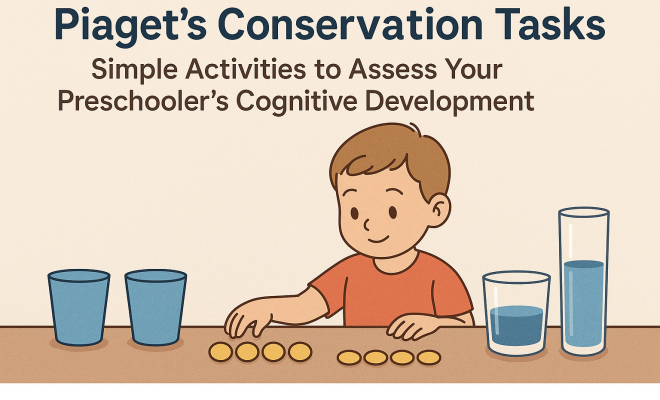
The Piaget conservation tasks are a series of tasks designed to test a child’s understanding of the principle of conservation — the idea that certain properties of objects remain constant despite changes in their form or arrangement. For instance, if you pour water from a tall, narrow glass into a short, wide glass, a child who has mastered the concept of conservation will understand that the amount of water remains the same, despite its different appearance.
Piaget identified several specific conservation tasks, including those related to volume, number, and mass. Each of these tasks is crucial for understanding how children perceive and reason about the physical world. Let’s explore some of these key tasks in detail.
Key Conservation Tasks to Assess Cognitive Development
1. Conservation of Volume
This task typically involves two identical containers filled with liquid, such as water or juice. When the liquid from one container is poured into a differently shaped container, children who haven’t yet grasped the concept of conservation may believe that the amount of liquid has changed simply due to the change in shape.
To test this with your child, fill two identical glasses with water. Ask them if the amount of water is the same. Then, pour one glass of water into a taller, narrower glass and ask the same question again. This hands-on experience will help you observe whether your child can recognize that the amount of liquid has remained unchanged.
2. Conservation of Number
The conservation of number task involves two lines of objects, such as coins or blocks, arranged in equal quantities. One line is then spread out, while the other line remains compact. Children who have not developed an understanding of conservation may erroneously assert that the longer line has more items.
To carry out this task, you can use small toys or counters. Line up ten toy cars in a row, ensuring they are equally spaced. Then, spread the line of cars out. Ask your child if the number of cars has changed. This simple activity highlights how children deal with numerical concepts.
3. Conservation of Mass
This task can be done using clay or playdough. Roll two equal balls of clay and ask your child if they are the same size. Next, flatten one of the balls into a pancake shape and ask if the amount of clay has changed. Children who understand conservation will recognize that the quantity remains constant, regardless of its shape.
Doing this task with your child provides a tactile experience in understanding mass and shape, engaging their sensory skills while fostering cognitive development.
Implementing Piaget Conservation Tasks at Home
Parents can easily incorporate the Piaget conservation tasks into everyday activities. The key is to make these tasks fun and engaging. Here are some creative ideas: (See: Jean Piaget's contributions to psychology.)
- Water Play: Use different containers in the bathtub or during playtime. Fill various shapes with water and ask your child to compare their volumes.
- Snack Time: Arrange snacks like grapes or cookies in different formations and have your child assess their number.
- Art Projects: Use modeling clay or playdough to create different shapes and ask your child to determine if the volume remains the same.
The Importance of Engaging with Conservation Tasks
Why are these conservation tasks significant? Understanding conservation helps children develop critical thinking skills and lays the groundwork for more complex mathematical concepts later in their education. By grasping that quantity, volume, and mass remain constant despite changes in appearance, children learn to think abstractly and logically.
Moreover, these tasks can also enhance a child’s problem-solving skills. They encourage children to explore and experiment with their environment, fostering curiosity and an inquisitive mindset. This exploration is fundamental to cognitive growth and can be supported by parents through engaging activities.
Recognizing Cognitive Milestones
As you conduct the Piaget conservation tasks with your preschooler, it’s essential to be aware of typical cognitive milestones. Around ages 4-5, many children begin to demonstrate an understanding of conservation concepts, but this varies from child to child. Some may grasp these ideas earlier, while others might take longer to develop this understanding.
Observing your child’s responses during these tasks can provide insight into their cognitive development. Are they able to recognize that the number of objects remains unchanged when arranged differently? Do they understand that the shape of a substance doesn’t alter its mass? Tracking these milestones can help you better support your child’s learning journey.
Challenges and Misconceptions
It’s not uncommon for children to face challenges when engaging with conservation tasks. Many preschoolers may latch onto visual cues rather than logical reasoning, leading them to make incorrect assumptions about quantities and numbers. For instance, they might insist that the spread-out line of cars has more items simply because it takes up more space visually.
As a parent, it’s crucial to approach these challenges with patience and understanding. Cognitive development is a gradual process, and errors are a part of learning. Encourage your child to think aloud as they work through these tasks. This dialogue will provide insight into their thought processes and help them articulate their reasoning.
Adapting Conservation Tasks for Individual Needs
Not every child will engage with conservation tasks in the same way. Some may need additional support, while others might require more challenging variations. Adapting these tasks according to your child’s interests and developmental stage can facilitate better engagement.
For example, if your child is fascinated by animals, consider using animal figurines instead of blocks during the conservation of number task. Or, if they enjoy stories, create a narrative around the conservation tasks to make them feel more engaging. Tailoring activities to your child’s interests not only keeps them invested but also reinforces the learning process.
Current Relevance of Piaget’s Conservation Tasks
In today’s educational landscape, Piaget’s conservation tasks remain relevant. Educators and psychologists still utilize these tasks to assess cognitive development, as they provide a clear, observable way to measure children’s understanding of fundamental concepts. In early childhood education settings, teachers often incorporate these activities into their curriculum to foster critical thinking and logical reasoning.
Moreover, with the increasing emphasis on play-based learning, the principles behind Piaget’s tasks align seamlessly with modern educational paradigms. Hands-on learning experiences, such as those involving conservation tasks, are invaluable in nurturing children’s cognitive and social skills.
Deepening Understanding: The Science Behind Conservation
To appreciate the significance of Piaget conservation tasks, it’s helpful to understand the cognitive science behind conservation. Piaget argued that children move through cognitive stages, and the ability to grasp conservation is a hallmark of the transition from preoperational to concrete operational thought. This shift signifies a growing ability to think logically about physical objects and their properties.
During the preoperational stage, children are egocentric and struggle to see things from perspectives other than their own. They focus on surface appearances rather than underlying principles. This is why a preoperational child may believe that a taller glass holds more water than a shorter one, even if the two glasses hold the same amount. By the concrete operational stage, typically around age 7, children can perform operations mentally and transform objects without altering their intrinsic properties.
Expert Perspectives on Piaget’s Conservation Tasks
Experts in child psychology often emphasize the importance of Piaget’s conservation tasks in assessing cognitive development. Dr. Linda Smith, a cognitive scientist, explains that these tasks are not just about getting the right answer but also provide insight into children’s reasoning processes. “Understanding how children arrive at their conclusions can be as important as the conclusions themselves,” she notes. She encourages parents to observe not only the outcomes but also the thought processes that lead to those outcomes. (See: Understanding child cognitive development.)
Dr. Anne Marie DeMarchi, a child development specialist, adds that incorporating play into these tasks can enhance learning. “When children engage with materials they find enjoyable, they are more likely to explore and experiment, leading to a deeper understanding of concepts like conservation.” This highlights the importance of making conservation tasks interactive and enjoyable.
Statistics on Cognitive Development and Conservation
Numerous studies underscore the relevance of Piaget’s tasks in understanding cognitive development. For example, a study published in the International Journal of Behavioral Development found that approximately 60% of children aged 5-6 show an understanding of conservation of number, while about 80% demonstrate conservation of mass by age 7. These statistics reflect the gradual development of these concepts and the importance of targeted activities to bolster understanding.
Furthermore, research indicates that children who engage in hands-on learning experiences are more likely to master conservation tasks. A recent meta-analysis in the Journal of Educational Psychology suggests that children who participate in play-based learning environments perform better on conservation tasks compared to those in more traditional educational settings. This reinforces the idea that the context in which learning occurs can significantly impact cognitive development.
Comparisons: Piaget vs. Vygotsky
While Piaget’s conservation tasks are well-known, it’s also valuable to compare his theories with those of another giant in developmental psychology, Lev Vygotsky. Vygotsky emphasized the role of social interaction and language in cognitive development. He believed that children learn best through guided interaction with more knowledgeable others.
Where Piaget focused on individual cognitive construction, Vygotsky’s theories highlight the collaborative aspects of learning. For example, in a Vygotskian approach, a child might engage in a conservation task with guidance from a parent or teacher, who helps them verbalize their thought processes. This collaboration can lead to a deeper understanding of conservation concepts and a more robust cognitive development overall.
Both theorists offer valuable insights, and understanding their differing perspectives can help parents and educators create comprehensive learning experiences that foster cognitive growth.
FAQ: Understanding Piaget Conservation Tasks
What age should my child start understanding conservation tasks?
While many children begin to grasp these concepts around ages 4-5, cognitive development varies widely. Some may show understanding earlier, while others may take longer. Regular practice and engagement can help facilitate this learning.
How can I tell if my child has mastered conservation tasks?
Watch for their ability to consistently recognize that quantity, volume, or mass remains unchanged despite changes in form or arrangement. They should be able to explain their reasoning when assessing these tasks.
Are there specific activities to reinforce conservation learning?
Yes! Activities like water play, using snacks for counting, and engaging with clay can reinforce these concepts. You can also incorporate everyday situations to make learning practical and relevant.
How can I support a child struggling with conservation tasks?
Be patient and encouraging. You can provide additional hands-on experiences, use comparisons, and engage in discussions that allow your child to articulate their thought processes. Tailoring activities to their interests can also help foster engagement.
What if my child seems uninterested in conservation tasks?
Try to make the tasks more relatable by incorporating their favorite themes, such as animals or superheroes. Keeping the activities fun and interactive will help maintain their interest and motivate them to participate.
Common Misunderstandings About Piaget’s Conservation Tasks
Many parents might wonder why their children struggle with understanding conservation tasks. A frequent misunderstanding is that children are simply not paying attention or are being difficult. In reality, these tasks require a level of cognitive development that not all children reach simultaneously. It’s essential to remember that mastery develops over time and is often influenced by various factors, including individual temperament, experiences, and exposure to similar concepts.
Children may also show different levels of understanding depending on the specific conservation task. For instance, a child might easily grasp conservation of mass but struggle with conservation of volume. This variability is typical and should not be a cause for concern.
To clarify these misconceptions, parents can engage in discussions about the tasks. By asking open-ended questions like, “Why do you think that?” or “What do you notice about the shapes?” you can encourage your child to reflect on their reasoning and provide insights into their cognitive processes.
Real-Life Applications of Conservation Knowledge
Understanding conservation doesn’t just play a role in academic settings; it also has real-world applications. For example, when children grasp the concept of volume, they can better understand measurements when cooking. They may learn about different measurements in a recipe and how they relate to the actual quantities being used. This practical application of conservation skills nurtures critical thinking and problem-solving abilities that extend beyond the classroom.
Furthermore, conservation tasks can influence how children approach other subjects, such as science and art. In science, understanding the properties of materials can help children grasp concepts like buoyancy and density. In art, their understanding of mass and volume can enhance their creativity as they experiment with various mediums and techniques.
By connecting conservation tasks to everyday experiences, parents can help children see the relevance of these concepts in their lives, making learning more meaningful and engaging.
Tips for Encouraging Cognitive Development Beyond Conservation Tasks
While conservation tasks are vital for cognitive development, they are just one piece of the puzzle. Here are some additional strategies to enhance your child’s cognitive growth:
- Encourage Curiosity: Foster a love for learning by encouraging questions and exploration. When your child asks about the world around them, engage in conversations that delve deeper into their interests.
- Provide Diverse Experiences: Expose your child to various activities, from nature walks to art classes. Each new experience contributes to cognitive development by helping children make connections between different ideas.
- Incorporate Play: Use play as a learning tool. Games that involve counting, sorting, or measuring can provide fun learning opportunities that reinforce conservation concepts.
- Model Problem-Solving: Demonstrate how to approach challenges. When faced with a problem, verbalize your thought process. This practice shows children how to think critically and tackle obstacles effectively.
Conclusion
Engaging your preschooler with Piaget conservation tasks can be an enriching experience that aids their cognitive development and enhances your bond with them. These tasks not only help assess their understanding of fundamental concepts but also lay the groundwork for future learning. By incorporating simple yet effective activities into your daily routine, you can foster critical thinking and problem-solving skills in an enjoyable and engaging way. The journey of cognitive development is a collaborative one, and by supporting your child in mastering conservation tasks, you’re contributing to their lifelong learning and growth.
“`
Trending Now
Frequently Asked Questions
What are Piaget's conservation tasks?
Piaget's conservation tasks are activities designed to assess a child's understanding of the principle of conservation, which states that certain properties of objects remain constant despite changes in their form or arrangement. These tasks help evaluate a child's cognitive development, particularly in recognizing that quantity, volume, and mass do not change even when their appearance does.
How do I conduct Piaget's conservation tasks with my child?
To conduct Piaget's conservation tasks, you can perform simple experiments like pouring water from a tall glass into a short one or rearranging items like clay. Ask your child questions about whether the amount of liquid or the number of items has changed. This interactive approach helps assess their understanding of conservation principles.
What is the significance of conservation tasks in child development?
Conservation tasks are significant in child development as they help gauge a child's cognitive abilities, specifically their understanding of quantity and volume. Mastering these tasks indicates that a child is developing logical reasoning and a more sophisticated understanding of the physical world, which is crucial for their overall cognitive growth.
At what age do children understand conservation?
Children typically begin to understand conservation between the ages of 5 and 7, during the preoperational to concrete operational stages of Piaget's cognitive development theory. Mastery of conservation tasks indicates that they can recognize that certain properties remain constant despite changes in appearance.
What are examples of conservation tasks?
Examples of conservation tasks include the water pouring task, where children compare the amount of water in different-shaped containers, and the clay task, where they observe that reshaping a ball of clay does not change its mass. These tasks help illustrate children's understanding of conservation principles in a tangible way.
What’s your take on this? Share your thoughts in the comments below — we read every one.