Bloom’s Revised Taxonomy: From Knowledge to Creation (2001)
“`html
When it comes to education, the goal isn’t just to fill students’ heads with facts and figures; it’s about fostering creativity, critical thinking, and the ability to apply knowledge in innovative ways. This is where Bloom’s Revised Taxonomy comes into play. Originally created by Benjamin Bloom in the 1950s and later revised by a team led by Lorin Anderson in 2001, this framework provides educators with a structured approach to enhancing learning outcomes. In this article, we’ll explore how to effectively move students from the foundational level of knowledge to the higher-order thinking skills of creation.
1. The Basics of Bloom’s Revised Taxonomy
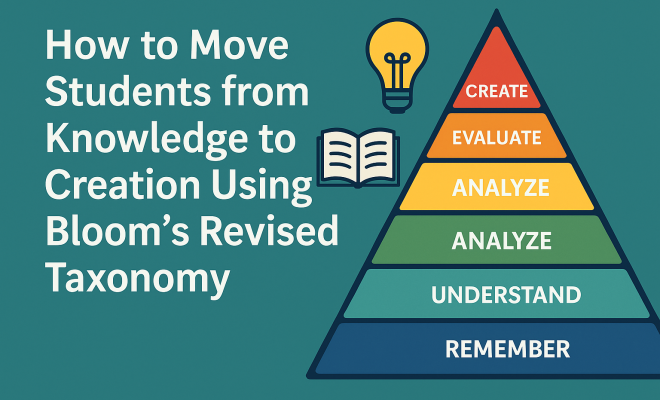
Understanding Bloom’s Revised Taxonomy begins with familiarizing yourself with its structure. The original taxonomy outlined six levels of cognitive skills: Knowledge, Comprehension, Application, Analysis, Synthesis, and Evaluation. The revised version restructured these into a hierarchy that includes Remembering, Understanding, Applying, Analyzing, Evaluating, and Creating.
This hierarchy emphasizes a progression from lower-order thinking skills, such as remembering and understanding, to higher-order skills that include analyzing, evaluating, and ultimately, creating. The shift towards ‘Creating’ represents a significant educational goal, one that aligns with the demands of the 21st century, where innovation and problem-solving are paramount.
2. Why Focus on Creation?
Focusing on creation is essential for several reasons. First, it prepares students for real-world challenges. Employers today seek individuals who can think critically and creatively, analyze information, and devise innovative solutions. By fostering these skills in the classroom, educators are not just teaching content; they are equipping students with the tools necessary to thrive in modern workplaces.
Moreover, creation as a learning outcome encourages engagement. When students create, they are often more invested in their learning process. This is evident in project-based learning environments where students feel a sense of ownership over their work. By transitioning from passive learning to active engagement, students are more likely to retain information and apply their knowledge effectively.
3. Strategies to Move from Knowledge to Creation
To effectively utilize Bloom’s Revised Taxonomy in the classroom, educators can implement a variety of strategies aimed at moving students from knowledge-based learning to creation. One effective method involves incorporating project-based learning (PBL). PBL allows students to work on a project over an extended period, which can involve researching, collaborating, and ultimately creating a product or solution.
Another strategy is to integrate technology into the learning process. Tools such as digital storytelling, video production, and online collaborations can facilitate creativity. By providing students with the opportunity to create digital presentations, podcasts, or websites, teachers can tap into their interests and help them express their understanding in unique, creative ways.
4. Assessment Techniques Aligned with the Taxonomy
Effective assessment is key to moving students through the levels of Bloom’s Revised Taxonomy. Traditional assessments often focus on the lower levels of the taxonomy, measuring knowledge and comprehension. However, to assess higher-order thinking skills, educators can use rubrics that specifically evaluate creativity and critical thinking.
For instance, project presentations can be assessed not just on the final product but also on the process, including research methods, problem-solving approaches, and collaboration with peers. This method allows teachers to gather valuable insights into each student’s understanding and skills, thereby informing future instruction. (See: Bloom's Taxonomy overview.)
5. Creating a Supportive Classroom Environment
Transitioning students from knowledge to creation requires a classroom environment that fosters creativity. This involves encouraging risk-taking and making it clear that mistakes are a natural part of the learning process. Students should feel safe to express their ideas and experiment with different solutions.
Teachers can promote a culture of collaboration by organizing group projects where students can brainstorm and build on each other’s ideas. This not only enhances their creative outputs but also develops essential teamwork skills. Providing constructive feedback is vital, as it helps students refine their work and enhances their ability to think critically about their creations.
6. The Role of Collaborative Learning
Collaborative learning is an essential component in moving students to higher levels of the taxonomy. When students work together, they bring diverse perspectives and skills to the table, which can spark creativity and innovation. Group discussions, peer reviews, and collaborative projects allow students to learn from each other while developing their own ideas.
Furthermore, collaborative learning promotes social interaction, which can enhance motivation and engagement. When students collaborate on creative tasks, they not only learn content but also improve their communication skills and emotional intelligence—both critical in today’s world.
7. Utilizing Technology for Creative Expression
Modern educational technology offers countless tools that can enhance creative expression. From multimedia presentations to coding platforms, technology can serve as a springboard for creativity. For example, students can use apps like Canva or Adobe Spark to design infographics or digital posters, allowing them to present their knowledge visually and artistically.
Moreover, platforms such as Google Classroom and Microsoft Teams facilitate collaboration between students, enabling them to work on creative projects together, regardless of their physical locations. Technology not only aids in the creation process but also prepares students for a tech-driven world.
8. Real-World Applications of Creation in Education
Implementing creation-focused learning doesn’t just stop at the classroom door. By engaging students in projects that connect classroom learning to real-world issues, educators can significantly enhance the relevance of their lessons. For instance, students can participate in community service projects that require them to devise solutions for local problems, from environmental concerns to social issues.
This real-world application not only motivates students by illustrating the impact of their work but also reinforces their learning. When students see the tangible effects of their creations, they are likely to develop a greater appreciation for their education and its potential to effect change.
9. Integration of Bloom’s Revised Taxonomy Across Subjects
One of the most powerful aspects of Bloom’s Revised Taxonomy is its applicability across various subjects and disciplines. Whether in science, mathematics, or the arts, educators can use this framework to enhance learning. For instance, in a science class, students might start with basic experiments (Remembering) and progress to designing their own experiments to test a hypothesis (Creating). In literature, students could analyze themes in a novel (Analyzing) before crafting their own narratives that reflect those themes (Creating).
This cross-disciplinary approach not only allows for greater flexibility in teaching but also helps students see the interconnectedness of knowledge. When students can apply their learning across various contexts, they become more adept problem solvers who can think critically in any situation.
10. The Impact of Bloom’s Revised Taxonomy on Student Engagement
Research has shown that when students are engaged in higher-order thinking, their retention and understanding of material improve significantly. According to a study published in the Journal of Educational Psychology, students who participate in learning activities that emphasize creation and critical thinking are more likely to retain information long term compared to those who engage in rote memorization. (See: U.S. Department of Education on teaching strategies.)
This increased engagement can lead to better academic performance and a more profound appreciation for the subject matter. When students see their ideas taking form and understand that their opinions matter, their motivation spikes. This, in turn, creates a more vibrant classroom atmosphere where curiosity thrives.
11. Common Misconceptions About Bloom’s Revised Taxonomy
Despite its widespread use, there are several misconceptions about Bloom’s Revised Taxonomy that can hinder its effectiveness in the classroom. One common misunderstanding is that the levels are strictly linear. In reality, students may move back and forth between levels as they gain a deeper understanding of a topic. For example, while creating a project, a student might need to revisit their understanding of the foundational knowledge or analyze feedback from peers.
Another misconception is that Bloom’s Taxonomy is only applicable to academic subjects. In truth, it can be adapted for skills training, social-emotional learning, and even extracurricular activities. For instance, teaching students about teamwork and leadership can effectively integrate the higher-order thinking skills of analyzing and creating in the context of sports or clubs.
12. FAQ: Understanding Bloom’s Revised Taxonomy
What is Bloom’s Revised Taxonomy?
Bloom’s Revised Taxonomy is a framework used in education to categorize learning objectives into levels of complexity and specificity. It helps educators design lessons that promote higher-order thinking skills, moving from basic knowledge acquisition to advanced creation skills.
How can Bloom’s Revised Taxonomy improve student learning?
By focusing on higher-order thinking skills, Bloom’s Revised Taxonomy encourages students to engage more deeply with the material. This results in better retention of knowledge, increased engagement, and the ability to apply learning in real-world contexts.
Can Bloom’s Revised Taxonomy be applied to all subjects?
Yes, Bloom’s Revised Taxonomy is versatile and can be effectively applied across various subjects and disciplines. Whether in science, mathematics, literature, or the arts, educators can use this framework to elevate student learning outcomes.
What are some examples of activities aligned with Bloom’s Revised Taxonomy?
Examples of activities include writing a research paper (Analyzing), creating a presentation (Creating), conducting experiments (Applying), and discussing themes (Evaluating). Each of these activities aligns with different levels of the taxonomy, promoting a comprehensive learning experience.
How does technology play a role in supporting Bloom’s Revised Taxonomy?
Technology provides tools that enhance creative expression and collaboration. From multimedia presentations to online collaboration platforms, technology can facilitate higher-order thinking by allowing students to create, share, and critically analyze their work.
13. The Future of Bloom’s Revised Taxonomy in Education
As education continues to evolve, the principles of Bloom’s Revised Taxonomy will likely remain relevant. With the increasing emphasis on personalized learning and student-centered approaches, educators will continue to find new ways to leverage this taxonomy to enhance learning experiences. Emerging trends such as gamification, adaptive learning technologies, and interdisciplinary projects can all benefit from the structured framework provided by Bloom’s Revised Taxonomy.
Going forward, educators will need to remain flexible and innovative in their application of this taxonomy. By continually assessing the needs of their students and adapting their teaching strategies, they can ensure that the learning environment remains dynamic and responsive to the challenges of the future.
14. Examples of Successful Implementation
Looking at real-life examples of how Bloom’s Revised Taxonomy has been implemented can offer valuable insights into its effectiveness. Consider a high school history class where students are tasked with researching a historical event. The assignment is structured to guide them through the taxonomy:
- Remembering: Students begin by recalling key facts and figures about the event.
- Understanding: They discuss the significance of the event and its impact on society, ensuring they grasp its context.
- Applying: Students then create a timeline that applies their knowledge, visually representing the sequence of events.
- Analyzing: Next, they work in groups to analyze different perspectives surrounding the event, prompting a deeper discussion.
- Evaluating: Students critique various historical interpretations presented in class, fostering critical thinking.
- Creating: Finally, they develop a multimedia presentation that synthesizes their findings and presents a new perspective on the event.
This structured approach not only engages students at each level of the taxonomy but also results in a richer understanding of history and enhances critical thinking skills.
15. The Importance of Professional Development for Educators
For educators to effectively utilize Bloom’s Revised Taxonomy, professional development is essential. Teachers need ongoing training to familiarize themselves with the taxonomy and learn how to incorporate it into their teaching practices. Workshops, seminars, and online courses focused on higher-order thinking skills can empower educators to create engaging and meaningful learning experiences.
Additionally, educators can benefit from collaborative learning communities where they share strategies, successes, and challenges in implementing the taxonomy. Such networks not only support personal growth but also cultivate a culture of innovation within schools.
16. Conclusion: The Future of Education with Bloom’s Revised Taxonomy
The journey from knowledge to creation using Bloom’s Revised Taxonomy is a transformative process that can significantly impact students’ learning experiences. By embracing strategies that promote higher-order thinking skills, educators can better prepare students for the complexities of modern life. As education evolves, the emphasis on creativity, collaboration, and critical thinking will undoubtedly shape the future of learning. Ultimately, when students are empowered to create, they are not just learning; they are becoming innovators and problem-solvers ready to tackle the challenges of tomorrow.
“`
Trending Now
Frequently Asked Questions
What is Bloom's Revised Taxonomy?
Bloom's Revised Taxonomy is a framework that categorizes cognitive skills into a hierarchy. It includes six levels: Remembering, Understanding, Applying, Analyzing, Evaluating, and Creating. This structure helps educators enhance learning outcomes by moving students from basic knowledge to higher-order thinking skills.
Why is creation important in education?
Creation is important in education because it prepares students for real-world challenges by fostering critical and creative thinking. It equips them with the skills needed to analyze information and develop innovative solutions, making them more valuable in today's job market.
How can teachers use Bloom's Taxonomy to improve learning?
Teachers can use Bloom's Taxonomy by designing lessons that encourage progression through the cognitive levels. By starting with foundational knowledge and moving towards higher-order skills like analyzing and creating, educators can enhance student engagement and learning outcomes.
What are the benefits of higher-order thinking skills?
Higher-order thinking skills, such as analyzing, evaluating, and creating, promote deeper understanding and retention of knowledge. These skills enable students to apply what they've learned in innovative ways, making them more adaptable and effective problem-solvers in various contexts.
How does Bloom's Taxonomy relate to 21st-century skills?
Bloom's Taxonomy relates to 21st-century skills by emphasizing the importance of creativity and critical thinking. The focus on creating aligns with the demands of modern workplaces, where innovation and the ability to solve complex problems are essential for success.
Agree or disagree? Drop a comment and tell us what you think.