What Is Syntax in Language Development? Examples for Parents
“`html
Language is a cornerstone of human interaction, and understanding its mechanics is vital for fostering effective communication. One of the most intriguing aspects of language is syntax in language development, the set of rules that dictate how words combine to form phrases and sentences. For parents, grasping this concept not only enhances their understanding of their child’s communication skills but also equips them with tools to support their language journey. Let’s dive deep into the realm of syntax, its significance in language growth, and practical insights for nurturing these skills in children.
Understanding Syntax: The Building Blocks of Language
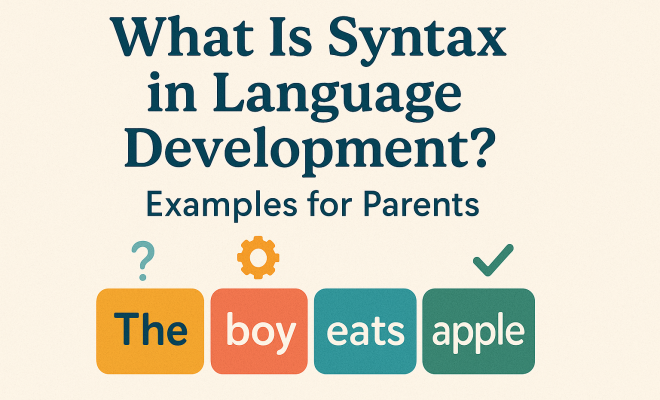
At its core, syntax refers to the arrangement of words within sentences. It’s the framework that allows us to convey meaning clearly and coherently. For instance, the difference between “The cat chased the dog” and “The dog chased the cat” illustrates how word order can entirely shift the meaning of a sentence.
In linguistics, syntax involves several components: phrases, clauses, and the roles of different parts of speech (nouns, verbs, adjectives, etc.). The complexity of syntax unfolds as children develop their language abilities, moving from simple structures to more nuanced and varied expressions. Understanding this progression can provide valuable insights for parents as they support their child’s language development.
The Stages of Syntax Development in Children
Children typically pass through distinct stages as they acquire syntax. Recognizing these stages helps parents identify where their child is in the language development process:
- Pre-linguistic stage (0-12 months): At this stage, infants communicate through babbling and gestures, laying the groundwork for future language skills.
- Single-word stage (12-18 months): Children begin using single words (holophrases) to express complete thoughts. For example, saying “milk” might mean “I want milk.”
- Two-word stage (18-24 months): As their vocabulary expands, children start combining two words to form simple sentences, like “more juice” or “mommy go.”
- Telegraphic speech (24-30 months): This stage features short, simple sentences that include only essential words, resembling telegrams (e.g., “want cookie” or “big truck”).
- Complex sentences (3-5 years): Children begin to use conjunctions and relative clauses, allowing them to form more complex sentences. For instance, they might say, “I want to play because it’s fun.”
Each stage builds upon the previous one, showcasing the child’s expanding grasp of syntax and communication. Understanding these stages helps parents foster an environment conducive to language growth.
Influences on Syntax Development
Several factors influence syntax development in children, ranging from biological to environmental elements. Here are a few key influences:
- Biological Factors: Genetics play a role in language development. Studies suggest that children inherit certain linguistic capabilities, which can affect how they acquire syntax.
- Social Interaction: Engaging with caregivers and peers significantly impacts a child’s language skills. Frequent conversations provide exposure to varied syntax and vocabulary, enriching their understanding.
- Reading Exposure: Books introduce children to complex syntax structures. Reading aloud not only enhances vocabulary but also familiarizes them with different sentence forms.
- Multilingual Environments: Children raised in multilingual settings may experience unique challenges and benefits in syntax development. They often learn to navigate multiple grammatical structures, which can enhance cognitive flexibility.
Understanding these influences allows parents to create a supportive environment for their child’s language acquisition journey.
Practical Tips for Supporting Syntax Development
Parents play a crucial role in shaping their child’s language abilities. Here are some actionable strategies to support syntax in language development:
- Engage in Frequent Conversations: Talk to your child throughout the day, describing activities, asking questions, and encouraging them to express their thoughts. This enhances their exposure to varied syntax.
- Ask Open-ended Questions: Encourage your child to expand their responses by asking questions that require more than a yes or no answer. For example, instead of asking, “Did you like the movie?” try, “What did you think about the movie?” This encourages them to articulate their thoughts more fully.
- Read Together: Choose books with rich language and varied sentence structures. Discuss the story and ask your child to predict outcomes, which helps them think about sentence construction.
- Model Complex Sentences: Use varied and complex sentence structures in your own speech. When your child hears sophisticated syntax, they are more likely to adopt it in their own language.
- Play with Language: Engage in activities that encourage creativity, like storytelling or role-playing. This not only boosts vocabulary but also enables exploration of different sentence forms.
These strategies promote a robust language environment that supports your child’s growing understanding of syntax.
Common Syntax Errors and How to Address Them
As children develop their language skills, they may make syntax errors that can be both amusing and educational. Here are some common mistakes and strategies to address them:
- Misplacing Adjectives: A child might say, “I saw a red big dog” instead of “I saw a big red dog.” Instead of correcting them harshly, gently repeat their sentence back to them with the correct syntax. For example, you can say, “Oh, you saw a big red dog!” This reinforces the correct structure without discouraging them.
- Omitting Subjects or Verbs: A child might say, “Going to the park” instead of “I am going to the park.” Encourage them to use complete sentences by modeling the correct form. You could respond, “That sounds great! You’re going to the park?”
- Overgeneralization of Rules: Children might apply grammatical rules too broadly, such as saying “goed” instead of “went.” When they make these errors, it’s crucial to gently correct them in a conversational context. You might say, “Yes, we went to the park yesterday!”
By addressing syntax errors with patience and encouragement, parents can enhance their child’s language skills while maintaining their enthusiasm for communication.
The Role of Play in Syntax Development
Play is often overlooked as a vital component of language development. Through play, children naturally experiment with language, testing out different syntax forms in a low-pressure setting. Role-playing games, for instance, allow children to create scenarios where they can practice complex sentence structures. (See: Supporting language development in children.)
Moreover, playtime fosters social interaction, which is critical for language acquisition. When children engage with peers or adults in play, they encounter new vocabulary and sentence constructions. This exposure significantly contributes to their understanding of syntax.
Encouraging imaginative play, such as puppetry or storytelling, can also help children practice syntax in a fun and engaging way. The more they play with language, the more confident and skilled they become at using complex sentences.
The Impact of Technology on Syntax Development
In our digital age, technology significantly influences language development. While tools like educational apps and interactive storytelling can support syntax learning, they also come with challenges. Children may be more inclined to engage with screens rather than face-to-face interactions, which are essential for building language skills.
It’s crucial for parents to strike a balance between screen time and traditional play. When using technology, opt for high-quality educational content that emphasizes language learning. Interactive programs that require verbal responses can encourage children to practice their syntax in a guided setting.
However, nothing beats real-life conversations. Ensure that technology complements rather than replaces meaningful interactions. Limit screen time and prioritize activities that foster direct communication, such as family dinners or reading together.
Current Research on Syntax and Language Development
Research in the field of linguistics and language acquisition continues to evolve, uncovering fascinating insights into how children learn syntax. Studies show that early exposure to diverse language and syntax forms can significantly influence a child’s linguistic capabilities later in life.
One groundbreaking study published in the journal Child Development found that children who interacted with adults who used complex syntax were more likely to adopt these structures in their speech. This emphasizes the importance of modeling rich language in everyday interactions.
Additionally, research suggests that bilingual children may develop a more flexible understanding of syntax due to their exposure to multiple grammatical systems. This cognitive flexibility can enhance overall language skills, making bilingualism a valuable asset for language development.
Understanding the Connection Between Syntax and Other Language Skills
While syntax is critical for constructing sentences, it does not exist in isolation. It interacts closely with other language skills, such as vocabulary, phonology, and semantics. A child’s ability to use syntax effectively is often intertwined with their understanding of word meanings and sounds.
For instance, a strong vocabulary can empower children to use more complex sentences. When they know a broad range of words, they can experiment with different syntactical structures, enriching their speech. Additionally, phonological awareness—the ability to recognize and manipulate sounds in words—can influence sentence construction. Children who have a good grasp of how sounds work may find it easier to form grammatically correct sentences.
Understanding semantics, or the meaning of words and phrases, is also crucial. Children learn that certain words fit together better than others, leading to more natural-sounding sentences. By fostering these interrelated skills, parents can create a comprehensive language development approach that focuses not just on syntax but on the entire linguistic system.
Statistics on Language Development and Syntax
Several studies have highlighted the significance of syntax in children’s language development. For instance, research conducted by the American Speech-Language-Hearing Association (ASHA) indicates that children typically produce their first two-word combinations by around 18 months. By the age of three, many children are able to produce sentences with up to six words, showcasing a significant leap in their syntactical abilities.
Furthermore, the National Institute of Child Health and Human Development reported that children who are exposed to rich and diverse language environments are more likely to demonstrate advanced syntax skills by the time they reach preschool. This highlights the importance of parental engagement and social interaction in nurturing language skills.
Beyond syntax, studies suggest that children who engage in regular reading with their parents develop better language skills overall. According to a survey conducted by the Pew Research Center, 87% of parents who read to their children daily reported that their kids had a greater vocabulary and better comprehension skills compared to those who did not. This not only correlates with vocabulary acquisition but also directly impacts the child’s understanding of syntax. (See: Stages of language development.)
Expert Perspectives on Syntax in Language Development
Experts in linguistics and child development often emphasize the importance of syntax in early language learning. Dr. Noam Chomsky, a renowned linguist, argued that humans possess an innate ability for language acquisition, which includes the understanding of syntax. He posited that children are pre-wired to learn the syntax of their native language, which evolves as they are exposed to it in their environment.
Another expert, Dr. Linda Acredolo, a developmental psychologist, highlights the connection between syntactical skills and cognitive development. She suggests that as children learn to navigate syntax, they also develop critical thinking and problem-solving skills. This interrelation underscores the significance of supporting syntax development to foster overall cognitive growth.
In educational settings, speech-language pathologists advocate for the integration of syntax teaching into early childhood curricula. They recommend activities that encourage children to play with words and construct sentences, thereby reinforcing syntactical understanding as part of a broader literacy framework.
FAQ on Syntax in Language Development
What is syntax, and why is it important for children?
Syntax refers to the rules that govern how words are arranged to form sentences. It is essential for children because it allows them to convey their thoughts clearly, enabling effective communication and comprehension.
At what age do children typically start using complex syntax?
Most children begin using more complex syntax, including conjunctions and relative clauses, around the ages of three to five years. However, this can vary based on individual development and exposure to language.
How can I tell if my child is developing syntax normally?
Watch for milestones such as two-word combinations by 18 months and more complex sentences by age three. If you notice significant delays or concerns, consulting a speech-language pathologist can provide insights and support.
Can reading aloud to my child help with syntax development?
Absolutely! Reading aloud exposes children to complex sentence structures and varied vocabulary, which can enhance their understanding of syntax and improve their overall language skills.
Are there any specific resources or activities to promote syntax development?
Yes! Consider engaging your child in activities like storytelling, role-playing, and reading together. Additionally, educational apps that focus on language skills can be beneficial. Look for resources that encourage meaningful interactions rather than passive consumption.
What should I do if my child makes syntax errors?
Gently correct their syntax by modeling the correct structure in conversation. Instead of pointing out mistakes, reinforce the correct form naturally in your responses. This encourages growth without discouragement.
The Significance of Early Exposure to Syntax
The importance of early exposure to varied syntax cannot be overstated. Research indicates that children who are introduced to complex language structures early on tend to have a stronger command of language as they grow. For instance, a study published in the journal Developmental Psychology found that children who heard richer syntactical variations in their early years had better outcomes in both language comprehension and production during later developmental stages.
One reason for this phenomenon is the concept of critical periods in language acquisition. During these periods, children’s brains are particularly receptive to learning language patterns, including syntax. For example, children exposed to complex sentences through storytelling or conversations are more likely to internalize these patterns and apply them in their own speech.
Additionally, the use of varied syntax in daily interactions—such as during mealtime, playtime, or reading—can create a more dynamic linguistic environment. Children thrive on novelty and repetition; thus, hearing new sentence structures repeatedly helps solidify their understanding and usage.
Encouraging Syntax Development Through Music and Rhymes
Music and rhymes are powerful tools for fostering syntax development. The rhythm and melody of songs can enhance children’s ability to grasp language patterns, including sentence structures. Many educational songs use repetitive and varied syntax, making them excellent for this purpose.
For younger children, nursery rhymes and sing-along songs provide an engaging way to introduce new vocabulary and sentence structures in a playful context. The repetition inherent in songs helps reinforce language patterns, making it easier for children to remember and use them.
As children grow, encourage them to create their own songs or rhymes, allowing them to experiment with language and syntax creatively. This not only makes learning fun but also supports their ability to manipulate language in innovative ways.
The Role of Cultural Context in Syntax Development
Cultural context plays a significant role in shaping how children acquire syntax. Different languages and cultures have unique syntactic structures, which can influence how children understand and use their native language. For example, some languages may place the verb at the end of a sentence, which can lead children to develop different syntactic expectations compared to those who speak languages where the verb appears earlier.
Exposing children to diverse cultural contexts can enhance their understanding of language structures. Bilingual families, for example, naturally offer cross-linguistic insights that can enrich a child’s grasp of syntax. Children in such environments often learn to switch between various syntactical structures based on context, which builds flexibility in their language skills.
Engaging with multicultural literature can also foster this understanding. Books from different cultures not only introduce new vocabulary but also showcase various syntactic forms, allowing children to see the diversity of language use across different societies.
Conclusion: Nurturing Syntax Skills for Lifelong Communication
Understanding syntax in language development is essential for parents who want to support their child’s communication skills effectively. By recognizing the stages of syntax development, employing practical strategies, and fostering a rich language environment, parents can play an active role in their child’s linguistic journey.
Remember, language is not just about words; it’s about connection and expression. As your child navigates the intricate world of syntax, your encouragement and engagement can inspire a love for language that lasts a lifetime. So, keep talking, reading, and playing — your efforts will undoubtedly pay off in your child’s linguistic prowess.
“`
Trending Now
Frequently Asked Questions
What is syntax in language development?
Syntax in language development refers to the set of rules that govern how words are arranged to form phrases and sentences. It plays a crucial role in conveying meaning and helps in understanding the structure of language as children grow.
Why is syntax important for children?
Syntax is important for children because it helps them construct meaningful sentences. Mastering syntax allows children to express their thoughts clearly and understand others, which is essential for effective communication and social interaction.
What are the stages of syntax development in children?
Children typically progress through several stages of syntax development: the pre-linguistic stage (0-12 months), single-word stage (12-18 months), and the two-word stage (18-24 months), each marking significant milestones in their language acquisition.
How can parents support their child's syntax development?
Parents can support their child's syntax development by engaging in conversations, reading together, and encouraging children to express their thoughts. Providing a rich linguistic environment enhances their understanding and use of syntax.
What are examples of syntax in sentences?
Examples of syntax in sentences include variations in word order that change meaning, such as 'The cat chased the dog' versus 'The dog chased the cat.' These examples illustrate how syntax affects comprehension and communication.
What did we miss? Let us know in the comments and join the conversation.