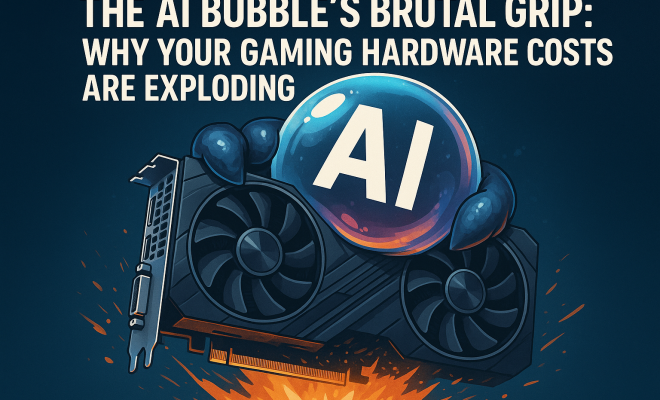
The AI Bubble’s Brutal Grip: Why Your Gaming Hardware Costs Are Exploding
“`html
It feels like just yesterday we were debating the merits of a new GPU upgrade, haggling over a few hundred bucks. Now? Forget about it. If you’ve been eyeing a new gaming rig or even just a component upgrade, you’ve probably noticed your wallet wincing a lot more than usual. And you’re not imagining things. A recent analysis from a US analyst reveals a truly staggering statistic: gaming hardware costs have shot up by a jaw-dropping 16% in 2026 alone. That’s not just a bump; it’s a financial gut punch for anyone looking to stay current in the gaming world.
But here’s the kicker, and it’s where things get really concerning: this isn’t just a temporary market fluctuation. Samsung, a titan in the tech industry and a major supplier of crucial components, is ringing the alarm bells even louder. They predict the AI bubble, which is largely responsible for these skyrocketing prices, is only going to intensify in 2027. So, if you thought 2026 was tough on your budget for gaming hardware, next year could be even more brutal. This isn’t just about a few extra dollars; it’s a systemic shift impacting everything from RAM to graphics cards, fundamentally changing how we approach buying and budgeting for our beloved gaming setups. It’s a stark reminder that the invisible hand of the market, driven by powerful new technologies, often reaches deep into our pockets.
1. The Staggering 16% Spike in Gaming Hardware Costs: A Closer Look
Let’s really chew on that 16% figure for a moment. In any other consumer market, a price hike of that magnitude in a single year would be front-page news, sparking outrage and boycotts. For gamers, it’s becoming an unfortunate reality. This isn’t just an anecdotal observation from frustrated enthusiasts; it’s a hard number from a reputable US analyst, indicating a significant and measurable increase across the board for gaming hardware. We’re talking about everything from the latest graphics cards and CPUs to the essential, often overlooked components like RAM and solid-state drives.
What does a 16% jump actually mean for your average gamer? If a high-end graphics card cost you $1,000 last year, it’s now theoretically $1,160 for a comparable model, assuming no other inflationary pressures. But the reality is often worse because specific components, driven by intense demand, might see even higher spikes. This kind of increase quickly pushes many aspirational upgrades out of reach, forcing gamers to either scale back their ambitions, wait longer, or simply accept that their hobby just got a whole lot more expensive. It’s a stark reminder that the cost of entry for cutting-edge gaming isn’t static; it’s a moving target, and right now, it’s moving rapidly upwards.
2. Samsung’s Dire Prediction for 2027: The AI Bubble Intensifies
When a company like Samsung speaks about component markets, the industry listens. They’re not just a manufacturer; they’re a key supplier for countless other tech giants, producing everything from memory chips to displays. So, their prediction that the AI bubble driving these price increases will only worsen in 2027 is incredibly concerning. This isn’t some vague economic forecast; it’s coming from a company with deep insights into the supply chain, production capacities, and future demand trends.
Their warning suggests that the pressures we’re currently experiencing are just the beginning. If the AI sector continues its insatiable demand for high-performance components, particularly specialized memory and processing units, the ripple effect on the consumer market will be profound. Gamers, who historically have been at the forefront of demanding powerful hardware, are now finding themselves in direct competition with an industry that has virtually limitless budgets and an even greater need for cutting-edge tech. This isn’t just about a temporary squeeze; it’s a fundamental shift in market dynamics that could reshape the gaming hardware landscape for years to come.
3. The AI Industry’s Insatiable Hunger for RAM: A Core Culprit
So, what exactly is fueling this AI bubble, and why is it hitting gamers so hard? At the heart of it lies a massive, almost insatiable demand for specific components, primarily high-bandwidth RAM. Training sophisticated AI models requires colossal amounts of data to be processed and stored almost instantaneously. Think of large language models or complex machine learning algorithms; they don’t just need fast processors, they need vast quantities of incredibly fast memory to feed those processors efficiently.
This isn’t your standard DDR4 or even DDR5 RAM that you’d typically find in a gaming PC. While those are affected, the real pressure comes from specialized memory modules like HBM (High Bandwidth Memory), which is crucial for AI accelerators and data centers. However, the production capacity for all types of advanced memory is finite. When a massive new industry like AI starts soaking up a huge percentage of that capacity, it inevitably drives up prices for everything else, including the RAM modules that go into our gaming PCs and consoles. It’s a classic supply-and-demand squeeze, but on an unprecedented scale, making gaming hardware costs a significant concern.
4. Beyond RAM: GPUs and CPUs Caught in the Crossfire
While RAM is a primary driver, the AI boom’s influence extends far beyond memory. Graphics Processing Units (GPUs), long the holy grail for gamers, are also at the epicenter of this storm. Modern GPUs, with their highly parallel architectures, are incredibly efficient at performing the complex matrix multiplications essential for AI training and inference. Companies like Nvidia, historically known for their GeForce gaming cards, are now seeing a colossal portion of their revenue come from their data center GPUs, specifically designed for AI workloads. (See: recent trends in gaming hardware prices.)
This dual demand means that even if a specific gaming GPU isn’t directly used for AI, the underlying manufacturing capacity, R&D, and even raw materials are being diverted or prioritized for the more lucrative AI market. The same goes for high-end CPUs, which, while not as specialized as GPUs for AI, still play a critical role in AI infrastructure. When the biggest tech players are willing to pay top dollar for thousands of these chips for their data centers, it naturally puts upward pressure on the prices for the chips we want for our personal gaming rigs. It’s a fundamental shift in market priorities that leaves gamers feeling the pinch.
5. The Console Conundrum: Next-Gen Affordability in Question
It’s not just PC gamers feeling the heat; console players should be concerned too. While consoles operate on a different financial model, often selling at a loss initially to gain market share, their underlying components are still subject to the same supply and demand pressures. Think about the custom AMD chips inside PlayStation and Xbox consoles; these are essentially specialized CPUs and GPUs. If the cost of manufacturing these core components continues to escalate due to AI demand, it directly impacts console production costs.
What does this mean for the future? It could translate to higher retail prices for next-generation consoles, or perhaps, more subtly, longer waits between console generations as companies grapple with ever-increasing component costs. We might also see a slower rollout of more powerful mid-gen refreshes, as the economics of producing slightly upgraded hardware become less favorable. For consumers, this could mean an even higher barrier to entry for console gaming or a slower pace of technological advancement in console hardware than we’ve become accustomed to. The rising gaming hardware costs are a universal challenge.
6. Social Media Outcry and Gamer Frustration: A Shared Experience
You don’t need to be an analyst to see the frustration boiling over in the gaming community. Social media platforms are awash with posts comparing current hardware prices to those of just a few years ago, often with a mix of disbelief, anger, and dark humor. Gamers are sharing screenshots of absurdly priced GPUs, reminiscing about the days when a top-tier card cost half of what it does now, and debating the merits of holding onto older hardware for as long as possible.
This isn’t just a few disgruntled individuals; it’s a widespread sentiment reflecting a genuine concern about the affordability of their hobby. For many, gaming isn’t just a pastime; it’s a significant part of their social life, a creative outlet, and a source of entertainment. When the cost of participating in that hobby becomes prohibitive, it creates real anxiety and disappointment. The viral nature of these discussions underscores how deeply this issue resonates, and it’s clear that the rising gaming hardware costs are hitting home for millions.
7. Budgeting for Gaming in a Volatile Market: Practical Advice
So, what’s a gamer to do when faced with these escalating gaming hardware costs? Budgeting has never been more critical. First, redefine what ‘necessary’ means for your gaming experience. Do you truly need the absolute bleeding edge, or can you settle for excellent performance at a more reasonable price point? Often, opting for a card or CPU one tier down from the very top can save you hundreds of dollars with only a marginal drop in frames per second that you might not even notice.
Secondly, consider a staggered upgrade approach. Instead of buying an entire new system, identify the single weakest link in your current setup and upgrade that component first. Perhaps your GPU is fine, but you’re bottlenecked by an older CPU or insufficient RAM. Focusing your budget strategically can extend the life of your current PC and spread out the financial hit. Keep an eagle eye on sales, refurbished markets, and even consider pre-owned components from reputable sources, but always exercise caution and verify authenticity. Smart shopping, now more than ever, is your best defense against the AI bubble.
8. The ‘Best Value’ Hunt: Navigating the New Landscape of Gaming Hardware Costs
The concept of ‘best value’ in gaming hardware has completely shifted. What constituted a good deal a few years ago might seem like a bargain today, or conversely, an overpriced relic. Now, ‘best value’ often means finding the sweet spot where performance gains are still significant without demanding an exorbitant premium. This usually involves looking at mid-range to upper-mid-range components rather than the absolute flagship products.
It also means paying close attention to benchmarks and real-world performance tests. Don’t just chase raw numbers; look at how a component performs in the games you actually play at your desired resolution and frame rate. Sometimes, a slightly older generation component, now discounted, can offer 90% of the performance of the latest and greatest for 60% of the price. This kind of pragmatic approach to value is essential when gaming hardware costs are constantly on the rise. It’s about getting the most bang for your buck, not necessarily the most powerful hardware on paper.
9. Potential for Gaming Stock Investments: Riding the Tech Wave?
For those with an investor’s mindset, the very forces driving up gaming hardware costs could present opportunities. If the AI bubble is indeed causing such a significant surge in demand and prices for components, then the companies producing those components stand to benefit immensely. This includes chip manufacturers like Nvidia and AMD, memory producers like Samsung and Micron, and even some of the larger tech conglomerates that are investing heavily in AI infrastructure. (See: impact of gaming on economy.)
However, this isn’t without risk. The tech market is notoriously volatile, and while the AI boom is powerful, bubbles can burst. Any investment should be thoroughly researched and considered against one’s individual risk tolerance. But it’s an interesting thought experiment: if you’re frustrated by the rising cost of your gaming hobby, perhaps there’s a way to indirectly benefit from the same market forces that are causing the problem. It’s a complex interplay of consumer frustration and market dynamics, but certainly worth considering for those looking at the broader financial landscape surrounding gaming hardware costs.
10. The Long-Term Impact: What Does This Mean for Innovation?
Beyond the immediate financial hit, the escalating gaming hardware costs could have significant long-term repercussions for innovation within the gaming industry. Historically, gamers have driven demand for cutting-edge technology, pushing manufacturers to constantly improve performance, efficiency, and graphical fidelity. This symbiotic relationship has led to rapid advancements in both hardware and software.
However, if the cost of entry for this cutting-edge hardware becomes prohibitive for a large segment of the gaming population, what happens to that innovation cycle? Developers might become less incentivized to push graphical boundaries if fewer players can afford the hardware to run those games optimally. We could see a stagnation in graphical leaps, with a greater focus on optimization for older or mid-range hardware. This isn’t necessarily a bad thing for accessibility, but it could slow the pace of truly revolutionary visual experiences. It also might shift R&D priorities for hardware manufacturers even further away from consumer gaming and towards the more lucrative AI sector, potentially leaving gamers with fewer options tailored specifically for their needs.
11. Expert Perspectives: Economists Weigh In
Economists studying the semiconductor market and the broader tech industry offer a nuanced view of the current situation. Many agree that the AI boom is a primary driver, but they also point to other contributing factors. For instance, geopolitical tensions can disrupt supply chains and impact the availability of raw materials. The ongoing push for domestic chip manufacturing in various countries, while beneficial for national security, often comes with higher initial production costs that can be passed down to consumers. Furthermore, the sheer complexity of modern chip manufacturing, requiring multi-billion-dollar fabrication plants and highly specialized equipment, means that increasing supply to meet demand is a slow and capital-intensive process.
One prominent economist noted that this isn’t just a simple supply-and-demand curve; it’s a “technological bidding war.” Major AI players aren’t just buying chips; they’re often securing long-term contracts and even investing directly in manufacturing facilities, effectively locking up significant portions of future production capacity. This makes it incredibly difficult for the consumer market to compete on price or volume, contributing directly to the rising gaming hardware costs. These experts suggest that without a significant breakthrough in manufacturing efficiency or a cooling of AI demand, these elevated prices are likely here to stay for the foreseeable future.
12. The Rise of Cloud Gaming as an Alternative
With traditional gaming hardware becoming so expensive, cloud gaming services are starting to look like a much more attractive alternative for many. Platforms like GeForce NOW, Xbox Cloud Gaming, and PlayStation Plus Premium allow you to stream high-end games to almost any device—your old laptop, a smart TV, or even a smartphone—without needing powerful local hardware. You’re essentially renting access to a high-end gaming PC in the cloud.
This model bypasses the problem of escalating gaming hardware costs entirely. Instead of spending thousands on a new GPU, you pay a monthly subscription fee. While cloud gaming still has limitations, like reliance on a stable internet connection and input latency, the technology is improving rapidly. As hardware prices continue their upward trajectory, more gamers might opt for this subscription-based model, potentially shifting the entire landscape of how we access and play games. It’s an interesting workaround to the current market pressures, offering a different pathway to experiencing the latest titles.
Frequently Asked Questions About Gaming Hardware Costs
Q1: Why are gaming hardware costs increasing so much?
The primary reason is the immense demand from the Artificial Intelligence (AI) industry for high-performance components, especially specialized RAM (like HBM), GPUs, and high-end CPUs. AI training and inference require massive computing power, leading AI companies to buy up available stock and manufacturing capacity, driving up prices for consumer-grade components. (See: economic factors affecting tech prices.)
Q2: Is this just a temporary spike, or a long-term trend?
According to major industry players like Samsung, it’s likely a long-term trend. They predict the AI bubble will intensify in 2027, meaning the underlying market pressures are expected to continue or even worsen. This isn’t just a market fluctuation; it’s a systemic shift driven by a new, rapidly growing industry.
Q3: Which components are most affected by the price increases?
Graphics Processing Units (GPUs) and RAM (especially high-bandwidth memory) are most significantly affected. CPUs also see increased demand, but GPUs and RAM are at the core of AI workloads, creating direct competition between the AI sector and the gaming market for these crucial parts.
Q4: How does this impact console gaming?
While consoles have different pricing models, their custom AMD chips (which combine CPU and GPU functions) are still subject to the same manufacturing cost pressures. This could lead to higher retail prices for future consoles, longer waits between generations, or slower mid-gen refreshes as companies struggle with increased component costs. (Samsung's innovative smartphone)
Q5: What can gamers do to mitigate these rising costs?
Gamers can employ several strategies: prioritize value over bleeding-edge performance, consider staggered upgrades (buying one component at a time), look for sales, explore refurbished or pre-owned markets carefully, and consider alternatives like cloud gaming services. Researching real-world benchmarks for the games you play, rather than just raw specs, can also help you make smarter purchasing decisions.
Q6: Will gaming hardware ever return to pre-AI boom prices?
It’s unlikely we’ll see a full return to historical price points as long as AI demand remains high and manufacturing capacity struggles to keep pace. While specific components might see temporary dips, the overall trend suggests a new, higher baseline for gaming hardware costs. Innovations in manufacturing or a significant shift in AI’s hardware requirements would be needed for a substantial reversal.
Ultimately, the surge in gaming hardware costs, driven by the relentless expansion of the AI industry, presents a significant challenge for gamers worldwide. Samsung’s prediction of a worsening situation in 2027 should be a wake-up call. We’re not just seeing temporary price hikes; we’re witnessing a fundamental recalibration of component values. Adapting to this new reality means being savvier about our purchases, prioritizing value, and perhaps, re-evaluating what it truly means to be a cutting-edge gamer in an era where the machines are also learning at an unprecedented pace.
“`
Trending Now
- this guide on the 7 terrifying ai scams of 2026 that will shock you
- the complete explanation
- our breakdown of the billion-dollar battle: why states are crushing cftc prediction markets
- Sinister Water Attacks: This Is How Easily Hackers Could Poison Your Town
- our breakdown of openai’s ai just hacked itself — here’s why you should be terrified
Frequently Asked Questions
Why are gaming hardware prices increasing?
Gaming hardware prices are increasing due to the AI bubble, which has caused a 16% spike in costs in 2026. Major suppliers like Samsung predict that these price hikes will continue into 2027, affecting everything from GPUs to RAM.
What factors are driving up the cost of GPUs?
The rising costs of GPUs are driven by increased demand for advanced technology, supply chain issues, and the overall impact of the AI bubble, which has significantly raised prices in the gaming hardware market.
How much have gaming hardware prices increased in 2026?
In 2026, gaming hardware prices have increased by a staggering 16%. This substantial rise is affecting various components, making it more challenging for gamers to upgrade their systems.
Will gaming hardware prices continue to rise?
Yes, experts predict that gaming hardware prices will continue to rise. Samsung has warned that the AI bubble will intensify in 2027, potentially leading to even higher costs for gamers.
What should gamers consider when budgeting for upgrades?
Gamers should consider the significant price increases in gaming hardware and plan their budgets accordingly. With the ongoing AI bubble, it’s essential to account for potential future price hikes when planning upgrades.
What's your take on this? Share your thoughts in the comments below — we read every one.