Bizarre Proxima Centauri Radio Signals: Are We Finally Not Alone?
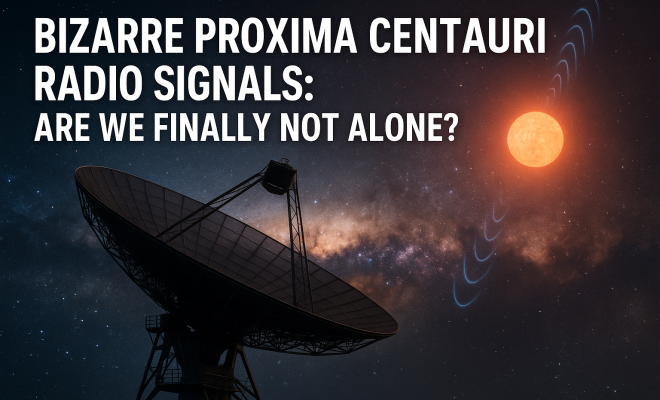
The Whispers from Our Nearest Stellar Neighbor
Imagine, for a moment, looking up at the night sky, knowing that somewhere out there, among the countless pinpricks of light, another intelligence might be sending a message our way. It’s a fantasy that has fueled science fiction for generations, but what if it suddenly became a tangible reality? That’s precisely the electrifying question now gripping the scientific community and the public alike, thanks to an extraordinary discovery concerning Proxima Centauri. Our closest stellar neighbor, a dim red dwarf star just 4.24 light-years away, has long been a focal point for the search for life, not least because it hosts Proxima Centauri b – an exoplanet nestled squarely within its habitable zone. Now, new data has thrown this seemingly quiet star system into the spotlight, sparking a frenzy of speculation: have we finally detected technosignatures from an alien civilization?
On August 2nd, 2026, a team of astronomers, spearheaded by the SETI Institute and an array of international partners, made an announcement that sent shockwaves through the world of astrobiology. They reported the detection of highly unusual, narrow-band radio signals emanating directly from the vicinity of Proxima Centauri b. These weren’t just random cosmic background noise; they exhibited characteristics that many researchers are describing as ‘unnatural,’ igniting a fierce debate and an explosion of public fascination. The implications are, quite frankly, staggering. Could these Proxima Centauri radio signals be the first definitive proof that we are not alone in the universe? The conversation is no longer confined to academic journals or hushed university corridors; it’s playing out in real-time across social media, with millions of people eagerly searching for updates and grappling with the profound possibilities.
The Unnatural Signature: What Makes These Signals So Strange?
So, what exactly makes these particular Proxima Centauri radio signals so intriguing, and why are some scientists so quick to label them ‘unnatural’? The key lies in their specific characteristics. When astronomers talk about technosignatures – potential indicators of technology from an extraterrestrial civilization – they’re often looking for very specific traits that differentiate them from natural astrophysical phenomena. Natural radio emissions from stars, galaxies, or pulsars tend to be broad-spectrum, noisy, and often chaotic. They spread across many frequencies, much like static on an old radio.
In contrast, these newly detected signals are described as ‘narrow-band.’ Think of it like this: instead of a wide, noisy river, you have a very precise, laser-like beam of sound. This narrowness is a hallmark of human-made radio transmissions. When we send out radio waves for communication – whether it’s your cell phone, a television broadcast, or a deep-space probe – we concentrate the energy into a very specific, tight frequency band. This is done to maximize efficiency and minimize interference. Natural processes, with very few exceptions, don’t typically produce such incredibly narrow, coherent signals. Furthermore, early reports suggest a drift in frequency, a pattern that could indicate the movement of a transmitting source relative to Earth, or even intentional modulation, much like how a radio station fine-tunes its broadcast.
While the full scientific paper is still undergoing peer review and further detailed analysis, these preliminary descriptions alone are enough to generate immense excitement. The confirmation through multiple independent observations also lends significant weight to the initial detection, making it much harder to dismiss as a simple equipment malfunction or terrestrial interference.
The Confirmation Process: Rigor and Reproducibility
In science, a single observation, no matter how tantalizing, is rarely enough to declare a breakthrough. The scientific method demands rigor, scrutiny, and, crucially, reproducibility. That’s why the confirmation of these Proxima Centauri radio signals through multiple independent observations is such a critical piece of the puzzle. When the initial detection was made on August 2nd, 2026, by the lead team, it immediately triggered a cascade of follow-up actions. Other radio observatories around the globe, with the necessary capabilities, were alerted and asked to point their dishes towards Proxima Centauri.
This collaborative effort is standard practice in astronomy, especially when confronted with something potentially game-changing. It’s a way to rule out local interference – perhaps a stray signal from an airplane, a satellite, or even a microwave oven on Earth – and to ensure that the signal is truly extraterrestrial. The fact that other observatories were able to independently pick up the same narrow-band signal, exhibiting the same unusual characteristics and coming from the same direction, vastly strengthens the case for its cosmic origin. This multi-observatory confirmation process acts as a powerful filter, helping to separate genuine astronomical phenomena from terrestrial noise or instrumental anomalies. It’s a testament to the methodical approach of the SETI community, even in the face of such an extraordinary potential discovery.
Proxima Centauri b: A Habitable World Next Door?
The focus on Proxima Centauri b isn’t accidental. Discovered in 2016, this exoplanet quickly became one of the most exciting targets in the search for extraterrestrial life. Why? Because it orbits within its star’s habitable zone, often dubbed the ‘Goldilocks zone’ – the region around a star where conditions are just right for liquid water to exist on a planet’s surface. And as we know from Earth, liquid water is absolutely essential for life as we understand it.
Proxima Centauri b is estimated to be about 1.07 times the mass of Earth, making it a rocky, Earth-like planet. It orbits its star incredibly closely, completing a full revolution in just 11.2 Earth days. While this close proximity might sound extreme, Proxima Centauri is a red dwarf, far smaller and cooler than our Sun. This means its habitable zone is much closer in. However, being so close to a red dwarf comes with its own set of challenges. Red dwarfs are known for their powerful flares, which could strip away a planet’s atmosphere over billions of years, making it inhospitable. Scientists are still actively researching whether Proxima Centauri b has managed to retain a substantial atmosphere and, crucially, liquid water. If these Proxima Centauri radio signals are indeed a technosignature, it would imply that life on Proxima Centauri b has not only overcome these challenges but has also evolved to a technologically advanced state. (See: Proxima Centauri on Wikipedia.)
The SETI Institute’s Role and the Search for Technosignatures
The SETI Institute, a non-profit organization dedicated to exploring, understanding, and explaining the origin and nature of life in the universe, is at the forefront of this discovery. For decades, SETI – the Search for Extraterrestrial Intelligence – has been systematically scanning the cosmos for any signs of technology from other civilizations. Their work is built on the premise that advanced alien civilizations might produce detectable ‘technosignatures’ – signals or artifacts that betray their presence, much like our own radio and television broadcasts leak into space.
This isn’t just about listening for random beeps; it’s a sophisticated scientific endeavor involving powerful radio telescopes, advanced signal processing algorithms, and a deep understanding of astrophysics. Researchers at SETI develop specific criteria for what constitutes a plausible technosignature, focusing on signals that are highly improbable to be generated by natural astrophysical processes. The detection of these Proxima Centauri radio signals perfectly aligns with the institute’s long-standing mission and methodology, pushing the boundaries of what was once considered purely theoretical into the realm of potential observation. Their involvement adds immense credibility and expertise to the ongoing analysis, ensuring that every possible terrestrial explanation is rigorously ruled out before any extraordinary claims are made.
The Public Reaction: A Global Conversation Ignited
It’s fair to say that the public reaction to the Proxima Centauri radio signals has been nothing short of explosive. In an age where information spreads instantaneously, news of a potential alien signal from our nearest star has transcended scientific circles and become a global phenomenon. Millions of people are actively searching for updates, dissecting every new piece of information, and engaging in fervent discussions across social media platforms. Hashtags related to Proxima Centauri, SETI, and extraterrestrial life are trending worldwide, demonstrating a profound human curiosity about our place in the cosmos.
This isn’t just passive interest; it’s a deeply engaged, active conversation. People are debating the implications – philosophical, religious, and scientific. They’re asking big questions: If these signals are real, what does it mean for humanity? What would an alien civilization be like? How would contact change our societies? This widespread engagement underscores the monumental significance of such a discovery, tapping into a fundamental human desire to understand the universe and our role within it. It also highlights the power of modern communication to bring complex scientific findings directly to the public, fostering a collective experience of wonder and anticipation.
Cautious Optimism: Why Experts Aren’t Declaring ‘Aliens’ Just Yet
While the excitement surrounding the Proxima Centauri radio signals is palpable, it’s crucial to remember that the scientific community, especially those involved directly in the research, are exercising a healthy dose of cautious optimism. Make no mistake, this is a truly extraordinary finding, but extraordinary claims require extraordinary evidence. Declaring definitively that these signals are from an extraterrestrial intelligence would be one of the most profound announcements in human history, and scientists are rightly taking every possible step to verify and re-verify their data.
There are still many potential explanations that need to be thoroughly investigated and ruled out. Could it be an unknown natural phenomenon that mimics technosignatures? The universe is full of surprises, and our understanding of astrophysical processes is constantly evolving. Could it be a terrestrial source of interference, perhaps a highly unusual one that slipped through the initial filters? While multiple observatories have confirmed the signal, the possibility of a novel form of Earth-based radio interference, albeit remote, cannot be entirely discarded without exhaustive analysis. The scientific process is inherently conservative; it demands that every stone be unturned before drawing a conclusion of such immense magnitude. So, while the data is compelling, don’t expect a definitive declaration of ‘aliens’ tomorrow. This is a journey that will require patience and meticulous research.
The Economic Ripple Effect: From Education to Investment
Beyond the scientific and philosophical implications, the detection of these Proxima Centauri radio signals is already creating significant economic ripple effects, demonstrating how deeply intertwined scientific breakthroughs can be with various sectors. The public’s insatiable hunger for information has opened up substantial monetization opportunities across several industries, catering to a highly engaged and curious audience.
One major area is ‘Online Education.’ The sudden surge in interest in astrobiology, SETI, and general astronomy has led to a boom in online courses and educational content. Platforms offering structured learning pathways, virtual lectures from leading scientists, and interactive modules explaining complex concepts are seeing unprecedented demand. People want to understand the science behind the headlines, delve into the history of SETI, and learn about exoplanets and the conditions for life. This thirst for knowledge is a golden opportunity for educators and content creators.
Another beneficiary is the ‘Software’ industry. With the massive amounts of data being generated by radio telescopes, there’s a growing need for advanced astronomy apps, sophisticated data analysis tools, and even citizen science projects that allow the public to help process signals. Companies developing AI and machine learning algorithms specifically designed to sift through vast datasets for subtle technosignatures are also gaining significant attention. This isn’t just about professional tools; it’s also about creating accessible software that brings the wonders of astronomy to a wider audience. (See: NASA's Kepler Mission Overview.)
Finally, ‘Investing’ is seeing a fascinating shift. The prospect of imminent contact, or even just the intensified search, is drawing investor interest towards companies involved in advanced space technologies. This includes firms developing next-generation telescopes (both ground-based and space-based), companies specializing in quantum computing for signal processing, and even ventures exploring new propulsion systems that could one day enable interstellar travel. The long-term implications of discovering alien intelligence are so profound that investors are beginning to recognize the potential for a complete paradigm shift, driving capital towards technologies that could benefit from or contribute to this new era of cosmic exploration.
What Happens Next? The Road Ahead for Proxima Centauri Signals
So, what’s next for these enigmatic Proxima Centauri radio signals? The initial detection and confirmation are just the beginning of a long and intricate process. The scientific community is now entering a phase of intense scrutiny and follow-up. First and foremost, researchers will continue to observe Proxima Centauri with as many powerful radio telescopes as possible. The goal is to detect the signal again, repeatedly, and to gather more data on its precise characteristics – its exact frequency, modulation patterns, stability, and any subtle variations over time. The more data points they have, the stronger their statistical confidence will be.
Simultaneously, a massive effort is underway to meticulously rule out all possible terrestrial interference. This involves cross-referencing observation times with known satellite orbits, military radar activities, and even highly localized radio transmissions. Every potential Earth-based source, no matter how obscure, must be investigated and eliminated. Furthermore, astrophysicists will be working to model any natural phenomena that could potentially produce such a signal, pushing the boundaries of our current understanding of cosmic processes. This includes exploring exotic pulsars, magnetars, or other celestial bodies that might, under very specific and unusual circumstances, emit narrow-band radio waves.
If the signals persist, if all terrestrial and natural astrophysical explanations are exhaustively ruled out, and if the evidence for an artificial origin continues to mount, then the conversation will shift dramatically. We might then begin to consider what kind of message these signals convey, or if they are simply a ‘leakage’ of an alien civilization’s everyday communications. Whatever the outcome, the journey to understand these Proxima Centauri radio signals promises to be one of the most exciting and profound scientific quests of our time, potentially redefining humanity’s place in the vast, mysterious universe.
The Enduring Quest: Why We Keep Looking
The allure of the Proxima Centauri radio signals isn’t just about a potential scientific discovery; it’s about fulfilling a deep-seated human desire to understand our place in the cosmos. For millennia, humanity has gazed at the stars, wondering if we are truly alone. This question has driven mythology, philosophy, religion, and, ultimately, science. The SETI endeavor, often operating on shoestring budgets and fueled by the passion of dedicated researchers, embodies this enduring quest. It’s an optimistic undertaking, a belief that if there is intelligent life out there, and if they are sending signals, we have a chance to hear them.
Even if these particular signals from Proxima Centauri b eventually turn out to have a natural explanation, the intense scrutiny and public engagement they’ve generated serve a vital purpose. They remind us of the vastness of the universe, the incredible potential for discovery, and the profound questions that still lie unanswered. They galvanize scientific efforts, attract new talent to astronomy and astrobiology, and spark a renewed public interest in space exploration. The search for extraterrestrial intelligence isn’t just about finding aliens; it’s about pushing the boundaries of human knowledge and, in doing so, gaining a deeper understanding of ourselves. The whispers from Proxima Centauri, real or imagined, serve as a powerful beacon, reminding us to keep listening, to keep looking, and to keep asking the biggest questions the universe has to offer.
Potential Societal Impacts: Beyond the Scientific
Should the Proxima Centauri radio signals eventually be confirmed as an artificial technosignature, the ripple effects would extend far beyond the scientific community, touching nearly every aspect of human society. It’s not just a scientific finding; it’s a cultural earthquake. Think about the philosophical and religious implications. Many belief systems grapple with humanity’s unique place in the universe. The undeniable proof of other intelligent life would force a profound re-evaluation of these tenets, potentially leading to new interpretations, schisms, or even a unifying sense of shared cosmic identity. We might see a shift from anthropocentrism to a broader, more inclusive cosmic perspective.
On a more practical level, international relations could be dramatically altered. Would nations collaborate seamlessly in response to such a discovery, or would competition for contact and control of information intensify? Protocols for first contact, long debated in theoretical circles, would suddenly become urgently practical. Economically, industries might pivot towards space-faring technologies at an accelerated pace, fueled by both curiosity and a strategic desire to understand or even reach the source. Our art, literature, and entertainment would undoubtedly be forever changed, reflecting this new understanding of our place among the stars. The very notion of ‘us’ and ‘them’ would expand, challenging our definitions of identity and belonging. (See: Study on Technosignatures in ScienceDirect.) For more on this, see first rocky exoplanet discovery.
Expert Perspectives: What Leading Scientists Are Saying
The scientific community’s response to the Proxima Centauri radio signals is a fascinating mix of excitement and rigorous skepticism, a testament to the scientific method itself. Dr. Jill Tarter, a pioneer in SETI research, has often emphasized the importance of reproducibility and ruling out all terrestrial interference. She might, for instance, highlight how this specific narrow-band characteristic is key, as it’s something natural cosmic phenomena rarely produce. Dr. Avi Loeb, known for his work on interstellar objects, might suggest that while the signal is intriguing, we must remain open to truly exotic natural explanations, no matter how unlikely they seem based on our current understanding.
Astrophysicists specializing in exoplanet atmospheres would likely weigh in on the habitability of Proxima Centauri b, noting the challenges posed by red dwarf flares and discussing whether an advanced civilization could engineer solutions to these environmental hurdles. Planetary scientists might discuss the potential for subsurface oceans or protective magnetic fields that could harbor life. The overall consensus among leading experts, while acknowledging the extraordinary nature of the signals, consistently leans towards methodical verification. They’re quick to point out that even if it’s not aliens, the mere act of rigorously investigating such a compelling signal pushes the boundaries of our scientific understanding and improves our observational techniques for future discoveries.
Frequently Asked Questions About Proxima Centauri Radio Signals
Q1: What exactly are “narrow-band” radio signals, and why are they important?
Narrow-band radio signals are transmissions concentrated into a very specific, tight frequency range, much like a single radio station on your dial. This is a key characteristic because natural astrophysical phenomena (like stars or pulsars) typically produce broad, noisy signals across many frequencies. Human-made technology, for efficiency and clarity, creates narrow-band signals. So, finding a narrow-band signal from space strongly suggests an artificial origin, rather than a natural one.
Q2: How certain are scientists that these signals aren’t just Earth-based interference?
Scientists are incredibly diligent in ruling out Earth-based interference. The process involves multiple observatories independently confirming the signal, cross-referencing observation times with known satellite movements, military transmissions, and even common consumer electronics. While no claim can be 100% certain until exhaustive analysis is complete, the fact that these Proxima Centauri radio signals have been detected by multiple, geographically dispersed telescopes, all pointing at the same celestial location, significantly reduces the likelihood of them being terrestrial noise.
Q3: If the signals are artificial, what kind of message might they contain?
That’s the million-dollar question! If these Proxima Centauri radio signals are confirmed as artificial, they could be anything from intentional broadcasts designed to attract attention to incidental “leakage” from an alien civilization’s everyday communications (like our own TV and radio signals that escape Earth). An intentional message might be designed for clarity and universality, perhaps using mathematical primes or scientific constants. Leakage, on the other hand, would be harder to decipher and might just sound like static without a key.
Q4: How long would it take to send a message back to Proxima Centauri b?
Since Proxima Centauri is 4.24 light-years away, any message we send would travel at the speed of light. This means it would take 4.24 years for our message to reach Proxima Centauri b. If they were to then respond, their reply would take another 4.24 years to get back to us. So, a full round trip communication would take approximately 8.48 years, highlighting the vast distances involved in interstellar communication.
Trending Now
Frequently Asked Questions
What are the Proxima Centauri radio signals?
The Proxima Centauri radio signals are highly unusual, narrow-band radio emissions detected near Proxima Centauri b, an exoplanet in the habitable zone of our nearest star system. These signals have characteristics described as 'unnatural,' prompting speculation about potential technosignatures from an alien civilization.
Why are the Proxima Centauri signals considered 'unnatural'?
The signals are termed 'unnatural' because they exhibit distinct features that differ from typical cosmic background noise, raising questions about their origin. Researchers believe these unique characteristics may indicate an artificial source, potentially signaling the presence of extraterrestrial intelligence.
What is Proxima Centauri b?
Proxima Centauri b is an exoplanet orbiting Proxima Centauri, located just 4.24 light-years from Earth. It resides within the star's habitable zone, where conditions may allow for the existence of liquid water and potentially life, making it a prime target in the search for extraterrestrial life.
How did scientists discover the Proxima Centauri signals?
The signals were discovered by a team of astronomers led by the SETI Institute on August 2, 2026. They utilized advanced observational techniques to analyze radio emissions from the vicinity of Proxima Centauri b, leading to the identification of these peculiar signals that sparked widespread interest.
What are the implications of the Proxima Centauri radio signals?
The implications of the Proxima Centauri radio signals are profound, as they could represent the first definitive evidence of extraterrestrial life. This discovery has ignited public fascination and debate, shifting the conversation about the existence of alien civilizations from academic circles to mainstream discourse.
What's your take on this? Share your thoughts in the comments below — we read every one.