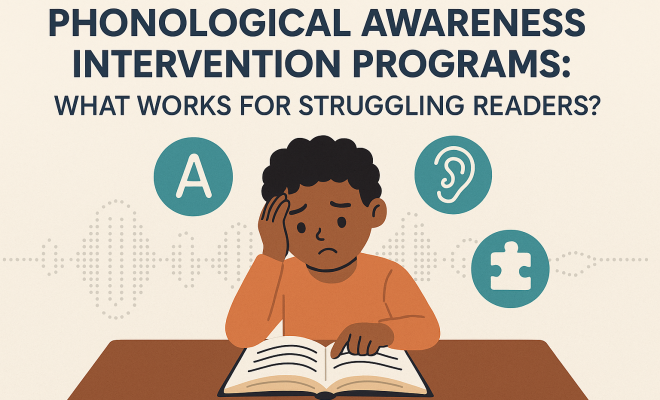
“Phonological Awareness Intervention Programs: What Works for Struggling Readers?”
“`html
Reading is a foundational skill vital for academic success and everyday life. Yet, for many children, mastering reading can be a significant challenge. Struggling readers often grapple with phonological awareness, a critical component of reading that involves recognizing and manipulating sounds in spoken language. This article explores effective phonological awareness intervention programs designed to support these learners and highlights what truly works in helping them improve their reading skills.
Understanding Phonological Awareness
Phonological awareness refers to the ability to recognize and work with sounds in spoken language. This skill encompasses various elements, including recognizing words, syllables, onsets, and rimes, as well as individual phonemes. Phonemic awareness, the most specific subset of phonological awareness, focuses on the ability to identify and manipulate the smallest units of sound in language.
Research indicates that phonological awareness is a strong predictor of later reading success. Children who struggle with phonological awareness may find it difficult to decode words, leading to challenges in fluency and comprehension. Without intervention, these difficulties can affect their overall academic performance.
The Importance of Early Intervention
Early identification and intervention for phonological awareness deficits are crucial. According to the National Reading Panel, systematic and explicit instruction in phonological awareness can significantly improve reading outcomes for struggling learners. The earlier the intervention begins, the better the chances for success, underscoring the importance of teacher training and parent involvement in recognizing early signs of reading difficulties.
For example, a child who exhibits difficulty rhyming or breaking words into syllables may benefit from targeted phonological awareness intervention. Educators and parents should collaborate to monitor progress and adjust instructional strategies accordingly. By focusing on phonological awareness in the early stages of reading development, children can build a strong foundation for future literacy skills.
Characteristics of Effective Phonological Awareness Interventions
Not all phonological awareness intervention programs are created equal. Effective programs share several key characteristics:
- Explicit Instruction: Lessons should be clear and direct, teaching specific skills in a sequential manner.
- Systematic Approach: Interventions should follow a structured program that builds upon previous knowledge and gradually increases in complexity.
- Multisensory Techniques: Engaging multiple senses can enhance learning. Incorporating visual, auditory, and kinesthetic modalities can make lessons more effective.
- Frequent Assessment: Ongoing assessment helps track progress and informs instructional adjustments.
- Small Group Instruction: Providing individualized attention in small groups can facilitate more personalized learning experiences.
Types of Phonological Awareness Intervention Programs
There are several types of phonological awareness intervention programs available, each designed to address different needs and learning styles. Here are a few common approaches:
1. Direct Instruction Programs
Direct instruction programs, such as the Phonological Awareness Training, focus on explicitly teaching phonological skills through a structured curriculum. These programs utilize systematic lesson plans that guide educators through various phonological tasks, from recognizing sounds to manipulating phonemes. This approach is beneficial for students who require step-by-step guidance to grasp complex phonological concepts.
2. Curriculum-Based Programs
Curriculum-based programs often integrate phonological awareness instruction directly into the reading curriculum. Programs like Read Well and Success for All embed phonological awareness activities within a broader literacy framework. This method reinforces phonological skills while promoting overall reading comprehension, making it easier for students to see the relevance of phonological awareness in their reading journey.
3. Digital/Interactive Programs
With the rise of technology in education, digital phonological awareness intervention programs have gained popularity. Programs like Reading Rockets and Starfall offer interactive activities that engage students in phonological tasks through games and multimedia content. These programs can be particularly appealing to students who may struggle with traditional teaching methods, as they often provide immediate feedback and a fun learning environment.
Case Studies: Successful Implementations
Examining real-life implementations of phonological awareness intervention can provide valuable insights. For instance, a school district in California implemented a targeted phonological awareness program for struggling readers in kindergarten and first grade. By focusing on explicit instruction and small group interventions, they saw a significant increase in students’ phonological awareness scores within a single academic year. Many students transitioned from being non-readers to achieving grade-level proficiency.
Another notable case comes from a New York City elementary school, where teachers incorporated a blend of direct instruction and digital resources into their curriculum. Students engaged in interactive phonological games on tablets while also participating in teacher-led lessons. This dual approach not only improved phonological skills but also fostered a love for reading, resulting in higher engagement rates. (See: National Institute of Child Health and Human Development.)
Measuring the Effectiveness of Interventions
To ensure that phonological awareness interventions are effective, it is crucial to measure their impact. Common assessment tools include:
- Dynamic Indicators of Basic Early Literacy Skills (DIBELS): This widely-used assessment tool evaluates phonemic awareness and other early literacy skills to track student progress.
- Phonological Awareness Test (PAT): The PAT assesses various phonological skills, providing specific insights into students’ strengths and weaknesses.
- Observational Assessments: Teachers can use informal observations and anecdotal records to gauge student engagement and understanding during lessons.
Regular assessment not only helps educators refine their teaching strategies but also empowers students by showing them their progress over time. When students see measurable improvements, they’re more likely to stay motivated and engaged in their learning.
Challenges in Implementing Phonological Awareness Interventions
While phonological awareness intervention programs have proven effective, several challenges can arise during implementation:
- Lack of Training: Teachers may not receive adequate training in phonological awareness instruction, leading to inconsistent delivery of intervention programs.
- Resource Limitations: Some schools may struggle with limited resources, impacting their ability to purchase effective intervention materials or provide necessary training.
- Diverse Learning Needs: Students come with a wide range of learning styles and needs, making it essential to adapt interventions to suit individual learners.
To overcome these challenges, schools can prioritize professional development for teachers, allocate resources effectively, and foster a collaborative environment where educators can share best practices and strategies for meeting diverse learning needs.
Future Directions in Phonological Awareness Interventions
The field of phonological awareness intervention is continually evolving, with ongoing research focused on refining teaching methods and exploring innovative approaches. Future directions might include:
- Integration of Artificial Intelligence: AI-driven tools can provide personalized learning experiences, adapting lessons to individual student needs and progress.
- Focus on Multilingual Learners: More research is needed to understand how phonological awareness interventions can be tailored for students learning in multiple languages.
- Enhancing Parent Involvement: Equipping parents with tools and strategies to support phonological awareness at home can reinforce what students learn in school.
By staying informed about advancements in phonological awareness interventions, educators can better equip struggling readers with the skills they need to succeed.
Key Takeaways and Practical Insights
Implementing effective phonological awareness interventions can significantly enhance the reading abilities of struggling learners. Here are some practical insights for educators and parents:
- Begin interventions early, ideally in preschool or kindergarten, to address phonological awareness deficits before they impact overall literacy.
- Utilize a combination of direct instruction, curriculum-based strategies, and interactive resources to cater to different learning styles.
- Regularly assess student progress to inform instructional decisions and maintain motivation.
- Foster a collaborative environment among educators, parents, and specialists to share insights and strategies for supporting struggling readers.
By embracing these practices, you can make a meaningful difference in the lives of children struggling with reading, ensuring they acquire the skills necessary to thrive both academically and beyond.
Understanding the Different Levels of Phonological Awareness
Phonological awareness is not a one-size-fits-all skill; it exists on a continuum that includes several levels of understanding. Each level builds upon the previous one, and recognizing these distinctions can help educators tailor interventions effectively.
1. Word Awareness
This is the most basic level, where children recognize that sentences are made up of words. Activities might include counting the number of words in a sentence or identifying which words in a spoken sentence rhyme. For instance, a teacher might say, “Let’s clap for each word in this sentence: ‘The cat sat on the mat.’ How many claps did you do?” This level lays the groundwork for further phonological skills.
2. Syllable Awareness
Next comes syllable awareness, where children learn to break words into syllables. This is crucial as it helps with decoding longer words. Activities may involve clapping out syllables in a word (e.g., “butterfly” has three syllables). Engaging students in games that involve syllable sorting or syllable counting can make this practice enjoyable and educational.
3. Onset and Rime Awareness
Once students are comfortable with syllables, they can begin to understand onsets (the initial consonant sound of a syllable) and rimes (the vowel and any following consonants). For example, in the word “cat,” “c” is the onset and “at” is the rime. Activities could involve sorting words based on their onsets or creating new words by changing the onset (e.g., changing “cat” to “bat”). This skill is essential in helping children with word families, which are crucial for early reading success.
4. Phoneme Awareness
The most advanced level is phoneme awareness, where children learn to manipulate individual sounds in words. This includes blending sounds to form words, segmenting words into their constituent sounds, and even deleting or substituting sounds. For example, if a teacher says the sounds /b/, /a/, /t/, students should be able to blend those sounds to say “bat.” Activities may include sound matching games or phoneme segmentation tasks. This level is particularly significant as it directly correlates with reading success. (See: CDC on Reading and Academic Success.)
Statistics on Phonological Awareness and Reading Success
Understanding the impact of phonological awareness on reading can be quantified through various statistics. Research shows that:
- Students with strong phonological awareness skills are 80% more likely to become proficient readers by the end of third grade compared to their peers with weaker skills.
- A study by the National Institute for Literacy revealed that 95% of students identified as at-risk for reading difficulties lack adequate phonological awareness.
- Intervention programs that target phonological awareness can lead to a 30% increase in reading fluency among participants within a single academic year.
Expert Perspectives on Phonological Awareness Interventions
Experts in the field of literacy stress the importance of phonological awareness interventions. Dr. Timothy Shanahan, a renowned literacy expert, states that phonological awareness is the foundation for reading and spelling. He emphasizes that “without a solid understanding of sounds and how they work together, children will struggle with reading for years to come.”
Additionally, Dr. Susan B. Neuman, an educator and researcher, argues that early interventions are critical. “If we wait until children fail, it becomes much harder to catch them up,” she warns, highlighting that timely, targeted interventions are key to preventing long-term literacy issues.
FAQ About Phonological Awareness Intervention
Here are some frequently asked questions regarding phonological awareness interventions:
What age should phonological awareness interventions begin?
Interventions can start as early as preschool, ideally focusing on word and syllable awareness. Early exposure can minimize difficulties as children progress into more complex phoneme awareness tasks.
How can I support phonological awareness at home?
Parents can engage in fun activities like rhyming games, clapping syllables in words, or playing sound-matching games. Reading aloud and encouraging children to identify sounds in words can also reinforce skills learned in school.
Are phonological awareness interventions effective for older students?
While younger students typically benefit the most, older students who struggle with reading can also gain from phonological awareness interventions, particularly if they have underlying phonological deficits.
How long should a phonological awareness intervention last?
The duration of interventions can vary, but consistent, focused practice over several weeks to months is key. Regular assessments can help determine when students are ready to advance or if they need continued support.
What resources are available for teachers implementing these interventions?
There are numerous resources available, including professional development workshops, online training modules, and instructional materials from organizations like the International Literacy Association. Many educational websites also offer free resources and activities that teachers can incorporate into their lessons.
Strategies for Home-Based Phonological Awareness Intervention
In addition to classroom interventions, parents can play a crucial role in supporting phonological awareness at home. Here are some practical strategies:
1. Reading Aloud
Reading to children regularly helps them hear language in context. Choose books with rhyme and rhythm, such as Dr. Seuss classics, to naturally expose them to phonological patterns. After reading, ask questions about the sounds in the story, such as identifying words that rhyme. (See: U.S. Department of Education on Early Literacy.)
2. Rhyming Games
Engage in rhyming games where children come up with words that rhyme with a given word. You can make it a fun challenge by setting a timer and seeing how many rhyming words they can come up with in a minute.
3. Sound Scavenger Hunts
Create a scavenger hunt that focuses on sounds. For example, ask your child to find items around the house that start with the sound /s/, like “sock,” “spoon,” or “sandwich.” This activity helps reinforce sound recognition in a fun and interactive way.
4. Syllable Clapping
Use clapping to identify syllables in words. Start with simple words and gradually move to more complex ones. Clapping out syllables makes learning kinesthetic and can help children better understand the structure of words.
Research Insights on Phonological Awareness Interventions
Numerous studies have explored the effectiveness of phonological awareness interventions. A meta-analysis conducted by the National Reading Panel found that students who received phonological awareness instruction improved their reading skills more significantly than those who did not. The analysis pointed out that interventions focusing on phonemic awareness were particularly effective for at-risk students.
Another study published in the Journal of Learning Disabilities found that students who participated in phonological awareness training saw a 20% increase in their reading fluency scores. These findings reinforce the importance of implementing evidence-based interventions as early as possible to support struggling readers.
Community Involvement in Phonological Awareness Programs
Successful phonological awareness interventions often involve the community. Schools can collaborate with local libraries and community organizations to promote literacy initiatives. For instance, libraries can host story hours that emphasize phonological skills or provide resources for parents.
Furthermore, community events centered on reading can help raise awareness about the importance of phonological awareness. Workshops for parents on how to support reading at home can empower families to take an active role in their child’s literacy development.
Conclusion
Phonological awareness intervention plays a crucial role in equipping students with the skills they need for reading success. By understanding the levels of phonological awareness, utilizing effective intervention strategies, and seeking out appropriate resources, educators and parents can make a significant difference in the literacy journey of struggling readers. With the right support, every child has the potential to become a proficient reader and a confident learner.
“`
Trending Now
Frequently Asked Questions
What is phonological awareness and why is it important?
Phonological awareness is the ability to recognize and manipulate sounds in spoken language, including recognizing words, syllables, and phonemes. It is crucial because it strongly predicts later reading success, helping children decode words and improve fluency and comprehension.
How can early intervention help struggling readers?
Early intervention in phonological awareness is vital, as research shows that systematic instruction can significantly enhance reading outcomes. The sooner children receive support, the better their chances of overcoming reading difficulties and achieving academic success.
What are effective phonological awareness intervention programs?
Effective phonological awareness intervention programs include systematic and explicit instruction that focuses on sound recognition and manipulation. These programs often involve engaging activities that help children practice skills like rhyming, segmenting, and blending sounds.
What signs indicate a child may struggle with phonological awareness?
Signs of phonological awareness difficulties include trouble with rhyming, breaking words into syllables, or recognizing sounds in words. Early identification of these challenges can lead to timely intervention and support.
How can parents support their child's phonological awareness at home?
Parents can support phonological awareness by engaging in activities like reading aloud, playing rhyming games, and encouraging sound manipulation exercises. Collaborating with teachers to monitor progress and reinforce skills at home is also beneficial.
Have you experienced this yourself? We’d love to hear your story in the comments.