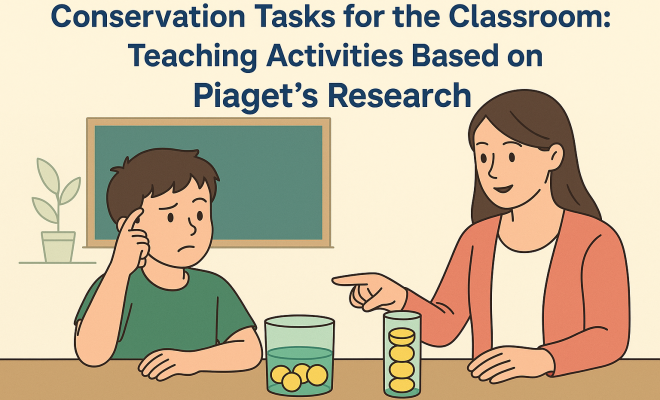
“Conservation Tasks for the Classroom: Teaching Activities Based on Piaget’s Research”
“`html
When it comes to understanding how children learn and develop, few names resonate as strongly as Jean Piaget. His groundbreaking work on cognitive development has not only shaped educational practices but also paved the way for innovative classroom conservation activities. These activities aim to deepen students’ understanding of conservation — a fundamental concept in mathematics and science — while also enhancing their cognitive skills. In this article, we’ll explore the essence of Piaget’s research, the significance of conservation tasks, and how educators can implement effective classroom conservation activities.
Understanding Piaget’s Theory of Cognitive Development
Jean Piaget, a Swiss psychologist, introduced a theory of cognitive development that revolutionized educational practices. His work emphasized that children are not simply smaller versions of adults; they think differently and go through distinct stages of cognitive development. Piaget identified four primary stages: sensorimotor, preoperational, concrete operational, and formal operational.
During the preoperational stage (ages 2 to 7), children begin to engage in symbolic play but struggle with understanding the concept of conservation. This is where conservation tasks come into play. According to Piaget, children in this stage may perceive objects differently based on their visual characteristics rather than understanding their underlying properties. For instance, if you pour the same amount of liquid from a short, wide glass into a tall, narrow one, a child may believe that the taller glass contains more liquid simply because it looks taller.
What Are Conservation Tasks?
Conservation tasks are activities designed to assess a child’s understanding of the principle that certain properties of objects remain unchanged despite changes in their form or appearance. These tasks often involve tangible materials that children can manipulate, allowing them to explore concepts of volume, mass, and number effectively.
Some well-known conservation tasks include:
- Liquid Conservation: This task involves pouring liquids between containers of different shapes and sizes.
- Mass Conservation: In this activity, children compare two identical balls of clay; one is flattened to see if they understand that the amount of clay remains the same.
- Number Conservation: This task asks children to determine if a group of objects remains the same when they are rearranged.
The Importance of Classroom Conservation Activities
Classroom conservation activities are not just about evaluating students’ understanding of mathematical concepts; they play a crucial role in the overall cognitive development of children. By engaging in these activities, students learn to think critically, solve problems, and develop a deeper understanding of the world around them.
Additionally, these tasks encourage hands-on learning, which has been shown to enhance retention and understanding. When students manipulate objects, they are more likely to comprehend abstract concepts because they can see and feel the differences in the materials they’re working with. This kinesthetic approach resonates well with many learners, making the classroom a more dynamic environment.
Implementing Conservation Tasks in the Classroom
Integrating conservation tasks into classroom activities doesn’t have to be complicated. Here are some practical steps to consider:
- Start Simple: Begin with basic tasks that require minimal setup. For example, use two identical cups and pour liquid from one to the other.
- Incorporate Group Work: Allow students to work in pairs or small groups. This collaboration can lead to discussions that deepen their understanding.
- Use Everyday Materials: Objects like blocks, clay, or even snacks can be used to demonstrate conservation concepts easily.
- Encourage Questions: Foster an environment where students feel comfortable asking questions and expressing their thoughts.
- Reflect on Activities: After completing a task, engage students in a discussion about what they observed and learned.
Examples of Effective Classroom Conservation Activities
Here are some specific classroom conservation activities that educators can implement, drawing on Piaget’s research:
1. Liquid Conservation Experiment
For this task, gather two identical containers and a third container of a different shape. Have students pour liquid from one of the identical containers into the differently shaped one. Ask them to predict which container holds more liquid and discuss their reasoning. After pouring, ask them whether the amount of liquid has changed and why they think so.
2. Clay Ball Comparison
Provide each child with a ball of clay. Have them shape one ball into a flat disc and then compare it to the original ball. Ask questions like, “Do you have the same amount of clay?” and “How do you know?” This activity challenges their understanding of mass conservation while allowing them to visualize the concept. (See: Jean Piaget's contributions to psychology.)
3. Coin Arrangement
Using a set of coins, arrange them in a line and then spread them out. Ask the students if the number of coins has changed. This task helps children understand how the arrangement of objects doesn’t change their quantity.
The Role of Technology in Conservation Tasks
With advancements in technology, educators now have access to various tools that can enhance classroom conservation activities. Digital apps and educational software can simulate conservation tasks and provide immediate feedback, allowing students to explore concepts at their own pace.
For instance, virtual manipulatives can be used to demonstrate conservation in a digital format. These tools can engage students who may struggle with traditional methods, making abstract concepts more accessible. Additionally, online platforms allow teachers to track student progress and adapt tasks to meet individual needs.
Current Relevance and Future Directions
As educational philosophies evolve, the importance of hands-on learning, as emphasized in Piaget’s research, remains relevant. Many modern curricula incorporate inquiry-based learning, where students explore concepts through direct experience. This approach aligns well with Piagetian principles, emphasizing the importance of active learning in cognitive development.
Moreover, as classrooms become increasingly diverse, incorporating various teaching methods, including visual, auditory, and kinesthetic learning styles, becomes essential. Classroom conservation activities can be adapted to meet these needs, ensuring that all students have the opportunity to grasp crucial concepts.
Challenges in Implementing Conservation Tasks
Despite the benefits of conservation tasks, teachers may face challenges when integrating them into their classrooms. Limited time, curriculum constraints, and varying student readiness can hinder the implementation of effective conservation activities.
To overcome these challenges, educators can focus on integrating conservation tasks into existing lessons rather than treating them as separate activities. This integration can make conservation tasks feel more organic and relevant to students’ overall learning experience.
Professional Development for Educators
To effectively implement classroom conservation activities, professional development is crucial. Workshops and training sessions on Piaget’s theory and the practical application of conservation tasks can empower teachers with the knowledge and skills they need.
Additionally, collaboration between educators can foster a sharing of ideas and resources. By exchanging successful strategies and insights, teachers can create a supportive community that enhances their effectiveness in the classroom.
Final Thoughts on Classroom Conservation Activities
Incorporating classroom conservation activities rooted in Piaget’s research can significantly enhance students’ cognitive development and understanding of key concepts. By actively engaging students in hands-on tasks, educators can foster critical thinking and problem-solving skills that will serve them well beyond the classroom.
Expanding Classroom Conservation Activities
Classroom conservation activities can be expanded in various ways to enhance learning further. Educators can implement thematic units that connect conservation tasks with broader interdisciplinary subjects. For instance, a science unit on water can include liquid conservation tasks alongside discussions on water conservation and environmental stewardship.
Furthermore, educators can involve families in classroom conservation efforts. Assigning simple tasks that students can perform at home, such as measuring liquid volumes using different containers or creating shapes with clay, encourages family engagement in the learning process. This not only reinforces concepts learned in class but also fosters a culture of curiosity and inquiry outside of school. (See: Understanding child development and learning.)
Statistics and Research Supporting Conservation Activities
Research indicates that engaging students in hands-on conservation activities significantly boosts their understanding of mathematical and scientific concepts. A study published in the Journal of Educational Psychology found that students who participated in hands-on learning activities scored 30% higher on standardized tests that measured conservation skills compared to their peers who only received traditional instruction.
Another study conducted by the American Educational Research Association found that students who engaged in inquiry-based learning, including conservation tasks, were more likely to develop problem-solving skills and demonstrate higher levels of critical thinking. This highlights the effectiveness of integrating these activities into the curriculum, as they not only teach essential concepts but also prepare students for real-world challenges.
Expert Perspectives on Conservation Activities
Leading educators and psychologists emphasize the impact of conservation activities on child development. Dr. Maria Montessori, a pioneer in educational reform, advocated for hands-on learning as a means to promote deeper understanding. She stated, “The hands are the instruments of man’s intelligence,” underscoring the importance of physical engagement in learning.
Additionally, educational psychologist Dr. Howard Gardner, known for his theory of multiple intelligences, noted that incorporating activities that appeal to various learning styles—such as kinesthetic tasks—can enhance students’ overall educational experience and help them excel in diverse subjects.
Frequently Asked Questions
What age group is best suited for conservation tasks?
Conservation tasks are most effective for children aged 4 to 8, as they are in the preoperational and early concrete operational stages of development. However, adaptations can be made for older students to reinforce concepts they may have learned previously.
How can I assess students’ understanding of conservation concepts?
Assessment can be conducted through observation during activities, asking open-ended questions, and giving simple quizzes related to the conservation tasks. Look for students’ ability to articulate their reasoning and demonstrate their understanding through manipulation of materials.
Can conservation activities be done at home?
Absolutely! Parents can easily recreate conservation activities at home using everyday objects. Simple tasks like sorting different types of pasta, measuring ingredients for a recipe, or comparing the weight of different fruits can all reinforce conservation concepts.
What are some additional resources to learn about conservation tasks?
There are many resources available, including educational websites, teacher forums, and books focused on hands-on learning strategies. Websites like TeacherVision and Education.com offer various lesson plans and activities that can be easily implemented in the classroom.
How can I adapt conservation tasks for students with learning disabilities?
Adaptations may include providing additional visual supports, using manipulatives that are easier to handle, or allowing more time for tasks. Collaborating with special education teachers can also provide insights into effective strategies that cater to diverse learning needs.
Broader Implications of Conservation Activities in Education
Classroom conservation activities not only enhance cognitive development but also have broader implications for education as a whole. By integrating these activities into the curriculum, educators are promoting essential skills such as critical thinking, problem-solving, and collaboration. As students engage in these tasks, they learn to communicate their ideas clearly and work together with their peers, laying the groundwork for future academic and social success.
In an increasingly interconnected world, fostering these skills is vital. According to a report by the World Economic Forum, skills like critical thinking, creativity, and collaboration will be among the most sought-after by employers in the coming decades. By embedding conservation activities into classroom routines, teachers are not just teaching students about mathematical concepts; they are equipping them with skills that will be invaluable in their future careers.
Real-World Applications of Conservation Skills
The skills developed through conservation activities extend beyond the classroom. Understanding conservation concepts can help students in various real-world situations. For instance, when cooking or baking, they utilize concepts of volume and mass, determining how much ingredient to add based on changes in state or shape. These skills are also relevant in fields such as engineering, environmental science, and economics, where understanding quantities and their relationships is crucial.
Consider the example of a student who engages in a conservation task involving measuring liquid. This task might spark an interest in science, ultimately leading to a career in environmental studies focused on water conservation. Real-world applications of these skills encourage students to see the relevance of their learning, making them more motivated and engaged in their education.
Encouraging a Culture of Conservation
As educators implement conservation activities, they can also encourage a culture of conservation within their schools. This can be achieved through initiatives that teach students the importance of conserving resources in their everyday lives. For example, incorporating lessons on recycling, energy conservation, and sustainable practices into the curriculum can build on the foundational concepts learned through conservation tasks.
Schools can also organize events like “Conservation Days” where students can participate in activities such as tree planting, clean-up drives, and workshops on reducing waste. Not only do these activities reinforce classroom learning, but they also foster a sense of community and responsibility among students, teaching them the importance of being stewards of the environment.
Future Innovations in Conservation Education
As education continues to evolve, there is potential for innovative approaches to conservation education. With advances in technology and educational research, new methods for teaching conservation concepts will likely emerge. For instance, augmented reality (AR) could allow students to visualize conservation tasks in a more interactive and engaging way, bridging the gap between abstract concepts and tangible experiences.
Furthermore, a shift toward a more globally connected classroom can also enhance conservation education. Collaborating with schools from different countries to share conservation practices and challenges can provide students with a broader perspective on the importance of conservation in a global context. This exposure will encourage them to think critically about the role they play in the world and how they can contribute to sustainable practices.
Conclusion
As we continue to adapt our teaching methods to meet the needs of diverse learners, it’s essential to remain grounded in research-backed practices. By embracing and implementing conservation tasks effectively, we can create a more enriching educational experience for all students, preparing them for a world that requires thoughtful, critical thinkers.
“`
Trending Now
- the complete explanation
- our breakdown of the relationship between object permanence and cognitive development in infants
- our breakdown of how adhd affects executive function and emotional regulation in high school
- The Role of Nonverbal Communication in Pragmatic Language Development
- our breakdown of how scaffolding supports english language learners in elementary school
Frequently Asked Questions
What are conservation tasks in education?
Conservation tasks are educational activities designed to evaluate a child's understanding that certain properties of objects remain constant despite changes in their appearance or form. These tasks help children grasp fundamental concepts in mathematics and science, allowing them to manipulate tangible materials and explore their properties.
How does Piaget's theory relate to conservation tasks?
Piaget's theory of cognitive development highlights that children progress through distinct stages, with the preoperational stage being critical for understanding conservation. During this stage, children may struggle to grasp that quantities remain unchanged despite visual alterations, making conservation tasks essential for their cognitive development.
Why are conservation tasks important for children?
Conservation tasks are vital because they help children develop critical thinking and reasoning skills. By engaging in these activities, students learn to understand that quantities, volume, and number are invariant, which lays the groundwork for more advanced mathematical and scientific concepts.
At what age do children understand conservation?
Children typically begin to understand conservation concepts around the age of 7, during the concrete operational stage of Piaget's cognitive development theory. Prior to this stage, children may not recognize that properties like volume or number remain constant despite changes in appearance.
What activities can teachers use to teach conservation?
Teachers can implement various hands-on activities to teach conservation, such as pouring liquids between different containers, using clay to reshape objects while keeping their mass constant, or exploring number conservation through counting exercises. These interactive tasks engage students and reinforce their understanding of conservation principles.
What’s your take on this? Share your thoughts in the comments below — we read every one.