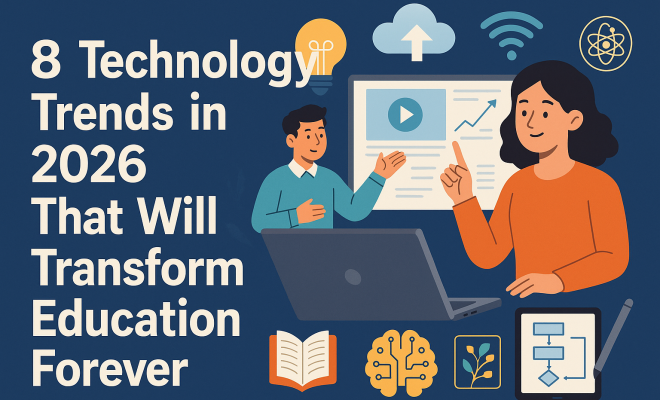
8 Tech Trends in 2026 Reshaping Education Forever
“`html
As we look ahead to 2026, the landscape of technology is set to change dramatically, especially in the realm of education. With advancements in artificial intelligence (AI), extended reality (XR), and quantum computing, the ways in which we learn and teach are being redefined. This article explores the top eight technology trends for 2026 and how they will shape the future of education, impacting how students, educators, and parents approach learning.
1. AI: The Ubiquitous Tutor
By 2026, artificial intelligence will have become an integral part of our daily lives, and education is no exception. AI-driven tutoring systems will be commonplace, providing personalized assistance to students at all levels. These systems will analyze individual learning styles, strengths, and weaknesses to tailor educational content accordingly. Imagine a scenario where students have on-demand access to a tutor who knows their learning preferences and adapts to their pace.
This shift toward AI in education comes with significant benefits. Students can receive immediate feedback and support, helping them to grasp challenging concepts more effectively. Moreover, teachers will be able to focus on facilitating discussions and providing emotional support rather than getting bogged down with administrative tasks or grading. The integration of AI will allow educators to dedicate more time to mentorship and personalized instruction.
Research indicates that AI-based platforms can significantly improve student performance. For example, a study from the Stanford Graduate School of Education found that students using AI tutoring systems scored on average 22% higher on standardized tests compared to those who did not use such systems. This trend is expected to grow as more institutions adopt AI solutions, creating a more tailored approach to education.
2. Extended Reality (XR): Learning Beyond the Classroom
Extended reality, which encompasses both virtual reality (VR) and augmented reality (AR), is set to revolutionize education in 2026. XR technologies will create immersive learning experiences that allow students to explore complex subjects in ways that were previously unimaginable. For instance, students studying biology can take virtual field trips to the human body, observing processes from the inside out.
These immersive experiences enhance engagement and retention, making learning not just informative but also enjoyable. Schools that adopt XR technology will likely see improved student outcomes as learners become more actively involved in their education. Parents and educators alike will need to understand how to integrate these technologies effectively into curriculums to maximize their potential.
An illustrative example can be seen in the way that universities like Stanford and MIT are using XR for subjects like architecture and history. Students can walk through virtual reconstructions of ancient ruins or explore the inner workings of complex structures, providing a depth of understanding that traditional methods cannot achieve. Additionally, statistics from a 2023 report by the New Media Consortium indicate that 78% of educators believe XR could enhance learning outcomes in various subjects.
3. Quantum Computing: A New Era of Problem-Solving
Quantum computing represents a profound shift in computational capabilities that can have far-reaching implications for education. By 2026, advancements in this technology could enable the rapid processing of vast amounts of data, paving the way for breakthroughs in various fields, including medicine, engineering, and climate science. Educational institutions will need to adapt their curriculums to include quantum computing fundamentals, preparing students for the jobs of the future.
Understanding quantum principles and algorithms will become essential for students pursuing STEM careers. As quantum computing becomes more mainstream, educational programs will need to incorporate hands-on experiences and projects that allow students to engage with this cutting-edge technology. This will not only enhance their skill set but also position them as innovators in an evolving job market.
To illustrate the potential of quantum computing in education, consider its application in solving complex problems that classical computers struggle with. For instance, quantum algorithms can optimize supply chains or model complex biological processes, offering students real-world applications of their studies. By 2026, universities may offer specialized courses in quantum programming, ensuring students are well-equipped for emerging career paths in this domain.
4. Data-Driven Education: Personalizing the Learning Experience
The use of big data in education will continue to grow, with institutions leveraging analytics to improve student outcomes. By 2026, schools will harness the power of data to track individual student progress, identify trends, and make informed decisions about instructional strategies. This data-driven approach will enable educators to create personalized learning pathways for each student. (See: AI's role in education.)
With advanced analytics, teachers will be equipped to identify at-risk students early on and implement interventions tailored to their specific needs. This proactive approach can help close achievement gaps, ensuring that every student receives the support required to succeed. For parents, understanding how data influences their child’s education will be crucial in advocating for the best learning opportunities.
Additionally, schools will begin using predictive analytics to forecast student success and dropout rates. A study by the Bill & Melinda Gates Foundation reports that institutions implementing predictive models have seen a decrease in dropout rates by up to 30%. Data-driven education will not only personalize learning but also foster an environment where students can thrive through timely support and resources.
5. Remote and Hybrid Learning: The New Norm
The COVID-19 pandemic accelerated the shift towards remote and hybrid learning models, and this trend is likely to continue into 2026. As technology becomes more integrated into education, schools will adopt flexible learning environments that cater to diverse student needs. This will empower students to learn at their own pace, whether attending classes in person or virtually.
Remote and hybrid learning will also promote inclusivity, allowing students with disabilities or those living in remote areas to access quality education. Educators will need to develop skills in online teaching and create engaging, interactive content that keeps students motivated. Parents will also play a vital role in supporting their children’s learning journey, ensuring they have the resources they need to thrive in this new educational landscape.
According to a report from the International Society for Technology in Education (ISTE), 74% of educators believe that hybrid learning enhances student engagement. As schools design curriculums that blend in-person and online learning modules, students will benefit from varied instructional strategies that cater to different learning styles. This flexibility will redefine what education looks like, making it more accessible than ever.
6. Blockchain: Ensuring Security in Education
Blockchain technology is not only for cryptocurrencies; its potential extends to education as well. By 2026, blockchain could be used to secure student records, credentials, and achievements, providing a tamper-proof way to verify qualifications. This transparency will benefit educational institutions, employers, and students, simplifying the process of credential verification.
With blockchain, students can have full control over their educational records, allowing them to share their qualifications easily with potential employers or educational institutions. This shift towards decentralized credentialing systems will enhance trust and security in the education sector, making it crucial for schools to explore blockchain applications as part of their administrative processes.
Real-world applications of blockchain in education are gaining traction, with institutions like the Massachusetts Institute of Technology (MIT) already issuing digital diplomas using blockchain technology. This initiative not only verifies the authenticity of credentials but also allows graduates to share their accomplishments more efficiently. By 2026, we may see widespread adoption of such systems, fundamentally changing how educational achievements are recognized.
7. Social-Emotional Learning (SEL): Technology as a Support System
As technology evolves, so does the understanding of the importance of social-emotional learning (SEL) in education. By 2026, schools will increasingly integrate SEL into their curriculums, recognizing its role in fostering resilience, empathy, and interpersonal skills among students. Technology can play a significant role in promoting SEL by providing digital tools that facilitate emotional well-being.
Online platforms that offer mental health resources, peer support systems, and SEL-focused programs will become essential components of educational institutions. Educators will be expected to incorporate SEL practices into their teaching, ensuring that students develop both academically and emotionally. This holistic approach to education will prepare students for the challenges of the future, emphasizing the importance of emotional intelligence in the workplace.
Data from the Collaborative for Academic, Social, and Emotional Learning (CASEL) shows that integrating SEL into school curriculums can lead to improved academic performance by 11%. As educators embrace technology to track and support students’ emotional health, we can expect SEL initiatives to become a priority, aligning with the growing recognition of mental health in education.
8. Career-Ready Skills: Bridging the Gap Between Education and Employment
As technology trends in 2026 unfold, there will be a significant emphasis on equipping students with career-ready skills. Schools will need to adapt their curriculums to focus on critical thinking, creativity, collaboration, and digital literacy. These skills are essential for success in an increasingly automated and technology-driven job market.
Partnerships between educational institutions and industry leaders will become crucial in ensuring that students are prepared for the workforce. Internships, mentorship programs, and real-world projects will bridge the gap between education and employment, providing students with valuable experience and insight into their future careers. Parents and educators must work together to advocate for these opportunities, helping students develop the skills that will matter most in the years to come. (See: AI in personalized learning.)
Statistics show that employers increasingly seek candidates with soft skills alongside technical abilities. A 2023 report from LinkedIn revealed that 92% of talent professionals consider soft skills just as important, if not more so, than technical skills. Schools that prioritize developing both will prepare their students not just for jobs, but for meaningful careers.
Future Technology Trends: Anticipating Changes Beyond 2026
While this article has highlighted the critical technology trends for 2026, it’s also important to think about what comes next. Innovations such as biotechnology, advanced robotics, and even further developments in AI will likely continue to shape the educational landscape. For instance, biotechnology could personalize learning experiences even more through genomics, tailoring educational content to students’ genetic predispositions.
Moreover, as we look to the future, we might see the emergence of more sophisticated analytical tools that can predict learning behaviors and outcomes based on historical data. This could create an even stronger feedback loop, allowing educators to adjust their teaching methods in real time based on student interactions with content across multiple platforms.
9. The Role of 5G in Education
The rollout of 5G networks is expected to revolutionize the way we connect to the internet, and education will be one of the primary beneficiaries. With faster internet speeds and lower latency, 5G will enable seamless access to online resources and applications, enhancing the learning experience. Imagine classrooms where students can download large educational materials in seconds or engage in high-quality video calls without interruptions.
5G will also support advanced technologies like augmented reality and virtual reality. For remote students, this means more interactive and engaging lessons that can be experienced in real time, regardless of their physical location. Schools that invest in 5G infrastructure will be at an advantage, providing enhanced learning environments that are responsive to the needs of modern learners.
Statistics from the Global System for Mobile Communications Association (GSMA) suggest that by 2026, 5G technology could connect over 1.5 billion smartphones globally. This connectivity will empower students in diverse geographical regions, bridging educational gaps and ensuring equitable access to information and learning opportunities.
10. Adaptive Learning Technologies
Adaptive learning technologies are designed to personalize education based on individual student performance. By 2026, we can expect these systems to become increasingly sophisticated, utilizing AI to adjust the difficulty of tasks and the pace of learning according to each student’s needs. This personalized approach will help address learning gaps and reinforce concepts that students struggle with.
Schools will likely implement adaptive learning platforms that provide real-time feedback to students, allowing them to understand their progress and areas needing improvement. For example, platforms could analyze a student’s response patterns to modify future exercises, ensuring that each learner is challenged appropriately.
Studies suggest that adaptive learning can significantly boost student engagement and performance. A report from McKinsey & Company indicates that students using adaptive learning technologies improved their scores by an average of 30%. As more schools adopt these tools, the potential for personalized education will expand, ultimately shaping a more effective learning environment.
FAQs: Understanding Technology Trends in Education
What are the most significant technology trends in education for 2026?
The key trends include AI-driven tutoring, extended reality for immersive learning, quantum computing in STEM education, data-driven personalized learning, remote and hybrid learning models, blockchain for credential security, social-emotional learning integration, a focus on career-ready skills, the role of 5G, and adaptive learning technologies. (See: Future of AI in classrooms.)
How will AI change the role of teachers in the classroom?
AI will allow teachers to shift their focus from administrative tasks to mentorship and personalized instruction. With AI handling routine assessments and feedback, teachers can spend more time facilitating discussions and addressing individual student needs.
What impact will XR have on student engagement?
Extended reality (XR) is expected to significantly enhance student engagement by providing immersive and interactive learning experiences. These technologies allow students to explore subjects in a hands-on way, making learning both fun and effective.
Why is data-driven education important?
Data-driven education enables personalized learning experiences, allowing educators to identify students who may need additional support. By leveraging analytics, schools can track progress and adapt instructional methods to meet individual learning styles and needs.
Is remote learning here to stay?
Yes, remote and hybrid learning models are likely to remain a key component of education. They provide flexibility and inclusivity, enabling students from diverse backgrounds to access quality education regardless of their circumstances.
How can parents support their children in a technology-driven education landscape?
Parents can play an essential role by staying informed about technology trends, advocating for necessary resources at schools, and providing a supportive home environment that encourages exploration and learning through technology.
What is the significance of 5G in education?
5G technology will enhance internet access, enabling faster downloads and smoother streaming for educational content. It will facilitate the use of advanced technologies like AR and VR, creating more engaging and interactive learning experiences for students.
How can adaptive learning technologies improve education?
Adaptive learning technologies tailor educational content to individual student needs, adjusting the difficulty and pace based on performance. This personalized approach can help reinforce learning and address gaps, enhancing overall student engagement and success.
As we approach 2026, staying informed about these technology trends is essential for parents, educators, and students. The landscape of education is rapidly evolving, and understanding how these innovations will impact learning can help ensure that everyone is prepared for the changes ahead. Embracing these trends will not only enhance educational experiences but also equip the next generation with the skills they need to thrive in a tech-driven world.
“`
Trending Now
Frequently Asked Questions
What are the top technology trends in education for 2026?
The top technology trends in education for 2026 include AI-driven tutoring systems, extended reality (XR) for immersive learning, quantum computing, personalized learning platforms, and enhanced data analytics. These advancements aim to improve student engagement, provide tailored educational experiences, and support educators in their teaching methods.
How will AI impact education by 2026?
By 2026, AI is expected to revolutionize education by providing personalized tutoring experiences for students. AI systems will analyze individual learning styles and adapt educational content accordingly, allowing for immediate feedback and support. This will enable teachers to focus more on mentorship and less on administrative tasks.
What is extended reality (XR) and how will it be used in education?
Extended reality (XR) includes virtual reality (VR) and augmented reality (AR), which will be utilized in education to create immersive learning experiences. By 2026, XR technologies will allow students to interact with complex concepts in a virtual environment, enhancing engagement and understanding beyond traditional classroom settings.
What benefits does AI tutoring provide to students?
AI tutoring systems offer significant benefits, including personalized learning experiences tailored to individual strengths and weaknesses. Students receive immediate feedback, which helps them grasp challenging concepts more effectively. Research indicates that students using AI tutoring score higher on tests compared to those who do not.
How will technology change the role of teachers in 2026?
In 2026, technology will shift the role of teachers from traditional instruction to facilitators of learning. With AI handling administrative tasks and providing personalized support to students, educators can focus more on mentorship, emotional support, and facilitating discussions, leading to a more engaging learning environment.
What’s your take on this? Share your thoughts in the comments below — we read every one.