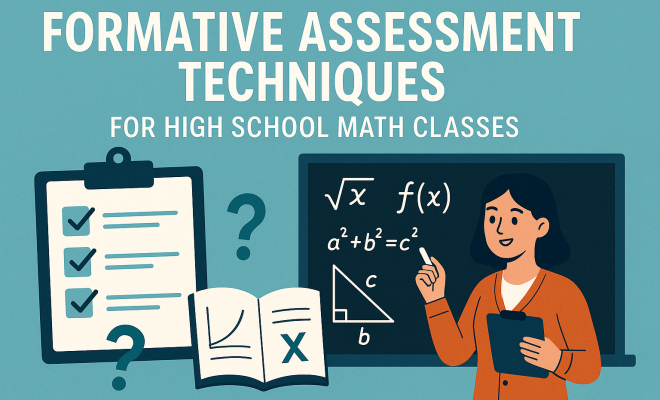
Formative Assessment Techniques for High School Math Classes
“`html
In the realm of education, particularly in high school math, formative assessments have gained significant attention for their transformative potential. These assessments are not merely tests; they serve as diagnostic tools to gauge student understanding, inform instructional practices, and ultimately enhance learning outcomes. This article delves into effective formative assessment techniques tailored for high school math classes, shedding light on their importance, practical applications, and current relevance.
Understanding Formative Assessment
Formative assessment refers to a variety of methods teachers use to evaluate student comprehension, learning needs, and academic progress during a lesson or unit. Unlike summative assessments, which evaluate student learning at the end of an instructional unit by comparing it against some standard or benchmark, formative assessments are ongoing and provide immediate feedback. This immediate feedback loop allows teachers to adjust their instructional strategies and helps students identify their strengths and areas for improvement.
The Role of Formative Assessment in High School Math
In high school math, where concepts can become increasingly abstract and challenging, formative assessments play a crucial role. They not only aid in understanding complex mathematical ideas but also nurture a growth mindset among students. Students learn that setbacks are part of the learning process and that they can improve through effort and practice.
Moreover, formative assessments can help in building confidence. As students receive timely feedback and see their progress, they are likely to become more engaged and motivated in their learning. For math educators, fostering a positive learning environment where mistakes are viewed as opportunities for growth is vital in promoting deeper mathematical thinking.
1. The Power of Questioning
Effective questioning is one of the simplest yet most powerful formative assessment techniques. By posing open-ended, thought-provoking questions, teachers can stimulate critical thinking and gauge student comprehension. For instance, instead of asking, “What is the formula for the area of a circle?” a teacher might ask, “How would you explain the concept of area to a classmate using a circle as an example?” This approach encourages students to articulate their understanding and reasoning.
Additionally, questioning can be tailored to different levels of difficulty, allowing teachers to assess a wide range of student abilities. Incorporating strategies like wait time—allowing students to think and formulate their answers before responding—can also enhance the quality of student contributions.
2. Exit Tickets
Exit tickets are a quick and effective formative assessment tool used at the end of a lesson. Students write down what they learned, questions they still have, or problems they found particularly challenging. This method allows teachers to assess individual understanding and adjust future lessons based on student feedback.
For example, a math teacher might ask students to solve a specific problem related to the day’s lesson and submit their solutions on a slip of paper as they exit. The teacher can then analyze these responses to identify common misconceptions or areas that may need further clarification.
3. Peer Assessment
Peer assessment encourages collaboration and enhances students’ learning experiences. In high school math, students can work in pairs or small groups to assess each other’s work, providing constructive feedback and learning from one another’s approaches to problem-solving. This not only strengthens their understanding of mathematical concepts but also builds essential social skills.
When implementing peer assessment, it’s crucial to provide students with clear guidelines and criteria for evaluation. This ensures that feedback is constructive and focused on learning outcomes. Teachers can facilitate this process by modeling the assessment criteria and demonstrating how to provide feedback effectively.
4. Concept Mapping
Concept mapping is a visual representation of the relationships between different mathematical concepts. This technique allows students to organize their knowledge and demonstrate their understanding of how various ideas connect. In high school math, concept maps can be particularly useful for reviewing topics such as functions, geometry, or algebraic expressions.
Teachers can use concept mapping as a formative assessment tool by having students create maps after a lesson or unit. This not only provides insight into student comprehension but also encourages active engagement with the material. Additionally, reviewing these maps can help teachers identify misconceptions or gaps in understanding that need to be addressed.
5. Digital Tools and Interactive Platforms
In our increasingly digital world, incorporating technology into formative assessments can enhance the learning experience. Various platforms and tools, like Kahoot!, Quizizz, and Google Forms, allow teachers to create interactive quizzes and polls that can provide immediate feedback to students. (See: U.S. Department of Education research.)
For instance, a math teacher can use Kahoot! to create a fun, competitive quiz on polynomial functions. As students answer questions, the teacher receives real-time data on student performance, enabling quick adjustments to instruction based on the results. This immediate feedback is invaluable in high school math, where understanding foundational concepts is key to tackling more advanced material.
6. Think-Pair-Share
The Think-Pair-Share strategy is a collaborative learning technique that encourages students to think critically about a problem, discuss their ideas with a partner, and then share their findings with the larger group. This method is particularly effective in math classes, as it gives students the opportunity to verbalize their thought processes and learn from each other.
For example, a teacher might pose a complex math problem and ask students to take a moment to think about their approach before discussing it with a partner. After discussing, pairs can share their strategies with the class. This not only promotes deeper understanding but also helps students develop communication skills that are essential in mathematics.
7. Formative Feedback
Providing formative feedback is perhaps one of the most critical aspects of assessment in education. Feedback should be timely, specific, and constructive, focusing on how students can improve their understanding and performance. In high school math, feedback should relate directly to the learning objectives and guide students on how to enhance their skills.
A teacher might use a rubric to provide detailed feedback on a math assignment, highlighting areas where the student excelled and others needing improvement. This targeted feedback empowers students to take ownership of their learning and encourages them to seek help where necessary.
8. Performance Tasks
Performance tasks are activities that require students to apply their mathematical knowledge in real-world scenarios. These tasks go beyond traditional problem-solving; they challenge students to demonstrate their understanding through projects, presentations, or practical applications. For example, students could be tasked with budgeting for a school event, requiring them to use their math skills to calculate costs and make financial decisions.
By implementing performance tasks, teachers can assess not only students’ mathematical abilities but also their critical thinking and problem-solving skills. Performance tasks provide a more holistic view of student learning and can be incredibly engaging for high school math students.
9. Collaborative Group Work
Collaborative group work fosters an environment of shared learning and accountability. In high school math, students can work together on problem sets, projects, or investigations, allowing them to leverage individual strengths and support each other’s learning. Group discussions and collaboration can lead to richer understanding and retention of mathematical concepts.
Teachers can facilitate group work by assigning specific roles within groups (e.g., facilitator, recorder, reporter) to ensure all students are actively participating. By observing group interactions, teachers gain insights into each student’s understanding and can intervene when necessary to guide learning.
10. The Importance of Reflection
Finally, encouraging students to reflect on their learning processes is crucial for developing lifelong learners. In high school math, reflection can take many forms, including journals, self-assessments, or class discussions. Students should be prompted to consider what strategies worked for them, what challenges they faced, and how they can improve moving forward.
Teachers can facilitate reflection by asking targeted questions such as, “What did you find most challenging about today’s lesson?” or “How can you apply what you learned to future problems?” This process not only reinforces learning but also cultivates metacognitive skills that are essential in mathematics and beyond.
Current Relevance and the Future of Formative Assessment in High School Math
As education continues to evolve, the importance of formative assessment in high school math is becoming more pronounced. With the integration of technology, teachers have access to a plethora of tools and resources to implement these assessment techniques effectively. Furthermore, there is a growing recognition of the need for adaptive learning environments that cater to diverse student needs.
Incorporating formative assessment techniques not only enhances student understanding but also encourages a culture of continuous improvement and resilience. As we look to the future, educators must remain committed to refining their assessment methods, ensuring they align with student learning goals and the ever-changing landscape of mathematics education.
In summary, formative assessment high school math is not just about evaluating student performance; it’s about fostering a dynamic learning environment that supports growth, understanding, and collaboration. By applying these various techniques, teachers can empower students to take charge of their learning and develop the skills necessary to succeed both in math and in life. (See: National Institutes of Health on learning.)
11. The Impact of Formative Assessment on Student Achievement
Research has shown that formative assessments can significantly impact student achievement in mathematics. A meta-analysis conducted by Hattie and Timperley (2007) indicates that feedback from formative assessments can lead to substantial gains in student performance. For instance, schools that have adopted regular formative assessments often see a measurable increase in test scores and overall student engagement in math.
Statistics reveal that students who receive regular formative feedback tend to outperform their peers in summative assessments. A study by Black and Wiliam (1998) highlighted that formative assessment techniques can lead to an average improvement of around 20 percentile points in student achievement. This evidence emphasizes the necessity of integrating formative assessment practices into high school math curricula.
12. Case Studies of Effective Formative Assessment Practices
Looking at successful implementations of formative assessment can provide valuable insights for educators. For example, a high school in California adopted a comprehensive formative assessment framework that included weekly quizzes, peer assessments, and reflective journals. The result was a 15% increase in students’ overall math proficiency scores within one academic year.
Another case study from a school district in Texas illustrated the importance of utilizing technology in formative assessments. By integrating platforms like Google Classroom for real-time feedback, teachers were able to identify and address learning gaps instantly. This led to a noteworthy improvement in student engagement, as students felt more connected and invested in their learning journey.
13. Expert Opinions on Formative Assessment
Experts in education often emphasize the need for formative assessment in developing critical thinking skills in students. Dr. Dylan Wiliam, a prominent researcher in assessment practices, asserts that formative assessments are essential for understanding where students are in their learning journey. He states, “Without assessment, there is no real learning.” His perspective underlines the importance of continuous assessment to foster a deeper understanding of mathematical concepts among high school students.
Additionally, Dr. Susan M. Brookhart, an authority on formative assessment, stresses that the feedback derived from these assessments is pivotal in shaping students’ learning experiences. She argues that effective formative assessment not only informs instruction but also empowers students to take ownership of their learning process, thus enhancing motivation and engagement.
14. Comparing Formative and Summative Assessment in High School Math
Understanding the differences between formative and summative assessments is crucial for educators. While formative assessments focus on the learning process and provide ongoing feedback, summative assessments evaluate what students have learned at the end of a unit or course. Both types of assessment serve important purposes in education.
For example, a formative assessment might involve a quiz or a class discussion that helps the teacher gauge student understanding during a unit on quadratic functions. In contrast, a summative assessment might consist of a final exam that tests students’ mastery of all the concepts covered in the unit. By balancing both types of assessments, teachers can create a more comprehensive evaluation of student learning.
15. Frequently Asked Questions About Formative Assessment in High School Math
What are some simple formative assessment techniques I can use in my classroom?
Some effective formative assessment techniques include exit tickets, think-pair-share, peer assessments, and quick quizzes. Each of these methods allows you to gauge student understanding and adjust your teaching accordingly.
How often should I use formative assessments?
It’s beneficial to incorporate formative assessments regularly throughout your lessons. Daily or weekly assessments can help you stay informed about student understanding and guide your instructional decisions.
Can formative assessments be used for all math topics?
Absolutely! Formative assessments can be adapted to any math topic, whether it’s algebra, geometry, statistics, or calculus. The key is to tailor the assessments to match the concepts being taught.
How can I ensure that my students take formative assessments seriously?
Creating a positive classroom environment where feedback is viewed as a tool for improvement can help students appreciate formative assessments. Make sure students understand that these assessments are for their benefit and are not graded harshly.
What role does technology play in formative assessment?
Technology can significantly enhance formative assessment by providing tools for immediate feedback and interactive learning experiences. Platforms like Google Forms, Kahoot!, and others make it easy to gather data and engage students efficiently. (See: ScienceDirect on formative assessment.)
Can formative assessments help with students who struggle in math?
Yes, formative assessments can be particularly helpful for struggling students. By identifying specific areas of difficulty, teachers can provide targeted support and interventions, helping those students build confidence and improve their understanding of the material.
How can I incorporate student feedback in formative assessments?
Encouraging students to provide feedback on the assessments can be invaluable. Ask them what worked for them, what didn’t, and what they found particularly helpful. This information can guide you in adjusting your teaching methods and assessment practices.
16. The Connection Between Formative Assessment and Differentiated Instruction
Formative assessment plays a pivotal role in differentiated instruction, which is crucial for meeting the diverse needs of high school math students. By utilizing formative assessments, teachers can identify varying levels of readiness, interest, and learning profiles among their students. This information allows educators to tailor their teaching strategies and resources to meet individual learning needs effectively.
For instance, a teacher might use formative assessments to determine which students grasped the concept of linear equations and which ones needed additional support through alternative methods or resources. This might include small group instruction, one-on-one tutoring, or providing enrichment tasks for advanced learners.
Ultimately, the goal of integrating formative assessment into differentiated instruction is to ensure that each student has equal access to learning opportunities and is able to progress at their own pace.
17. The Importance of Building a Feedback Culture in Math Class
Establishing a feedback culture within the math classroom is essential for effective formative assessment practices. When students feel comfortable giving and receiving feedback, they are more likely to engage meaningfully with the learning process. Educators can foster this culture by modeling constructive feedback, encouraging peer-to-peer reviews, and emphasizing the value of continuous improvement.
For example, a teacher might create a classroom norm where students are expected to offer feedback on classmates’ work using specific criteria. This not only helps students become more adept at self-assessment but also enhances their ability to communicate mathematically.
Furthermore, regular feedback sessions can help students set and track personal learning goals, establishing a sense of ownership over their mathematical journey. Teachers can guide students in reflecting on feedback by asking them to articulate how they plan to act on the input received.
18. Final Thoughts on Formative Assessment in High School Math
As teachers continue to explore innovative instructional methods, the significance of formative assessment in high school math cannot be overstated. It is an essential component of effective teaching that not only identifies student needs but also fosters resilience and motivation among learners. By implementing a variety of strategies, educators can create a rich, supportive environment that prioritizes student growth and understanding. Ultimately, the goal is to equip high school students with the skills and confidence they need to thrive in mathematics and beyond.
“`
Trending Now
Frequently Asked Questions
What are formative assessment techniques in high school math?
Formative assessment techniques in high school math include methods like questioning, peer assessments, quizzes, and interactive activities. These techniques provide ongoing feedback, allowing teachers to adjust instruction based on student understanding and helping students identify their strengths and weaknesses.
Why are formative assessments important in math education?
Formative assessments are crucial in math education as they help gauge student comprehension in real-time, inform teaching strategies, and enhance learning outcomes. They encourage a growth mindset by allowing students to learn from mistakes and improve their understanding of complex concepts.
How can teachers implement formative assessments in math classes?
Teachers can implement formative assessments in math classes through various strategies such as using exit tickets, conducting quick quizzes, facilitating group discussions, and incorporating technology tools for instant feedback. These methods encourage engagement and allow for immediate instructional adjustments.
What is the difference between formative and summative assessments?
The main difference between formative and summative assessments is their timing and purpose. Formative assessments are ongoing evaluations that provide immediate feedback during the learning process, while summative assessments evaluate student learning at the end of an instructional unit against a standard.
How do formative assessments promote a growth mindset in students?
Formative assessments promote a growth mindset by helping students understand that setbacks are part of learning. With timely feedback and opportunities for improvement, students learn that effort leads to progress, fostering resilience and a positive attitude toward challenges in math.
What did we miss? Let us know in the comments and join the conversation.