Bloom’s Taxonomy Explained: Guide to Higher-Order Thinking
“`html
Understanding how students learn best is at the heart of effective teaching. One of the most reliable frameworks to guide educators in this quest is Bloom’s Taxonomy, a hierarchical model that categorizes educational goals and objectives. Developed by Benjamin Bloom and his collaborators in 1956, this taxonomy serves as a crucial tool in designing educational experiences that foster higher-order thinking skills.
1. The Origins of Bloom’s Taxonomy
Bloom’s Taxonomy was first introduced in 1956, aimed at providing a structured approach to education that focuses on cognitive development. The original framework consisted of six levels: Knowledge, Comprehension, Application, Analysis, Synthesis, and Evaluation. Each level represented a different type of cognitive task, with Knowledge being the most basic, and Evaluation being the most complex.
This framework was not just an academic exercise; it responded to a growing need for a systematic way to describe educational outcomes. Bloom’s work laid the groundwork for a more comprehensive understanding of learning and pedagogy, which has influenced teaching practices for decades. In the early 2000s, a revised version of the taxonomy was introduced by a group of cognitive psychologists, which updated the categories and language, reflecting changes in educational theory and practice.
2. The Revised Bloom’s Taxonomy
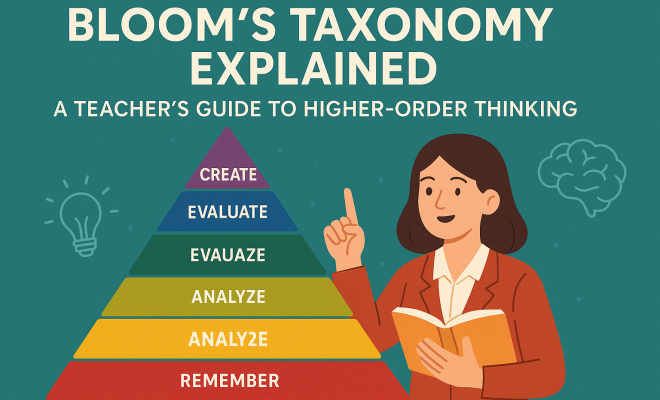
The revised version of Bloom’s Taxonomy features a more dynamic approach to learning and includes two dimensions: the Knowledge Dimension and the Cognitive Process Dimension. The Knowledge Dimension encompasses four types of knowledge: factual, conceptual, procedural, and metacognitive. Meanwhile, the Cognitive Process Dimension consists of six levels: Remember, Understand, Apply, Analyze, Evaluate, and Create. Notably, ‘Create’ replaces ‘Synthesis’ as the highest order of thinking, emphasizing the importance of innovation in the learning process.
This shift reflects a broader understanding of how students learn and interact with information in today’s digital age. It encourages teachers to go beyond rote memorization, fostering creativity and critical thinking skills in their students. Understanding these levels helps educators create lessons that not only engage students but also develop their cognitive abilities.
3. Understanding Higher-Order Thinking
At the core of Bloom’s Taxonomy is the concept of higher-order thinking (HOT), which involves analyzing, evaluating, and creating rather than merely remembering or understanding information. These skills are crucial for students as they prepare for a world that increasingly values critical analysis and innovation.
Higher-order thinking skills enable students to transfer their knowledge to new situations, solve complex problems, and make informed decisions. For example, a student who can evaluate the credibility of a source is better equipped to navigate the vast amount of information available online. Educators play a pivotal role in nurturing these skills by designing activities that challenge students to think deeply and critically.
4. Practical Strategies for Incorporating Bloom’s Taxonomy
Integrating Bloom’s Taxonomy into your teaching can be straightforward if you adopt practical strategies. Start by aligning your learning objectives with the different levels of the taxonomy. For instance, you could create lesson plans that begin with lower-order thinking tasks, such as recalling facts, and gradually progress to higher-order tasks that require analysis and creation.
Consider using questioning techniques that stimulate higher-order thinking. Instead of asking, “What is the main idea of this text?” try asking, “How would you apply this idea in a real-world situation?” Additionally, project-based learning can be an effective way to engage students in higher-order thinking, as it typically requires them to analyze information, collaborate, and create a final product.
5. Assessment Techniques Aligned with Bloom’s Taxonomy
Assessment is a critical component of the educational process, and aligning your assessments with Bloom’s Taxonomy can make them more meaningful. Lower-order assessments might include multiple-choice tests or short answer questions that focus on remembering and understanding. In contrast, higher-order assessments could involve essays, presentations, or projects that require students to analyze data or create new solutions.
Rubrics based on Bloom’s levels can help clarify expectations for students and provide a structured way to evaluate their performance. For instance, a project rubric might outline criteria for analysis, creativity, and presentation, enabling students to self-assess their work against higher-order thinking criteria. (See: Bloom's Taxonomy on Wikipedia.)
6. Bloom’s Taxonomy in the Digital Age
As education continues to evolve, so too does the application of Bloom’s Taxonomy in the digital age. The advent of technology has transformed the way students access information and interact with content. Online learning environments, digital tools, and social media provide new avenues for higher-order thinking.
Educators can leverage technology to create interactive learning experiences that foster critical thinking. For example, using digital platforms to conduct simulations or collaborative projects encourages students to analyze scenarios, evaluate their implications, and create original solutions. Additionally, the ability to collaborate online expands opportunities for peer feedback, pushing students to refine their ideas through evaluation and critique.
7. Real-World Applications of Bloom’s Taxonomy
Bloom’s Taxonomy extends beyond the classroom; its principles can be applied in various real-world contexts. For instance, in the business world, professionals often use higher-order thinking skills to assess market trends, evaluate strategic options, and innovate solutions to challenges. Understanding how to analyze information critically is just as vital in the workplace as it is in educational settings.
Moreover, educators can incorporate case studies and practical scenarios into their lessons, allowing students to apply higher-order thinking skills to realistic problems. This not only prepares them for future careers but also helps them become informed citizens capable of making decisions based on thorough analysis and evaluation.
8. Challenges in Implementing Bloom’s Taxonomy
Despite its many advantages, implementing Bloom’s Taxonomy can come with challenges. One major hurdle is the tendency to revert to traditional teaching methods focused on lower-order thinking, primarily due to standardized testing pressures. Teachers may feel compelled to teach to the test, emphasizing memorization over critical thinking.
Additionally, educators may struggle with the time constraints often present in standardized curricula, which can limit opportunities for higher-order thinking activities. However, overcoming these challenges is essential. Professional development and collaboration among educators can provide support and strategies for integrating Bloom’s Taxonomy effectively, ensuring that students develop the critical skills they need.
9. The Future of Bloom’s Taxonomy
As educational paradigms continue to shift, the relevance of Bloom’s Taxonomy will likely persist. With the increasing emphasis on critical thinking and problem-solving skills, this framework provides a solid foundation for educators aiming to prepare students for a rapidly changing world.
Looking ahead, it’s crucial for educators to remain adaptable, embracing new teaching methods and technologies while maintaining the core principles of Bloom’s Taxonomy. By doing so, they can cultivate a generation of learners equipped not only with knowledge but also with the skills necessary to thrive in their personal and professional lives.
10. Expert Perspectives on Bloom’s Taxonomy
To deepen our understanding of Bloom’s Taxonomy, it can be helpful to consider insights from educational experts. Dr. Patricia Anderson, an educational psychologist, notes that “Bloom’s Taxonomy serves as a guide for educators to create a scaffolded learning environment. It helps in designing curriculums that not only aim for knowledge acquisition but also for skill mastery.”
In addition, Dr. John Hattie, known for his research on visible learning, emphasizes that the successful application of Bloom’s Taxonomy requires clarity in what constitutes higher-order thinking. He suggests that “students benefit when teachers explicitly outline the levels of thinking required in each task, helping them understand how to progress from one level to another.”
These expert perspectives highlight the importance of intentionality in applying Bloom’s Taxonomy in classroom settings, ensuring that students are not only engaged but also able to develop the necessary skills for future challenges.
11. Statistics on Higher-Order Thinking in Education
Research supports the effectiveness of fostering higher-order thinking skills in education. A study by the Organization for Economic Cooperation and Development (OECD) found that students who engage in higher-order thinking tasks score up to 20% higher in problem-solving assessments compared to their peers who focus on lower-order tasks. (See: Bloom's Taxonomy on ScienceDirect.)
Additionally, the National Center for Education Statistics (NCES) reports that schools implementing Bloom’s Taxonomy principles see a 30% increase in student engagement and motivation. This underscores the significant impact that structured frameworks can have on teaching and learning outcomes.
12. Comparative Analysis: Bloom’s Taxonomy vs. Other Educational Frameworks
While Bloom’s Taxonomy is widely recognized, it’s one of several frameworks educators can use. For instance, the SOLO Taxonomy (Structure of the Observed Learning Outcome) focuses on the depth of understanding rather than the hierarchical levels of cognition. In contrast, while Bloom’s emphasizes the cognitive processes involved in learning, SOLO highlights the complexity of students’ understanding. This distinction can influence how educators approach lesson design and assessment.
Additionally, the 21st Century Skills Framework incorporates elements of Bloom’s Taxonomy but expands to include critical skills like collaboration and digital literacy. Understanding these frameworks’ similarities and differences can help educators choose the right approach for their teaching context.
13. FAQs about Bloom’s Taxonomy
What is the main purpose of Bloom’s Taxonomy?
Bloom’s Taxonomy provides a structured framework for educators to design learning objectives, assessments, and activities that facilitate higher-order thinking and cognitive skills development.
How can I implement Bloom’s Taxonomy in my classroom?
You can implement Bloom’s Taxonomy by aligning your lesson objectives with its hierarchy, using a mix of assessment types, and encouraging higher-order thinking through discussions and project-based learning.
Is Bloom’s Taxonomy only applicable to certain subjects?
No, Bloom’s Taxonomy can be applied across all subjects and educational levels. Its principles can guide lesson planning and assessment strategies in any discipline, from the humanities to the sciences.
How has Bloom’s Taxonomy changed over the years?
The original taxonomy focused on six levels of cognitive processes, while the revised version introduced a more dynamic approach, adding dimensions of knowledge types and emphasizing creativity as the highest order of thinking.
Can Bloom’s Taxonomy be used in online learning?
Absolutely! In online learning environments, Bloom’s Taxonomy can guide the design of interactive activities, assessments, and collaborative projects that promote higher-order thinking.
14. Implementing Bloom’s Taxonomy in Diverse Learning Environments
Bloom’s Taxonomy can be tailored to fit various learning environments, including traditional classrooms, online settings, and blended learning scenarios. In a traditional classroom, teachers can use direct instruction, group discussions, and hands-on activities to address different levels of the taxonomy. For example, after introducing a new concept, teachers can facilitate group discussions that encourage students to analyze and evaluate the idea, ultimately leading to a creative project where they apply what they’ve learned.
In online environments, educators can utilize multimedia resources, such as videos and interactive quizzes, to engage students at different cognitive levels. For instance, a video might present new information (Remember), followed by an online forum where students can discuss their understanding (Understand) and finally, work on a collaborative Google Doc to create a presentation (Create). This flexibility allows educators to reach a diverse range of learners effectively.
15. Case Studies on Successful Implementation of Bloom’s Taxonomy
Real-world examples of educators successfully implementing Bloom’s Taxonomy can provide valuable insights. At a local high school, a biology teacher utilized the taxonomy to enhance students’ understanding of ecosystems. She began with straightforward definitions of terms (Remember), moved on to discussions that required students to compare different ecosystems (Analyze), and culminated in a project where students designed their own ecosystem models, encouraging creativity and application of knowledge (Create).
Similarly, a university professor in a psychology course applied Bloom’s principles to improve student engagement. By designing assessments that prompted students to apply psychological theories to real-life situations (Apply) and evaluate case studies critically (Evaluate), she saw a marked improvement in students’ analytical skills and overall performance in the course, highlighting the effectiveness of the taxonomy in higher education settings.
16. Future Trends in Education and Bloom’s Taxonomy
The educational landscape is rapidly evolving, and trends such as personalized learning, competency-based education, and the integration of artificial intelligence are becoming more prevalent. Each of these trends can be enhanced by Bloom’s Taxonomy. For instance, personalized learning allows educators to tailor their teaching methods to meet the needs of individual students, using Bloom’s levels to guide the development of customized learning paths that promote higher-order thinking.
Competency-based education focuses on student mastery of skills rather than time spent on a subject. Bloom’s Taxonomy can help educators define competencies at various levels of cognition, ensuring that students progress through the levels as they demonstrate mastery. Moreover, AI tools that analyze student performance can provide educators with insights on where students struggle and excel within the taxonomy, enabling more effective instruction.
17. Common Misconceptions about Bloom’s Taxonomy
Despite its widespread use, several misconceptions about Bloom’s Taxonomy persist. One common belief is that it only applies to the cognitive domain. While the original taxonomy focused on cognitive processes, educators have expanded its application to include emotional and social domains. For instance, educators can create objectives that also address students’ attitudes and values, enriching the learning experience.
Another misconception is that Bloom’s Taxonomy is rigid and prescriptive. In reality, it is a flexible framework that educators can adapt to meet the needs of their students and curriculum. Understanding that each level can be approached in various ways allows for creativity in lesson planning and student engagement.
18. Conclusion
Bloom’s Taxonomy is more than just a framework; it’s a blueprint for effective teaching and learning. By understanding and implementing its principles, educators can enhance student engagement, foster critical thinking, and prepare students for a rapidly changing world. As educational methodologies evolve, the adaptability of Bloom’s Taxonomy ensures its continued relevance in promoting deeper learning across all disciplines.
“`
Trending Now
Frequently Asked Questions
What is Bloom's Taxonomy in education?
Bloom's Taxonomy is a hierarchical model that categorizes educational goals and objectives, developed by Benjamin Bloom in 1956. It focuses on cognitive development, structuring learning outcomes across six levels: Knowledge, Comprehension, Application, Analysis, Synthesis, and Evaluation, guiding educators in fostering higher-order thinking skills.
How has Bloom's Taxonomy changed over time?
In the early 2000s, Bloom's Taxonomy was revised to incorporate a dynamic approach with two dimensions: the Knowledge Dimension and the Cognitive Process Dimension. The updated levels include Remember, Understand, Apply, Analyze, Evaluate, and Create, with 'Create' emphasizing innovation as the highest order of thinking.
Why is Bloom's Taxonomy important for teachers?
Bloom's Taxonomy is essential for teachers as it provides a structured framework for designing educational experiences. It helps educators develop lesson plans that encourage higher-order thinking, ensuring that students not only remember information but also apply, analyze, and create based on their knowledge.
What are the levels of Bloom's Taxonomy?
The original Bloom's Taxonomy levels are Knowledge, Comprehension, Application, Analysis, Synthesis, and Evaluation. The revised taxonomy includes Remember, Understand, Apply, Analyze, Evaluate, and Create. Each level represents a different cognitive task, progressing from basic knowledge to higher-order thinking skills.
How can Bloom's Taxonomy be applied in the classroom?
Teachers can apply Bloom's Taxonomy in the classroom by designing activities that target different cognitive levels. For instance, they can create quizzes for knowledge recall, group discussions for comprehension, and projects for applying and creating, thereby fostering a comprehensive learning environment that enhances critical thinking.
Agree or disagree? Drop a comment and tell us what you think.