Exoplanet Discoveries Spark Hope for Extraterrestrial Life
“`html
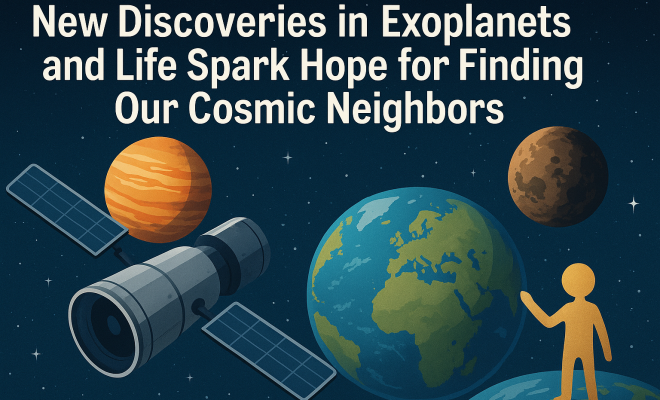
The quest to discover extraterrestrial life has captivated humanity for centuries, and recent advancements in exoplanet research are reigniting that curiosity. With new findings about habitable worlds, scientists are closer than ever to answering one of the most profound questions of our existence: Are we alone in the universe? The latest discoveries not only alter our understanding of the cosmos but also raise tantalizing possibilities about the existence of life beyond Earth.
The Evolution of Exoplanet Research
The field of exoplanet research has evolved dramatically since the first confirmed detection of an exoplanet in 1992. Back then, the idea of worlds beyond our solar system was still largely theoretical. Fast forward to today, and thousands of exoplanets have been cataloged, each bringing with it new data that scientists analyze for signs of habitability and life.
Advancements in telescope technology, such as the Kepler Space Telescope and the Transiting Exoplanet Survey Satellite (TESS), have enabled astronomers to locate and study these distant worlds with unprecedented precision. They use various methods, such as the transit method, to detect changes in a star’s brightness caused by a planet passing in front of it. This has led to an increasing number of discoveries that suggest some of these planets may have conditions suitable for life.
The Habitability Criteria
Understanding what makes a planet habitable is crucial to the search for life. Scientists typically look for several key criteria:
- Distance from its star: A planet must be in the “Goldilocks zone,” where it’s not too hot or too cold for liquid water to exist.
- Atmospheric composition: An atmosphere rich in necessary gases like oxygen and nitrogen is vital for sustaining life as we know it.
- Geological activity: Planets with tectonic activity can recycle nutrients and maintain a stable environment.
- Presence of water: The existence of liquid water is considered a fundamental requirement for life.
Recent studies have revealed exoplanets that meet these criteria, providing hope that they may harbor life. For example, researchers have identified planets that not only lie within their star’s habitable zone but also possess atmospheres with potential for the essential chemical processes for life.
Recent Discoveries That Excite Scientists
One of the most striking recent findings involves a group of exoplanets located in the TRAPPIST-1 system, just 40 light-years away. This system contains seven Earth-sized planets, three of which are situated in the habitable zone. The potential for liquid water on these planets has led scientists to speculate about their capacity to support life.
Another noteworthy discovery is the identification of exoplanets that exhibit the right atmospheric conditions. For instance, scientists have detected signs of water vapor in the atmosphere of K2-18b, an exoplanet located about 124 light-years from Earth. This exciting revelation has ignited interest in studying the planet further, as it may harbor conditions favorable for life.
The Role of Artificial Intelligence in Discoveries
Artificial intelligence (AI) is playing an increasingly crucial role in the search for exoplanets and life. By analyzing vast amounts of data collected from telescopes, AI can identify patterns and anomalies that human researchers may overlook. For instance, machine learning algorithms have been used to analyze light curves from stars, leading to the discovery of new exoplanets more efficiently than ever before.
This technological leap not only accelerates the pace of discovery but also enhances the accuracy of predictions regarding which exoplanets may have conditions suitable for life. As AI continues to evolve, it will undoubtedly open new doors in our understanding of the universe and the possibility of life beyond Earth. (See: NASA Kepler Mission Overview.)
The Fermi Paradox and Its Implications
Despite the growing number of exoplanets that could potentially host life, we are still searching for signs of extraterrestrial civilizations. This dilemma is often referred to as the Fermi Paradox, named after physicist Enrico Fermi, who famously asked, “Where is everybody?” If the universe is teeming with habitable planets, why haven’t we encountered any signs of intelligent life?
Several theories attempt to explain this paradox. Some suggest that intelligent life is exceedingly rare or that civilizations may self-destruct before becoming advanced enough to explore space. Others propose that extraterrestrial civilizations are deliberately avoiding contact with us. This uncertainty only heightens the intrigue surrounding exoplanets and life, pushing scientists to explore new frontiers in their search.
Public Interest and the Search for Exoplanets
The public’s fascination with exoplanets and life has surged in recent years, fueled by both scientific discoveries and popular culture. Movies, television shows, and online content often spotlight the ideas of alien worlds, igniting imaginations and shaping perceptions about our place in the cosmos.
Moreover, the internet has made it easier than ever for people to access information about scientific discoveries. When a new exoplanet is discovered, it can generate significant traffic, with searches spiking as curious individuals seek to learn more. This public interest provides vital support for funding and resources dedicated to further research in this captivating field.
The Future of Exoplanet Exploration
As we look to the future, the exploration of exoplanets is set to gain even more momentum. Upcoming missions like the James Webb Space Telescope are expected to revolutionize our understanding of distant worlds. With its advanced capabilities, the Webb telescope will allow scientists to analyze the atmospheres of exoplanets in greater detail, searching for biosignatures—chemical indicators of life.
Moreover, ongoing missions such as TESS will continue to identify new exoplanets, expanding the catalog of potentially habitable worlds. The prospect of sending probes or missions to these planets, while still distant, is a tantalizing goal for future generations of scientists.
Exoplanets: Types and Characteristics
Exoplanets can be classified into various categories based on their characteristics and the types of stars they orbit. Understanding these classifications helps scientists narrow down which exoplanets might be most promising in the search for life.
- Gas Giants: Similar to Jupiter and Saturn, gas giants are large planets with thick atmospheres. They may have moons that could potentially support life, making them of interest in the pursuit of extraterrestrial existence.
- Super-Earths: These are rocky planets larger than Earth but smaller than Neptune. They often reside in the habitable zone of their stars, which increases the likelihood of having the right conditions for life.
- Ice Giants: Planets like Uranus and Neptune fall under this category. While inhospitable, their moons could present interesting environments for potential life.
- Earth-like Planets: These planets have conditions similar to Earth and are prime candidates in the search for life. Features like rocky surfaces, atmospheres, and water presence elevate their significance.
The Chemistry of Life and Exoplanets
To understand the potential for life on exoplanets, it’s crucial to consider the chemistry of life. Earth life is carbon-based, relying on complex organic compounds. Scientists search for exoplanets where these compounds can exist and interact optimally. This includes analyzing the presence of essential elements such as carbon, hydrogen, nitrogen, oxygen, phosphorus, and sulfur (CHNOPS).
Research has shown that under certain conditions, these elements can form the building blocks of life. For example, the detection of methane in the atmosphere of an exoplanet could indicate biological activity, as methane is often produced by living organisms on Earth. The search for complex molecules in exoplanet atmospheres is a critical component of astrobiology.
Potential Biosignatures to Look For
When searching for life on exoplanets, scientists look for biosignatures—signs that indicate the possible presence of life. Some potential biosignatures include: (See: NASA Exoplanet Exploration.)
- Oxygen and Ozone: On Earth, oxygen is produced by photosynthetic organisms. Its presence, especially in combination with methane, could suggest biological activity.
- Methane: As previously mentioned, the presence of methane in an atmosphere can indicate life, particularly if it coexists with oxygen.
- Carbon Dioxide: While not a direct indicator of life, elevated levels of carbon dioxide in conjunction with other gases could suggest geological processes influenced by biological systems.
- Water Vapor: The detection of water vapor can imply that a planet has the right conditions for life. It can also play a role in climate regulation, which is essential for maintaining stable temperatures.
Comparative Analysis of Exoplanetary Systems
Not all exoplanetary systems are created equal. By comparing different systems, scientists can identify patterns that aid in understanding potential habitability. For example, the TRAPPIST-1 system mentioned earlier captures attention due to its compact arrangement of Earth-sized planets in close proximity to each other, while systems like Kepler-90 are notable for hosting a diverse array of planets, including gas giants and super-Earths.
Moreover, the star type significantly influences the habitability prospects of its orbiting planets. For example, M-dwarfs, or red dwarfs, are the most common type of stars in our galaxy and can host numerous Earth-sized planets in their habitable zones. However, they also emit strong stellar flares that could strip a planet’s atmosphere, raising questions about the long-term viability of life. In contrast, more massive stars like G-type stars (which our Sun belongs to) provide stable environments, but they have shorter lifespans that limit the time available for life to evolve.
Technological Innovations Fueling Exoplanet Research
The search for exoplanets and life is being driven forward by a barrage of innovative technologies. Advances in spectroscopy allow astronomers to analyze the atmosphere of exoplanets in unprecedented detail. For instance, the ability to detect specific chemical signatures within an atmosphere using ground-based telescopes has been enhanced immensely. Telescopes like the Extremely Large Telescope (ELT), expected to be operational in the coming years, will give scientists the capacity to probe the atmospheres of smaller, Earth-like exoplanets.
Additionally, space missions using adaptive optics technology are refining our ability to differentiate between light from stars and planets. The use of coronagraphs, which block out starlight, enables clearer observations of orbiting planets, making it feasible to detect faint biosignatures that could indicate life. These advancements not only enhance our observational capabilities but also significantly boost the efficiency and accuracy of exoplanet research.
Interdisciplinary Approaches in the Search for Life
The search for life beyond Earth is not confined to astronomy alone. It involves an interdisciplinary approach that includes biology, chemistry, physics, and even philosophy. Astrobiology, a field that merges these disciplines, has emerged as a driving force in understanding how life might arise and persist on other worlds.
For example, scientists are studying extremophiles—organisms that thrive in extreme environments on Earth—such as hydrothermal vents and acidic lakes. These studies provide insights into the types of life that might exist in similarly harsh conditions on exoplanets. Additionally, planetary scientists study the geology of planets in our solar system to draw parallels with exoplanets, providing essential clues about their potential habitability.
Frequently Asked Questions (FAQ)
What is an exoplanet?
An exoplanet is a planet that orbits a star outside our solar system. These planets vary widely in size, composition, and distance from their stars.
How are exoplanets discovered?
Exoplanets are primarily discovered using methods such as the transit method, where scientists observe the dimming of a star’s light as a planet passes in front of it, and the radial velocity method, which detects variations in a star’s movement caused by gravitational interactions with orbiting planets.
What makes a planet habitable?
A habitable planet typically exists in the Goldilocks zone of its star, has an atmosphere capable of supporting life, contains liquid water, and exhibits geological activity to recycle nutrients. (See: Scientific Research on Exoplanets.)
Are there known exoplanets that could support life?
Yes, several exoplanets, such as those in the TRAPPIST-1 system, and K2-18b, are considered potentially habitable due to their location in the habitable zone and atmospheric conditions.
What is the likelihood of finding extraterrestrial life?
While it’s difficult to quantify, many scientists believe the vast number of exoplanets increases the probability of finding life. Each discovery brings us closer to understanding the potential for life beyond Earth.
How do scientists determine if an exoplanet is in the habitable zone?
Scientists determine if an exoplanet is in the habitable zone by calculating the distance from the star that allows for liquid water to exist on the planet’s surface. This involves considering the star’s luminosity and temperature to identify the region where conditions are just right.
What technologies are used to study exoplanets?
Various technologies are employed to study exoplanets, including space telescopes like the James Webb Space Telescope, ground-based observatories equipped with adaptive optics, and spectrometers that can analyze the composition of exoplanet atmospheres.
Conclusion: A New Era of Discovery
The latest findings in exoplanet research remind us that the universe is vast and full of potential. As technology advances and our understanding deepens, we move closer to uncovering the mysteries of exoplanets and life. Each discovery brings us one step closer to answering the age-old question of whether we are alone in the universe.
As we continue to explore the cosmos, the excitement surrounding exoplanets and life is unlikely to fade. Instead, it will burgeon, drawing both scientists and the public into a shared journey of discovery. The search for extraterrestrial life may not yield immediate answers, but the pursuit itself enriches our understanding of nature, life, and humanity’s place in the universe.
“`
Trending Now
Frequently Asked Questions
What are exoplanets and why are they important?
Exoplanets are planets located outside our solar system. They are crucial for understanding the potential for life beyond Earth, as they can host conditions similar to our own planet. Recent discoveries suggest that many exoplanets may have the necessary criteria for habitability, reigniting interest in the search for extraterrestrial life.
How do scientists detect exoplanets?
Scientists detect exoplanets using various methods, with the transit method being one of the most common. This technique involves observing changes in a star's brightness when a planet passes in front of it. Advanced telescopes like the Kepler Space Telescope and TESS have significantly enhanced our ability to find and study these distant worlds.
What makes a planet potentially habitable?
A planet is considered potentially habitable if it meets several criteria: it must be in the 'Goldilocks zone' for liquid water, have a suitable atmospheric composition, exhibit geological activity, and possess liquid water. These factors are essential for sustaining life as we understand it.
What advancements have been made in exoplanet research?
Recent advancements in telescope technology, particularly with the Kepler Space Telescope and TESS, have revolutionized exoplanet research. These tools allow astronomers to detect and analyze thousands of exoplanets, providing new insights into their characteristics and potential for life.
Are we close to finding extraterrestrial life?
While definitive proof of extraterrestrial life has not yet been found, recent discoveries in exoplanet research indicate that many planets have conditions suitable for life. This progress brings scientists closer to answering the age-old question of whether we are alone in the universe.
What did we miss? Let us know in the comments and join the conversation.