Starship Mars Mission: Is SpaceX’s Vision in Jeopardy?
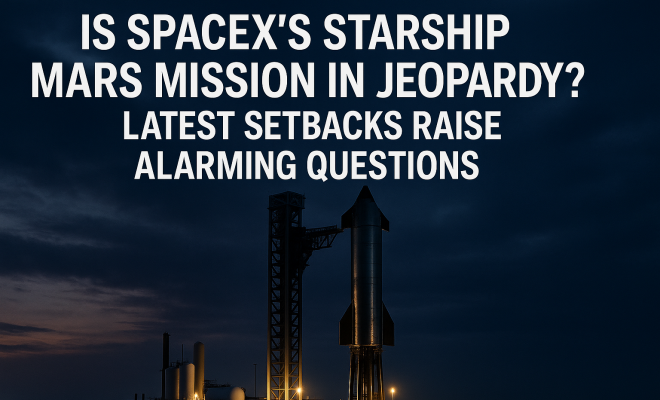
“`html
In the ever-evolving world of space exploration, few topics capture attention quite like SpaceX’s ambitious plans for its Starship Mars mission. With Elon Musk at the helm, the company has stirred excitement not just for its groundbreaking technology but also for its ambitious timelines. However, recent setbacks in Starship’s development have sparked fresh concerns about its future, both in terms of interplanetary travel and as a contender in the commercial launch market. Let’s explore the latest developments, key challenges, and the implications of these delays.
1. The Starship Ambition
SpaceX’s Starship is not just a rocket; it’s a vision for humanity’s future in space. The goal is to create a fully reusable spacecraft capable of carrying humans and cargo to Mars and beyond. Elon Musk has touted this mission as essential for making life multi-planetary. The intended design of Starship includes a massive payload capacity and advanced technologies that could potentially reduce the cost of space travel significantly.
However, the ambitious nature of this project inherently comes with challenges. Critics often point out that while the vision is grand, the technical execution must keep pace. With every launch attempt, SpaceX aims to refine its systems, learning from failures and successes alike. As of now, the path to operational reliability seems fraught with obstacles.
2. Latest Testing Setbacks
Recent tests of the Starship prototype have been met with mixed results, drawing both awe and skepticism from the aerospace community. After several high-profile launches, including explosive test landings, the latest developments have raised questions about the timeline for achieving operational status. Each test failure not only represents a technical hurdle but also feeds into the public perception of SpaceX’s reliability as a launch provider.
For instance, during a high-altitude test flight, the Starship experienced anomalies that resulted in a loss of vehicle. This failure prompted an internal review and raised questions about the design and engineering of the rocket. While SpaceX often embraces setbacks as learning opportunities, the recurring nature of these failures could impact investor confidence and public enthusiasm.
3. Timeline Slippage and Its Implications
Initially, Musk set an ambitious timeline for regular Starship launches and crewed missions to Mars by the mid-2020s. However, repeated technical setbacks have led to slippage in these timelines. Analysts now speculate that the operational rollout may be delayed significantly, which could adversely affect not only SpaceX’s ambitions but also NASA’s plans for lunar exploration and other commercial space endeavors.
The delay in the Starship Mars mission could have cascading effects on various stakeholders. NASA relies on SpaceX’s technological advancements for its Artemis program, which aims to send astronauts back to the Moon. If SpaceX cannot deliver a reliable Starship in the projected time frame, it could push back NASA’s lunar timeline as well, affecting international partnerships and commercial contracts.
4. The Importance of Public Perception
The spectacle of rocket launches combined with the dramatic nature of test failures generates tremendous media coverage. Every launch attempt becomes a spectacle, drawing millions of eyes on social media and news outlets alike. However, the perception of reliability is crucial for gaining public trust and securing future investments. As failures mount, the narrative can shift quickly from excitement to skepticism.
SpaceX has cultivated a unique relationship with the public by sharing in-depth insights into their testing processes, making the audience feel like part of the journey. However, if the setbacks continue, public enthusiasm could wane, leading to calls for more accountability and transparency regarding the project’s status and timelines.
5. Technical Challenges Ahead
SpaceX’s engineering team faces a multitude of technical challenges as they work towards achieving a reliable Starship that can withstand the rigors of interplanetary travel. Key among these challenges is developing a robust heat shield that can endure the extreme temperatures of re-entry into Earth’s atmosphere, as well as the Martian environment.
Additionally, the rocket’s propulsion system must be perfected for multiple launches and landings, a requirement for SpaceX’s plan for rapid reuse of the spacecraft. Each of these factors complicates the engineering process and contributes to delays in the testing schedule. (See: SpaceX Starship on Wikipedia.)
6. Impact on NASA’s Lunar Plans
With NASA’s Artemis program aiming to return humans to the Moon, the agency has placed significant reliance on SpaceX’s Starship for its lunar lander. The partnership between NASA and SpaceX has been celebrated as a model for public-private collaboration in space exploration. However, any ongoing delays with the Starship Mars mission could hamper NASA’s timeline for lunar missions.
If Starship cannot achieve consistent reliability, NASA may need to explore alternative solutions for its lunar lander, which would not only increase costs but could also delay the broader goals of returning humans to the Moon and eventually sending astronauts to Mars. This uncertainty puts a spotlight on the need for contingency planning within NASA’s strategy.
7. Competitive Landscape in Commercial Space Flight
SpaceX is not alone in its ambitions within the commercial space sector. Competitors like Blue Origin and Boeing are eager to carve out their own niches in the market and are continuously monitoring SpaceX’s progress. As Starship faces setbacks, these competitors may capitalize on the opportunity to strengthen their positions and secure contracts that SpaceX might otherwise dominate.
Moreover, the growing number of private players entering the space race means that the competition is increasingly fierce. While SpaceX has been a pioneer in reusable rocket technology, maintaining that edge amidst challenges will be crucial. Delays could result in lost contracts and partnerships as clients consider other options.
8. Moving Forward: What Lies Ahead for SpaceX?
The future of SpaceX’s Starship Mars mission may be uncertain, but the company’s tenacity is well-known. Despite the challenges, SpaceX has a history of bouncing back from setbacks. The company’s iterative design approach allows for rapid testing, which accelerates learning and helps to refine the spacecraft. The upcoming months will be pivotal for demonstrating whether SpaceX can turn the tide on its current issues.
As stakeholders, from investors to space enthusiasts, keep a close watch on the developments, the stakes have never been higher. Will SpaceX manage to navigate through these challenges and deliver on its promise of an interplanetary future? The answer may lie in the next round of test flights and the innovations that follow.
9. Final Thoughts
SpaceX’s Starship Mars mission embodies both the potential and the peril of modern space exploration. The ambition to send humans to Mars is a monumental task that requires unparalleled innovation and engineering. As setbacks continue to emerge, it’s a reminder that the path to becoming a multi-planetary species is fraught with challenges. Nevertheless, the excitement surrounding SpaceX remains palpable, fueled by a public eager to witness what might become one of the most significant advancements in human history.
10. Exploring the Technologies Behind Starship
At the core of the Starship Mars mission lies groundbreaking technology that aims to redefine space travel. The spacecraft utilizes Raptor engines, which are powered by a combination of liquid methane and liquid oxygen. This innovative choice not only improves efficiency but also aligns with Musk’s vision of in-situ resource utilization on Mars, where methane can be produced from the Martian atmosphere.
The Raptor engines are designed for reusability, an essential factor for long-duration missions. Each engine is capable of generating over 230 metric tons of thrust, allowing Starship to lift substantial payloads into orbit. This capability is critical as SpaceX aims to transport not just astronauts but also equipment and supplies necessary for establishing a human presence on Mars.
11. Potential Mars Colonization Scenarios
Looking beyond the technology, the vision for Mars colonization posed by SpaceX is ambitious. Musk envisions a self-sustaining city on Mars by 2050, capable of supporting a population of one million people. This plan includes establishing manufacturing facilities, agricultural systems, and even entertainment to create a livable environment for future Martians.
A key aspect of this vision is the ability to transport large numbers of people and cargo efficiently. SpaceX has proposed using Starship to launch multiple flights daily, with plans to increase capacity over time. This approach could dramatically increase the speed at which humanity can establish a presence on the Red Planet.
12. SpaceX’s Vision for Interplanetary Travel
SpaceX’s ambitions do not stop at Mars; they extend to broader interplanetary travel. The company envisions a future where interplanetary travel becomes as routine as air travel is today. Musk has spoken about the potential for Starship to facilitate missions to the Moon, Mars, and even beyond, including the moons of Jupiter and Saturn.
This vision of interplanetary travel speaks to the long-term goal of making humanity a multi-planetary species, which Musk considers vital for the survival of our civilization. The advancements made through the Starship program could pave the way for future missions that explore the outer Solar System, potentially discovering new resources and expanding human knowledge. (See: NASA Mars Exploration Program.)
13. The Environmental Considerations
As SpaceX continues to push the boundaries of space exploration, it’s essential to address the environmental implications of its activities. Rocket launches contribute to atmospheric pollution, and the production of rockets themselves has a carbon footprint. While SpaceX is focused on reusability to minimize waste, the environmental impact of its operations is an ongoing discussion in the aerospace community.
Additionally, the potential colonization of Mars introduces questions about planetary protection. Ethical considerations regarding contamination of other celestial bodies must be weighed against the desire to explore and settle new worlds.
14. Expert Perspectives on the Future of SpaceX
Industry experts have varied opinions on SpaceX’s trajectory and the feasibility of its Starship Mars mission. Some argue that Musk’s timelines are overly ambitious, while others believe in the company’s ability to innovate rapidly. For instance, Dr. John Logsdon, a prominent space policy expert, has expressed concerns over the technological challenges but acknowledges SpaceX’s unique approach to problem-solving.
On the other hand, advocates like Amy Shira Teitel, a space historian, argue that the iterative design philosophy of SpaceX could be a game-changer for the space industry, enabling quicker advancements than traditional aerospace methods. Their insights reflect the complex landscape of opinions surrounding this groundbreaking mission.
15. FAQ Section
Q1: What is the primary goal of the SpaceX Starship Mars mission?
A1: The primary goal is to land humans on Mars and establish a sustainable human presence there, ultimately making life multi-planetary.
Q2: When is SpaceX planning to send the first crewed mission to Mars?
A2: While initial timelines suggested crewed missions could occur in the mid-2020s, recent setbacks have led to speculation that this timeline may be delayed.
Q3: How does SpaceX plan to produce fuel on Mars?
A3: SpaceX aims to produce methane and oxygen from the Martian atmosphere using a process known as the Sabatier reaction, which would allow for the refueling of Starship on Mars for return missions to Earth.
Q4: What are the main challenges SpaceX faces with Starship?
A4: Major challenges include developing a reliable heat shield, perfecting the Raptor engines, and establishing consistent operational timelines amid ongoing technical hurdles.
Q5: How does SpaceX’s Starship compare to other rockets in development?
A5: Starship is designed to be fully reusable and has a much larger payload capacity compared to other rockets like NASA’s Space Launch System (SLS) and Blue Origin’s New Glenn, which may give it a competitive edge for future missions.
Q6: What implications do Starship delays have for NASA’s Artemis program?
A6: Delays in the Starship program could push back NASA’s timelines for lunar missions, as they rely on SpaceX’s technology for lunar landings and other objectives related to the Artemis program.
16. Understanding the Financial Aspects of SpaceX’s Starship Program
Financial backing is crucial for the ambitious plans of SpaceX’s Starship Mars mission. In 2020, SpaceX raised approximately $1.9 billion in a funding round, which solidified investor confidence in its vision of interplanetary travel. This investment is essential as the development of Starship and its associated technologies requires substantial capital. (See: Scientific analysis of space travel.)
Moreover, government contracts play a significant role in SpaceX’s financial strategy. NASA’s contracts for the Artemis program not only provide funding but also validate SpaceX’s technology. In fact, a significant portion of the funding for the Starship program comes from these partnerships, and any delays could hinder future investment opportunities. Additionally, SpaceX has begun to explore commercial opportunities for Starship, such as space tourism and satellite launches, which could diversify its revenue streams.
17. International Collaborations in Space Exploration
SpaceX’s Starship Mars mission is not just an American endeavor; it has potential international implications. Countries like the United Arab Emirates and China are ramping up their own space programs and may either partner with SpaceX or compete against it. Collaborations could lead to shared technologies, resources, and expertise in ensuring the success of interplanetary missions. For example, discussions around potential partnerships for Mars exploration may include shared missions or data exchanges that could enhance human understanding of the Martian environment.
Moreover, international partnerships could foster a spirit of cooperation in space exploration, mitigating competitive tensions and enabling a collective approach to solving the challenges of interplanetary travel.
18. The Role of AI and Robotics in Mars Exploration
As SpaceX looks to the future, the integration of AI and robotics in the Starship Mars mission could revolutionize how we explore the Red Planet. AI can assist in data analysis, navigation, and even decision-making during missions, while robotics can be used for constructing habitats, conducting scientific experiments, and performing repairs on equipment. The synergy between human capability and robotic efficiency could significantly enhance the success rate of Mars expeditions.
For instance, autonomous drones could scout terrain ahead of human landers, providing critical data on potential sites for exploration or settlement. This capability would minimize risks and optimize mission planning, all while ensuring the safety of the crew. As SpaceX advances its plans, the integration of these technologies will likely play a pivotal role in its overall strategy for Mars colonization.
19. Public Engagement and the Future of Space Exploration
Public support and engagement are vital for the success of SpaceX’s Starship Mars mission. The company has effectively utilized social media and public demonstrations to create excitement around its projects. By engaging the public through livestreams of test flights and progress updates, SpaceX has fostered a community of enthusiasts who feel personally connected to the mission.
Educational outreach is another critical component. SpaceX has the opportunity to inspire the next generation of scientists, engineers, and explorers by promoting STEM (Science, Technology, Engineering, and Mathematics) education. Collaborations with schools and educational institutions could amplify interest in space exploration and cultivate a workforce ready to tackle the challenges of going to Mars.
20. Looking Ahead: The Future is Now
The journey toward achieving a successful SpaceX Starship Mars mission is just beginning. With the lessons learned from setbacks and the technological advancements being made, the potential to redefine interplanetary travel remains within reach. As we watch developments unfold, it’s clear that SpaceX is not just aiming to send humans to Mars but to establish a new era of exploration that could inspire generations to come.
“`
Trending Now
Frequently Asked Questions
Is SpaceX's Starship mission to Mars still on track?
SpaceX's Starship mission to Mars is facing significant challenges due to recent testing setbacks. While the vision for a fully reusable spacecraft remains, technical hurdles and mixed results from high-altitude tests have raised concerns about the timeline for achieving operational status.
What are the latest developments in SpaceX's Starship program?
The latest developments in SpaceX's Starship program include mixed results from recent test launches, with some high-profile failures. These setbacks have sparked discussions regarding the reliability of the Starship and its future as a contender in both interplanetary travel and the commercial launch market.
What challenges does SpaceX's Starship face?
SpaceX's Starship faces a variety of challenges, including technical execution issues and the need for operational reliability. Recent test failures have raised concerns about the spacecraft's development timeline and its ability to meet ambitious goals for Mars exploration.
How does SpaceX plan to make life multi-planetary?
SpaceX aims to make life multi-planetary through its Starship program, which is designed to transport humans and cargo to Mars and beyond. The company is focusing on creating a fully reusable spacecraft that can significantly reduce the costs associated with space travel.
What impact do test failures have on SpaceX's reputation?
Test failures impact SpaceX's reputation by raising questions about the reliability of its launch services. Each failure not only represents a technical challenge but also affects public perception, as the aerospace community watches closely for improvements and successful outcomes in future tests.
What did we miss? Let us know in the comments and join the conversation.