Social Learning Theory & PBS: A Powerful Educational Duo
“`html
In the evolving landscape of education, two frameworks have gained significant traction: social learning theory in education and positive behavior support (PBS). While they originate from different theoretical backgrounds, their integration can lead to more effective teaching strategies, enhanced student engagement, and improved classroom environments. Understanding how these two concepts complement each other is crucial for educators aiming to foster a supportive and collaborative learning atmosphere.
Understanding Social Learning Theory
Social learning theory, pioneered by psychologist Albert Bandura in the 1960s, posits that learning occurs through observation, imitation, and modeling. Bandura’s famous Bobo doll experiment illustrated how children learn behaviors not just through direct experience but by observing others and the consequences of their actions.
This theory emphasizes the importance of social interaction and the environment in the learning process. For instance, when a student sees a peer being rewarded for completing a homework assignment, they are more likely to imitate that behavior. This emphasizes the role of vicarious reinforcement, where learners adjust their actions based on observed outcomes.
The Core Principles of Social Learning Theory
To fully grasp the implications of social learning theory in education, it’s important to highlight its core principles:
- Observational Learning: Students learn by watching others, particularly peers or authority figures.
- Imitation: Individuals are likely to replicate behaviors they have seen, especially if those behaviors are rewarded.
- Modeling: Effective models are crucial; educators can serve as role models to guide student behavior.
- Reciprocal Determinism: Behavior, environment, and personal factors all interact to influence learning.
- Attention, Retention, Reproduction, and Motivation: For observational learning to be effective, students must pay attention to the behavior, retain it, reproduce it, and feel motivated to do so.
These principles can transform how we approach teaching and learning, helping educators create environments where students are more likely to thrive.
Exploring Positive Behavior Support
Positive behavior support, on the other hand, is an evidence-based approach focused on promoting positive behaviors while reducing negative behaviors. It was developed in the 1990s to provide a proactive strategy for behavior management in schools. PBS emphasizes prevention, teaching appropriate behaviors, and using data to make informed decisions about interventions.
The approach is built on a framework that seeks to create supportive environments that encourage positive behavior through:
- Clear Expectations: Establishing and teaching clear behavioral expectations within the classroom.
- Positive Reinforcement: Rewarding desired behaviors to encourage their recurrence.
- Data-Driven Strategies: Utilizing data to assess behaviors and interventions, ensuring that strategies are effective.
- Collaboration: Involving teachers, parents, and students in the behavior support process.
By focusing on creating an environment that fosters positive behavior, PBS aims to improve student outcomes and reduce disciplinary issues.
Integrating Social Learning Theory with Positive Behavior Support
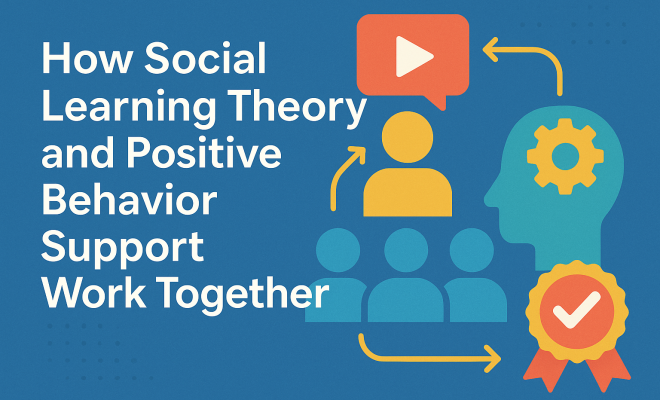
The intersection of social learning theory and positive behavior support creates a multifaceted approach to education. By understanding the dynamics of behavior and learning, educators can develop strategies that not only promote positive behavior but also enhance learning through observation and modeling.
For example, when teachers model positive behaviors, such as respectful communication or effective problem-solving, they are not just telling students what to do; they are showing them. This modeling can have a profound impact on a student’s willingness to adopt similar behaviors. Coupled with PBS, which reinforces these behaviors through recognition and rewards, students are more likely to engage in positive actions consistently. (See: Social Learning Theory on Wikipedia.)
Real-World Applications in the Classroom
Integrating social learning theory with positive behavior support can manifest in various classroom strategies. Here are a few practical applications:
- Behavior Modeling: Teachers demonstrate desired behaviors during lessons, such as teamwork, critical thinking, and respectful disagreement. For instance, during a group activity, a teacher can model how to listen actively while another student shares their ideas.
- Peer Mentoring Programs: Pairing students together to encourage positive behaviors among peers can be effective. Older students can serve as role models for younger ones, reinforcing social learning principles.
- Celebrating Success: Schools can implement systems to publicly recognize students who exhibit positive behaviors, which reinforces the behaviors they are trying to promote. This aligns with the positive reinforcement component of PBS.
- Interactive Learning Environments: Utilizing group work and collaborative projects encourages students to learn from one another and observe the behaviors of their peers.
These strategies not only instill positive behaviors but also create a culture of learning where social learning theory thrives.
The Role of Technology in Enhancing Social Learning
In today’s digital age, technology plays a crucial role in enhancing social learning. Online platforms and tools can facilitate collaboration, allowing students to share their learning experiences beyond the traditional classroom setting. For example, platforms like Google Classroom or Microsoft Teams enable students to engage in discussions, share resources, and provide feedback to one another.
Social media can also serve as a powerful tool for positive behavior promotion. Educators can create online communities where students celebrate each other’s successes or share strategies for overcoming challenges. This reinforces the idea that learning is a social process and encourages students to emulate positive behaviors observed within their peer groups.
Challenges and Considerations
Despite the promising integration of social learning theory and positive behavior support, some challenges remain. For instance, not all students are equally influenced by modeling; individual differences in personality, background, and experiences can affect how students respond.
Moreover, educators must be trained effectively in both frameworks. Without a deep understanding of these theories and how to implement them, the potential benefits may not be fully realized. It’s crucial for schools to invest in professional development that focuses on these methodologies so that teachers can confidently apply them in their classrooms.
Current Relevance and Future Directions
Today’s educational landscape is increasingly focused on social-emotional learning (SEL), which aligns closely with both social learning theory and positive behavior support. SEL emphasizes the importance of understanding emotions, setting goals, showing empathy, and maintaining positive relationships—all of which are core to the principles of social learning and PBS.
As schools evolve to meet the needs of diverse learners, the integration of social learning theory in education with positive behavior support can lead to more inclusive and effective teaching practices. The future may include even more innovative applications, such as the integration of artificial intelligence to personalize learning experiences based on observed behaviors and interactions.
Real-World Examples of Social Learning Theory in Action
To better illustrate the application of social learning theory in educational settings, let’s examine some real-world examples where schools have successfully implemented these concepts.
One example comes from an elementary school in California that adopted a peer mediation program. In this program, trained student mediators helped resolve conflicts among their classmates. By observing their peers engaging in conflict resolution, students learned valuable social skills and how to manage disagreements constructively. Not only did this foster a more harmonious environment, but it also empowered students to take ownership of their social interactions.
Another compelling case study is found in a high school that integrated a community service requirement into its curriculum. Students were encouraged to participate in various service projects, such as tutoring younger students or volunteering at local shelters. Through these experiences, students learned from each other, developed empathy, and recognized the impact of their contributions. This approach not only reinforced positive behaviors but also created a sense of community within the school, highlighting the social aspect of learning.
Statistics Supporting the Integration of Social Learning Theory and PBS
Research has consistently shown that integrating social learning theory with positive behavior support can lead to significant improvements in student outcomes. A study conducted by the National Center for Education Statistics (NCES) reported that schools implementing PBS frameworks saw a reduction in behavioral incidents by up to 30%. Furthermore, students in these schools demonstrated higher levels of academic achievement and social competence. (See: CDC on Social Learning in Youth.)
Moreover, a meta-analysis published in the Journal of Educational Psychology reviewed over 50 studies on social learning interventions in educational settings and found that students exposed to these strategies were 25% more likely to exhibit positive behaviors and improve their academic performance compared to their peers who did not receive similar interventions.
Expert Perspectives on Social Learning Theory in Education
To provide additional insight into the relevance of social learning theory and positive behavior support, it’s helpful to hear from experts in the field. Dr. Andrew G. D. Reilly, an educational psychologist, emphasizes that “the integration of social learning principles within classroom management strategies not only fosters a more inclusive environment but also prepares students for real-world interactions.” His research highlights how students who learn in collaborative settings tend to develop stronger communication and interpersonal skills.
Similarly, Dr. Maria J. Hernandez, a leading advocate for social-emotional learning, notes, “When students see their peers modeling positive behaviors, they’re more likely to adopt those behaviors themselves. This is where social learning theory truly shines.” Her work showcases the significant impact of role modeling on student behavior and learning outcomes.
FAQ: Understanding Social Learning Theory in Education
What is social learning theory?
Social learning theory is a psychological framework that suggests learning occurs through observation, imitation, and modeling. It highlights the importance of social interactions in the learning process.
How does social learning theory apply in education?
In education, social learning theory can be applied through methods such as peer modeling, group work, and collaborative projects, where students learn from observing and interacting with their peers and teachers.
What are the benefits of integrating social learning theory with positive behavior support?
The integration can lead to a more supportive and collaborative classroom environment, where positive behaviors are reinforced through observation and modeling, ultimately improving student engagement and academic outcomes.
Can social learning theory help with classroom management?
Yes, by utilizing social learning principles, teachers can promote positive behaviors through modeling and reinforcement, leading to improved classroom management and a more positive learning environment.
What role does technology play in social learning?
Technology enhances social learning by providing platforms for collaboration and communication, allowing students to engage with each other and share their learning experiences beyond the classroom.
Are there any drawbacks to social learning theory in education?
Some challenges include individual differences among students; not all students may respond to modeling in the same way. Additionally, effective training for educators is essential to implement these strategies successfully.
Future Trends in Social Learning Theory and Education
As education continues to evolve, several trends are emerging that aim to strengthen the application of social learning theory. One of the most significant is the rise of experiential learning environments. These environments allow learners to engage in real-world tasks, where they can observe and emulate models in authentic contexts. For instance, internships or project-based learning can provide students with opportunities to learn directly from industry professionals or community leaders, thereby enhancing their observational learning experiences.
Another trend is the focus on personalized learning paths that incorporate social learning principles. By leveraging data analytics and learning management systems, educators can tailor experiences that not only accommodate different learning styles but also encourage peer-to-peer interaction. This ensures that students are not just passive consumers of knowledge but active participants in their educational journeys.
The Impact of Collaborative Learning Spaces
Modern educational facilities are increasingly designed with collaboration in mind. Open classroom layouts, flexible seating arrangements, and technology-integrated spaces allow students to move freely, work together, and engage in dialogue. These collaborative learning spaces foster social learning by providing an environment where students feel comfortable sharing ideas and learning from one another. Studies have shown that students in collaborative environments are more likely to develop critical thinking skills and enhance their understanding of content through social interactions.
For example, a school district that renovated its classrooms to create open, flexible learning environments reported an increase in student engagement and a decrease in behavioral issues. Teachers noted that students were more willing to participate in discussions and collaborate with their peers, reinforcing the principles of social learning theory.
Implementing Professional Development for Educators
To effectively integrate social learning theory in education, ongoing professional development is crucial. Teachers must be equipped not only with theoretical knowledge but also practical strategies they can employ in the classroom. Workshops, coaching, and collaborative planning sessions can help teachers explore how to incorporate modeling and observational learning in their instruction.
For instance, a district may offer training sessions on effective modeling techniques, allowing teachers to practice demonstrating desired behaviors and creating a supportive classroom culture. Investing in professional development can lead to a more cohesive understanding of social learning theory among educators, ultimately benefiting student outcomes.
Conclusion: A Holistic Approach to Education
In summary, the synergy between social learning theory and positive behavior support offers a powerful framework for educational improvement. By understanding how students learn through observation and how positive behaviors can be reinforced, educators can create environments that not only promote academic success but also cultivate social skills and emotional well-being.
As we continue to explore the dynamics of learning and behavior in the classroom, embracing these concepts can lead to a more supportive educational system. The collaborative nature of learning, coupled with effective behavior management strategies, sets the stage for students to flourish both academically and socially.
“`
Trending Now
Frequently Asked Questions
What is social learning theory in education?
Social learning theory, developed by Albert Bandura, suggests that learning occurs through observation and imitation of others. It emphasizes the role of social interaction and the environment, where students learn behaviors by watching peers and the consequences of their actions.
How does positive behavior support work?
Positive behavior support (PBS) is a framework aimed at improving student behavior through proactive strategies. It focuses on teaching and reinforcing positive behaviors, creating supportive environments, and using data to guide interventions, ultimately fostering a positive school climate.
How can social learning theory and positive behavior support be integrated?
Integrating social learning theory with positive behavior support enhances teaching strategies by using observational learning and modeling. Educators can demonstrate positive behaviors and reinforce them, encouraging students to imitate these behaviors, which promotes a supportive and collaborative learning atmosphere.
What are the core principles of social learning theory?
The core principles of social learning theory include observational learning, imitation, modeling, reciprocal determinism, and the components of attention, retention, reproduction, and motivation. These principles highlight how students learn behaviors through social contexts and interactions.
Why is social interaction important in learning?
Social interaction is crucial in learning as it allows students to observe and imitate behaviors from peers and role models. This interaction fosters engagement, motivates students, and enhances their ability to learn effectively through shared experiences and vicarious reinforcement.
What did we miss? Let us know in the comments and join the conversation.