Bloom’s Taxonomy Question Stems for Every Level
“`html
Understanding Bloom’s Taxonomy
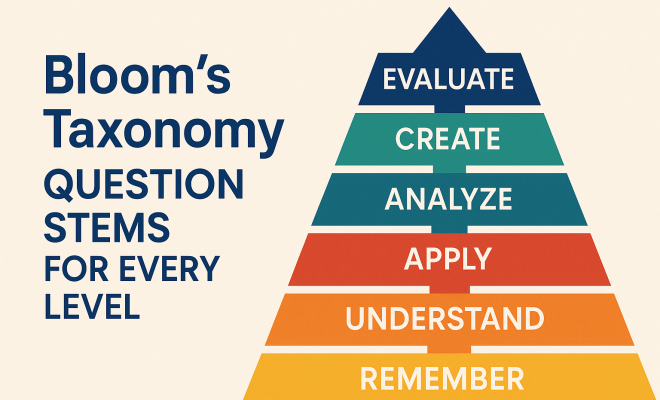
Developed by Benjamin Bloom and his colleagues in 1956, Bloom’s Taxonomy provides a structured framework for categorizing educational goals. Over the years, this framework has undergone revisions, with a significant update in 2001 by Lorin Anderson and David Krathwohl, who transformed the original static categories into dynamic processes. The taxonomy consists of six levels: Remembering, Understanding, Applying, Analyzing, Evaluating, and Creating. Each of these levels reflects a deeper engagement with material, encouraging learners to progress from basic recall to higher-order thinking.
Why Use Question Stems?
Question stems serve as prompts that guide students in their thinking processes across all levels of Bloom’s Taxonomy. They not only facilitate the formulation of critical questions but also foster deeper inquiry and engagement. By incorporating Bloom’s Taxonomy question stems into classroom discussions or assessments, educators can support students in developing higher-order thinking skills. This approach can effectively enhance students’ cognitive abilities, making the learning experience more enriching.
Question Stems for Each Level of Bloom’s Taxonomy
Now, let’s explore specific question stems associated with each level of Bloom’s Taxonomy. These stems can be adapted to fit various subjects and learning objectives.
1. Remembering
This foundational level involves recalling facts and basic concepts. Effective question stems for this level might include:
- What is…?
- Can you list…?
- How would you define…?
- Who is…?
- When did… happen?
For example, in a history class, a teacher might ask, “Who were the key figures in the American Civil War?” This question prompts students to recall specific individuals and dates, laying the groundwork for further exploration.
2. Understanding
At this level, students demonstrate comprehension of the material through various formats. Question stems to promote understanding might include:
- Can you explain…?
- How would you summarize…?
- What does this mean…?
- Can you describe…?
- Why is it important to…?
For instance, in a literature class, a teacher could ask, “Can you summarize the main themes of the novel?” This encourages students to articulate their understanding in their own words.
3. Applying
At the application level, students use their knowledge in new situations. Effective question stems here include:
- How would you use…?
- Can you show me how…?
- What examples can you find to…?
- How is this similar to…?
- Can you apply this concept to…?
A relevant example might be, “How would you apply the scientific method to solve a classroom experiment?” This encourages students to take theoretical knowledge and put it into practice.
4. Analyzing
This level requires students to break down information into components and understand its structure. Useful question stems for analyzing include:
- What are the parts of…?
- Can you distinguish between…?
- How is this related to…?
- What evidence can you find to support…?
- What are the underlying assumptions of…?
For example, a teacher might say, “What evidence from the text supports your interpretation of the protagonist’s motivations?” This prompts students to analyze a text critically.
5. Evaluating
At the evaluation level, students make judgments based on criteria and standards. Appropriate question stems include:
- What criteria would you use to assess…?
- How would you compare…?
- What are the strengths and weaknesses of…?
- Do you agree with…? Why or why not?
- How would you justify your opinion on…?
An example might be, “How would you evaluate the effectiveness of the author’s argument?” This encourages students to articulate their reasoning and support it with evidence. (See: Bloom's Taxonomy overview on Wikipedia.)
6. Creating
At the highest level, students synthesize information to create new ideas or products. Effective question stems for this level include:
- Can you design a…?
- What would happen if you combined…?
- How can you develop a new…?
- What alternative solutions can you propose for…?
- Can you formulate a new plan to…?
For instance, a teacher might ask, “Can you design a marketing campaign for a new product?” This pushes students to apply their knowledge creatively and innovatively.
Integrating Question Stems into Instruction
Incorporating Bloom’s Taxonomy question stems into your teaching practice can be a transformative experience for both educators and students. Here are a few strategies to effectively integrate them into your instruction:
1. Planning Lessons
When planning lessons, consider incorporating a variety of question stems that span all levels of Bloom’s Taxonomy. This will encourage different types of thinking throughout the lesson. For instance, you might start with questions that assess recall, move to application, and then challenge students to evaluate or create by the end of the lesson.
2. Facilitating Discussions
Using question stems during discussions can prompt deeper conversation and encourage students to think critically. For instance, after reading a text, a teacher could ask, “What are the implications of the author’s argument?” This invites students to evaluate and analyze the material collaboratively.
3. Assessments
In assessments, educators can utilize Bloom’s Taxonomy question stems to create questions that assess various cognitive skills. This can help in creating a more comprehensive evaluation of students’ understanding and abilities. For example, a math test may include a question that requires students to apply a formula, as well as one that asks them to analyze a problem’s structure.
Current Relevance of Bloom’s Taxonomy Question Stems
In today’s educational landscape, the relevance of Bloom’s Taxonomy question stems remains robust. With the shift towards fostering critical thinking and problem-solving skills, educators are more inclined to integrate these question stems into their teaching practices.
Additionally, with the growing emphasis on standardized testing, which often prioritizes higher-order thinking skills, Bloom’s Taxonomy serves as a valuable guide for creating effective assessments. Schools and educators can benefit from this framework to align their teaching strategies with the demands of modern education.
Challenges and Considerations
While Bloom’s Taxonomy question stems are incredibly useful, there are challenges that educators may face when implementing them. Here are a few considerations:
1. Over-Reliance on Rigid Stems
One potential challenge is the tendency to rely too heavily on specific question stems without adapting them to the context of the lesson or the needs of the students. It’s essential to be flexible and modify questions to suit the learning environment and the specific content being taught.
2. Varying Student Abilities
Students come with a diverse range of abilities and experiences. A question stem that works well for one group may not resonate with another. Educators need to differentiate their questions, ensuring that all students are challenged appropriately while providing support where needed.
3. Encouraging Engagement
Even with effective question stems, student engagement can sometimes be a hurdle. To combat this, educators can create a safe and supportive classroom environment where students feel comfortable voicing their thoughts and ideas. Encouraging collaborative learning and active participation can further enhance engagement.
Professional Development and Resources
For educators looking to deepen their understanding of Bloom’s Taxonomy and how to implement question stems effectively, numerous resources and professional development opportunities are available. Workshops, webinars, and educational conferences often cover instructional strategies related to Bloom’s Taxonomy. Additionally, books and articles on cognitive development and assessment strategies can provide valuable insights.
Examples of Effective Use of Question Stems
Applying Bloom’s Taxonomy question stems can look quite different across various subjects and grade levels. Here’s how different educators have successfully utilized these tools in their classrooms: (See: CDC's resources on educational evaluation.)
1. Science Classes
In a high school biology class, an educator might use the question stem, “How would you apply this concept to a real-world scenario?” after a lesson on ecosystems. This question encourages students to think about how ecological principles affect environmental policies or community projects. Students might then research a local environmental issue, applying their classroom knowledge to suggest solutions.
2. Social Studies
In a middle school social studies class, a teacher could ask, “What evidence can you find to support different perspectives on a historical event?” during discussions about the American Revolution. This not only prompts analysis but also encourages students to engage with multiple viewpoints, fostering critical thinking and empathy.
3. Language Arts
In literature studies, a teacher could pose the question, “Can you design an alternative ending for this story?” This question stem, aligned with the Creating level, invites students to synthesize their understanding of themes and character motivations while exercising their creativity. It can lead to group projects where students present their endings in various formats, such as plays or visual presentations.
4. Mathematics
In math classes, a relevant question stem might be, “Can you show me how to apply this formula in a real-world context?” This could encourage students to relate mathematical concepts to scenarios such as budgeting for a trip or planning a garden. By making connections between math and real life, students are more likely to see the value in what they’re learning.
Statistics and Studies Supporting Bloom’s Taxonomy
Numerous studies have demonstrated the effectiveness of Bloom’s Taxonomy in enhancing educational outcomes. Research indicates that students exposed to higher-order thinking activities perform better on assessments that measure critical thinking skills. For instance, a study published in the “Journal of Educational Psychology” found that students who engaged in lessons designed around Bloom’s Taxonomy question stems scored an average of 20% higher on standardized tests compared to those who did not.
Furthermore, another study revealed that teachers who incorporated Bloom’s Taxonomy into their lesson planning reported increased student engagement and motivation. They noted that students were more likely to participate in discussions and take ownership of their learning when higher-order thinking skills were emphasized. These statistics underscore the value of utilizing Bloom’s Taxonomy question stems in the classroom.
FAQ About Bloom’s Taxonomy Question Stems
What grade levels are Bloom’s Taxonomy question stems suitable for?
Bloom’s Taxonomy question stems can be adapted for all grade levels, from elementary school through higher education. The key is to modify the complexity of the questions based on students’ developmental stages and cognitive abilities.
How can I create my own question stems?
Creating your own question stems involves identifying the specific learning objectives you want your students to achieve. Start by focusing on the desired level of thinking according to Bloom’s Taxonomy, and then formulate questions that prompt that level of engagement. Use the existing stems as a reference to shape your own based on the content and context.
Can Bloom’s Taxonomy question stems be used in online learning environments?
Absolutely! Bloom’s Taxonomy question stems are versatile and can be applied in both traditional and online learning environments. In virtual classrooms, educators can use these stems during discussions, in forums, or even in assessment tools, ensuring that students engage with the material thoughtfully.
How can I assess students’ responses to question stems?
To assess students’ responses effectively, consider using rubrics that align with Bloom’s Taxonomy levels. This will provide clear criteria for evaluating student work based on the depth of understanding and critical thinking demonstrated in their answers. Additionally, providing feedback on their reasoning and creativity can further enhance their learning experience.
What are some common misconceptions about Bloom’s Taxonomy?
One common misconception is that Bloom’s Taxonomy is a rigid checklist. In reality, it is a flexible framework meant to inspire diverse learning experiences. Additionally, some educators may mistakenly believe that lower levels of the taxonomy are less important. All levels play a crucial role in building a comprehensive understanding and skill set in students.
Practical Strategies for Implementing Question Stems
Integrating Bloom’s Taxonomy question stems into classroom instruction doesn’t have to be daunting. Here are some practical strategies that can help streamline the process:
1. Use Visual Aids
Creating visual aids, such as posters or handouts that list question stems categorized by Bloom’s levels, can be a valuable resource. Display these aids in the classroom for both teachers and students to reference during discussions and activities. This way, everyone can easily access prompts that encourage critical thinking.
2. Engage in Collaborative Learning
Encourage students to work in pairs or small groups to formulate their own question stems. This collaborative approach not only empowers students to take ownership of their learning but also fosters a sense of community. Groups can present their stems to the class, providing an opportunity for peer learning and feedback.
3. Incorporate Technology
Leverage technology to enhance the use of question stems. For example, using online discussion boards or educational platforms, teachers can post question stems for students to respond to asynchronously. This allows for thoughtful reflection and gives students more time to formulate their responses.
4. Model Questioning Techniques
Demonstrate how to use question stems through modeling. During lessons, think aloud as you navigate through questions, showing students how to analyze and reflect on their thinking. This can demystify the process and encourage students to engage similarly during their own learning activities.
Benefits of Using Bloom’s Taxonomy Question Stems
Utilizing Bloom’s Taxonomy question stems provides numerous benefits to both educators and students. Here are some key advantages:
1. Encourages Deeper Understanding
Question stems that require higher-order thinking encourage students to engage with material at a deeper level. This not only solidifies their understanding but also promotes critical analysis and synthesis of information.
2. Supports Differentiated Instruction
By using a range of question stems, teachers can tailor their approach to meet the diverse needs of students. Whether working with advanced learners or those who require additional support, question stems can be modified to suit various levels of readiness.
3. Promotes Lifelong Learning Skills
Incorporating Bloom’s Taxonomy question stems into education fosters skills that are essential for lifelong learning. By teaching students how to ask thoughtful questions, educators equip them with tools to approach problems critically and creatively throughout their lives.
4. Enhances Engagement
When students are encouraged to think critically and creatively, their engagement in the learning process increases dramatically. Question stems ignite curiosity and motivate students to explore topics more deeply, leading to a more enriching classroom experience.
Final Thoughts
Bloom’s Taxonomy question stems are a powerful tool for educators aiming to foster higher-order thinking and deeper understanding in their students. By thoughtfully incorporating these stems into lessons, discussions, and assessments, teachers can create a rich learning environment that encourages inquiry, creativity, and critical analysis. As education continues to evolve, tools like Bloom’s Taxonomy remain essential in cultivating the skills necessary for success in an increasingly complex world.
“`
Trending Now
Frequently Asked Questions
What are the levels of Bloom's Taxonomy?
Bloom's Taxonomy consists of six levels: Remembering, Understanding, Applying, Analyzing, Evaluating, and Creating. These levels represent a progression from basic recall of information to higher-order thinking skills, encouraging deeper engagement with the material.
How can question stems improve student learning?
Question stems guide students in their thinking processes and promote critical questioning. By using Bloom's Taxonomy question stems, educators can facilitate deeper inquiry and engagement, helping students develop higher-order thinking skills and enhancing their cognitive abilities.
What are some examples of question stems for the Remembering level?
Examples of question stems for the Remembering level include: 'What is…?', 'Can you list…?', 'How would you define…?', 'Who is…?', and 'When did… happen?'. These prompts help students recall basic facts and concepts.
Why is Bloom's Taxonomy important in education?
Bloom's Taxonomy is important because it provides a structured framework for categorizing educational goals. It helps educators design curricula and assessments that encourage students to progress through different levels of cognitive engagement, ultimately fostering critical thinking.
How has Bloom's Taxonomy evolved over time?
Originally developed in 1956, Bloom's Taxonomy was revised in 2001 by Lorin Anderson and David Krathwohl. The update transformed the static categories into dynamic processes, reflecting a more active form of learning and engagement among students.
What did we miss? Let us know in the comments and join the conversation.