Bloom’s Taxonomy: Elementary Applications for Deeper Learning
“`html
When it comes to teaching young learners, educators often seek frameworks that can guide instructional strategies while promoting deeper understanding. One such framework, Bloom’s Taxonomy, has proven invaluable in developing age-appropriate applications for elementary education. Originally created by Benjamin Bloom and his colleagues in 1956, this educational model serves as a roadmap for cognitive development, helping teachers design lessons that cater to various levels of learning. In this article, we’ll explore the core components of Bloom’s Taxonomy in Elementary Education, its relevance today, and practical ways it can be implemented in classrooms.
Understanding Bloom’s Taxonomy
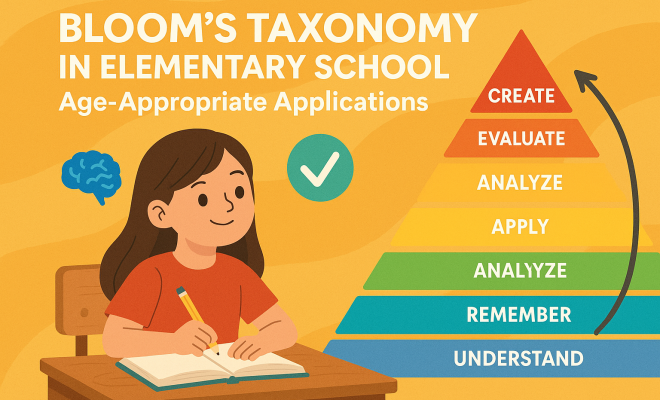
Bloom’s Taxonomy divides cognitive skills into six hierarchical levels, each representing a progression of learning. These levels were initially presented as: Knowledge, Comprehension, Application, Analysis, Synthesis, and Evaluation. In 2001, a revised version updated the terminology and structure to: Remembering, Understanding, Applying, Analyzing, Evaluating, and Creating. This updated hierarchy is more aligned with contemporary educational practices and reflects a greater emphasis on creative and critical thinking abilities.
The Importance of Age-Appropriate Applications
In elementary education, understanding the developmental stage of children is crucial. The cognitive abilities of a first grader differ vastly from those of a fifth grader. Therefore, applying Bloom’s Taxonomy requires careful consideration of age-appropriate strategies. Lessons designed using this taxonomy not only help students grasp basic concepts but also encourage higher-order thinking as they advance through grades.
Practical Insights for Each Level of Bloom’s Taxonomy
Implementing Bloom’s Taxonomy in the classroom involves tailoring activities to suit each cognitive level. Here’s how educators can apply each level effectively:
1. Remembering
At the remembering stage, students should recall facts and basic concepts. Teachers can introduce fun, interactive games such as flashcards or matching activities that reinforce vocabulary and key ideas. For example, using colorful index cards with pictures and words can engage kindergarteners in recalling names of animals or colors.
2. Understanding
Once students can remember information, the next step is ensuring they understand it. Teachers can utilize storytelling, discussions, and visual aids. For instance, after reading a story, educators might ask students to summarize the plot or identify the main character, ensuring they grasp the material and can express it in their own words.
3. Applying
The application stage encourages students to use their knowledge in practical situations. This could translate into hands-on activities such as science experiments or math problems where students apply learned concepts. For instance, after a lesson on plants, a teacher might have the class plant seeds, allowing them to apply their understanding of growth processes.
4. Analyzing
At the analyzing level, students begin to break down information and examine it critically. Group projects that require collaboration can be beneficial. For example, a class could analyze different habitats and compare the plants and animals found in each. By working together, students learn to dissect topics and present their findings.
5. Evaluating
Evaluation tasks prompt students to make judgments based on criteria. This might include peer reviews of written work or discussions on the pros and cons of various solutions to a problem. A good activity could involve students debating the best way to conserve energy, allowing them to weigh different perspectives and articulate their reasoning.
6. Creating
Finally, the highest level of Bloom’s Taxonomy is creating, where students synthesize information to generate new ideas or products. Projects that allow for creativity, such as designing an advertisement for a book or inventing a new game, can foster students’ innovation. For example, fifth graders might create their own board game based on historical events, applying what they’ve learned in a fun and imaginative way.
Integrating Technology with Bloom’s Taxonomy
In today’s digital age, integrating technology into classroom activities can enhance the application of Bloom’s Taxonomy. Various educational tools and platforms support differentiated learning, allowing teachers to adjust tasks based on student needs while remaining aligned with the taxonomy. For instance, apps that facilitate quizzes can help students practice remembering and understanding concepts. In contrast, collaborative online platforms, like Google Docs, can foster analyzing and creating by enabling students to work together remotely, sharing ideas and editing each other’s work. (See: Bloom's Taxonomy overview.)
Challenges in Implementation
Despite its benefits, implementing Bloom’s Taxonomy in elementary education is not without challenges. One of the primary concerns is teachers’ familiarity with the taxonomy and its levels. Professional development programs focused on these teaching strategies can help educators effectively integrate the taxonomy into their lesson plans.
Another challenge is time. Curriculum demands can pressure teachers to cover extensive material quickly, leaving less room for activities that engage higher-order thinking. However, by incorporating Bloom’s principles into daily lessons, teachers can foster an environment of inquiry, ensuring that students are not just passive recipients of information.
The Role of Assessment in Bloom’s Taxonomy
Assessment plays a critical role in understanding how well students are grasping concepts and progressing through Bloom’s Taxonomy. Formative assessments, such as quizzes and class discussions, provide immediate feedback and help educators adapt instruction accordingly. Summative assessments, like projects or presentations, gauge student learning at the end of a unit, ensuring that all levels of the taxonomy are being addressed.
Moreover, rubrics based on Bloom’s levels can offer clear expectations for students and help them achieve their learning goals. For example, a rubric for a writing assignment might include criteria for remembering (fact recall), understanding (summarizing), applying (using examples), analyzing (comparing), evaluating (justifying choices), and creating (developing unique ideas).
Real-World Examples and Success Stories
Across the nation, many schools have successfully integrated Bloom’s Taxonomy into their curricula, yielding positive results. One notable example is a school district in California that revamped its science curriculum using the taxonomy. Teachers emphasized inquiry-based learning, encouraging students to ask questions and explore topics deeply. After two years, standardized test scores in science improved dramatically, demonstrating the effectiveness of this approach.
Another success story comes from a New York City elementary school that focused on creating a project-based learning environment. By allowing students to engage in real-world problems and apply their learning, they saw significant increases in student engagement and critical thinking abilities. Through this experience, students developed a love for learning that extended beyond the classroom.
Current Relevance of Bloom’s Taxonomy in Education
As education continues to evolve, the relevance of Bloom’s Taxonomy remains steadfast. In a world that values critical and creative thinking, teachers are challenged to cultivate these skills in their students. With the rise of educational standards, such as the Common Core, Bloom’s Taxonomy provides a robust framework for aligning teaching objectives while meeting diverse learning needs.
Moreover, with the emphasis on social-emotional learning, Bloom’s Taxonomy can be intertwined with teaching kids how to collaborate, communicate, and think critically about their actions and choices. This holistic approach to education prepares students not just academically but also socially and emotionally for the challenges they will encounter.
Expanding Bloom’s Taxonomy Beyond the Classroom
Bloom’s Taxonomy can also extend its impact beyond the traditional classroom setting. Engaging parents and the community in the learning process can solidify students’ understanding of concepts and promote lifelong learning. For instance, schools might hold workshops for parents that demonstrate how to use Bloom’s principles at home, such as through games that encourage critical thinking or discussions that promote understanding of various topics.
Community involvement can also take the form of local experts visiting classrooms to share knowledge, allowing students to analyze real-world scenarios and apply their learning in authentic contexts. This can take many forms, such as inviting scientists to discuss environmental issues, local historians to share insights on community heritage, or artists to inspire creativity.
Professional Development for Educators
For teachers to effectively use Bloom’s Taxonomy, ongoing professional development is essential. Workshops and training sessions can provide educators with the strategies and tools they need to implement the taxonomy effectively. Collaborating with colleagues to share best practices and experiences can also create a supportive environment for teachers as they explore this framework.
Additionally, creating a community of practice within a school can foster a culture of inquiry among educators, allowing for the exchange of ideas and resources that align with Bloom’s Taxonomy. Educators can create lesson plans together, review assessment strategies, and reflect on their teaching practices to enhance student learning outcomes. (See: Learning and cognitive development.)
Incorporating Bloom’s Taxonomy into Special Education
Bloom’s Taxonomy is also adaptable for special education settings, where understanding individual student needs is paramount. Teachers can modify activities to ensure that all students, regardless of their learning abilities, can engage with the material. For example, while teaching the concept of plants, a teacher may use multisensory approaches such as hands-on activities for kinesthetic learners or visual aids for visual learners.
Individualized Education Programs (IEPs) can benefit from the structured approach of Bloom’s Taxonomy, ensuring that goals set for students align with cognitive levels that facilitate growth. Assessments can also be tailored to reflect the student’s capabilities, allowing for a fair evaluation of their understanding and progress.
Common Misconceptions About Bloom’s Taxonomy
Despite its widespread use, there are a few misconceptions surrounding Bloom’s Taxonomy. One common misunderstanding is that the levels are entirely linear, meaning students must master one level before moving to the next. In reality, students often move between levels as they engage with various subjects and concepts, sometimes demonstrating higher-order thinking even when they are still learning fundamental ideas.
Another misconception is that the taxonomy can only be applied to academic subjects. In fact, it is versatile and can be used in art, music, physical education, and social-emotional learning. Educators can create activities that promote critical and creative thinking in any discipline, proving that Bloom’s Taxonomy is not limited to traditional academic settings.
Strategies for Classroom Management Using Bloom’s Taxonomy
Effective classroom management is crucial for creating an environment where Bloom’s Taxonomy can thrive. Teachers can utilize strategies that align with the different levels of the taxonomy to maintain order and promote positive behavior. For instance:
- Clear Expectations: At the Remembering and Understanding levels, set clear behavioral expectations and routines. Students should be able to recall the rules and understand their importance in maintaining a productive classroom.
- Engaging Lessons: Incorporate activities that require higher-order thinking to keep students engaged. When students are actively participating in Analyzing or Creating tasks, they are less likely to disrupt the class.
- Collaborative Learning: Encourage group work that aligns with the Analyzing and Evaluating levels. By working together, students learn to manage conflicts and support one another, fostering a sense of community.
Real-World Applications of Bloom’s Taxonomy in Various Subject Areas
Applying Bloom’s Taxonomy across different subjects can demonstrate its flexibility and relevance. Here are examples from various disciplines:
1. Mathematics
In math, teachers can use the taxonomy to help students progress from basic arithmetic (Remembering) to solving complex word problems (Analyzing) and creating their own math games or puzzles (Creating). A project might involve students designing their own school budget, requiring them to apply and analyze their knowledge of addition, subtraction, and percentages.
2. Science
In science classes, educators can start with students recalling facts about ecosystems (Remembering) before moving to experiments where they apply the scientific method (Applying). They can then analyze results, evaluate hypotheses, and ultimately create their own experiments, presenting findings to the class.
3. Language Arts
In language arts, students can begin by recalling elements of a story (Remembering), then summarize plots (Understanding), analyze characters’ motivations (Analyzing), and eventually create their own stories or poems (Creating) based on learned literary techniques.
FAQ: Bloom’s Taxonomy in Elementary Education
1. What is Bloom’s Taxonomy?
Bloom’s Taxonomy is a framework that categorizes cognitive skills into six levels: Remembering, Understanding, Applying, Analyzing, Evaluating, and Creating. It helps educators design lessons that promote critical thinking and deeper understanding.
2. How can Bloom’s Taxonomy be applied in elementary classrooms?
Teachers can use Bloom’s Taxonomy by creating activities that correspond to each cognitive level. For example, they can use flashcards for remembering, group discussions for understanding, and projects for creating.
3. Why is Bloom’s Taxonomy important in education?
It encourages higher-order thinking, which is essential for students to develop critical thinking, problem-solving skills, and creativity, all of which are vital for success in today’s world.
4. How does Bloom’s Taxonomy support diverse learning needs?
Bloom’s Taxonomy provides a structured approach that can be adapted to different learning styles and abilities. Teachers can modify activities and assessments to accommodate individual students, ensuring everyone can engage with the material.
5. Can Bloom’s Taxonomy be used for online learning?
Absolutely! The principles of Bloom’s Taxonomy can be applied in online settings. Educators can use digital tools to facilitate collaboration, create assessments, and engage students in higher-order thinking activities.
6. What are some resources for teachers looking to implement Bloom’s Taxonomy?
There are many resources available, including books, online courses, and workshops focused on Bloom’s Taxonomy. Websites like the Association for Supervision and Curriculum Development (ASCD) and Edutopia offer valuable insights and practical strategies.
7. How does Bloom’s Taxonomy benefit student engagement?
By structuring lessons around Bloom’s levels, educators can promote deeper engagement. Students are more likely to participate when tasks challenge them to think critically and creatively, making learning more relevant and enjoyable.
8. Can I create interdisciplinary lessons using Bloom’s Taxonomy?
Yes! Bloom’s Taxonomy is ideal for interdisciplinary teaching. Teachers can design lessons that integrate multiple subjects, encouraging students to apply knowledge in varied contexts, such as combining art and history through project-based learning.
The Road Ahead for Bloom’s Taxonomy in Elementary Education
Bloom’s Taxonomy in Elementary Education is more than a theoretical framework; it is a practical strategy that guides teachers in fostering essential skills in young learners. Educators who implement its principles can create engaging, meaningful learning experiences that encourage students to think critically and creatively. As you reflect on your teaching practices, consider how you can harness the levels of Bloom’s Taxonomy to enrich your classroom environment. The future of education lies in our ability to cultivate not just knowledge, but a love for lifelong learning.
“`
Trending Now
Frequently Asked Questions
What is Bloom's Taxonomy in simple terms?
Bloom's Taxonomy is an educational framework that categorizes cognitive skills into six levels: Remembering, Understanding, Applying, Analyzing, Evaluating, and Creating. It helps educators design lessons that promote deeper understanding and critical thinking among students, particularly in elementary education.
How can Bloom's Taxonomy be applied in elementary classrooms?
In elementary classrooms, Bloom's Taxonomy can be applied by creating age-appropriate activities tailored to each cognitive level. For example, teachers can use games for remembering, discussions for understanding, and projects for creating, thereby fostering higher-order thinking as students progress through grades.
Why is Bloom's Taxonomy important for young learners?
Bloom's Taxonomy is important for young learners because it provides a structured approach to cognitive development. By aligning teaching strategies with students' developmental stages, educators can effectively promote both foundational knowledge and critical thinking skills, essential for academic success.
What are the revised levels of Bloom's Taxonomy?
The revised levels of Bloom's Taxonomy, updated in 2001, include: Remembering, Understanding, Applying, Analyzing, Evaluating, and Creating. This updated structure emphasizes creative and critical thinking, making it more relevant to contemporary educational practices.
How does Bloom's Taxonomy support higher-order thinking?
Bloom's Taxonomy supports higher-order thinking by encouraging students to progress through increasingly complex cognitive tasks. As students move from remembering basic facts to evaluating and creating new ideas, they develop critical thinking skills that are vital for deeper learning and problem-solving.
What did we miss? Let us know in the comments and join the conversation.