Bloom’s Taxonomy for Parents: Deepen Child’s Learning at Home
“`html
As parents, we are always looking for effective ways to support our children’s education and foster a love for learning. One powerful tool that can make a significant impact is Bloom’s Taxonomy for Parents. Developed by educational psychologist Benjamin Bloom in the 1950s, this framework helps categorize learning objectives and can guide the types of questions we ask our children. Understanding this taxonomy not only enhances their cognitive skills but also deepens their engagement with the material they study. In this article, we will explore how you can use Bloom’s Taxonomy to enrich your child’s learning experience at home.
1. Understanding Bloom’s Taxonomy
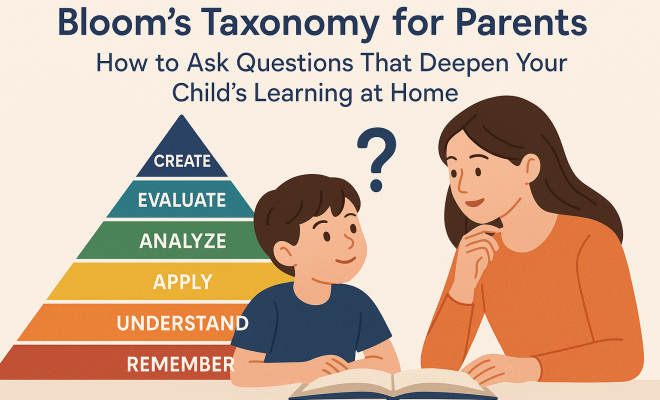
Bloom’s Taxonomy is a hierarchical model that classifies educational learning objectives into levels of complexity and specificity. The original version consisted of six levels: Knowledge, Comprehension, Application, Analysis, Synthesis, and Evaluation. In 2001, a revised version of the taxonomy was released, rephrasing the levels and adjusting their order to: Remember, Understand, Apply, Analyze, Evaluate, and Create.
This structure helps educators, and now parents, to formulate questions that encourage deeper thinking. For instance, instead of merely asking a child to recall facts, Bloom’s Taxonomy encourages questions that require understanding or application, fostering critical thinking and creativity. By employing this framework, you can create a more stimulating learning environment at home.
2. Bloom’s Taxonomy for Parents: Why It Matters
So why should parents care about Bloom’s Taxonomy? The reason is simple: it equips you to engage more effectively with your child’s learning process. When you ask the right questions, you not only promote critical thinking but also build their confidence and curiosity. Children are naturally inquisitive, and by aligning your questions with Bloom’s levels, you can channel that curiosity into meaningful learning experiences.
Research has shown that students who regularly engage in higher-order thinking (those that involve analyzing, evaluating, and creating) tend to perform better academically. By leveraging Bloom’s Taxonomy, you tap into the potential of your child’s mind, encouraging them to think independently and creatively. This approach not only enhances their academic skills but also prepares them for real-world problem-solving.
3. Asking Questions at the Remember Level
The first level of Bloom’s Taxonomy, Remember, involves recalling facts and basic concepts. At this level, your child should be able to recognize and remember information. You can support this process by asking questions that require them to retrieve knowledge, enabling them to build a foundation for deeper learning.
Examples of questions you might ask include: “What did you learn about the water cycle?” or “Can you name the characters in your favorite book?” These questions encourage your child to recall information, setting the stage for more complex thinking. Furthermore, engaging them in discussions about what they remember helps solidify that knowledge in their mind.
4. Encouraging Understanding Through Questions
The next level, Understand, focuses on comprehension. Here, the aim is to ensure that your child can explain concepts in their own words and demonstrate understanding. By asking questions that prompt explanation, you encourage them to process the information meaningfully.
Consider questions like, “Can you explain why the seasons change?” or “How would you summarize the main idea of the story you read?” These types of inquiries not only check for understanding but also invite your child to articulate their thoughts and connect ideas. This level of questioning is crucial because it helps to solidify their comprehension and enhances retention.
5. Application: Putting Knowledge to Use
Once your child has a grasp on the material, it’s time to move on to the Application level. This level encourages learners to use their knowledge in new situations, demonstrating their ability to apply what they’ve learned. By asking relevant application questions, you foster their ability to think critically. (See: Bloom's Taxonomy overview.)
You might ask, “How would you use what you learned about fractions to share a pizza with your friends?” or “Can you think of a real-life situation where you would need to know about ecosystems?” These questions compel children to transfer their learning to real-world contexts, enhancing their problem-solving skills and making learning more relevant and engaging.
6. Analyzing Information: Digging Deeper
The Analysis level invites students to break down information into parts and understand its structure. At this stage, it’s essential to ask questions that encourage your child to explore relationships between ideas and identify patterns.
For instance, you can ask, “What are the similarities and differences between two characters in your book?” or “How do the elements of a story work together to create suspense?” Such questions prompt children to think critically about the information they have learned, paving the way for deeper insights and understanding.
7. Evaluating Ideas: Forming Judgments
Once your child has analyzed information, the next step is Evaluation. Here, your questions should encourage them to make judgments based on criteria and standards. This level is crucial for developing critical thinking and reasoning skills.
Ask questions like, “What do you think about the author’s perspective in the story?” or “Which solution to this problem do you think is best, and why?” This encourages your child to assess information critically and develop their opinions, fostering their ability to engage in thoughtful discussions.
8. Creating New Ideas and Perspectives
The final level, Create, is where true learning culminates. At this stage, you want to encourage your child to generate new ideas or products based on their understanding of the material. This is where creativity shines and where your child can express their knowledge in innovative ways.
To facilitate this, you might ask, “Can you come up with a different ending for the story?” or “What project can you create that showcases what you learned about energy?” Such questions inspire your child to think outside the box, synthesizing their knowledge and expressing it uniquely. This is a powerful way to promote creativity and independence in learning.
9. Practical Tips for Implementing Bloom’s Taxonomy at Home
Implementing Bloom’s Taxonomy in your daily interactions with your child doesn’t have to be complex. Here are some practical tips to help you along the way:
- Integrate Questions into Daily Activities: Use the taxonomy during routine activities, such as cooking or shopping. Ask your child to explain the steps involved or how they would solve a problem related to those activities.
- Be Patient: Encourage your child to think through their answers. Sometimes, they might need a moment to formulate a response, especially at higher levels.
- Adjust Your Questions: Tailor your questions to your child’s age and development level. Younger children may need simpler questions, while older children can handle more complex ones.
- Encourage Reflection: After discussing a topic, ask your child how they feel about what they’ve learned. This not only reinforces their learning but also builds metacognitive skills.
- Make It Fun: Turn questions into games or challenges. This can make learning more engaging and reduce any pressure your child might feel.
By actively engaging with your child through Bloom’s Taxonomy, you’re not just helping them with schoolwork; you’re instilling a lifelong love for learning. Each question you ask can open doors to deeper understanding and critical thinking. Remember, learning is a partnership, and by using these strategies, you can become a vital part of your child’s educational journey.
10. Bloom’s Taxonomy Across Different Subjects
Bloom’s Taxonomy isn’t just a one-size-fits-all approach; it can be adapted to various subjects. Whether your child is diving into math, science, literature, or social studies, you can leverage the taxonomy to enhance their understanding and engagement.
Math
In mathematics, the Remember level might involve recalling basic formulas. As they progress to the Understand level, you could ask them to explain why a particular formula works. For Application, you could pose a scenario, asking how they would use their math skills to budget for a birthday party. As they analyze, encourage them to compare different methods of solving a problem. Evaluating could involve discussing which method is the most efficient, while Creating could lead to them developing a new game that incorporates mathematical principles.
Science
Science lends itself beautifully to Bloom’s Taxonomy as well. Start with simple recall questions about the scientific method. Move to understanding by asking your child to explain why a hypothesis is essential. For Application, you might have them conduct a simple experiment. Analyze by discussing the results, while Evaluation can focus on what conclusions they can draw. Finally, Create by encouraging them to propose an experiment to test a new hypothesis. (See: Harvard University education resources.)
Literature
In literature, you can start by asking your child to remember details about characters or plot points. Transition to understanding by asking them to summarize the story or discuss the main themes. For application, ask how the story mirrors real-world situations. Analyzing can involve comparing two different authors’ writing styles, and evaluating can focus on their opinions about the book’s ending. Finally, encourage them to create an alternative ending or a new character.
Social Studies
Social studies can benefit from Bloom’s Taxonomy, too. Begin by having your child recall historical facts or figures. Move to understanding by discussing the causes and effects of significant events. For application, ask them how history might influence current events. Analyzing involves breaking down the impact of a historical figure on society, while evaluating can focus on their viewpoints on historical decisions. Finally, engage them in creating a presentation about a historical event.
11. Benefits of Bloom’s Taxonomy for Parents
Adopting Bloom’s Taxonomy in your parenting practice offers numerous benefits. Here are just a few:
- Enhances Communication: By asking thoughtful questions, you improve the quality of conversations with your child, making discussions more insightful and engaging.
- Strengthens Critical Thinking: Encouraging your child to think critically helps them become problem solvers and decision-makers.
- Promotes Independence: When children learn to answer higher-order thinking questions, they become more independent learners, capable of tackling problems on their own.
- Builds Confidence: As your child engages in deeper thinking, they gain confidence in their intellectual abilities and are more willing to express their thoughts and ideas.
- Fosters a Growth Mindset: Bloom’s Taxonomy encourages children to embrace challenges and view mistakes as opportunities to learn, nurturing a growth mindset.
12. Common Misconceptions about Bloom’s Taxonomy
Despite its widespread use, there are several misconceptions about Bloom’s Taxonomy that can hinder its application:
- It’s Only for Teachers: Some believe that Bloom’s Taxonomy is solely for educators. However, parents can effectively use it to enhance their child’s learning at home.
- It’s Too Complex: While the taxonomy has layers, it can be adapted simply for everyday conversations and does not require extensive training to implement.
- Higher Levels Are Always Better: There’s a belief that higher-level questioning is always superior. While important, all levels of questioning serve a purpose in learning.
- It’s Rigidity: Some may think it’s a rigid framework, but Bloom’s Taxonomy is flexible and can be adjusted to fit various learning situations.
13. FAQ: Bloom’s Taxonomy for Parents
What is Bloom’s Taxonomy?
Bloom’s Taxonomy is a framework that categorizes learning objectives into levels of cognitive complexity, helping educators and parents formulate effective questions to promote deeper thinking.
How can I use Bloom’s Taxonomy at home?
You can integrate Bloom’s Taxonomy into your daily conversations by asking questions that correspond to its various levels, encouraging your child to think critically and creatively about what they learn.
Is Bloom’s Taxonomy suitable for all ages?
Yes! Bloom’s Taxonomy can be adapted to fit children of all ages by adjusting the complexity of the questions you ask.
What if my child struggles with higher-order thinking?
It’s essential to be patient and supportive. Encourage them by starting with lower-order questions and gradually increasing complexity as their confidence grows.
Can Bloom’s Taxonomy help in subjects outside traditional academics?
Absolutely! The principles of Bloom’s Taxonomy can enhance learning in any area, including arts, sports, and everyday life skills.
Does Bloom’s Taxonomy apply to emotional and social learning?
Yes, you can apply Bloom’s Taxonomy to emotional and social learning by encouraging children to analyze their feelings, evaluate their interactions, and create strategies for improved relationships. (See: CDC on health and academic success.)
How does Bloom’s Taxonomy promote a love for learning?
By engaging children in meaningful conversations and critical thinking, Bloom’s Taxonomy helps create a stimulating environment where curiosity thrives, fostering a lifelong love of learning.
14. Real-World Applications of Bloom’s Taxonomy
Understanding Bloom’s Taxonomy can significantly affect how children perceive learning beyond academics. You might find opportunities to apply it in everyday life. For example, during family outings, you can explore educational themes related to history or science. If visiting a museum, ask your child to identify key exhibits (Remember), discuss what they found interesting about a particular display (Understand), or even relate it to something they learned in school (Apply).
Consider also engaging in community projects or volunteer work. You can guide your child to analyze societal issues (Analyze) and evaluate potential solutions (Evaluate). Finally, encourage them to plan a community event, allowing them to create and implement their ideas (Create).
15. Assessing the Effectiveness of Bloom’s Taxonomy in Your Parenting
It’s beneficial to periodically assess how well Bloom’s Taxonomy is working for your family. Start by observing changes in your child’s engagement and enthusiasm for learning. Are they asking more questions? Are they more willing to tackle challenging subjects? Keep an eye on their confidence and independence in learning tasks too.
Another useful method is to have discussions with your child about their learning experiences. Ask them what they enjoy most and where they feel challenged. This feedback can help you adjust your approach to better suit their needs and preferences, ensuring that the application of Bloom’s Taxonomy remains effective.
16. Supporting Resources for Parents
For parents looking to dive deeper into Bloom’s Taxonomy, numerous resources are available:
- Books: There are various books about Bloom’s Taxonomy that can provide deeper insights and practical strategies.
- Online Courses: Websites like Coursera or edX offer courses on educational frameworks, including Bloom’s Taxonomy.
- Educational Blogs: Many educators share tips and experiences using Bloom’s Taxonomy on blogs, offering real-life examples of its application.
- Workshops: Check if local schools or educational institutions offer workshops for parents on Bloom’s Taxonomy.
- Community Groups: Joining parenting or education-focused groups can provide a platform for sharing experiences and strategies related to Bloom’s Taxonomy.
By implementing Bloom’s Taxonomy for Parents into your daily routine, you can help your child develop critical thinking skills, enhance their understanding of various subjects, and encourage a love for learning that lasts a lifetime.
“`
Trending Now
Frequently Asked Questions
What is Bloom's Taxonomy and how can it help parents?
Bloom's Taxonomy is a framework that categorizes educational objectives into levels of complexity. For parents, it provides a structured way to ask questions that promote deeper thinking and engagement in their child's learning, fostering critical skills like analysis and creativity.
How can I use Bloom's Taxonomy to ask better questions?
To use Bloom's Taxonomy effectively, start by understanding its levels: Remember, Understand, Apply, Analyze, Evaluate, and Create. Frame questions that align with these levels, encouraging your child to think critically and engage more deeply with the material they study.
Why is it important for parents to engage in their child's learning?
Engaging in your child's learning is vital as it builds their confidence, curiosity, and critical thinking skills. By asking thoughtful questions based on Bloom's Taxonomy, you can create a supportive environment that enhances their educational experience at home.
What are some examples of questions based on Bloom's Taxonomy?
Examples include: 'Can you explain why this is important?' (Understand), 'How would you solve this problem?' (Apply), and 'What are the implications of this idea?' (Analyze). These types of questions encourage deeper engagement and critical thinking.
How does Bloom's Taxonomy promote critical thinking in children?
Bloom's Taxonomy promotes critical thinking by encouraging questions that require more than rote memorization. By guiding children to analyze, evaluate, and create, parents can help them develop higher-order thinking skills that are essential for effective learning.
What’s your take on this? Share your thoughts in the comments below — we read every one.