Bloom’s Taxonomy: Original vs. Revised (2001) – Key Differences
“`html
Bloom’s Taxonomy has been a cornerstone of educational theory since it was introduced by Benjamin Bloom and his colleagues in 1956. The framework has undergone significant changes over the years, leading to the revised version in 2001. Understanding the Bloom’s Taxonomy differences between the original and revised models is crucial for educators, curriculum developers, and anyone interested in effective teaching strategies. This article aims to explore these differences in depth, examining what changed, why those changes matter, and how they can be applied in contemporary educational settings.
The Origins of Bloom’s Taxonomy
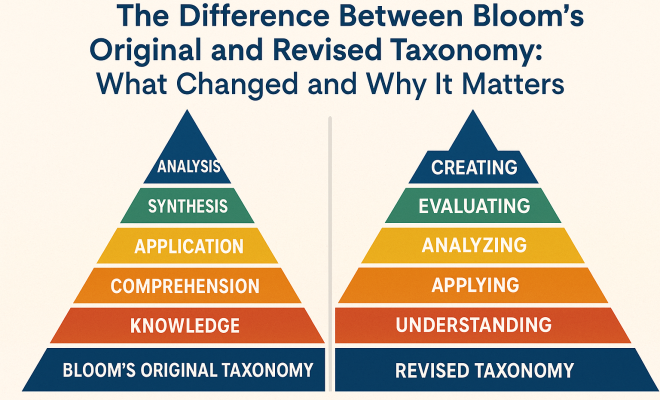
Bloom’s original taxonomy emerged from the need to categorize educational objectives, making it easier for educators to set clearer goals for their students. The original model consisted of a hierarchy of cognitive skills that ranged from simple to complex, divided into six levels: Knowledge, Comprehension, Application, Analysis, Synthesis, and Evaluation. Each level represented a different kind of learning, beginning with the basic recall of facts and advancing to higher-order thinking skills.
This classification was revolutionary at the time, as it provided educators with a structured way to assess and promote student learning. By identifying specific cognitive skills and aligning them with educational objectives, teachers could design curricula that fostered deeper understanding and critical thinking.
The Need for Revision
As educational theories and practices evolved, so did the need for a more contemporary framework. By the late 1990s, it became apparent that the original taxonomy was somewhat limited. Critics argued that it was too rigid and did not account for the dynamic and interconnected nature of learning processes. Additionally, the rise of constructivist approaches highlighted the need for a more flexible model that encouraged active learning and student engagement.
In 2001, a group of cognitive psychologists, curriculum theorists, and educators, led by Lorin Anderson (one of Bloom’s former students), undertook the task of revising the original taxonomy. Their goal was to modernize the framework to better reflect current educational practices and theories.
Key Differences in Structure
One of the most significant Bloom’s Taxonomy differences lies in the structure of the revised version. The original taxonomy presented a unidirectional hierarchy, whereas the revised taxonomy introduced a two-dimensional framework. This new model comprises a knowledge dimension and a cognitive process dimension, providing a more nuanced view of how learning occurs.
The cognitive process dimension mirrors some elements of the original taxonomy but changes the name of several levels. Instead of Knowledge, Comprehension, Application, Analysis, Synthesis, and Evaluation, the revised version lists Remembering, Understanding, Applying, Analyzing, Evaluating, and Creating. This shift in terminology reflects a more active engagement with knowledge, emphasizing that learning is not merely about recalling information but involves deeper cognitive processes.
From Synthesis to Creating: A Paradigm Shift
Perhaps the most intriguing change in the Bloom’s Taxonomy differences is the replacement of Synthesis with Creating. This is not just a semantic change but a significant shift in how we perceive higher-order thinking. The term ‘Creating’ implies a process of innovation and original thought, encouraging students to generate new ideas, products, or approaches based on their understanding of concepts.
In the original taxonomy, synthesis was often viewed as a cognitive skill that involved combining various elements to form a coherent whole. However, in the revised version, creating encompasses a broader and more complex range of skills, such as designing, constructing, and producing. This change reflects contemporary educational priorities that emphasize creativity as a vital skill necessary for students in the 21st century.
Knowledge Dimension: A Broader Perspective
The revised taxonomy also introduced a knowledge dimension that categorizes knowledge types into four categories: Factual, Conceptual, Procedural, and Metacognitive. This differentiation recognizes that not all knowledge is created equal and that learners engage with different types of knowledge in distinct ways.
- Factual Knowledge: Refers to the basic elements students must know to be acquainted with a discipline.
- Conceptual Knowledge: Involves the understanding of interrelationships among the basic elements within a larger structure.
- Procedural Knowledge: Entails how to do something, including methods and techniques.
- Metacognitive Knowledge: Involves awareness of one’s own cognition processes and understanding how to regulate those processes.
This nuanced approach allows educators to design learning objectives that cater to various types of knowledge, promoting a more comprehensive understanding of subject matter. (See: Bloom's Taxonomy overview.)
Implementation in the Classroom
Understanding the Bloom’s Taxonomy differences is vital for implementing effective teaching strategies. The revised taxonomy’s focus on active engagement and higher-order thinking encourages educators to create learning experiences that require students to analyze, evaluate, and create rather than merely remember and understand. This shift has profound implications for curriculum design, assessment, and teaching methodologies.
For instance, when designing learning objectives using the revised taxonomy, educators can craft goals that align with creating or evaluating. Instead of asking students to recall facts about a historical event, a teacher might ask them to evaluate the impact of that event on contemporary society or create a project that reflects their understanding of its significance.
Assessments and Bloom’s Taxonomy
Bloom’s taxonomy has long been used to inform assessment practices. The shift from simple recall-based assessments to those that gauge higher-order thinking skills reflects the changes in the revised version. This evolution emphasizes the importance of aligning assessments with educational goals that promote deeper understanding.
Utilizing the revised taxonomy can guide educators in developing diverse forms of assessment, such as project-based learning, portfolios, and performance assessments that encourage creativity and critical thinking. By assessing students in various ways, educators can better capture the full scope of their learning.
Current Relevance in Education
In today’s rapidly changing educational landscape, the relevance of Bloom’s revised taxonomy has only grown. The emphasis on critical thinking, collaboration, and creativity resonates with current educational priorities, such as the push for STEM education and the integration of technology in the classroom.
As schools increasingly incorporate project-based learning and inquiry-based approaches, the revised taxonomy serves as a valuable framework for designing curricula that prepare students for the challenges of the modern world. By fostering higher-order thinking skills, educators can better equip students to think critically and creatively in their future careers.
Practical Tips for Educators
Implementing the revised Bloom’s taxonomy in your classroom doesn’t have to be overwhelming. Here are some practical tips for educators looking to integrate the framework into their teaching:
- Foster a Growth Mindset: Encourage students to view challenges as opportunities for growth. This aligns with the revised taxonomy’s focus on creating and evaluating.
- Integrate Technology: Utilize digital tools to facilitate collaboration and creativity, such as collaborative document editing or video creation platforms.
- Create Diverse Assessments: Design assessments that require students to engage in higher-order thinking, such as reflective journals, presentations, or group projects.
- Collaborate with Peers: Engage in discussions with colleagues about ways to implement the revised taxonomy in your curriculum, sharing resources and strategies.
By adopting these practices, educators can apply the principles of the revised taxonomy more effectively, enhancing student learning experiences.
The Global Impact of Bloom’s Taxonomy
Bloom’s Taxonomy, both in its original and revised forms, has had a profound impact on educational systems worldwide. Its principles have been adopted and adapted across various cultures and educational contexts, underscoring its universal relevance in teaching and learning.
Countries implementing progressive educational reforms often reference Bloom’s Taxonomy as a foundational framework for developing critical thinking and creativity in their students. For instance, educators in Asia have integrated the revised taxonomy into their teaching methodologies, promoting inquiry-based learning that aligns with global competencies.
Exploring the Cognitive Levels Further
The cognitive process dimension consists of six levels, each representing a distinct type of cognitive activity. Let’s take a closer look at each level and how it can be applied in classroom settings:
Remembering
This is the foundation of learning, where students recall or recognize information. Teachers can employ strategies like quizzes, flashcards, and rote memorization techniques to bolster this level. For example, in a history class, students might be tasked with memorizing key dates and figures. (See: U.S. Department of Education on Bloom's Taxonomy.)
Understanding
Once students can recall information, the next step is to ensure they understand it. This could involve summarizing readings, explaining concepts in their own words, or teaching a peer. Group discussions and collaborative projects can be effective here, encouraging students to articulate their comprehension.
Applying
Applying involves using knowledge in new situations. In math, for instance, students might apply formulas to solve real-world problems. Science experiments offer another great opportunity for applying theoretical knowledge practically, allowing students to see the principles in action.
Analyzing
This level requires students to break down information into parts and examine relationships. Analyzing can be facilitated through activities like comparing and contrasting different theories or interpreting data sets. For example, in literature, students might analyze themes or character motivations, fostering deeper engagement with the text.
Evaluating
Evaluating requires making judgments based on criteria. Students might critique a piece of writing or assess the validity of different arguments in a debate format. This level encourages critical thinking, prompting students to consider the strengths and weaknesses of various viewpoints.
Creating
The highest level involves synthesizing information to produce something new. This could manifest as designing a research project, developing a business plan, or composing a piece of music. Encouraging creativity not only engages students but also prepares them for real-world challenges requiring innovation.
The Role of Educators in Facilitating Learning
As the landscape of education changes, the role of teachers has evolved from traditional sources of information to facilitators of learning. This shift means educators need to create environments that encourage exploration and inquiry. Here are a few strategies to consider:
- Encourage Questioning: Foster a classroom culture where students feel comfortable asking questions. This can lead to richer discussions and deeper understanding.
- Use Real-World Problems: Implement project-based learning that tackles real-world issues. This not only engages students but also helps them see the relevance of what they are learning.
- Foster Collaboration: Encourage group activities that require teamwork. Collaboration helps students develop necessary social skills while also learning from one another.
- Provide Feedback: Regular, constructive feedback is essential for student growth. It guides students in understanding their progress and areas for improvement.
Frequently Asked Questions (FAQ)
What are the main differences between the original and revised Bloom’s Taxonomy?
The primary differences involve the structure and terminology. The revised version uses a two-dimensional framework with cognitive process dimensions and a knowledge dimension, and it replaces ‘Synthesis’ with ‘Creating’ to reflect a more emphasis on innovation.
How can I apply Bloom’s Taxonomy in my teaching?
Start by aligning your learning objectives with the levels of Bloom’s Taxonomy. Use activities and assessments that address multiple levels of cognitive processes, ensuring students engage with material in varied ways.
Is Bloom’s Taxonomy still relevant today?
Yes, the revised Bloom’s Taxonomy remains highly relevant, especially as education increasingly focuses on critical thinking, creativity, and real-world application of knowledge. It provides tools for educators to design curricula that reflect contemporary educational needs.
How can assessments align with Bloom’s Taxonomy?
Incorporate a range of assessments that target different cognitive levels. For instance, use multiple-choice questions for remembering, essays for evaluating, and projects for creating to gauge students’ comprehensive understanding. (See: Harvard University educational resources.)
What is the importance of higher-order thinking skills?
Higher-order thinking skills are essential for students to navigate the complexities of life, work, and society. They foster the ability to analyze, evaluate, and create, which are crucial skills in an increasingly complex world.
Real-World Applications of Bloom’s Taxonomy
Beyond the classroom, Bloom’s Taxonomy has found application in various fields, including business, healthcare, and even technology. In these domains, the framework is used to design training programs, assess employee skills, and enhance collaboration among teams. For instance, corporate training often employs Bloom’s principles to ensure that employees advance from fundamental knowledge to practical application and creative problem-solving.
Case Study: Corporate Training Programs
Several companies have embraced Bloom’s Taxonomy in their training initiatives. Take a tech firm that develops software; they might use the taxonomy to craft a curriculum for new employees. Starting with basic coding knowledge, they would introduce hands-on projects where employees apply what they’ve learned. Eventually, they would encourage employees to analyze existing code for efficiency and create innovative solutions to improve software products.
Such application not only fosters a deeper understanding of the material but also equips employees with the higher-order thinking skills necessary for tech innovation. Companies like Google and Microsoft have incorporated similar frameworks into their learning and development strategies, emphasizing the importance of creativity and critical thinking in problem-solving.
Future Trends in Education and Bloom’s Taxonomy
Looking ahead, the landscape of education continues to shift, influenced by advancements in technology, the global economy, and the changing needs of society. Here are some emerging trends that will impact the application of Bloom’s Taxonomy:
- Personalized Learning: As education moves towards personalized learning environments, educators can leverage Bloom’s Taxonomy to tailor their approaches to individual student needs. This adaptive learning can enhance engagement and effectiveness.
- Integrating Artificial Intelligence: AI is becoming a prominent tool in education, providing resources for assessment and personalized feedback. Bloom’s Taxonomy can guide the development of AI-driven educational technologies, ensuring they align with cognitive processes.
- Focus on Social-Emotional Learning (SEL): As schools increasingly recognize the importance of SEL, Bloom’s principles can be adapted to incorporate emotional intelligence and interpersonal skills into the curriculum, merging cognitive and emotional development.
The Lasting Legacy of Bloom’s Taxonomy
The differences between Bloom’s original and revised taxonomy highlight the evolution of educational theory and practice over the decades. These changes reflect a deeper understanding of how learning occurs and the necessity to cultivate higher-order thinking skills in students.
As we continue to navigate the complexities of education in the 21st century, embracing the principles of the revised taxonomy is essential for preparing students to thrive in an increasingly interconnected and rapidly changing world. By understanding and applying the Bloom’s Taxonomy differences, educators can create more meaningful learning experiences that empower students to think critically, innovate, and succeed.
“`
Trending Now
- How Mindfulness Practices Improve Executive Function and Emotional Regulation
- this guide on the relationship between object permanence and cognitive development in infants
- our breakdown of how adhd affects executive function and emotional regulation in high school
- this guide on the role of nonverbal communication in pragmatic language development
- read the full story
Frequently Asked Questions
What are the main differences between Bloom's original and revised taxonomy?
The original Bloom's Taxonomy featured a hierarchy of cognitive skills from Knowledge to Evaluation, while the revised version, introduced in 2001, redefined the levels as Remembering, Understanding, Applying, Analyzing, Evaluating, and Creating. This shift emphasizes a more dynamic and interconnected approach to learning.
Why was Bloom's Taxonomy revised?
The revision was necessary to address criticisms of the original framework, which was seen as too rigid and not reflective of modern educational practices. The revised taxonomy incorporates contemporary theories, emphasizing active learning and student engagement, making it more applicable to current teaching strategies.
How can educators apply Bloom's revised taxonomy in the classroom?
Educators can use Bloom's revised taxonomy to design learning objectives that promote higher-order thinking. By aligning assessments and activities with the levels of the taxonomy, teachers can encourage students to engage in deeper understanding, critical thinking, and creativity.
What are the six levels of Bloom's revised taxonomy?
The six levels of Bloom's revised taxonomy are: Remembering, Understanding, Applying, Analyzing, Evaluating, and Creating. This progression encourages learners to build on foundational knowledge and develop complex cognitive skills necessary for effective problem-solving.
How does Bloom's Taxonomy benefit curriculum development?
Bloom's Taxonomy provides a structured framework that helps educators set clear learning objectives and assessment criteria. By utilizing this taxonomy, curriculum developers can ensure that educational goals promote a range of cognitive skills, fostering a more comprehensive and effective learning experience.
What’s your take on this? Share your thoughts in the comments below — we read every one.