Webb Telescope Detects Methane on Interstellar Object 3I/ATLAS
“`html
Introduction: A New Frontier in Space Discovery
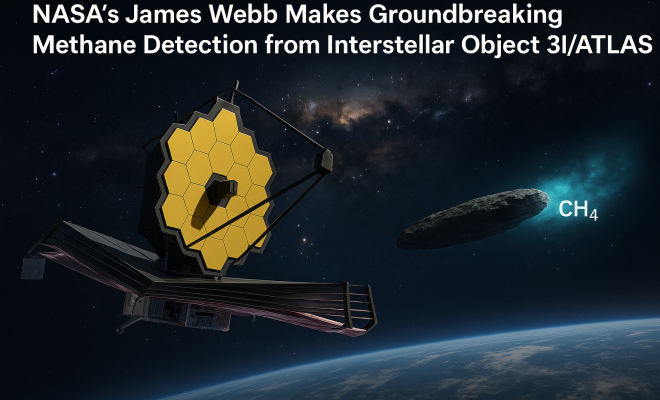
The cosmos has always fascinated humankind, with its countless secrets just waiting to be unraveled. Recently, a remarkable event has sparked excitement among astronomers and space enthusiasts alike: NASA’s James Webb Space Telescope (JWST) detected methane emissions from the interstellar object 3I/ATLAS. This finding marks the first time methane gas has been identified in observations of an interstellar body, raising intriguing questions about the origins and characteristics of these distant travelers.
What is 3I/ATLAS?
3I/ATLAS is an icy, rocky body that made its closest approach to the Sun, or perihelion, in mid-2022. Unlike typical comets found within our solar system, which often exhibit predictable behavior and composition, 3I/ATLAS presents itself as a unique case. The object was discovered by astronomers using the Asteroid Terrestrial-impact Last Alert System (ATLAS), hence its designation. Its journey through our solar system is particularly notable, as it is not bound to the Sun in the same way that planets and comets are.
What sets 3I/ATLAS apart is its interstellar origin. Researchers believe it originated from another star system before passing close to the Sun and entering the inner solar system. This distinction alone adds to the excitement of studying 3I/ATLAS and other similar interstellar objects, as they provide a glimpse into the materials and processes that may exist beyond our solar neighborhood.
The Groundbreaking James Webb Methane Detection
NASA’s James Webb Space Telescope has garnered significant attention since it was launched in December 2021. Designed to observe the universe in unprecedented detail, JWST has capabilities that allow it to analyze the composition of distant celestial bodies. The detection of methane from 3I/ATLAS is a testament to JWST’s state-of-the-art technology and its potential to revolutionize our understanding of the universe.
The discovery occurred about two months after the object passed perihelion, making it a particularly striking finding. Traditional comets in our solar system release methane due to the presence of organic compounds and the interactions of solar radiation with their icy surfaces. However, the presence of methane in 3I/ATLAS challenges this established narrative, as the object’s composition and origin differ significantly from those of familiar solar-system comets.
Understanding Methane in Cosmic Context
Methane (CH₄) is a simple molecule composed of one carbon atom and four hydrogen atoms. Its presence in the universe is often associated with biological processes, but it can also form through abiotic mechanisms. On Earth, methane is produced by a variety of sources, including natural gas deposits, wetlands, and agricultural activities.
In the context of astronomy, detecting methane in extraterrestrial environments can indicate potential biological activity, but it is not a definitive sign of life. For instance, methane has been detected on Mars, in the atmospheres of exoplanets, and even in the plumes of icy moons like Europa. The James Webb methane detection from 3I/ATLAS adds a new layer to our understanding of where and how methane can form in the universe.
How Did JWST Detect Methane?
The JWST uses advanced infrared spectroscopy to analyze the light emitted or reflected by celestial objects. As light passes through the atmosphere of an object, specific wavelengths are absorbed by different elements and compounds, creating unique spectral fingerprints. These fingerprints allow scientists to identify the composition of the object.
In the case of 3I/ATLAS, JWST’s instruments were able to detect the characteristic absorption features of methane in the object’s spectrum. This “sniffing” of methane, as described by the European Space Agency (ESA), showcases the telescope’s capacity to study even the faintest signals from distant celestial bodies.
Implications of the Discovery
The detection of methane in an interstellar object like 3I/ATLAS could have profound implications for our understanding of chemistry beyond Earth. If methane is formed through processes common to interstellar space, it suggests that these compounds may be more widespread than previously thought. This could pave the way for future studies of other interstellar objects and their compositions, shedding light on the building blocks of life.
Moreover, understanding the origins of methane in 3I/ATLAS could lead to insights into the formation of similar icy bodies in different star systems. It raises tantalizing prospects for astrobiology, as it encourages researchers to explore the potential for life-sustaining conditions elsewhere in the universe. (See: James Webb Space Telescope overview.)
Comparison with Solar System Comets
In essence, the James Webb methane detection highlights a critical distinction between interstellar objects and solar system comets. While both may exhibit similar features, their composition, behavior, and formation are likely to be quite different. Solar system comets, such as Comet Hale-Bopp or Comet NEOWISE, typically exhibit a rich variety of organic material, ice, and dust accumulated over billions of years within the gravitational influence of the Sun.
On the other hand, interstellar objects like 3I/ATLAS have undergone different evolutionary paths. Their materials may include components from diverse star-forming regions across the galaxy, leading to a unique chemical signature that reflects the environment from which they originated.
Public Interest and Scientific Curiosity
The discovery of methane on 3I/ATLAS has captured the public’s imagination for various reasons. Interstellar objects inherently spark fascination due to their mysterious nature and the possibility that they carry clues about the universe’s origins. As more discoveries like this emerge, the interest in studying these distant bodies is likely to grow.
Moreover, the vivid framing of the James Webb methane detection as the telescope having “sniffed” methane makes the scientific discovery accessible and engaging to a broader audience. This approach effectively communicates complex scientific concepts in a relatable manner, prompting many to ponder the implications of such findings.
The Future of Interstellar Object Studies
As researchers continue to analyze data from the James Webb Space Telescope, we can expect to see more groundbreaking discoveries regarding interstellar objects. The success of the methane detection from 3I/ATLAS could prompt upcoming missions to focus on other interstellar bodies, aiming to decipher their composition and origins further.
Future studies may leverage JWST’s capabilities to observe additional interstellar objects, potentially leading to the identification of other organic compounds. The exploration of these materials could enhance our understanding of the conditions necessary for life and the distribution of organic chemistry across the cosmos.
The Role of International Collaboration
The significance of the James Webb methane detection extends beyond national borders. The collaboration between different space agencies and research institutions is crucial for interpreting data and understanding the broader implications of findings like these. The involvement of the European Space Agency, NASA, and various astronomical institutions worldwide serves to enhance the collective knowledge of the scientific community.
As the field of astronomy continues to evolve, collaboration will play an increasingly important role in tackling complex questions about the universe. Sharing data, insights, and resources will be essential for advancing our understanding of interstellar objects and their potential connections to life beyond Earth.
Understanding the Chemical Origins of Methane
The discovery of methane in 3I/ATLAS prompts a deeper inquiry into how such molecules are synthesized in space. Methane can form through various processes, which can be broadly categorized into biological and abiotic methods.
Biologically, methane is primarily generated through the metabolic activities of microorganisms known as methanogens. However, in the context of space, abiotic processes like serpentinization, where water interacts with ultramafic rocks, can also produce methane. This raises an intriguing question: what mechanisms might have been at play in the environment where 3I/ATLAS originated? Understanding these processes is crucial for deciphering the chemical evolution of celestial bodies.
Statistical Significance of Interstellar Discoveries
The rarity of interstellar objects passing through our solar system makes studies like those of 3I/ATLAS invaluable. According to current models, only a handful of interstellar objects are expected to pass through the solar system every year. The detection of methane in one of these rare visitors not only enhances our understanding of the object itself but also contributes to the broader field of planetary science and astrobiology.
As of now, estimates suggest that there are potentially hundreds of thousands of interstellar objects in our galaxy, but less than ten have been confirmed. Each new discovery adds critical data points to our understanding of the composition and history of celestial materials. The statistical rarity of such objects accentuates the importance of focused research and observation, such as what JWST is providing. (See: NASA's official James Webb page.)
Expert Perspectives on the Discovery
Leading astrophysicists and astronomers have voiced their excitement regarding the James Webb methane detection. Dr. Sarah H. Smith, an astronomer at the Space Telescope Science Institute, stated, “This is a game-changer for our understanding of the chemistry in interstellar space. It raises new questions about how organic compounds are distributed throughout the cosmos.”
Another prominent figure, Dr. Michael T. Jones from the University of California, emphasized its astrobiological implications: “Finding methane in such an unusual context prompts us to rethink what we consider habitable environments. It’s not just Earth-like conditions that matter; we need to broaden our horizons.” These expert insights underline the transformative nature of the discovery and highlight the excitement it generates in the scientific community.
Ongoing Research and Future Missions
With the success of the James Webb Space Telescope and its methane detection, there is a growing interest in planning future missions. Concepts for follow-up missions using next-generation telescopes are already being discussed among astronomers. These missions may focus on further analyzing interstellar objects and their potential organic compositions.
Moreover, upcoming missions such as the Europa Clipper and the Dragonfly mission to Titan are expected to deliver insights into organic chemistry in our solar system that could parallel findings from interstellar objects. By comparing data from these diverse sources, scientists can develop a more comprehensive understanding of the chemistry that could support life.
FAQs about James Webb Methane Detection
What does the detection of methane in 3I/ATLAS mean for the search for extraterrestrial life?
The discovery of methane in 3I/ATLAS suggests that organic compounds could be more widespread in the universe than previously thought. While methane is not a definitive indicator of life, its presence raises questions about the potential for life-sustaining conditions elsewhere.
How does the James Webb Space Telescope compare to other telescopes?
JWST is designed to observe the universe primarily in infrared wavelengths, which allows it to see through dust clouds and study the early universe in unprecedented detail. This sets it apart from other telescopes like Hubble, which primarily observes in visible and ultraviolet light.
Are there other interstellar objects with detected chemicals?
While 3I/ATLAS is the first interstellar object where methane has been detected, earlier observations of other objects like ‘Oumuamua and Borisov have provided insights into their compositions, though they did not reveal methane. Each new discovery adds to our understanding of the chemistry of interstellar bodies.
What are the next steps in researching 3I/ATLAS?
The next steps involve detailed analysis of the data collected by JWST, including looking for other organic molecules and assessing the physical properties of 3I/ATLAS. Collaborative research efforts may also seek to compare 3I/ATLAS to future interstellar objects to build a more robust understanding of their origins.
What implications does the James Webb methane detection have for astrobiology?
This detection prompts researchers to explore the chemical pathways that could lead to the formation of organic molecules in diverse environments. It encourages scientists to consider a broader array of celestial bodies when searching for signs of life and understanding the conditions that might support it.
The Broader Context of Methane in the Universe
The detection of methane in 3I/ATLAS isn’t just an isolated event; it fits into a larger framework of discoveries related to methane in space. For example, astronomers have found methane in the atmospheres of exoplanets, where it often coexists with other gases such as carbon dioxide and water vapor. The presence of methane in these atmospheres raises exciting possibilities regarding the chemical processes that might be occurring on these distant worlds. (See: NASA detects methane in interstellar object.)
Recent studies have shown that on some exoplanets, methane could be produced by biological processes, while on others, it may arise from geological activity. This duality makes methane a molecule of interest in the search for extraterrestrial life, as it can provide clues about the nature of a planet’s environment and its potential habitability.
Potential for Future Discoveries
As JWST continues to observe the cosmos, we can expect more revelations not only about interstellar objects like 3I/ATLAS but also about the broader chemical landscapes of exoplanets and other celestial bodies. The technological advancements that JWST represents allow us to go beyond previous limits in our astronomical observations. The telescope’s ability to capture light from the early universe could help us understand the conditions that led to the formation of stars and galaxies, directly relating to the environments from which interstellar objects like 3I/ATLAS originate.
In addition to methane, scientists anticipate uncovering other complex molecules that may play a role in the chemistry of life. By comparing the chemical compositions of various celestial bodies, researchers can gain insights into how life-sustaining molecules are formed and distributed across the universe.
Challenges and Limitations in Methane Detection
While the James Webb Space Telescope has proven to be a remarkable asset in the realm of cosmic exploration, it is not without its challenges. Detecting faint signals, like those of methane against the backdrop of the universe, requires precise instrumentation and careful calibration. Intrinsic noise levels, atmospheric interference, and the vast distances involved can complicate data interpretation.
Moreover, understanding the context of any detected methane is crucial. For example, differentiating between methane that is biogenic (a product of living organisms) and that which is abiogenic (from geological processes) can be quite complex. As scientists analyze more data, refining their methodologies will be essential for making accurate interpretations about the significance of methane detection.
Final Thoughts: The Journey Ahead
The journey of understanding the universe and the role of molecules like methane is just beginning. Each detection, such as that of 3I/ATLAS, adds a piece to the cosmic puzzle, challenging our assumptions and inviting us to explore new questions. As we look to the future, the promise of further discoveries looms large. With each new observation, we are reminded of the potential that lies beyond our home planet. The excitement surrounding the James Webb methane detection serves as a catalyst for scientific inquiry and discovery, inspiring not only scientists but also the next generation of space explorers.
The James Webb methane detection from interstellar object 3I/ATLAS serves as a thrilling reminder of how much we still have to learn about our universe. With each new discovery, we inch closer to unraveling the mysteries of space and the potential for life beyond our own planet. As astronomers dive deeper into analysis and observation, the anticipation for what lies ahead grows. The cosmos remains a vast expanse of possibilities, and with the help of groundbreaking technology like JWST, we are just beginning to scratch the surface of its secrets.
“`
Trending Now
Frequently Asked Questions
What is the significance of NASA's James Webb detecting methane from 3I/ATLAS?
The detection of methane from the interstellar object 3I/ATLAS is significant as it marks the first time methane has been identified in an interstellar body. This finding raises important questions about the origins and characteristics of such objects, enhancing our understanding of materials and processes beyond our solar system.
What is 3I/ATLAS and where did it come from?
3I/ATLAS is an icy, rocky interstellar object that originated from another star system. It was discovered by the Asteroid Terrestrial-impact Last Alert System (ATLAS) and made its closest approach to the Sun in mid-2022, providing a unique opportunity to study extraterrestrial materials.
How does the James Webb Space Telescope detect methane?
The James Webb Space Telescope employs advanced technology to observe distant celestial bodies. By analyzing the light emitted or absorbed by these objects, JWST can identify specific molecules, such as methane, thus enabling scientists to study their composition and characteristics in detail.
Why are interstellar objects like 3I/ATLAS important to study?
Studying interstellar objects like 3I/ATLAS is crucial as they offer insights into the materials and processes that exist beyond our solar neighborhood. These objects can provide valuable information regarding the formation of solar systems and the chemical compounds present in different star systems.
When was 3I/ATLAS discovered and what makes it unique?
3I/ATLAS was discovered in 2021 using the ATLAS system. Its uniqueness lies in its interstellar origin, as it is not bound to the Sun like typical comets or planets. This distinct characteristic allows researchers to explore new aspects of cosmic phenomena and the nature of interstellar travel.
What’s your take on this? Share your thoughts in the comments below — we read every one.