Boost High School Learning: Bloom’s Taxonomy & Scaffolding
“`html
As educators strive to create engaging and effective learning environments, two pedagogical strategies have garnered significant attention: Bloom’s Taxonomy in education and scaffolding. Together, they form a powerful framework for enhancing student learning, particularly in high school settings. This article explores the synergy between these two approaches, their historical context, practical applications, and their relevance in today’s classrooms.
Understanding Bloom’s Taxonomy
Developed in the 1950s by educational psychologist Benjamin Bloom and his colleagues, Bloom’s Taxonomy serves as an essential framework for categorizing educational goals. Initially, it was designed to help educators create a structured approach to assessing learning outcomes. The taxonomy comprises six levels of cognitive processes: knowledge, comprehension, application, analysis, synthesis, and evaluation. Each level builds upon the previous one, creating a hierarchy that guides educators in designing lessons that promote critical thinking and deeper understanding.
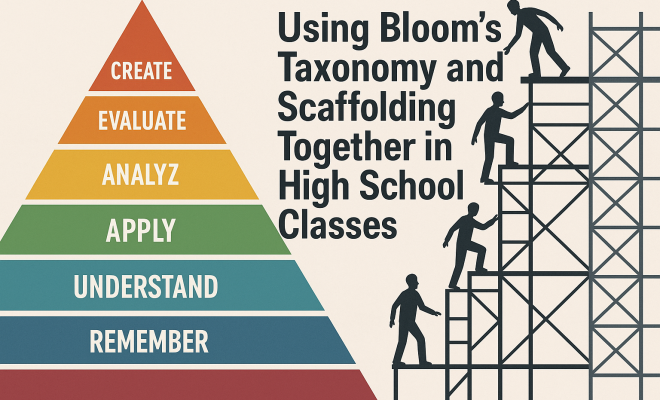
In the 2001 revision of Bloom’s Taxonomy, the levels were redefined as: remembering, understanding, applying, analyzing, evaluating, and creating. This updated version reflects a more dynamic and active approach to learning, emphasizing the importance of creativity and higher-order thinking skills. By utilizing Bloom’s Taxonomy in education, teachers can better align their instructional methods with student learning goals.
The Role of Scaffolding in Education
Scaffolding, another vital concept in educational theory, refers to the support provided to students as they learn new concepts or skills. Coined by Wood, Bruner, and Ross in the 1970s, scaffolding is a metaphorical structure that helps guide learners through the challenges of complex tasks. The goal is to provide temporary support until students can independently master the material.
Effective scaffolding involves several strategies, such as breaking tasks into manageable chunks, providing prompts, and encouraging collaboration among peers. By gradually removing support as students gain confidence and competence, teachers can foster independent learning and critical thinking. Scaffolding complements Bloom’s Taxonomy by offering a structured approach to guide students through the various cognitive levels outlined in the taxonomy.
Integrating Bloom’s Taxonomy and Scaffolding
When combined, Bloom’s Taxonomy and scaffolding create a comprehensive framework for advancing student learning in high school classrooms. Here’s how they work together:
- Targeted Instruction: By identifying specific levels of Bloom’s Taxonomy, teachers can scaffold instruction to meet learners at their current level of understanding.
- Gradual Release of Responsibility: Scaffolding supports the gradual shift of responsibility from the teacher to the student, allowing for deeper engagement with the material.
- Encouraging Higher-Order Thinking: Teachers can design activities that promote higher-order thinking skills by scaffolding tasks that align with the evaluation and creation levels of Bloom’s Taxonomy.
Practical Strategies for Teachers
Integrating Bloom’s Taxonomy and scaffolding requires thoughtful planning and execution. Here are some practical strategies teachers can implement in their high school classrooms:
1. Create Clear Learning Objectives
Start by formulating clear learning objectives that align with the levels of Bloom’s Taxonomy. For instance, if you want students to analyze a text, your objective might focus on the analysis level of the taxonomy. This clarity helps both teachers and students understand the goals and expectations for the lesson.
2. Use Questioning Techniques
Employ open-ended questions that target various levels of Bloom’s Taxonomy. For example, ask students to recall facts (remembering), explain concepts (understanding), or predict outcomes (analyzing). This technique encourages students to think critically and engage more deeply with the content.
3. Implement Collaborative Learning
Encourage students to work together in groups, where they can support each other through scaffolding. Group discussions and peer teaching allow students to articulate their understanding, helping them advance through the levels of Bloom’s Taxonomy while also enhancing their social skills.
4. Provide Feedback and Assessment
Offer timely and constructive feedback that aligns with the students’ progress through Bloom’s Taxonomy. Assessments should not only evaluate students’ knowledge but also their ability to apply, analyze, and create. Consider using formative assessments to gauge understanding before moving on to more complex tasks.
Real-World Applications: Case Studies
To illustrate the effectiveness of combining Bloom’s Taxonomy and scaffolding, let’s explore a couple of real-world examples from high school classrooms. (See: Bloom's Taxonomy overview.)
1. English Language Arts
In an English class, a teacher might introduce a novel by first having students summarize the plot (remembering) and identify key themes (understanding). As the discussions progress, the teacher can scaffold the learning by encouraging students to analyze character motivations (analyzing) and ultimately create their own alternative endings (creating). This gradual approach allows students to build confidence and competence in their literary analysis skills.
2. Science Education
A biology teacher could use Bloom’s Taxonomy and scaffolding to teach about ecosystems. Initially, students might be asked to memorize definitions of key terms (remembering). Next, they could participate in group discussions to explain the interdependence of organisms (understanding) and gradually work on a project to design a sustainable ecosystem (creating). Throughout this process, the teacher can provide templates, guiding questions, and peer review sessions to scaffold their learning experience.
Challenges and Considerations
While the integration of Bloom’s Taxonomy and scaffolding offers numerous benefits, it also presents challenges that educators must navigate. Here are a few considerations:
1. Diverse Learning Styles
Students come to class with varying backgrounds and learning styles. Some may excel in higher-order thinking tasks, while others struggle with foundational knowledge. Effective scaffolding requires differentiation to meet diverse needs. Teachers must be mindful of varying abilities and adjust their approaches accordingly to ensure all students benefit.
2. Time Constraints
High school teachers often face time limitations, making it difficult to implement comprehensive scaffolding strategies. Balancing the curriculum with the need for deep learning can be challenging. It’s essential for educators to prioritize critical concepts and focus on quality learning experiences rather than trying to cover everything superficially.
3. Assessment Alignment
Standardized assessments can sometimes misalign with the goals of Bloom’s Taxonomy and scaffolding. If assessments focus primarily on memorization, they may not accurately reflect students’ higher-order thinking skills. Educators should advocate for assessments that genuinely measure critical thinking and creative abilities.
Current Relevance and Future Implications
In a rapidly changing educational landscape, the integration of Bloom’s Taxonomy and scaffolding remains highly relevant. As technology continues to transform teaching and learning, the principles behind these strategies can be adapted to new tools and methods. For instance, online collaborative platforms offer innovative ways to facilitate peer learning and scaffold complex tasks, enabling high school students to thrive in virtual and blended learning environments.
Moreover, as educators increasingly emphasize skills such as critical thinking, creativity, and collaboration, the synergy between Bloom’s Taxonomy and scaffolding will be essential for developing curricula that prepare students for future challenges. By equipping students with these competencies, educators can cultivate a generation of learners who are not only knowledgeable but also adaptable and innovative.
Examples of Bloom’s Taxonomy in Different Subjects
Bloom’s Taxonomy is versatile and can be applied across various subjects, enriching the learning experience in unique ways. Let’s explore how different subjects can utilize this framework.
Mathematics
In a high school math class, a teacher might begin by having students memorize formulas (remembering). Then, students could demonstrate their understanding by solving equations (applying). As they progress, they might analyze the efficiency of different problem-solving methods (analyzing) before creating their own mathematical models to solve real-world problems (creating).
History
For a history lesson, educators can start with students recalling key dates and events (remembering). Next, they can explore the significance of those events (understanding) and compare different historical perspectives (analyzing). Finally, students might create a presentation that argues a specific viewpoint based on historical evidence (creating).
Frequently Asked Questions (FAQ)
What is Bloom’s Taxonomy?
Bloom’s Taxonomy is a hierarchical framework for categorizing educational goals, originally developed by Benjamin Bloom. It consists of levels of cognitive processes that guide educators in creating assessments and learning experiences that promote critical thinking.
How can Bloom’s Taxonomy be applied in the classroom?
Teachers can apply Bloom’s Taxonomy by creating learning objectives that correspond to each level, using questioning techniques to promote higher-order thinking, and designing assessments that evaluate students’ understanding at different cognitive levels. (See: Educational frameworks and scaffolding.)
What is scaffolding in education?
Scaffolding is a teaching strategy that involves providing temporary support to students as they learn new concepts. This support is gradually removed as students gain independence and confidence in their abilities.
How do Bloom’s Taxonomy and scaffolding work together?
When used together, Bloom’s Taxonomy and scaffolding help educators design instruction that meets students at their current cognitive level and guides them toward higher-order thinking skills through structured support.
Why is it important to consider diverse learning styles when using Bloom’s Taxonomy and scaffolding?
Recognizing diverse learning styles is crucial because students may have varying strengths and challenges. Tailoring instruction to accommodate these differences ensures that all students can achieve their learning goals effectively.
What challenges might educators face when implementing these strategies?
Some challenges include diverse learning styles among students, time constraints in the curriculum, and alignment of assessments with Bloom’s Taxonomy. Educators must navigate these challenges to create effective learning experiences.
Expanding on Bloom’s Taxonomy: A Deeper Dive
To appreciate the full impact of Bloom’s Taxonomy in education, it can be beneficial to explore each level with greater depth. Each level not only builds on the previous one but also serves unique educational purposes, accommodating different types of learning and understanding.
Remembering
The first level, remembering, involves the recall of facts and basic concepts. This forms the foundation of learning. It could include tasks like listing the key events of a historical timeline or recalling mathematical formulas. Engaging students at this level might include activities such as flashcards, quizzes, or memory games, which make the recall process active and enjoyable.
Understanding
Moving to the understanding level requires students to explain ideas or concepts. This could involve summarizing a chapter from a textbook or explaining the main idea in their own words. Teachers can facilitate understanding through discussions, visual aids, or multimedia presentations. For instance, using infographics to summarize complex information can help students grasp essential concepts more effectively.
Applying
At the application level, students use information in new situations. This could mean solving problems using learned formulas or applying theories in practical scenarios. Projects, case studies, and simulations are effective methods to promote application. For example, biology students could conduct experiments to apply their knowledge of ecosystems in real-world contexts, enhancing their ability to connect theory with practice.
Analyzing
Analysis involves breaking information into parts and examining it. Students might compare and contrast different theories or assess the effectiveness of various solutions to a problem. Activities that encourage analysis could include debate formats or writing analytical essays where students dissect arguments and evidence. Encouraging students to use graphic organizers can also help them visually sort and analyze information, fostering higher-level thinking.
Evaluating
At the evaluation level, students make judgments based on criteria and standards. They might critique a work of art or assess the validity of a scientific study. This involves higher-order thinking and requires students to justify their opinions. Educators can develop evaluation skills by incorporating peer reviews or guided critiques into their lessons, encouraging students to articulate their reasoning and engage in constructive feedback.
Creating
The highest level, creating, is where students put elements together to form a coherent whole. This could involve designing a new product, writing a short story, or developing a research proposal. Engaging students in project-based learning at this level can unleash their creativity and problem-solving abilities. For instance, in a technology class, students could work in teams to create an app that addresses a community need, integrating various skills from across the curriculum.
The Importance of Reflective Practice
Reflective practice is critical when using Bloom’s Taxonomy in education. It encourages educators to analyze their teaching methods and assess how effectively they scaffold learning for students at different cognitive levels. By reflecting on their practices, teachers can identify areas for improvement, adjust their instructional strategies, and ultimately enhance student learning outcomes. (See: Learning strategies in education.)
Reflection can take many forms, such as journaling, peer observations, or collaborative discussions with colleagues. Engaging in reflective practice allows educators to not only refine their approaches but also to share successful strategies and insights with one another. This collaborative environment fosters professional growth and, in turn, positively impacts student learning.
Innovative Technologies Supporting Bloom’s Taxonomy
With the rise of educational technology, there are new tools available that can enhance the application of Bloom’s Taxonomy in the classroom. These technologies can facilitate differentiated instruction, streamline assessment, and promote collaboration among students.
Learning Management Systems (LMS)
Platforms like Google Classroom or Moodle provide structure for organizing lessons according to Bloom’s Taxonomy. Teachers can create modules that correspond to different levels, allowing students to progress at their own pace. This setup can be particularly beneficial for students who may need more time to master foundational knowledge before moving on to higher-order thinking tasks.
Interactive Learning Tools
Tools such as Kahoot! or Quizizz make reviewing material fun and engaging. These platforms can be used to reinforce knowledge (remembering) and understanding while providing instant feedback. Additionally, they can include questions that require higher-order thinking, such as applying or analyzing, making them versatile tools for assessment.
Collaborative Tools
Applications like Padlet or Flipgrid offer students opportunities to collaborate and share their ideas creatively. These tools can be used for brainstorming sessions (understanding), project presentations (creating), or peer feedback (evaluating). Such interactive platforms help students engage with their peers and refine their understanding of complex concepts.
Data Analysis Tools
Tools like Google Forms or SurveyMonkey allow teachers to gather data on student performance and understanding. By analyzing assessment results, educators can adjust their scaffolding strategies to meet students’ needs better and ensure that they are progressing through the levels of Bloom’s Taxonomy effectively.
Conclusion: A Call to Action for Educators
The combination of Bloom’s Taxonomy in education and scaffolding offers a powerful framework for enhancing student learning in high school classrooms. By understanding the principles behind each strategy and implementing practical techniques, teachers can create dynamic learning environments that foster critical thinking and independence.
As you reflect on your teaching practices, consider how you can integrate these approaches to better support your students. Whether through collaborative learning, effective feedback, or tailored instructional strategies, the goal remains the same: to empower students to take ownership of their learning journey.
“`
Trending Now
Frequently Asked Questions
What is Bloom's Taxonomy in education?
Bloom's Taxonomy is a framework developed by Benjamin Bloom in the 1950s to categorize educational goals. It consists of six levels of cognitive processes: knowledge, comprehension, application, analysis, synthesis, and evaluation, which help educators design lessons that foster critical thinking and deeper understanding.
How does scaffolding work in the classroom?
Scaffolding is an educational strategy that provides temporary support to students as they learn new concepts or skills. It guides learners through complex tasks until they can independently master the material, promoting confidence and competence in their learning process.
What are the revised levels of Bloom's Taxonomy?
In its 2001 revision, Bloom's Taxonomy was updated to include six levels: remembering, understanding, applying, analyzing, evaluating, and creating. This revision emphasizes a more active approach to learning, focusing on creativity and higher-order thinking skills.
Why is Bloom's Taxonomy important for teachers?
Bloom's Taxonomy is crucial for teachers as it helps align instructional methods with learning goals. By understanding the hierarchy of cognitive processes, educators can design lessons that promote critical thinking and facilitate deeper understanding among students.
Can scaffolding and Bloom's Taxonomy be used together?
Yes, scaffolding and Bloom's Taxonomy can be effectively used together in the classroom. Combining these strategies allows educators to provide structured support while promoting higher-order thinking, thus enhancing student learning and engagement.
What did we miss? Let us know in the comments and join the conversation.