The Edvocate

Top Menu

Main Menu

  • Start Here
    • Our Brands
    • Governance
      • Lynch Education Consulting, LLC.
      • Dr. Lynch’s Personal Website
      • Careers
    • Write For Us
    • Books
    • The Tech Edvocate Product Guide
    • Contact Us
    • The Edvocate Podcast
    • Edupedia
    • Pedagogue
    • Terms and Conditions
    • Privacy Policy
  • PreK-12
    • Assessment
    • Assistive Technology
    • Best PreK-12 Schools in America
    • Child Development
    • Classroom Management
    • Early Childhood
    • EdTech & Innovation
    • Education Leadership
    • Equity
    • First Year Teachers
    • Gifted and Talented Education
    • Special Education
    • Parental Involvement
    • Policy & Reform
    • Teachers
  • Higher Ed
    • Best Colleges and Universities
    • Best College and University Programs
    • HBCU’s
    • Diversity
    • Higher Education EdTech
    • Higher Education
    • International Education
  • Advertise
  • The Tech Edvocate Awards
    • The Awards Process
    • Finalists and Winners of The 2025 Tech Edvocate Awards
    • Finalists and Winners of The 2024 Tech Edvocate Awards
    • Finalists and Winners of The 2023 Tech Edvocate Awards
    • Finalists and Winners of The 2021 Tech Edvocate Awards
    • Finalists and Winners of The 2022 Tech Edvocate Awards
    • Finalists and Winners of The 2020 Tech Edvocate Awards
    • Finalists and Winners of The 2019 Tech Edvocate Awards
    • Finalists and Winners of The 2018 Tech Edvocate Awards
    • Finalists and Winners of The 2017 Tech Edvocate Awards
    • Award Seals
  • Apps
    • GPA Calculator for College
    • GPA Calculator for High School
    • Cumulative GPA Calculator
    • Grade Calculator
    • Weighted Grade Calculator
    • Final Grade Calculator
  • The Tech Edvocate
  • Post a Job
  • AI Powered Personal Tutor

logo

The Edvocate

  • Start Here
    • Our Brands
    • Governance
      • Lynch Education Consulting, LLC.
      • Dr. Lynch’s Personal Website
        • My Speaking Page
      • Careers
    • Write For Us
    • Books
    • The Tech Edvocate Product Guide
    • Contact Us
    • The Edvocate Podcast
    • Edupedia
    • Pedagogue
    • Terms and Conditions
    • Privacy Policy
  • PreK-12
    • Assessment
    • Assistive Technology
    • Best PreK-12 Schools in America
    • Child Development
    • Classroom Management
    • Early Childhood
    • EdTech & Innovation
    • Education Leadership
    • Equity
    • First Year Teachers
    • Gifted and Talented Education
    • Special Education
    • Parental Involvement
    • Policy & Reform
    • Teachers
  • Higher Ed
    • Best Colleges and Universities
    • Best College and University Programs
    • HBCU’s
    • Diversity
    • Higher Education EdTech
    • Higher Education
    • International Education
  • Advertise
  • The Tech Edvocate Awards
    • The Awards Process
    • Finalists and Winners of The 2025 Tech Edvocate Awards
    • Finalists and Winners of The 2024 Tech Edvocate Awards
    • Finalists and Winners of The 2023 Tech Edvocate Awards
    • Finalists and Winners of The 2021 Tech Edvocate Awards
    • Finalists and Winners of The 2022 Tech Edvocate Awards
    • Finalists and Winners of The 2020 Tech Edvocate Awards
    • Finalists and Winners of The 2019 Tech Edvocate Awards
    • Finalists and Winners of The 2018 Tech Edvocate Awards
    • Finalists and Winners of The 2017 Tech Edvocate Awards
    • Award Seals
  • Apps
    • GPA Calculator for College
    • GPA Calculator for High School
    • Cumulative GPA Calculator
    • Grade Calculator
    • Weighted Grade Calculator
    • Final Grade Calculator
  • The Tech Edvocate
  • Post a Job
  • AI Powered Personal Tutor
  • Improve Your Writing Skills: Tips and Techniques to Write Like a Pro

  • Improve Your Toughest Student’s Behavior by Analyzing Your Own

  • Important Skills Kids Learn Through Coding –

  • Importance of Hands-On Learning In Early Education

  • Impact of Online Education on Families

  • Illinois Is Giving Kids 5 Mental Health Days a Year—We Should Follow Suit

  • If Your Edtech Product Won’t Solve Actual Problems, We Don’t Need It

  • If You’re Still Using These 5 Words as a Teacher, It’s Time to Reconsider

  • If You’re Not in the Classroom, Spare Teachers Your Armchair Quarterbacking

  • If You Want Your Professors to Become Better Teachers, Here is What You Should Do

Uncategorized
Home›Uncategorized›University of Calabar Finds that Turnitin Helps Improve Quality of Writing

University of Calabar Finds that Turnitin Helps Improve Quality of Writing

By Matthew Lynch
November 29, 2016
0
Spread the love

Visibility on the international stage of academia hinges, in part, upon University faculty and students being published in respected journals and conference proceedings. For universities from developing countries, gaining such recognition is no easy feat. In 2014, the University of Calabar in Nigeria began an effort to help its faculty and graduate students bring their writing up to global standards for academic integrity and quality with the express intent that publishing efforts would be more successful. The University turned to Turnitin Feedback Studio as one resource their faculty could use to improve the quality of their writing.

Princewill Odum, who lectures in Remote Sensing and GIS, took a lead role in bringing Turnitin Feedback Studio to the campus because he felt it would help his colleagues and the University’s graduate students. Associates and students could use Feedback Studio to self-evaluate their writing and citation methods before submitting for internal assessment to be awarded higher degrees, or for acceptance by journals and conference evaluating committees. Receiving feedback from Feedback Studio early in the writing process would foster more original thinking and hopefully help improve clarity of expression. As quality of writing improved, he expected that successes in publishing and advanced degrees should also follow.

Students, Princewill said, quickly discovered that putting their papers through Feedback Studio in their draft stages gave them valuable—and correctable—feedback prior to the final submission. The same was true for faculty members who had lamented that some of their submissions to academic journals and conferences were being rejected for improper citation and substandard writing quality.

Incorrect citation and plagiarism is quite often unintentional. “Their papers were turned down for potential plagiarism, as I explained to them, but with Turnitin they are able to see or understand word for word. More of these jobs get to pass. I think it’s really helping the writing skills,” he said. No data exists to quantify how much plagiarism is intentional and how much is accidental, however it is a fair estimate that a substantial portion of incorrect or omitted citations are due simply to the fact that the author is unfamiliar with academic writing conventions.

“What is significant about University of Calabar’s efforts is that they are being proactive and using Turnitin as an educational tool to improve the quality of writing. Teaching how to cite intellectual property correctly is best done before or during the writing process, not at the end,” said Gill Rowell, education manager at the company. “When students and faculty are presented with an originality report and then register where they went wrong, it pushes them to think more clearly and to find new ways to synthesize and then re-share that information.”

Digital analysis of a papers by Turnitin Feedback Studio which looks for improper citation or attribution creates an immediate learning opportunity. Writers see their errors and make edits of their own initiative, rather than waiting days or weeks for an instructor to return their papers. Or in the case of submitting to academic journals, waiting months before a rejection letter is received, assuming one is sent at all.

“For our students, Turnitin is a gauge, a meter,” said Odum. “They use it to check if their work is something to be proud of…That gives them good joy to know that their work is of an international standard.”

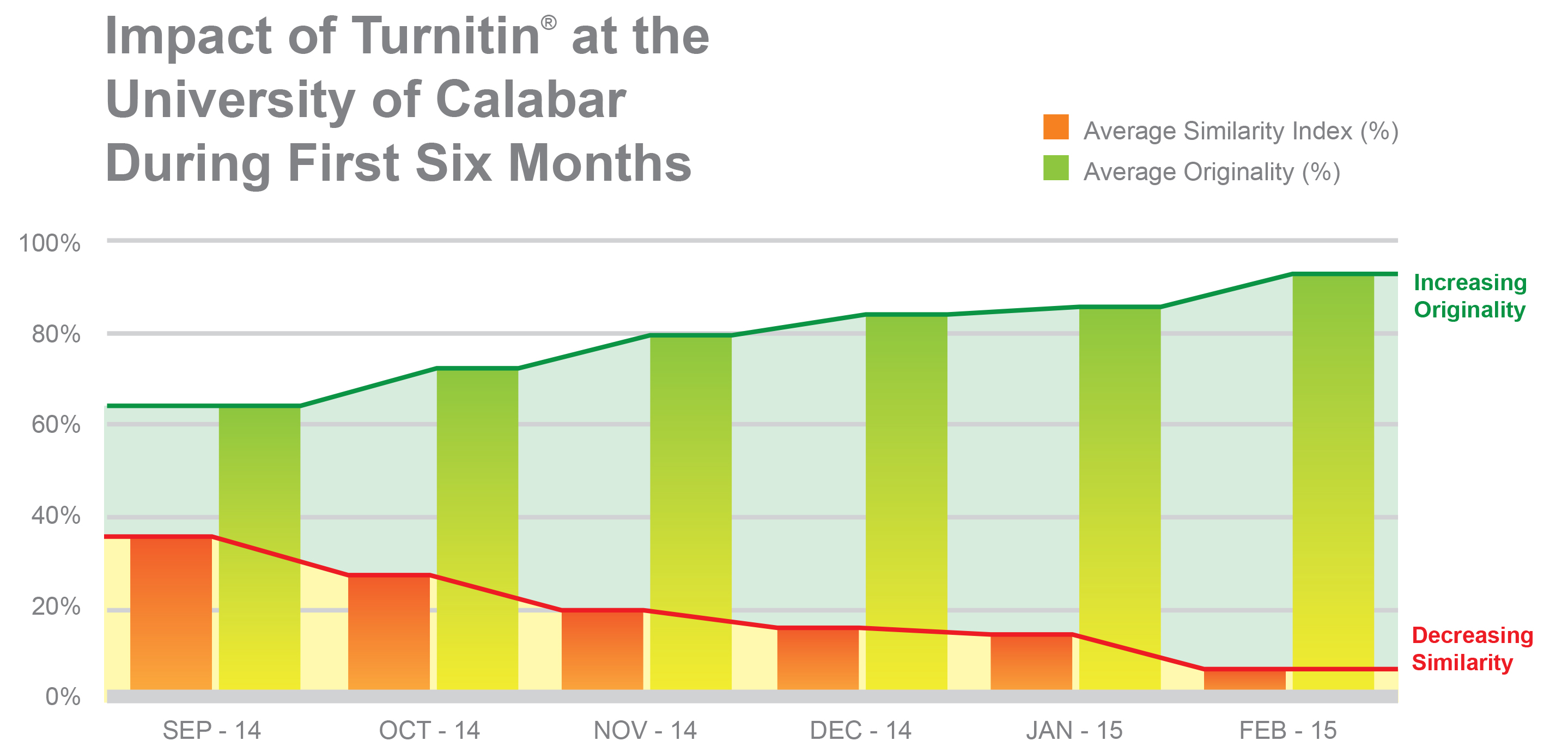
There has been a noticeable improvement in writing quality. In the first six months of using Feedback Studio, the originality percentage for research documents and final theses increased from 64 to 92.5 percent.
Print

The quality of submitted papers clearly showed improvement and Odum feels that recognition will naturally follow as this trend continues. Along the way, the learning process for faculty and students has been invaluable. “Before now, they [told us] ‘we sent our paper for publication and it was rejected.’ They didn’t really understand what they meant,” said Princewill. With Turnitin helping guide them to better writing, “there is wider acceptability of papers to publish in reputable journals than before. That’s commendable.”

Princewill was honored by Turnitin this year as the Global Innovation Award winner for his efforts to bring his University onto the world stage and help his colleagues and University students become better writers.


TagsdigpededchatEducationk12ntchatteachered
Previous Article

When do children develop their gender identity?

Next Article

Determining Your Educational Philosophy Part I: Philosophy ...

Matthew Lynch

Related articles More from author

  • Teachers

    How State Government Involvement Shaped 20th Century Education

    September 2, 2016
    By Matthew Lynch
  • Matthew LynchTeachers

    Teachers: A Quick Guide to Embracing Your Multicultural Classroom

    April 7, 2016
    By Matthew Lynch
  • Matthew LynchPolicy & Reform

    3 Things That Barack Obama Did For P-20 Education in 2015

    December 23, 2015
    By Matthew Lynch
  • Teachers

    The Surprising Diversity of Early American Approaches to Schooling

    September 2, 2016
    By Matthew Lynch
  • Equity

    Science still unclear on same-sex schooling

    July 11, 2016
    By Matthew Lynch
  • Higher EducationK-12

    The A-Z of Education Blogs: Letters D-E

    May 3, 2017
    By Matthew Lynch

Search

Registration and Login

  • Register
  • Log in
  • Entries feed
  • Comments feed
  • WordPress.org

Newsletter

Signup for The Edvocate Newsletter and have the latest in P-20 education news and opinion delivered to your email address!

RSS Matthew on Education Week

  • Au Revoir from Education Futures November 20, 2018 Matthew Lynch
  • 6 Steps to Data-Driven Literacy Instruction October 17, 2018 Matthew Lynch
  • Four Keys to a Modern IT Approach in K-12 Schools October 2, 2018 Matthew Lynch
  • What's the Difference Between Burnout and Demoralization, and What Can Teachers Do About It? September 27, 2018 Matthew Lynch
  • Revisiting Using Edtech for Bullying and Suicide Prevention September 10, 2018 Matthew Lynch

About Us

The Edvocate was created in 2014 to argue for shifts in education policy and organization in order to enhance the quality of education and the opportunities for learning afforded to P-20 students in America. What we envisage may not be the most straightforward or the most conventional ideas. We call for a relatively radical and certainly quite comprehensive reorganization of America’s P-20 system.

That reorganization, though, and the underlying effort, will have much to do with reviving the American education system, and reviving a national love of learning.  The Edvocate plans to be one of key architects of this revival, as it continues to advocate for education reform, equity, and innovation.

Newsletter

Signup for The Edvocate Newsletter and have the latest in P-20 education news and opinion delivered to your email address!

Contact

The Edvocate
910 Goddin Street
Richmond, VA 23230
(601) 630-5238
[email protected]
  • situs togel online
  • dentoto
  • situs toto 4d
  • situs toto slot
  • toto slot 4d
Copyright (c) 2025 Matthew Lynch. All rights reserved.