Teaching Syntax to English Language Learners: Effective Strategies
“`html
Teaching syntax to English language learners is an essential component of language acquisition that goes beyond vocabulary and grammar. Syntax, the arrangement of words and phrases to create well-formed sentences, is vital for clear communication. For English language learners (ELLs), mastering syntax can often feel like climbing a mountain; the right strategies can make that ascent a lot more manageable. This article explores effective techniques and insights that teachers can use to enhance ELLs’ understanding and use of English syntax.
Understanding the Importance of Syntax in Language Learning
Syntax is the backbone of any language. Without it, messages can become jumbled or lose their intended meaning. For ELLs, grasping the rules of English syntax is crucial not only for comprehension but also for producing meaningful speech and writing. Research indicates that a solid understanding of syntax can significantly impact ELLs’ overall language proficiency. In fact, studies have shown that students who master syntax tend to perform better in reading comprehension and writing tasks.
Furthermore, effective syntax instruction can aid ELLs in transferring their existing knowledge from their native languages, which often have different syntactic structures. This transfer can be a powerful tool if harnessed correctly. For instance, a Spanish-speaking student might find similarities in sentence structure that can facilitate easier understanding of English syntax.
Identifying Common Syntax Challenges for ELLs
Before diving into teaching methods, it’s essential to recognize the unique challenges ELLs face when learning English syntax. Some common pitfalls include:
- Word Order: Many languages have different word orders. For example, while English typically follows a Subject-Verb-Object (SVO) structure, languages like Japanese utilize Subject-Object-Verb (SOV).
- Articles and Prepositions: ELLs often struggle with the use of articles (a, an, the) and prepositions due to their absence or different rules in their native languages.
- Complex Sentences: Understanding how to connect clauses and use conjunctions can be daunting for ELLs, leading to overly simplistic sentence structures.
- Verb Tenses: Many ELLs may find English’s verb tense system confusing, particularly with irregular verbs and perfect tenses.
By recognizing these challenges, educators can tailor their instruction to better meet the needs of their students.
1. Use Visual Aids to Reinforce Syntax Rules
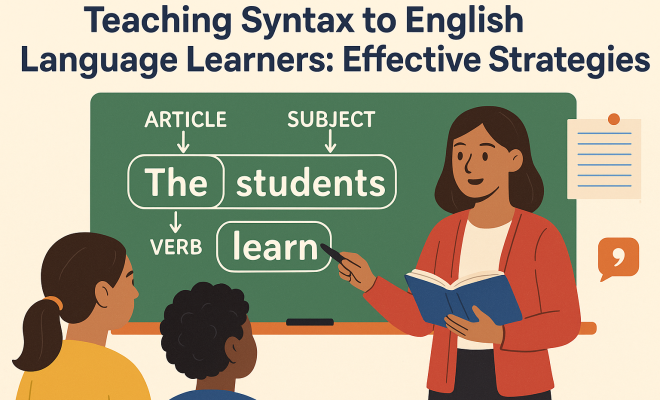
Visual aids serve as powerful tools in the syntax instruction toolbox. They can help demystify abstract concepts and anchor learning in concrete examples. For instance, sentence diagrams, flow charts, and graphic organizers can visually break down sentence structures. Teachers can utilize:
- Sentence Frames: Provide students with templates that outline the structure of a sentence, allowing them to fill in their own content.
- Pictures and Symbols: Use images to represent nouns, actions, and modifiers, encouraging students to create sentences based on visual stimuli.
- Anchor Charts: Create wall charts that outline common syntactic structures and rules, serving as a reference for students.
Visual aids cater to various learning styles and can significantly enhance comprehension for ELLs.
2. Incorporate Interactive Activities
Engagement is key when it comes to teaching syntax. Interactive activities can make learning more enjoyable and memorable. Consider employing:
- Sentence Building Games: Use cards with different parts of speech, allowing students to physically manipulate them to construct sentences.
- Role-Playing: Prompt students to act out sentences, reinforcing syntax through movement and social interaction.
- Group Work: Encourage collaborative sentence creation tasks where students can brainstorm and critique each other’s sentences.
These activities not only provide practice but also foster a supportive learning environment where students feel comfortable experimenting with syntax.
3. Teach Syntax in Context
Contextual learning is vital for ELLs. Teaching syntax in the context of meaningful communication helps students understand how syntax functions in real-life situations. This may involve:
- Reading Aloud: Choose texts that exemplify various syntactic structures and read them aloud, highlighting important sentences and phrases.
- Writing Prompts: Provide prompts that encourage students to write sentences or paragraphs, emphasizing the use of specific syntactic structures.
- Discussion Activities: Facilitate discussions on topics relevant to the students’ experiences, prompting them to practice syntax naturally.
By embedding syntax instruction within context, ELLs can better retain and apply the knowledge they gain. (See: Importance of language in education.)
4. Explicitly Teach Syntactic Structures
While it can be tempting to let students discover syntax on their own, explicit instruction often yields better results. This involves:
- Modeling: Demonstrate correct sentence structures and provide clear explanations of why they work.
- Direct Instruction: Teach specific syntactic rules and variations, such as subject-verb agreement, independently of larger grammar lessons.
- Targeted Feedback: Provide constructive feedback on student writing with a focus on syntax, allowing them to revise and improve their sentences.
Explicit instruction helps ELLs grasp complex concepts that may not come naturally to them through immersion alone.
5. Use Technology to Enhance Learning
In today’s digital age, technology can serve as an invaluable resource for teaching syntax. There are numerous applications and online resources that can facilitate syntax learning, such as:
- Grammar and Writing Software: Tools like Grammarly and ProWritingAid can provide immediate feedback on sentence structure and grammar.
- Interactive Learning Platforms: Websites like Kahoot! or Quizlet can make syntax practice engaging through games and quizzes.
- Video Resources: Utilize videos that explain syntax rules and demonstrate their application in real-world contexts.
Integrating technology not only motivates students but also personalizes learning experiences.
6. Foster a Growth Mindset
Encouraging a growth mindset is key to helping ELLs feel confident in their syntax skills. When students believe they can improve with effort, they are more likely to engage with challenging material. Strategies to foster a growth mindset include:
- Celebrating Effort: Recognize students’ hard work and improvements rather than just outcomes, reinforcing the idea that persistence leads to success.
- Normalized Mistakes: Create a classroom culture where mistakes are viewed as learning opportunities, encouraging risk-taking in language use.
- Goal Setting: Encourage students to set specific, achievable goals related to their syntax skills, tracking their progress over time.
When students adopt a growth mindset, they are more likely to embrace the complexities of English syntax with resilience.
7. Differentiate Instruction Based on Individual Needs
Each ELL brings unique strengths and challenges to the classroom. Differentiating instruction ensures that all students receive the support they need to succeed. Consider the following strategies:
- Flexible Grouping: Group students based on their proficiency levels so they can work with peers who have similar challenges.
- Modified Assignments: Adjust tasks to match students’ language levels; for example, provide sentence starters for beginners while encouraging advanced students to write complex sentences.
- Targeted Interventions: Identify specific syntactic challenges for individual students and provide focused instruction to address those areas.
Tailoring instruction not only enhances student engagement but also fosters a sense of belonging in the classroom.
8. Engage Families and Communities
The role of families and communities in supporting ELLs cannot be overstated. Engaging with them can reinforce syntax learning at home. Ways to involve families include:
- Workshops and Information Sessions: Host events that educate families about language development and the importance of syntax.
- Resources in Native Languages: Provide materials that are accessible in students’ native tongues, enabling families to support their learning.
- Encouraging Conversations: Invite families to create an environment where students feel comfortable practicing their English, even at home.
When families are involved, students are more likely to thrive in their language learning journey.
9. Evaluate and Reflect on Progress
Regular assessment of students’ understanding of syntax is crucial for effective teaching. Continuous evaluation allows teachers to adjust their instruction as needed. Consider employing:
- Formative Assessments: Use quizzes, writing samples, and discussions to gauge students’ grasp of syntax throughout the learning process.
- Self-Assessment: Encourage students to reflect on their syntax skills and set personal goals for improvement.
- Peer Review: Implement peer assessment activities where students provide feedback on each other’s syntax usage.
Reflection and evaluation not only guide instruction but also empower students to take ownership of their learning. (See: Language learning strategies for immigrants.)
10. Examples of Successful Syntax Instruction
Understanding how effective syntax instruction looks in practice can inspire teachers to implement similar strategies. Here are a few examples from successful classrooms:
- Case Study: Ms. Thompson’s Class – Ms. Thompson uses sentence frames during her lessons for ELLs. By providing structured templates, her students gain confidence and improve their sentence-building skills. Over a semester, students showed a 25% increase in their ability to construct complex sentences correctly.
- Case Study: Mr. Lee’s Interactive Sessions – In Mr. Lee’s class, students participate in “sentence-building races” where they compete to create grammatically correct sentences using provided words. This fun, competitive element has sparked enthusiasm and led to improved syntax understanding among his students.
- Online Learning: Ms. Garcia’s Virtual Classroom – Ms. Garcia utilizes online platforms like Edmodo to assign syntax-related activities that students can complete at home. She reports a marked increase in student engagement and understanding, particularly among those who may feel shy about speaking in class.
11. Statistics on Syntax and Language Learning
Research sheds light on the relationship between syntax knowledge and overall language proficiency among ELLs. Some compelling statistics include:
- According to a study by the National Literacy Trust, ELLs who receive explicit instruction in syntax demonstrate a 30% higher comprehension rate in reading compared to those who do not.
- A longitudinal study from the University of California revealed that ELLs with a strong grasp of syntactic structures are 40% more likely to achieve grade-level writing standards in English.
- Data from the Educational Testing Service indicates that ELLs who engage in regular sentence construction exercises see an improvement of up to 50% in their syntax usage within just a few months.
12. Expert Perspectives on Teaching Syntax
Experts in the field of language acquisition provide valuable insights into teaching syntax to ELLs. Here are a few notable quotes:
- Dr. Maria Rovira, Linguistics Expert: “Understanding syntax is essential for ELLs because it directly influences their fluency and confidence in speaking and writing, which is crucial for academic success.”
- Professor James Lightbown, Co-author of ‘How Languages are Learned’: “Teachers must recognize that every language learner is different, and thus syntax instruction should be tailored to meet diverse needs.”
- Dr. Patricia Kuhl, Cognitive Scientist: “The brain’s capacity to understand syntax is remarkable. We should harness this by providing rich and engaging input.”
13. Frequently Asked Questions (FAQ)
Here are some common questions educators have about teaching syntax to English language learners:
What are some effective strategies for teaching syntax to ELLs?
Effective strategies include using visual aids, engaging students in interactive activities, teaching syntax in context, and providing explicit instruction.
How can I assess my ELLs’ understanding of syntax?
You can assess understanding through formative assessments, self-assessments, and peer reviews to ensure a comprehensive evaluation of their skills.
What resources are available for teaching syntax?
There are various resources, including grammar and writing software, online learning platforms, and educational videos that focus on syntax instruction.
How long does it take for ELLs to master English syntax?
The timeline varies by individual, but with consistent practice and support, many ELLs can show significant progress in a matter of months. It’s essential to remember that language learning is a gradual process.
Can syntax instruction be integrated into other subjects?
Absolutely! Syntax instruction can be integrated into reading, writing, and even subjects like math and science by focusing on the language of instruction and encouraging students to articulate their understanding through correct syntax.
14. Real-Life Applications of Syntax Learning
Understanding syntax is not just essential for academic success; it also has real-life applications that are vital for ELLs. Consider how syntax plays a role in various everyday scenarios:
- Job Interviews: Being able to articulate thoughts clearly can make all the difference during job interviews. Mastery of syntax allows ELLs to convey their qualifications confidently and effectively.
- Social Interactions: Engaging in conversations with peers requires an understanding of syntax to form coherent and relatable sentences. This not only helps with social integration but also enhances their ability to make friends and build networks.
- Understanding Media: Whether it’s reading articles, watching movies, or listening to podcasts, a good grasp of syntax enables ELLs to comprehend and engage with various forms of media critically.
- Academic Presentations: When ELLs are asked to present their ideas or projects, proficiency in syntax ensures they can communicate their arguments persuasively and clearly.
Teaching syntax is not just about preparing students for tests; it’s about equipping them with the language tools they need for everyday life.
15. The Role of Cultural Context in Syntax Learning
Language and culture are intertwined, and understanding cultural nuances can significantly enhance ELLs’ grasp of syntax. Here’s how cultural context influences syntax learning:
- Figurative Language: Many cultures use idioms and expressions that may not translate directly. Understanding these can help ELLs appreciate syntax variations in English.
- Speech Patterns: Different cultures have distinct ways of organizing thoughts and ideas, which can affect how students construct sentences. Being aware of these differences can aid in teaching syntax more effectively.
- Contextual Relevance: Utilizing culturally relevant materials and examples in syntax instruction can help ELLs relate better to the language being taught, making learning more meaningful.
Incorporating cultural context not only enriches syntax instruction but also fosters inclusivity and respect for diversity in the classroom.
16. Collaborating with Other Educators
Collaboration among teachers can yield innovative strategies for teaching syntax to ELLs. Here are some ways to foster collaboration:
- Interdisciplinary Projects: Work together with colleagues from other subjects to create projects that require students to apply their understanding of syntax in varied contexts.
- Professional Development Workshops: Attend or organize workshops focused on ELL strategies, with an emphasis on syntax instruction, to share best practices and learn from each other.
- Curriculum Planning: Collaborate on curriculum design to ensure that syntax instruction is integrated across subjects, reinforcing students’ learning experiences.
By working together, educators can develop a more comprehensive approach to teaching syntax, benefiting both students and teachers alike.
17. Long-Term Benefits of Strong Syntax Skills
The benefits of mastering syntax extend beyond immediate academic performance. Here are some long-term advantages for ELLs:
- Enhanced Cognitive Skills: Understanding complex sentence structures can improve critical thinking and problem-solving abilities, as students learn to analyze and construct arguments.
- Greater Academic Achievement: Proficient syntax skills are correlated with higher grades and standardized test scores, particularly in writing and reading assessments.
- Career Opportunities: In the job market, strong communication skills are highly valued. Mastering syntax allows ELLs to present themselves more effectively, opening doors to various career paths.
- Social Mobility: Language proficiency, including syntax mastery, can lead to increased educational and occupational opportunities, ultimately enhancing social mobility for ELLs and their families.
By investing time in teaching syntax, educators help ELLs build a foundation for lifelong success.
Conclusion: A Holistic Approach to Teaching Syntax
Teaching syntax to English language learners is undeniably challenging, yet immensely rewarding. By employing a variety of strategies — from visual aids to technology integration — teachers can create a dynamic learning environment that fosters growth and understanding. As educators, embracing the complexities of teaching syntax, while being responsive to the diverse needs of ELLs, ultimately paves the way for their success in mastering English. In a world that increasingly values multilingualism, the ability to communicate effectively is a gift that can open doors for ELLs in countless ways.
“`
Trending Now
Frequently Asked Questions
What is syntax and why is it important for English language learners?
Syntax refers to the arrangement of words and phrases to create well-formed sentences. For English language learners (ELLs), mastering syntax is crucial for clear communication and comprehension, impacting their overall language proficiency and performance in reading and writing tasks.
What are common syntax challenges faced by English language learners?
Common challenges for ELLs include difficulties with word order, as different languages may have varying structures. Additionally, ELLs often struggle with the correct use of articles and prepositions, which can lead to confusion in sentence construction.
How can teachers help ELLs with syntax?
Teachers can employ effective strategies such as using visual aids, providing sentence frames, and drawing connections to students' native languages. These methods can enhance ELLs' understanding and application of English syntax, making learning more accessible.
What role does syntax play in language acquisition?
Syntax plays a critical role in language acquisition as it forms the backbone of communication. A solid grasp of syntax allows learners to produce meaningful speech and writing, thus improving their overall language proficiency.
Can understanding syntax improve reading comprehension for ELLs?
Yes, a strong understanding of syntax significantly enhances reading comprehension for ELLs. Studies show that students who master syntax are more likely to perform better in reading tasks, as they can better understand sentence structures and meanings.
Agree or disagree? Drop a comment and tell us what you think.