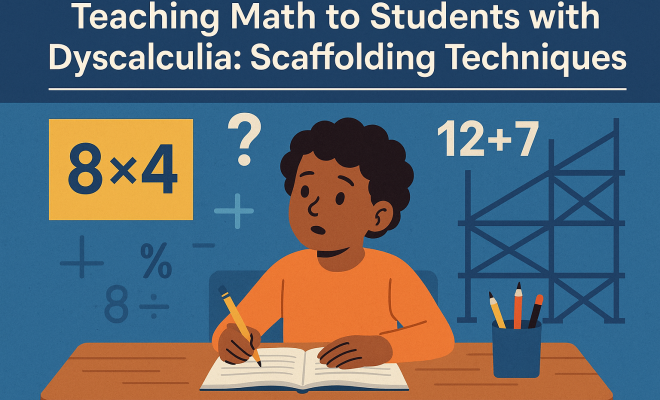
Teaching Math to Students with Dyscalculia: Scaffolding Techniques
“`html
Dyscalculia, often described as a specific learning disability in math, can pose significant challenges for students who struggle with understanding numbers and mathematical concepts. While traditional teaching methods may not be effective for these learners, implementing tailored dyscalculia teaching strategies can foster a more inclusive and productive learning environment. This article explores various scaffolding techniques that can help educators assist students with dyscalculia in overcoming their challenges and achieving success in math.
Understanding Dyscalculia: An Overview
Dyscalculia is often referred to as math dyslexia, although it is a distinct condition. It affects approximately 5-7% of the population, making it a common yet under-recognized learning disability. Students with dyscalculia may struggle with various aspects of mathematics, including number sense, memorization of math facts, fluency in calculations, and problem-solving skills.
The symptoms of dyscalculia can manifest in different ways. For instance, a student might find it challenging to count objects, recognize numbers, or understand the concept of quantity. It’s not unusual for them to experience anxiety related to math, which can hinder their overall academic performance. As such, identifying effective dyscalculia teaching strategies is crucial for educators who aim to support these learners.
The Importance of Scaffolding in Math Education
Scaffolding refers to the educational technique of providing temporary support to students as they learn new skills or concepts. Just as scaffolding supports a building during construction, educational scaffolding helps students build their knowledge progressively. For students with dyscalculia, scaffolding can be particularly beneficial, as it allows for the gradual introduction of mathematical concepts in a structured manner.
Effective scaffolding techniques can include breaking down complex tasks into manageable steps, providing visual aids, and using interactive tools. By employing these strategies, educators can help students with dyscalculia gain confidence while developing essential math skills. Understanding how to implement these techniques is key for educators working with this group.
Key Dyscalculia Teaching Strategies to Implement
Implementing dyscalculia teaching strategies involves a variety of techniques tailored to individual learning needs. Here are some effective strategies to consider:
- Use of Manipulatives: Physical objects such as counters, blocks, or number lines allow students to visualize mathematical concepts. By engaging with tangible materials, students can better understand abstract concepts.
- Visual Aids: Charts, diagrams, and pictorial representations can help students visualize relationships between numbers. These aids can make complex ideas more accessible.
- Chunking Information: Breaking down information into smaller, digestible parts can prevent students from feeling overwhelmed. By focusing on one concept at a time, students can gradually build their understanding.
- Incorporating Technology: Educational apps and games designed for students with dyscalculia can provide interactive learning opportunities. Many of these resources offer personalized learning experiences that adapt to the student’s pace.
- Regular Feedback and Assessment: Tailored assessments that identify specific areas of difficulty can provide insights into a student’s progress. Regular feedback helps students stay motivated and aware of their growth.
Building Number Sense: Foundational Skills for Math Success
Developing number sense is crucial for students with dyscalculia. Number sense refers to a deep understanding of numbers and their relationships. Here are some strategies to enhance this foundational skill:
Encouraging students to use number lines or ten-frames can solidify their understanding of quantity and numerical relationships. These tools allow students to visualize numbers and their placement, reinforcing concepts such as addition and subtraction.
Additionally, incorporating games that revolve around counting, comparing quantities, and identifying patterns can make learning more engaging. Activities such as “number talks” also facilitate discussions about mathematical reasoning, further strengthening number sense.
Teaching Math Concepts Through Real-World Applications
Another effective approach involves teaching math through real-world applications. Connecting mathematical concepts to everyday situations makes learning relevant and engaging for students. For example, when teaching fractions, you could involve cooking measurements or sharing pizza slices to illustrate portions.
By using relatable scenarios, students can see the purpose behind learning math. These practical applications can help demystify abstract concepts, making them easier to understand. Encouraging discussions about how math is used in various professions can also inspire students and show them the value of acquiring these skills. (See: Understanding dyscalculia and its impact.)
Creating a Supportive Classroom Environment
A supportive classroom environment is essential for students with dyscalculia to thrive. This includes fostering a culture where mistakes are viewed as part of the learning process rather than failures. Emphasizing growth and effort over correctness encourages students to take risks and engage with challenging material.
Classroom organization can also play a role. Ensure that materials are easily accessible and that the classroom layout is conducive to collaborative learning. Peer support can be invaluable; pairing students for group work can help them learn from each other, providing an opportunity for students to verbalize their thought processes while problem-solving together.
Collaboration with Specialists and Parents
Collaboration is key when it comes to supporting students with dyscalculia. Teachers should consider working closely with special educators, school psychologists, and other specialists to develop tailored instructional plans. These professionals can provide insights and strategies that align with the student’s specific needs.
Involving parents in the process is equally important. Educators can share resources and strategies with parents, enabling them to reinforce learning at home. Regular communication can help parents understand their child’s challenges and celebrate their successes, fostering a partnership that ultimately benefits the student’s learning experience.
Continuing Education and Professional Development for Teachers
For educators, understanding dyscalculia and its teaching strategies is an ongoing process. Engaging in professional development opportunities, attending workshops, and staying informed about the latest research can enhance their teaching methods. Many organizations offer resources specifically aimed at equipping teachers with effective dyscalculia teaching strategies.
Networking with other educators can also provide valuable support. Sharing experiences and insights can lead to the development of new strategies and techniques tailored to meet the diverse needs of students with dyscalculia.
Monitoring Progress and Adapting Strategies
Monitoring student progress is crucial to ensure that the implemented dyscalculia teaching strategies are effective. Regular assessments, both formal and informal, can help identify areas where students continue to struggle. Based on this data, educators may need to adapt their teaching approaches or explore alternative strategies.
Flexibility is essential. What works for one student may not work for another, and being willing to try different techniques can make a significant difference in a student’s learning journey. Additionally, setting specific, measurable goals can help track progress and celebrate achievements, no matter how small.
Fostering a Math-Positive Mindset
Creating a positive mindset around math is vital for students with dyscalculia. Many students internalize their struggles with math, leading to a fear of the subject. One effective way to counter this is by celebrating small victories. When students accomplish even minor tasks, acknowledging their efforts can significantly boost their confidence.
Incorporating growth mindset principles into classroom discussions can also help. Teaching students that intelligence and abilities can grow over time with effort fosters resilience. This perspective not only applies to math but can enhance their overall approach to learning. Discussing famous mathematicians and their struggles can also help students see that challenges are a common part of the learning journey.
Individualized Learning Plans
Creating individualized learning plans (ILPs) can be pivotal for students with dyscalculia. An ILP customizes educational strategies to fit a student’s unique learning profile. This plan might include specific goals, preferred learning styles, and methods of assessment. For example, if a child excels in tactile learning, the plan could incorporate more hands-on activities using manipulatives to teach mathematical concepts.
Regularly revisiting and revising the ILP based on progress ensures that the strategies remain relevant. This adaptive approach allows educators to provide support tailored to the student’s evolving needs. Collaborating with parents when forming these plans can also yield valuable insights into a student’s home learning environment, which can translate into more effective strategies in the classroom. (See: CDC resources on learning disabilities.)
Statistics and Research on Dyscalculia
Research highlights the importance of early identification and intervention in supporting students with dyscalculia. Studies have shown that early intervention strategies can significantly improve a child’s chances of success in math. For instance, a meta-analysis published in the “Journal of Learning Disabilities” found that students who received targeted interventions showed notable improvements in math fluency and conceptual understanding compared to those who did not receive such support.
Additionally, a survey conducted by the National Center for Learning Disabilities indicated that only 6% of teachers feel adequately prepared to teach students with dyscalculia. This statistic underscores the urgent need for improved training and resources in teacher education programs. Addressing this gap is crucial for fostering an educational system where all students, regardless of their learning challenges, can thrive in mathematics.
Expert Perspectives on Teaching Strategies for Dyscalculia
Many experts advocate for a multi-faceted approach to teaching students with dyscalculia. Dr. Linda Siegel, a researcher in the field of learning disabilities, emphasizes the necessity of understanding the individual learning profiles of students. “No two students with dyscalculia are the same,” she states. “What works for one may not work for another, and that’s why personalized strategies are so important.”
Additionally, Dr. David Geary, a psychologist known for his work on mathematical cognition, suggests integrating cognitive and emotional strategies. “We need to not only teach the concepts but also help students build their confidence. Teaching math in a way that is stress-free can lead to better learning outcomes,” he notes. This combination of cognitive understanding and emotional support can create a holistic learning experience that addresses both the academic and psychological needs of students with dyscalculia.
Frequently Asked Questions about Dyscalculia Teaching Strategies
What are some signs that a student may have dyscalculia?
Students with dyscalculia often exhibit a range of signs, including difficulty with number recognition, challenges in following a sequence of steps in math problems, and trouble in understanding time and money concepts. They might also show anxiety when faced with math tasks or avoid math-related activities altogether.
How can technology assist students with dyscalculia?
Technology can provide interactive and engaging ways to learn math concepts. Apps that offer games focusing on math skills, videos that explain concepts visually, and online resources that adapt to a student’s level can make learning more accessible. Tools like interactive whiteboards can also help educators present material in a more engaging way.
Is it possible for students with dyscalculia to succeed in math?
Absolutely! With the right support, strategies, and interventions, students with dyscalculia can develop their math skills and find success. Many students with dyscalculia go on to excel in math-related fields, especially when they are provided with a supportive learning environment that addresses their unique needs.
What role do parents play in supporting their child with dyscalculia?
Parents play a crucial role in supporting their children by reinforcing learning at home, communicating with teachers about their child’s needs, and providing encouragement. They can also help by creating a positive environment for learning, focusing on effort rather than perfection, and celebrating small successes.
Innovative Approaches to Dyscalculia Teaching Strategies
As educational research continues to evolve, new and innovative approaches are emerging to support students with dyscalculia. One such approach is the incorporation of gamification in learning. This method utilizes game design elements to enhance student engagement and motivation. For example, creating math-related games that allow students to practice their skills in a fun, competitive environment can transform the learning experience. Research shows that students are more likely to retain information when they are actively engaged in the learning process.
Another promising method is the use of storytelling in teaching math concepts. By framing math problems within a narrative context, students may find it easier to relate to and understand the material. For instance, presenting a word problem in the form of a story about a character trying to solve a real-world problem can help students engage with the math involved. This strategy not only improves comprehension but can also make learning more enjoyable. (See: National Institutes of Health on dyscalculia.)
Comparative Analysis: Dyscalculia vs. Other Learning Disabilities
Understanding dyscalculia also involves comparing it to other learning disabilities, such as dyslexia and ADHD. While dyslexia primarily affects reading and language skills, dyscalculia specifically impacts mathematical understanding. Both conditions can coexist, leading to compounded challenges for students. For instance, a child with both dyslexia and dyscalculia may struggle with word problems not just due to mathematical challenges but also because of reading difficulties.
ADHD can further complicate the learning landscape. Students with ADHD may find it hard to focus during math lessons, which can exacerbate the struggles associated with dyscalculia. Educators need to recognize these overlapping issues and implement strategies that cater to the unique needs of each student. For instance, incorporating movement breaks into lessons can help students with ADHD regain focus, while simultaneously benefiting students with dyscalculia who may need a different approach to learning.
The Role of Early Intervention in Math Learning
Early intervention is vital in addressing the needs of students with dyscalculia. Research consistently shows that the sooner a child receives support, the better their chances of success in math. Early intervention programs can include specialized preschool math curricula that focus on foundational skills, such as number recognition and basic operations. Educators can employ playful, age-appropriate activities that embed math learning into everyday contexts.
Moreover, training parents to recognize early signs of dyscalculia is crucial. Workshops that inform parents about the characteristics of dyscalculia and effective support strategies can empower them to advocate for their children. Parental involvement in early stages can bridge the gap between home and school, creating a solid foundation for future learning.
Creating a Community of Support for Students
Building a community around students with dyscalculia can greatly enhance their learning experience. Schools should promote awareness and understanding of dyscalculia among staff and students alike. Initiatives such as professional development workshops for teachers and informational sessions for parents can foster a more supportive atmosphere. Additionally, peer mentorship programs can be established to pair students with dyscalculia with older students who have successfully navigated similar challenges.
Creating alliances with local organizations that specialize in learning disabilities can also provide additional resources and support for both students and educators. These organizations often have valuable materials, workshops, and even tutoring programs that can be extremely beneficial.
Conclusion: Fostering a Math-Positive Environment for All Learners
Teaching math to students with dyscalculia can be challenging, but with the right dyscalculia teaching strategies, educators can create an environment where all students can succeed. By implementing scaffolding techniques, fostering number sense, and incorporating real-world applications, teachers can make math more accessible and engaging for learners who struggle with this subject.
Ultimately, the goal is to empower students with dyscalculia to develop confidence in their mathematical abilities. By collaborating with specialists, continuously educating themselves, and adapting their approaches, educators can help these students not only overcome their challenges but also build a lifelong appreciation for math.
“`
Trending Now
Frequently Asked Questions
What is dyscalculia and how does it affect learning?
Dyscalculia is a specific learning disability in math that affects approximately 5-7% of the population. It can hinder students' understanding of numbers, mathematical concepts, and problem-solving skills, often leading to anxiety related to math and impacting overall academic performance.
What are effective teaching strategies for students with dyscalculia?
Effective teaching strategies for students with dyscalculia include tailored scaffolding techniques that break down complex tasks into manageable steps, use visual aids, incorporate hands-on activities, and provide consistent practice with feedback to help reinforce understanding and build confidence.
How can scaffolding help students with dyscalculia?
Scaffolding helps students with dyscalculia by providing temporary support as they learn new concepts. This technique allows for the gradual introduction of mathematical ideas in a structured manner, making it easier for students to build knowledge and skills progressively.
What symptoms might indicate a student has dyscalculia?
Symptoms of dyscalculia can include difficulty counting objects, recognizing numbers, understanding quantity, and memorizing math facts. Students may also experience anxiety related to math, which can further affect their academic performance.
Why is it important to identify dyscalculia early?
Identifying dyscalculia early is crucial because it allows educators to implement effective teaching strategies and scaffolding techniques tailored to the student's needs. Early intervention can help mitigate the challenges these students face and promote a more positive learning experience.
Have you experienced this yourself? We’d love to hear your story in the comments.