“From Irreversibility to Reversible Thinking: How Children’s Logic Develops Over Time”
“`html
Children’s logic development is a fascinating journey that unfolds as they grow, shaping how they perceive the world around them. One of the critical milestones in this developmental process is the transition from irreversibility to reversible thinking. This article explores this transformative phase, uncovering its significance, the stages involved, and practical insights for nurturing logical reasoning in children.
The Foundation of Children’s Logic Development
Children’s logic development begins early in life, laying the groundwork for their ability to think critically and solve problems. Cognitive psychologist Jean Piaget’s theory of cognitive development serves as a cornerstone in understanding how children’s thinking evolves. According to Piaget, children move through distinct stages of cognitive growth, from sensorimotor intelligence in infancy to formal operational thinking in adolescence.
In the early years, children exhibit concrete operational thinking, which typically develops between the ages of 7 and 11. During this stage, they begin to grasp the concept of reversibility, which refers to the understanding that objects can be changed and then returned to their original state. This understanding marks a pivotal shift in their logic development, allowing them to process information more flexibly.
The Concept of Irreversibility in Early Childhood
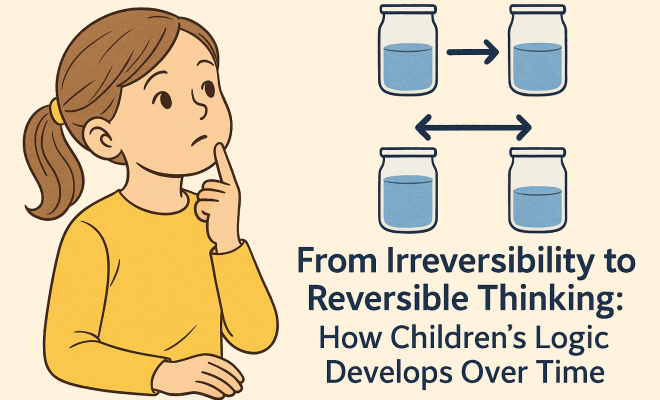
Before children develop reversible thinking, they often demonstrate what Piaget termed ‘irreversibility.’ This cognitive limitation means they struggle to comprehend that actions can be reversed or undone. For example, if a child sees a ball of clay flattened into a pancake shape, they might not understand that it can be re-formed into a ball.
Irreversibility manifests in children’s reasoning in various ways. They might insist that a change, such as pouring juice from a tall glass into a short, wide glass, alters the amount of juice, even when the volume remains the same. This inability to mentally reverse actions can significantly impact their problem-solving skills and understanding of cause-and-effect relationships.
Transitioning to Reversible Thinking
The transition from irreversibility to reversible thinking is not instantaneous; rather, it unfolds gradually as children encounter new experiences and challenges. This shift allows children to engage in more complex reasoning, leading to better problem-solving abilities. One of the factors that facilitate this transition is social interaction.
Children learn through play, conversation, and collaborative problem-solving with peers and adults. These interactions provide opportunities for children to experiment with reversible actions, such as building and dismantling structures or engaging in role-play scenarios where they can explore different perspectives. Through such activities, they begin to understand that situations can be altered and reverted, fostering more flexible thinking.
Key Stages in Logical Development
Understanding children’s logic development involves recognizing several key stages that they progress through. As they transition from irreversibility to reversible thinking, children typically pass through the following stages:
- Sensorimotor Stage (Birth to 2 years): During this stage, children learn about the world through their senses and actions. They develop object permanence but have no understanding of reversibility.
- Preoperational Stage (2 to 7 years): Children engage in symbolic play and build language skills but struggle with logical reasoning. Irreversibility is prominent as they cannot yet understand that actions can be reversed.
- Concrete Operational Stage (7 to 11 years): This is where the transition to reversible thinking begins. Children start grasping concepts like conservation and reversibility, allowing them to think logically about concrete situations.
- Formal Operational Stage (11 years and up): In this final stage, abstract reasoning develops. Children can think logically about hypothetical situations, further enhancing their logical reasoning abilities.
The Role of Education in Fostering Logical Thinking
Education plays a crucial role in children’s logic development, particularly in promoting reversible thinking. Educators can create an environment that encourages children to ask questions, explore concepts, and engage in hands-on learning experiences. Incorporating activities that require problem-solving can help children practice reversible thinking. (See: Cognitive development in children.)
For instance, math games that involve addition and subtraction can illustrate how numbers can be manipulated and reversed. Science experiments that require making predictions, observing outcomes, and discussing results further enhance their understanding of cause-and-effect relationships.
Examples of Reversible Thinking in Everyday Life
Real-life scenarios can provide excellent opportunities for children to exercise their reversible thinking skills. Here are a few examples:
- Cooking: Involving children in cooking teaches them about measurements and transformations. They learn that ingredients can be combined and separated, demonstrating reversibility.
- Gardening: Gardening allows children to observe changes in plants. They can see how seeds grow into plants and experience the process of pruning, which teaches them that actions can be reversed to encourage growth.
- Building with Blocks: When children build structures with blocks, they can experiment with creating and deconstructing. This process not only enhances spatial awareness but also reinforces the concept that structures can be taken apart and reassembled.
The Impact of Emotional and Social Factors
While cognitive development is critical, emotional and social factors also influence children’s logic development. A child’s confidence and willingness to explore can significantly impact their ability to engage in reversible thinking. Children who feel safe and supported in their learning environment are more likely to experiment with ideas and take risks in their thinking.
Peer interactions can also play a pivotal role in shaping logical reasoning. Collaborative activities, such as group projects or shared games, encourage children to discuss different perspectives, challenge each other’s ideas, and ultimately refine their reasoning skills.
Challenges in Developing Reversible Thinking
Despite the natural progression toward reversible thinking, some children may experience challenges along the way. Factors such as learning disabilities or environmental influences can hinder a child’s ability to grasp logical concepts. For instance, children with attention deficit hyperactivity disorder (ADHD) might struggle to focus on tasks that require sustained logical reasoning.
Moreover, cultural factors can also influence children’s logic development. In some cultures, emphasis on rote memorization may overshadow opportunities for critical thinking and problem-solving, stunting the development of reversible thinking. Educators and parents must recognize these challenges and adapt their approaches to support each child’s unique learning journey.
Current Relevance and Future Directions
The understanding of children’s logic development, particularly the transition from irreversibility to reversible thinking, remains highly relevant in today’s educational landscape. As advancements in educational psychology continue to emerge, it’s essential for parents and educators to remain informed about the best practices for supporting children’s cognitive growth.
Integrating technology in learning, for example, offers new avenues for fostering logic development. Educational apps and games that challenge children’s reasoning skills can provide interactive experiences that promote engagement. Furthermore, the rise of experiential learning emphasizes hands-on activities that align with the principles of reversible thinking.
Practical Insights for Supporting Children’s Logic Development
To effectively support children’s logic development, here are several actionable insights:
- Encourage Questioning: Create an environment where children feel comfortable asking questions. This curiosity can lead to deeper exploration and understanding.
- Provide Hands-On Experiences: Engage children in activities that require experimentation and problem-solving. Real-world applications can solidify their understanding of reversibility.
- Promote Collaborative Learning: Encourage group activities that foster communication and debate, allowing children to articulate their thoughts and learn from peers.
- Celebrate Mistakes: Help children view mistakes as learning opportunities. This mindset can reduce the fear of failure, enabling them to take risks in their thinking.
FAQs About Children’s Logic Development
What age does logic development begin?
Logic development begins in infancy, as children start using their senses to explore the world. However, significant development occurs during the preschool years, when they begin to engage in symbolic play and language development.
How can parents encourage logic development at home?
Parents can encourage logic development by providing opportunities for problem-solving through games, puzzles, and hands-on activities. Engaging in conversations that challenge them to think critically about their experiences is also beneficial. (See: Understanding learning and development.)
What are signs of delayed logic development?
Signs of delayed logic development can include difficulty in understanding cause-and-effect relationships, problems with problem-solving skills, and persistent reliance on memorization rather than understanding. If concerns arise, it’s advisable to consult with a child psychologist or developmental specialist.
Are there specific activities that enhance reversible thinking?
Yes, activities such as building with blocks, participating in role-playing games, and conducting simple science experiments can enhance reversible thinking. These activities encourage children to see the outcomes of their actions and understand that many situations can be altered and reverted.
How does play influence children’s logic development?
Play is vital for logic development as it allows children to experiment in a safe environment. Through play, they can test hypotheses, explore consequences, and develop flexible thinking skills. This unstructured time promotes creativity and problem-solving, which are essential for logical reasoning.
What role does cultural background play in logic development?
Cultural background can greatly influence how children develop logical reasoning. Different cultures may prioritize various learning styles or approaches to problem-solving. Understanding these cultural factors can help educators better support children’s unique learning paths and ensure they receive a well-rounded education.
Expert Perspectives on Children’s Logic Development
Experts agree that nurturing logical reasoning in children is essential for their overall cognitive development. Dr. Laura Berk, a developmental psychologist, emphasizes the importance of play in developing logical thinking skills. She notes, “Children learn best through active exploration and social interaction. These experiences lay the groundwork for higher-level thinking later on.”
Furthermore, Dr. David Elkind, a child psychologist, highlights the role of emotional security in fostering logical reasoning: “When children feel emotionally secure, they are more willing to take risks in their thinking. This willingness is crucial for engaging in the trial-and-error process that enhances logic development.”
Case Studies in Logic Development
Case studies of children in various educational settings demonstrate how different approaches to learning can influence logic development. For instance, children in Montessori programs often excel in problem-solving tasks due to the emphasis placed on hands-on learning and self-directed exploration. These children typically engage more frequently in activities that promote reversible thinking, like building and experimenting with materials.
Another case study examined children in traditional school settings with a heavy focus on rote learning. These children showed signs of difficulty when faced with tasks that required logical reasoning, as they had less experience with exploratory learning. This contrast highlights how educational philosophy can impact children’s capacity for logical thought.
Understanding the Role of Technology in Logic Development
In today’s digital age, technology increasingly impacts children’s learning and logic development. Educational tools and platforms provide innovative ways to engage children in logical reasoning. For example, coding games and logic puzzles cultivate analytical skills, allowing children to approach problems methodically and systematically.
Research shows that interactive learning through technology can enhance engagement and motivation. A study published in the Journal of Educational Psychology found that children who used educational apps demonstrated improved problem-solving skills compared to their peers who did not use such technology. However, balance is crucial; too much screen time without active engagement can hinder logic development. Parents and educators should curate a mix of technology use and traditional play-based learning.
Integrating Arts into Logic Development
While logic development is often associated with mathematics and science, the arts play a significant role too. Engaging in creative activities like drawing, music, or drama fosters critical thinking and flexible reasoning. For instance, when children create stories or play characters, they practice understanding different perspectives and narratives—skills that are crucial for logical reasoning.
Moreover, a 2020 study found that children who participated in arts education had better outcomes in creative problem-solving tasks. They were more likely to approach challenges with innovative solutions, showcasing how the arts can complement logical development.
Future Trends in Supporting Children’s Logic Development
As we look to the future, several trends are emerging in children’s logic development support. One growing movement is the emphasis on social-emotional learning (SEL). This approach recognizes that emotional intelligence is intertwined with cognitive development. Children who can manage their emotions and understand social dynamics are often more successful in logical reasoning and problem-solving tasks.
Another trend is the emphasis on personalized learning. With advances in educational technology, tailored learning experiences can meet the unique needs of each child. Adaptive learning programs assess a child’s abilities and adapt lessons accordingly, ensuring that they are sufficiently challenged without feeling overwhelmed.
Conclusion on Children’s Logic Development
As children navigate the journey from irreversibility to reversible thinking, their ability to think critically and logically will serve as a foundation for lifelong learning. By understanding and nurturing this development, parents and educators can empower children to become confident thinkers and problem solvers. Supporting children’s logic development is not just about fostering academic success; it’s about equipping them with the essential skills they need to navigate an increasingly complex world.
“`
Trending Now
- our breakdown of how mindfulness practices improve executive function and emotional regulation
- our breakdown of the relationship between object permanence and cognitive development in infants
- this guide on how adhd affects executive function and emotional regulation in high school
- this guide on the role of nonverbal communication in pragmatic language development
- our breakdown of how scaffolding supports english language learners in elementary school
Frequently Asked Questions
What is reversible thinking in children?
Reversible thinking is a cognitive ability that develops in children, allowing them to understand that actions can be undone or reversed. This typically occurs during the concrete operational stage, around ages 7 to 11, enabling children to process information more flexibly and grasp concepts like conservation of quantity.
What does Piaget's theory say about children's logic development?
Jean Piaget's theory outlines that children's logic develops through distinct stages, starting with sensorimotor intelligence in infancy and progressing to formal operational thinking in adolescence. Key milestones include the transition from irreversibility to reversible thinking, which enhances their problem-solving and critical thinking skills.
How can parents nurture logical reasoning in children?
Parents can nurture logical reasoning in children by providing opportunities for hands-on learning and problem-solving activities. Engaging in games that involve classification, sequencing, and reversible actions, as well as encouraging questions and discussions about their observations, can significantly support their cognitive development.
What is the significance of understanding irreversibility in early childhood?
Understanding irreversibility is crucial in early childhood as it highlights a child's cognitive limitations. Recognizing this phase helps caregivers and educators to tailor learning experiences that gradually introduce concepts of reversibility, fostering logical reasoning and enhancing overall cognitive growth.
At what age do children typically develop reversible thinking?
Children typically develop reversible thinking between the ages of 7 and 11, during the concrete operational stage of Piaget's cognitive development theory. This developmental milestone allows them to understand that changes can be reversed, significantly improving their reasoning and problem-solving abilities.
Have you experienced this yourself? We’d love to hear your story in the comments.