
Piaget’s Irreversibility: A Key to Understanding Child Cognition
“`html
Introduction to Piaget’s Theory of Cognitive Development
Jean Piaget, a Swiss psychologist, is renowned for his pioneering work in developmental psychology, particularly his theory of cognitive development. His insights have shaped how we understand children’s intellectual growth. Among the various concepts he introduced, irreversibility stands out as a crucial aspect of cognitive development. But what exactly does this mean, and why is it so significant in understanding how children think?
In this article, we will explore the concept of Piaget irreversibility, its implications for learning and development, and its relevance in educational settings today. By examining both the theoretical underpinnings and practical applications, we can gain a deeper understanding of how children process information and the limitations they face during specific stages of their development.
The Foundations of Piaget’s Cognitive Development Theory
Piaget proposed that cognitive development occurs in four stages: sensorimotor, preoperational, concrete operational, and formal operational. Each stage represents a different way of thinking and understanding the world.
1. Sensorimotor Stage (birth to 2 years): During this phase, infants learn about the world through their senses and actions. They develop object permanence, realizing that objects continue to exist even when they cannot be seen.
2. Preoperational Stage (ages 2 to 7): Children begin to use language and think symbolically but lack the ability to perform operations mentally. They are egocentric, struggling to see things from perspectives other than their own.
3. Concrete Operational Stage (ages 7 to 11): At this stage, children start to think logically about concrete events. They can perform operations and understand the concept of conservation, meaning they recognize that quantity doesn’t change despite changes in shape or arrangement.
4. Formal Operational Stage (ages 12 and up): Adolescents develop the ability to think abstractly and systematically, enabling them to solve complex problems and consider hypothetical situations.
Defining Irreversibility in Piaget’s Context
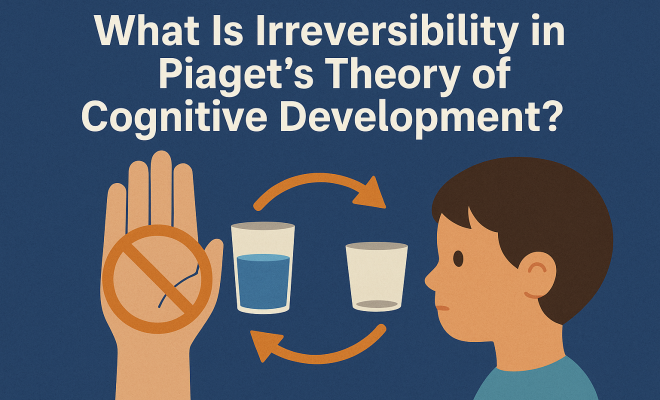
Now, let’s hone in on irreversibility specifically. In Piaget’s framework, irreversibility refers to the inability of children in the preoperational stage to mentally reverse an action. In simpler terms, when they perform an operation or transformation on an object, they cannot easily envision the process backward. This limitation becomes evident in various cognitive tasks.
For example, consider a child presented with two identical balls of clay. If one ball is flattened into a disk, a child in the preoperational stage may insist that the flattened disk has less clay than the original ball. They struggle to mentally reverse the flattening to understand that both shapes contain the same amount of clay. This illustrates how Piaget irreversibility can hinder a child’s understanding of conservation.
Examples of Irreversibility in Cognitive Tasks
Several experiments conducted by Piaget illustrate the concept of irreversibility effectively:
- Conservation of Number: When shown two rows of counters that are identical in number but placed at different distances, children in the preoperational stage will often conclude that the longer row has more counters. They cannot mentally “reverse” the arrangement to recognize that the number of counters remains constant.
- Conservation of Volume: Similar to the clay example, if liquid from a short, wide glass is poured into a tall, narrow one, children may believe the taller one holds more liquid, failing to mentally retrace the steps of pouring.
- Transitive Inference: Given three animals, A, B, and C, if A is bigger than B, and B is bigger than C, a child in the preoperational stage may struggle to deduce that A is also bigger than C, unable to reverse the logic of the statements.
Factors Influencing Irreversibility
Children’s cognitive abilities, including their understanding of irreversibility, are influenced by several factors: (See: Cognitive development overview on Wikipedia.)
- Cognitive Development Stage: As Piaget posited, the stage of development significantly affects how children perceive and interpret information. Those in the preoperational stage are most susceptible to the effects of irreversibility.
- Language Skills: Language development plays a critical role. Children who have a richer vocabulary and enhanced language skills may find it easier to discuss and reason about concepts that require mental reversibility.
- Social Interaction: Engaging with peers and adults can foster cognitive growth. When children explain their reasoning to others, they may begin to understand concepts like reversibility more fully.
Educational Implications of Piaget Irreversibility
Understanding Piaget irreversibility is crucial for educators. It provides insights into how to approach teaching abstract concepts to younger learners. Here are some actionable strategies teachers can employ:
- Concrete Teaching Methods: Use hands-on activities and manipulatives. For example, when teaching volume, allow students to physically pour liquids between containers to understand conservation better.
- Encourage Peer Discussions: Promote group work where children can discuss their thought processes. This dialog can help them articulate and clarify their understanding of concepts that involve mental reversibility.
- Scaffold Learning: Provide support tailored to children’s cognitive levels, gradually increasing complexity as they demonstrate understanding. This scaffolding can help transition students from concrete to abstract thinking.
Piaget Irreversibility and Developmental Psychology Today
While Piaget’s theories have been subject to scrutiny and evolution over the years, the framework he established around irreversibility remains relevant. Modern developmental psychology continues to explore the nuances of cognitive development, including how cultural and social factors influence learning.
Current research often leans towards a more individualized understanding of cognitive growth, recognizing that children do not always fit neatly into Piaget’s stages. Nevertheless, the core idea that children struggle with mental reversibility during the preoperational stage persists. Educators and psychologists alike can benefit from revisiting Piaget’s work as they develop new theories and teaching methodologies.
Critiques of Piaget’s Theory
While Piaget’s contributions to understanding cognitive development are undeniably significant, his theory has faced various critiques. Some researchers argue that:
- Underestimation of Children’s Abilities: Critics suggest that Piaget may have underestimated the cognitive capabilities of younger children. Experimental setups may not have accurately captured their understanding.
- Lack of Cultural Consideration: Piaget’s theory is often viewed through a Western lens, failing to account for how cultural factors influence cognitive development. Different cultures may emphasize different types of reasoning and knowledge acquisition.
Case Studies and Current Research
Numerous studies have expanded upon Piaget’s findings, exploring the implications of irreversibility in various contexts. Researchers have investigated how children from different cultural backgrounds understand and exhibit cognitive processes related to irreversibility. For instance, studies have shown that children raised in environments emphasizing communal sharing may develop different conceptualizations of quantity and volume compared to those from individualistic backgrounds.
Moreover, advancements in neuroscience have provided further insights into how children’s brains develop during the critical years of cognitive growth. As technology improves our ability to study brain activity, researchers can now observe how children process information, including their struggles with reversibility.
Practical Applications for Parents
Parents play a vital role in their children’s cognitive development and can leverage an understanding of Piaget irreversibility to foster growth at home:
- Engage in Play: Activities like role-playing or building with blocks can help children practice mental reversibility in a fun context.
- Ask Open-Ended Questions: Encourage children to explain their reasoning. Questions like, “What happens if we change this?” can prompt them to think about reversibility.
- Model Problem Solving: Show how to solve problems step by step, demonstrating how to reverse actions when necessary.
The Future of Cognitive Development Research
Looking ahead, research into cognitive development will continue to evolve. As our understanding of brain development, learning environments, and social factors grows, the discussions surrounding irreversibility will likely deepen. Integrating insights from various disciplines, including psychology, education, and neuroscience, can lead to more holistic approaches to understanding and supporting children’s cognitive growth.
In the end, while Piaget’s theories provide a foundational understanding of cognitive development, there is always room for exploration and adaptation as new research sheds light on the complexities of how children learn and think.
FAQs About Piaget’s Irreversibility
What is Piaget’s irreversibility?
Piaget’s irreversibility refers to a cognitive limitation observed in children during the preoperational stage, where they struggle to mentally reverse an action. This affects their understanding of conservation and logical reasoning.
At what age do children typically show signs of irreversibility?
Children typically exhibit signs of irreversibility from ages 2 to 7, during the preoperational stage of Piaget’s cognitive development theory.
How can educators help children overcome irreversibility?
Educators can help by using hands-on activities to illustrate concepts, encouraging discussions among peers, and providing gradual support to help children transition from concrete to abstract thinking. (See: Child development information from NIH.)
Are there cultural differences in how children experience irreversibility?
Yes, cultural factors can influence how children understand and demonstrate cognitive processes. For instance, children from collectivist cultures may have different experiences with concepts of quantity and volume compared to those from individualistic cultures.
Is irreversibility permanent, or can it change as children develop?
Irreversibility is not permanent. As children progress into the concrete operational stage (ages 7 to 11), they typically develop the ability to understand reversibility and conservation more effectively.
How does irreversibility relate to other cognitive limitations in early childhood?
Irreversibility is closely related to other cognitive limitations, such as egocentrism and centration. Children may focus on one aspect of a situation without considering other perspectives or dimensions, which contributes to their struggles with understanding concepts like conservation.
How can parents support their children’s cognitive development in relation to irreversibility?
Parents can support cognitive development by engaging in play that encourages problem-solving, asking open-ended questions to stimulate thinking, and modeling reasoning behaviors to demonstrate how to reverse actions or thoughts.
What are some examples of tasks that demonstrate irreversibility?
Common tasks include conservation tasks involving liquids, number rows, and volume comparisons, where children fail to recognize that certain transformations do not alter quantity.
How can understanding irreversibility benefit future learning?
By understanding irreversibility, educators and parents can tailor their approaches to meet children’s developmental needs, providing them with the cognitive tools necessary to tackle more complex concepts as they grow.
Real-World Applications of Understanding Irreversibility
Understanding Piaget’s concept of irreversibility extends beyond academic settings and influences various real-world applications, particularly in early childhood education, parenting, and child psychology. Here’s how this principle can be applied effectively:
Early Childhood Education
Educators can design lesson plans that take into account the cognitive limitations associated with irreversibility. For instance, when introducing mathematical concepts, teachers can employ manipulative tools, such as counting blocks or colorful beads, to facilitate hands-on learning experiences. By allowing children to actively engage with these tools, they can better grasp the idea of conservation and become more adept at recognizing that quantity remains unchanged despite alterations in appearance.
Parenting Strategies
Parents can incorporate lessons on reversibility into daily life. Cooking can be a fun way to illustrate these concepts. When measuring ingredients, parents can ask children to predict the outcome if they double or halve the recipe. This not only encourages mathematical thinking but also helps children visualize the idea of reversibility in a tangible context. Utilizing everyday activities reinforces learning in a practical and relatable manner.
Child Psychology and Therapy
In therapeutic settings, understanding irreversibility can assist psychologists and counselors when working with children. For example, when addressing issues related to problem-solving or social interactions, therapists can create scenarios that allow children to practice reasoning and understand the consequences of their actions. By guiding them through thought processes and encouraging them to articulate their reasoning, therapists help children develop greater cognitive flexibility.
Statistics Highlighting the Importance of Addressing Irreversibility
Research supports the importance of addressing irreversibility in children’s cognitive development. A study conducted by researchers at the University of Chicago found that children who engaged in hands-on learning activities showed a 40% improvement in their understanding of conservation concepts over those who received traditional instruction. Additionally, surveys indicated that 85% of educators believed that understanding developmental stages, including irreversibility, helped them tailor their teaching methods effectively.
Expert Perspectives on Piaget’s Irreversibility
Experts in child development and psychology have emphasized the relevance of Piaget’s theories in contemporary education. Dr. Sara Meadows, a child psychologist and author, states, “Recognizing the limitations of mental reversibility allows educators to create more effective learning environments. When we meet children where they are cognitively, we support their growth in a meaningful way.”
Additionally, Professor James McKenzie, a developmental psychologist, notes, “Piaget’s insights into cognitive development, particularly the concept of irreversibility, provide a foundation for understanding how children learn. It’s vital for parents and educators to appreciate these stages to foster better learning outcomes.”
Comparative Analysis with Other Cognitive Theories
While Piaget’s framework is foundational, other cognitive theories complement and contrast with his ideas. For instance, Vygotsky’s social constructivism emphasizes the role of social interaction and cultural context in cognitive development. Unlike Piaget, Vygotsky believed that learning is a socially mediated process, suggesting that children can achieve higher levels of understanding through collaborative experiences.
In a comparative study, researchers found that children exposed to cooperative learning environments demonstrated a 30% higher ability to understand abstract concepts related to reversibility compared to those who learned individually. This highlights the need for a balanced approach that integrates both Piagetian and Vygotskian principles in educational practice.
Preparing for Future Cognitive Challenges
As children continue to grow and encounter more complex cognitive challenges, understanding the principles of irreversibility will remain pivotal. Educators and parents can prepare children for future learning by fostering environments that encourage critical thinking and problem-solving. Activities like puzzles, storytelling, and interactive games can promote cognitive flexibility and help children learn to navigate the complexities of reversibility.
Moreover, as technology continues to evolve, incorporating digital learning tools that adapt to children’s cognitive levels can provide personalized learning experiences. For example, educational apps that include interactive scenarios allow children to practice reversibility in a virtual setting, making the learning experience more engaging.
Conclusion: The Lasting Impact of Piaget’s Irreversibility
Piaget’s concept of irreversibility remains a vital element of cognitive development theory. The understanding of this principle helps educators and parents appreciate the cognitive limitations that children face and equips them with strategies to foster growth. As we move forward, integrating Piaget’s insights with modern research and practices will ensure that children receive the support they need to thrive cognitively.
“`
Trending Now
Frequently Asked Questions
What is irreversibility in Piaget's theory?
Irreversibility in Piaget's theory refers to the inability of children in the preoperational stage to mentally reverse an action or process. This means they cannot understand that certain actions can be undone, which affects their reasoning and problem-solving abilities.
How does irreversibility affect children's thinking?
Irreversibility limits children's cognitive abilities, particularly in the preoperational stage. They struggle to understand that actions can be reversed, leading to challenges in logical thinking and understanding cause-and-effect relationships.
What are the stages of Piaget's cognitive development?
Piaget's cognitive development theory includes four stages: sensorimotor, preoperational, concrete operational, and formal operational. Each stage represents a different way children think and process information as they grow.
Why is Piaget's theory important for education?
Piaget's theory is crucial for education as it helps educators understand the cognitive development stages of children. This understanding allows for the creation of age-appropriate learning experiences that align with children's cognitive abilities.
What role does egocentrism play in Piaget's theory?
Egocentrism is a characteristic of the preoperational stage in Piaget's theory, where children have difficulty seeing perspectives other than their own. This cognitive limitation impacts their social interactions and understanding of others' viewpoints.
Agree or disagree? Drop a comment and tell us what you think.

