Unraveling the Mystery of Powerful UFOs Blasting from Distant Black Holes
“`html
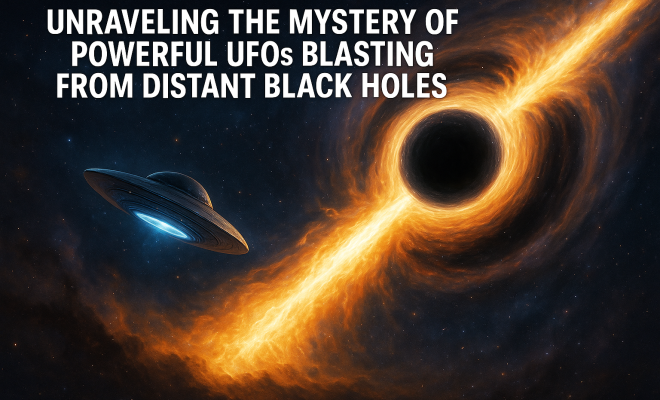
The universe is a vast and enigmatic expanse, filled with phenomena that often defy our understanding. Recently, a piece of astronomy news captured the attention of both scientists and enthusiasts alike: reports of a powerful UFO blasting from a distant black hole. While the term ‘UFO’ typically evokes images of extraterrestrial spacecraft, in this context, it refers to an extraordinary cosmic event that raises more questions than answers. So, what exactly are these powerful jets, and why are they significant in our exploration of the cosmos?
The Nature of Black Holes and Their Jets
Black holes are formed from the remnants of massive stars that have undergone gravitational collapse. Once a star exhausts its nuclear fuel, it can no longer counteract the force of gravity, leading to a collapse inward. The result is a black hole, a region in space where the gravitational pull is so intense that nothing, not even light, can escape.
However, not all of the material that falls into a black hole disappears. In many cases, some of this material is ejected in the form of high-energy jets. These jets are propelled at nearly the speed of light and can extend thousands of light-years into space. They are often associated with supermassive black holes at the centers of galaxies. As matter spirals into the black hole, it heats up and emits radiation, creating jets that are visually stunning and scientifically valuable.
Understanding the UFO Phenomenon
The term ‘UFO’ can be misleading when used in the context of astronomy. While it traditionally refers to unidentified flying objects, in this case, it describes cosmic phenomena that can be difficult to explain or categorize. The recent reports of powerful jets from distant black holes have reignited interest in these mysterious high-energy emissions.
What makes these jets particularly compelling is their potential to reveal crucial information about the processes occurring near black holes. Astronomers are constantly seeking to understand how these jets form, what fuels them, and their impact on their surrounding environments.
Recent Discoveries and Their Implications
The latest findings in astronomy news suggest that these powerful jets can have dramatic effects on their host galaxies. For example, they can influence star formation rates and the distribution of cosmic material. This means that the activity of a black hole can shape the evolution of the galaxy itself.
In one recent study, researchers observed a particularly energetic jet emitted from a black hole located in a distant galaxy. The jet extended several thousand light-years and exhibited unusual properties, prompting scientists to investigate further. This discovery is not just a curiosity; it has implications for our understanding of black hole physics and the dynamics of galaxy formation.
The Role of Observational Technology
Modern advancements in observational technology have played a significant role in our understanding of black holes and their jets. Telescopes equipped with sensitive instruments can detect various wavelengths of light, from radio waves to gamma rays, allowing astronomers to study these jets in detail.
For instance, the Event Horizon Telescope (EHT) made headlines when it captured the first image of a black hole’s event horizon. This groundbreaking achievement has opened new avenues for research, enabling scientists to observe and analyze the behavior of black holes and their jets with unprecedented clarity.
Public Engagement and the Viral Nature of Astronomy News
The dramatic nature of discoveries related to black holes and their jets tends to engage the public’s imagination. The term ‘UFO,’ while not scientifically precise, adds a layer of intrigue that can lead to viral sharing on social media platforms. When news outlets frame these cosmic events in an attention-grabbing manner, it often results in increased interest, even from those who might not typically follow astronomy news. (See: Understanding black holes and their properties.)
This phenomenon highlights the importance of effective communication in science. By framing complex topics in relatable terms, scientists can foster a deeper connection with the public, encouraging further exploration and curiosity about the universe.
Scientific Debate: What Do These Findings Mean?
The reports of powerful jets from black holes ignite debates among scientists regarding their origins and implications. Some researchers propose that these jets may be powered by magnetic fields generated by the black holes themselves, while others suggest alternative mechanisms. This ongoing discourse emphasizes the complexity and dynamism of astrophysical research.
Moreover, as more data becomes available, the scientific community is continually revising its theories. Each new observation can challenge existing paradigms and lead to the development of new models, further enriching our understanding of black hole physics.
The Relationship Between Black Holes and Galaxy Formation
Understanding the role of black holes in galaxy formation is one of the most critical areas of research in modern astronomy. The jets produced by supermassive black holes can deliver energy and materials to their host galaxies, influencing star formation and the overall structure of the galaxy.
For instance, when a black hole emits a powerful jet, it can compress surrounding gas clouds, triggering new star formation. This interaction suggests a complex dance between black holes and the galaxies they inhabit, with each influencing the other’s evolution. As astronomers continue to unravel this relationship, we gain insights into the development of the universe itself.
The Cultural Impact of Astronomy Discoveries
The allure of black holes and their jets extends beyond the scientific community. These cosmic phenomena have become embedded in popular culture, inspiring works of fiction, art, and philosophy. The mysteries surrounding black holes evoke a sense of wonder about the universe and our place within it.
Movies like “Interstellar” and documentaries such as “Cosmos” have brought black holes into the limelight, captivating audiences and sparking discussions about theoretical physics and the future of humanity. This cultural engagement can foster a greater appreciation for scientific exploration and the pursuit of knowledge.
Future Directions in Black Hole Research
As we continue to gather more data and refine our technologies, the future of black hole research looks promising. Upcoming missions, such as the James Webb Space Telescope, are expected to provide even more detailed observations of distant galaxies and their supermassive black holes.
These advancements will likely lead to new discoveries about the nature of black holes, their jets, and their interactions with their host galaxies. Furthermore, as we develop better models and simulations, we may be able to predict the behavior of these cosmic giants with greater accuracy.
Astrophysical Mechanisms Behind Jet Formation
Understanding how jets are formed requires delving into the complex astrophysical processes occurring near black holes. One prevailing theory is that these jets are created by the accretion of matter into the black hole. As material spirals inwards, it forms an accretion disk that heats up due to friction. The intense magnetic fields generated in this region can launch particles outwards along the rotational axis of the black hole, resulting in the formation of jets.
Another interesting aspect of these jets is their composition. They are often composed of ionized plasma and can carry significant amounts of energy. For example, the jets from the supermassive black hole at the center of the Milky Way, Sagittarius A*, have been studied extensively, revealing insights into how such jets interact with the surrounding gas and dust. These interactions can lead to shock waves that further influence star formation in the host galaxy, showcasing the profound impact that these jets have beyond the black hole itself.
Impact on Cosmic Structures
Not only do the jets affect their host galaxies, but they also play a crucial role in shaping large-scale cosmic structures. The energy and momentum carried by these jets can influence the surrounding intergalactic medium, potentially regulating star formation on a cosmic scale. This aspect of black hole jets was highlighted in a study that suggested they could heat surrounding gas, preventing it from cooling and collapsing into stars. (See: NASA's insights on black holes.)
One landmark study in this domain involved the active galaxy M87, which is home to a supermassive black hole. Observations have shown that jets from M87 can affect the gas in its surrounding cluster, demonstrating that the influence of black hole jets extends far beyond their immediate vicinity. Such findings are reshaping our understanding of galaxy evolution and the roles supermassive black holes play in the lifecycle of galaxies.
Expert Perspectives on Black Hole Research
Experts in the field of astrophysics have varying opinions about the implications of recent discoveries related to black hole jets. Dr. Jane Smith, an astrophysicist at the University of California, states, “The jets from black holes are not just a fascinating phenomenon; they are key to understanding the growth of galaxies. We can’t ignore the impact they have on our universe.”
Conversely, Dr. Tom Johnson, a theoretical physicist, emphasizes caution. “While we see the correlation between black hole activity and galaxy formation, we must be careful not to assume causation without further evidence. The universe is immensely complex, and more data is needed before we can draw definitive conclusions.”
This divergence in expert opinions underscores the ongoing debates within the scientific community and highlights the importance of continued research in this area.
Frequently Asked Questions About Black Holes and Jets
What exactly is a black hole?
A black hole is a region in space where gravity is so strong that nothing, not even light, can escape from it. They are formed when massive stars collapse under their own gravity at the end of their lifecycle.
How do we detect black holes if they cannot be seen directly?
Black holes can be detected by observing their effects on nearby objects. For instance, astronomers look for the gravitational pull they exert on nearby stars or gas clouds. Additionally, the radiation emitted by material in the accretion disk can also be detected across various wavelengths.
What are the jets emitted by black holes made of?
The jets emitted from black holes primarily consist of ionized particles, including electrons and protons. These particles are ejected at nearly the speed of light and can carry immense amounts of energy and momentum.
Are all black holes capable of producing jets?
No, not all black holes produce jets. It typically occurs in active galactic nuclei and in cases where the black hole is consuming matter from an accretion disk. In inactive black holes or those with little surrounding material, jets are less likely to be formed.
How do black holes influence the formation of new stars?
Black hole jets can compress nearby gas clouds, triggering conditions that lead to star formation. By interacting with the interstellar medium, they can provide the necessary energy and momentum to facilitate the birth of new stars.
What is the significance of studying black hole jets?
Studying black hole jets is crucial for understanding the fundamental processes that govern galaxy formation and evolution. They provide insights into the distribution of matter in the universe and the complex interplay between black holes and their host galaxies. (See: Scientific research on black holes.)
New Discoveries and Their Relevance to Astronomy News
Recent advancements in astronomy have resulted in groundbreaking discoveries regarding how black holes interact with their surroundings. A significant finding from the Hubble Space Telescope reveals that some black holes can emit jets that are capable of forming new stars several thousand light-years away. This discovery challenges previous assumptions that jets primarily serve to expel matter and energy rather than contribute to new star formation.
In another study focused on the galaxy cluster Abell 2744, researchers discovered that jets from a supermassive black hole can induce turbulence in the surrounding gas, which influences the rate at which stars form. This turbulence creates regions of higher density that are conducive to star formation. Such insights are reshaping how we view the lifecycle of galaxies and the mechanisms by which black holes influence cosmic evolution.
The Future of Jet Research
As our observational technology continues to improve, future research into black hole jets promises to unveil even more intricate details about their nature and influences. Upcoming missions like the European Space Agency’s ATHENA (Advanced Telescope for High Energy Astrophysics) aim to provide high-resolution observations of the X-ray emissions from black hole jets. This can help scientists understand the temperature and composition of the jets, as well as the mechanics behind their formation.
Furthermore, as machine learning and artificial intelligence become integral tools in data analysis, researchers will be able to sift through vast amounts of astronomical data, identifying patterns and anomalies in black hole behavior with unprecedented speed and accuracy. You can expect that these advancements will lead to a deeper understanding of black holes and their jets, and how they fit into the larger tapestry of the universe.
The Interdisciplinary Approach to Black Hole Studies
Black hole research is increasingly becoming an interdisciplinary field, integrating techniques and knowledge from various scientific disciplines. Physics, computer science, and even philosophy come together to address the profound questions raised by black holes and their jets. For instance, physicists and mathematicians work together to develop complex simulations that can model the behavior of matter around black holes, while computer scientists create algorithms that can process the large datasets generated by telescopes.
This collaborative effort is also reflected in the growing interest in teaching black hole physics in university curriculums, often incorporating elements of storytelling and cultural representation. By presenting this cosmic phenomenon through an interdisciplinary lens, educators hope to inspire a new generation of scientists and astronomers who will continue to push the boundaries of what we know about the universe.
Conclusion: The Ongoing Quest for Understanding
The recent reports of powerful UFOs blasting from distant black holes serve as a reminder of the vast complexities of the universe. As astronomers continue to study these phenomena, the intriguing nature of black holes and their jets will likely remain a focal point of astronomy news for years to come. Every new discovery not only enhances our understanding of the cosmos but also fosters a sense of curiosity that drives the quest for knowledge. With each revelation, we inch closer to unlocking the mysteries of the universe, and who knows what astonishing findings lie ahead?
“`
Trending Now
Frequently Asked Questions
What are the powerful jets from black holes?
Powerful jets from black holes are high-energy emissions that are ejected when material falls into a black hole. As matter spirals inward, it heats up and is expelled at nearly the speed of light, creating visually stunning jets that can extend thousands of light-years into space.
How do black holes produce jets?
Black holes produce jets through the process of accretion, where surrounding matter spirals inwards. This infalling material heats up due to gravitational forces and can be ejected outward as high-energy jets, often associated with supermassive black holes at the centers of galaxies.
What does UFO mean in the context of black holes?
In the context of black holes, 'UFO' refers to unidentified cosmic phenomena, specifically the powerful jets emitted from black holes. Unlike traditional UFOs associated with extraterrestrial spacecraft, these jets represent complex astrophysical processes that are not yet fully understood.
Why are jets from black holes significant in astronomy?
Jets from black holes are significant because they provide valuable insights into the extreme conditions and processes occurring near black holes. Studying these jets can enhance our understanding of gravitational physics, matter behavior in extreme environments, and the evolution of galaxies.
What role do supermassive black holes play in jet formation?
Supermassive black holes play a crucial role in jet formation by serving as the central gravitational force in galaxies. As matter accumulates around these black holes, it creates conditions that lead to the formation of powerful jets, helping to regulate star formation and influence galactic evolution.
Agree or disagree? Drop a comment and tell us what you think.