Act Now: Secure Top CD Rates Up to 4.30% APY in June 2026
“`html
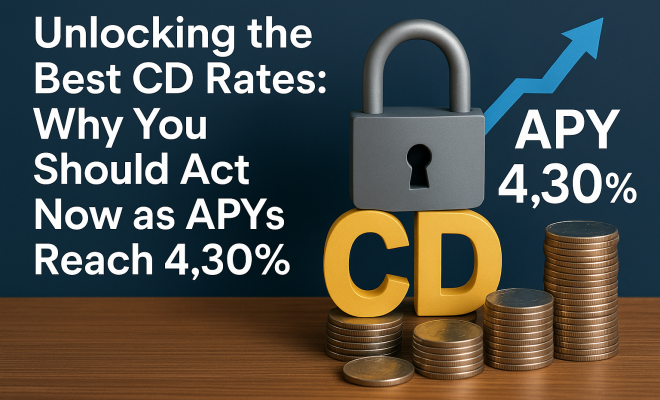
The finance world is buzzing with excitement over the current CD rates June 2026. With top certificates of deposit (CDs) offering yields as high as 4.30% APY, there’s a lot to unpack about why you might want to consider locking in these rates now. As economic conditions evolve, the urgency to secure these attractive returns is growing. Here’s what you need to know.
1. The Current Landscape of CD Rates
As of June 17, 2026, financial institutions are offering some of the best CD rates seen in recent years. Morgan Stanley, for example, has positioned itself at the forefront with its 4-year and 5-year CDs offering an impressive 4.30% APY. This competitive rate is a significant pull for savers looking for guaranteed returns in a historically low-rate environment.
This spike in CD rates comes at a time when the Federal Reserve has lowered its benchmark rates. While this traditionally signals a decrease in available interest rates across various financial products, the current situation contradicts expectations. For savers, this presents a unique opportunity to capitalize on relatively high yields before the market adjusts.
2. The Effects of Federal Reserve Policies
The Federal Reserve’s recent moves to reduce its benchmark interest rates have sent ripples through the financial sector. Typically, a lower benchmark rate implies a less favorable environment for traditional savings products, yet here we are witnessing the opposite regarding CDs. This contradiction is drawing attention to the lucrative opportunities offered by certificates of deposit.
When the Federal Reserve slashes rates, banks often reduce the yields they offer to customers. However, the current competitive landscape has led some institutions to maintain or even increase their CD offerings. This peculiar situation is further fueled by a growing anxiety among consumers that rates may continue to drop, prompting a fear of missing out on these higher yields.
3. Comparing CD Rates: A Smart Strategy
With banks offering varying APYs, it’s crucial for you, the consumer, to shop around. By comparing rates, you can maximize your returns. Consider not only the interest rate but also the terms and conditions associated with each CD. Some banks may offer the same rate but have different minimum deposit requirements or penalties for early withdrawal.
Take time to look at local banks alongside online financial institutions. While larger banks like Morgan Stanley may lead with appealing rates, smaller banks or credit unions can sometimes offer competitive options that deserve attention. Researching and comparing rates across the board can help ensure you’re making the best decision for your savings.
4. The Urgency of Locking in Rates
Time is of the essence when it comes to securing favorable CD rates. Given the current financial climate, there’s a palpable urgency to act before rates begin to decline. The fear of missing out (FOMO) is valid, and many financial experts advise locking in high rates now, especially if you’re considering a longer commitment like a 4-year or 5-year CD.
As you contemplate your options, remember that these rates won’t last indefinitely. Market conditions can shift, and what seems like an attractive rate today could dwindle in the coming months. If you’re serious about maximizing your savings, taking action sooner rather than later is wise.
5. Understanding APY and Its Importance
Annual Percentage Yield (APY) is a crucial figure for any investor considering CDs. It reflects the total amount of interest you can earn over a year, factoring in the effect of compounding. Understanding APY can help you make more informed decisions about where to place your savings. (See: Federal Reserve official website.)
In the case of CDs, a higher APY means more substantial returns on your investment. It’s essential to read the fine print and understand how often interest compounds—whether daily, monthly, or annually—as this can significantly affect your overall earnings. A CD offering a 4.30% APY compounded more frequently can yield higher returns than one compounded less frequently, even if their rates appear the same.
6. Different Types of CDs: Which One Is Right for You?
When exploring CD rates June 2026, it’s essential to know that not all CDs are created equal. There are various types of CDs available, including traditional, no-penalty, and bump-up CDs, each catering to different financial needs and strategies.
Traditional CDs offer fixed interest rates for a specified term, while no-penalty CDs allow you to withdraw your funds without incurring a fee, albeit often at a lower interest rate. Bump-up CDs, on the other hand, give you the option to increase your rate if interest rates climb during your CD’s term. Understanding these different types can help you choose a product that aligns best with your financial goals.
7. The Role of Inflation and Economic Forecasts
The relationship between CD rates and inflation is a critical aspect of financial planning. As inflation rises, the purchasing power of your returns decreases. Therefore, locking in a high yield now can help mitigate the negative impact of inflation on your savings.
Experts predict that while the Federal Reserve has cut rates, inflation may still be a concern moving forward. If inflation outpaces the rate of your return, you could effectively be losing money in real terms. Hence, a well-timed decision to invest in a high-yield CD can be a valuable hedge against future economic uncertainties.
8. Long-Term vs. Short-Term CDs: Making the Right Choice
Deciding between long-term and short-term CDs often comes down to your financial goals and how soon you’ll need access to your money. Long-term CDs generally offer higher interest rates, making them appealing for those willing to lock their funds away for several years.
Conversely, if you anticipate needing quick access to your savings or believe interest rates might rise significantly in the near future, short-term CDs could be the way to go. These typically have maturities ranging from three months to a year and provide greater liquidity. Assessing your financial situation and future needs will help dictate the best course of action.
9. CD Laddering: A Strategy to Consider
CD laddering is a popular strategy that can maximize returns while maintaining some liquidity. The basic idea is to stagger the maturity dates of your CDs. For instance, you could invest in several CDs with varying terms—some for one year, some for two, and others for three or more. This way, you can take advantage of higher rates on long-term CDs while still having access to some of your funds at shorter intervals.
The beauty of this approach lies in its flexibility. When one CD matures, you can reinvest it into a new long-term CD at potentially higher rates. This can be particularly beneficial in a rising interest rate environment, where new CDs might offer better rates than those you initially invested in.
10. Expert Opinions on Future CD Rates
Financial experts have varying opinions on the trajectory of CD rates in the coming months. Some believe that the current yields may hold steady for a while longer, especially if inflation remains a concern. Others, however, suggest that rates could drop as banks adjust to the new normal and as competition for deposits increases. (See: Centers for Disease Control and Prevention.)
According to a recent survey by a financial advisory group, about 70% of experts believe that locking in current rates is a wise move. One analyst mentioned, “With the uncertainty in the economy, locking in a yield of 4.30% today could be seen as a safe haven for many investors.” Locking in these rates could mean the difference between a secure, predictable return and having to settle for lower yields in the future.
11. FAQs About CD Rates
What are the typical terms for CDs?
CDs can have terms ranging from as short as three months to as long as ten years or more. The longer the term, the higher the interest rate typically offered. It’s essential to choose a term that aligns with your financial goals and liquidity needs.
Can I access my money before the CD matures?
While you can technically access your funds, doing so will often incur a penalty for early withdrawal. This penalty can be a percentage of the interest earned or a certain number of months’ interest, depending on the bank’s policy.
How much do I need to open a CD?
Minimum deposit requirements for CDs can vary significantly between institutions. Some may require as little as $500, while others may require $1,000 or more. Always check the fine print before opening an account.
Are CDs insured?
Yes, most CDs offered by banks and credit unions are insured by the FDIC (up to $250,000 per depositor, per institution) or by the NCUA for credit unions. This insurance makes CDs a low-risk investment option.
What happens when a CD matures?
When your CD matures, you have several options. You can withdraw your funds, roll them over into a new CD, or transfer them to another account. Most banks will notify you ahead of maturity to discuss your options.
12. Trends Influencing CD Rates
Understanding the trends influencing CD rates June 2026 can help you make better investment decisions. Over the last few years, we’ve seen a shift in consumer behavior, with more individuals looking for stable and secure investment options amid economic uncertainty. This trend has led to increased demand for CDs, compelling banks to offer competitive rates to attract deposits.
Another significant trend impacting CD rates is the rise of digital banking. Online banks frequently have lower operating costs than their brick-and-mortar counterparts, which allows them to offer higher APYs on CDs. As consumers grow more comfortable with online banking platforms, this competition can result in better rates across the board.
13. The Impact of Economic Indicators
Economic indicators play a crucial role in determining CD rates. Factors such as the unemployment rate, consumer confidence index, and gross domestic product (GDP) growth can provide insights into the direction of future interest rates. For instance, if the economy is showing signs of robust growth, the Federal Reserve might be prompted to raise interest rates to curb inflation, which could positively affect CD rates in the long run. (See: New York Times finance section.)
Conversely, if economic indicators suggest a slowdown, rates may remain low or even decrease. Keeping an eye on these indicators can help you make informed decisions about when to invest in CDs. For example, if you notice signs of economic improvement, it might be the right time to lock in a CD rate before a potential increase.
14. Alternative Investments: How Do CDs Compare?
While CDs can offer attractive returns, it’s essential to consider how they stack up against other investment options. For instance, high-yield savings accounts and money market funds also provide liquidity and relatively competitive rates, but they may not offer the same guaranteed returns as CDs.
On the other hand, investing in stocks or bonds can yield higher returns over the long term but come with increased risk and volatility. If you’re looking for a stable, low-risk addition to your portfolio, CDs can be a solid choice. The key is to assess your risk tolerance and financial goals before making investment decisions.
15. Long-Term Planning with CDs
Integrating CDs into your long-term financial strategy can be beneficial. They can serve as a stable component of your portfolio, providing guaranteed returns that can help you reach financial milestones, such as saving for a home or retirement. For those who are risk-averse, CDs can act as a safety net, ensuring that a portion of your savings is not subject to market fluctuations.
Moreover, you can use CDs as part of a variety of financial strategies, such as retirement planning. For example, if you’re nearing retirement age, shifting a portion of your funds into CDs might offer you the peace of mind of knowing that you have secure, predictable income without the risk of losing principal. In this context, CDs can be an excellent tool for managing risk while achieving your financial objectives.
16. Final Thoughts: Why Now Is the Time to Invest
The attractive CD rates June 2026 present a unique opportunity for savers. With yields reaching as high as 4.30% APY, now is a pivotal moment to consider how CDs can fit into your financial strategy. As the market continues to fluctuate due to economic pressures, locking in these rates could provide peace of mind and a secure return on your investments.
Whether you choose a long-term commitment with a bank like Morgan Stanley or explore alternatives with local institutions, the essential takeaway is clear: don’t let the chance to secure high yields pass you by. Take action now, and you could significantly boost your savings for years to come.
“`
Trending Now
Frequently Asked Questions
What are the current CD rates as of June 2026?
As of June 17, 2026, financial institutions are offering some of the highest CD rates in recent years, with yields reaching up to 4.30% APY. This competitive rate is particularly attractive for savers looking for guaranteed returns in a low-rate environment.
Why should I consider locking in CD rates now?
Locking in CD rates now is advisable due to the current high yields before potential market adjustments. The urgency is heightened by the Federal Reserve's recent rate cuts, which typically lead to lower yields in other savings products, making this an opportune time for savers.
How do Federal Reserve policies affect CD rates?
While the Federal Reserve's recent cuts to benchmark interest rates usually lead to decreased yields on savings products, the current market has seen some banks maintain or even increase their CD rates, presenting a unique opportunity for savers amidst the contradictory trends.
What is the impact of lowering benchmark rates on CDs?
Lowering benchmark rates generally signals reduced yields across financial products. However, the current competitive landscape has led some banks to offer higher CD rates, creating a rare chance for consumers to secure attractive returns despite the overall trend.
What should I know before investing in a CD?
Before investing in a CD, consider the current rates, the term length, and potential penalties for early withdrawal. With rates as high as 4.30% APY currently available, it's essential to act quickly to secure these yields before they potentially decrease.
Have you experienced this yourself? We’d love to hear your story in the comments.