Teaching Reversibility Concepts in Elementary School Math
“`html
Understanding math can often feel like an uphill battle for elementary students. Among the various concepts they encounter, reversibility in math for elementary students stands out as a foundational skill that can make a significant impact on their mathematical development. Reversibility refers to the ability to understand that certain operations can be undone, paving the way for deeper comprehension of addition, subtraction, multiplication, and division. In this article, we will explore effective strategies for teaching reversibility concepts, the importance of these skills, and practical insights to enhance student learning.
What is Reversibility in Math?
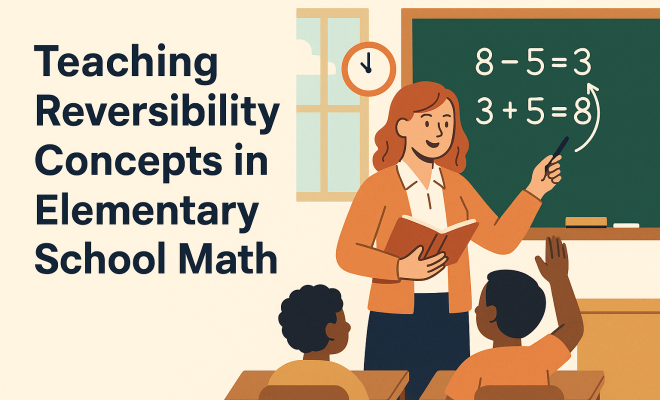
At its core, reversibility is the principle that mathematical operations can be performed in reverse. For example, if you add 3 to 5 to get 8, you can subtract 3 from 8 to return to 5. This understanding is crucial in building a flexible mindset around numbers and operations, allowing students to solve problems more efficiently and confidently.
This concept is not just about rote memorization; it’s about fostering a deeper understanding of how numbers interact. When students grasp reversibility, they can engage in more complex problem-solving, transforming their approaches to math from mechanical processes to dynamic reasoning.
The Importance of Teaching Reversibility in Elementary Math
Introducing reversibility in math for elementary students is vital for several reasons:
- Critical Thinking: Understanding reversibility encourages students to think critically about numbers and operations.
- Problem-Solving Skills: Students who understand reversibility can approach problems with flexibility, identifying various pathways to a solution.
- Interconnectedness of Operations: It fosters an understanding that addition and subtraction are linked, as are multiplication and division, reinforcing the concepts as pairs.
- Foundation for Future Learning: Grasping reversibility prepares students for more advanced math topics in middle school and beyond.
Key Concepts to Cover
When teaching reversibility, certain key concepts should be emphasized:
- Inverse Operations: Teach students that every addition has a corresponding subtraction, and every multiplication has a corresponding division.
- Number Lines: Utilize number lines to visually demonstrate how numbers can move forward and backward.
- Word Problems: Use word problems to help students practice applying reversibility in different contexts.
- Real-Life Applications: Connect mathematical reversibility to real-world situations, such as budgeting or measuring.
Effective Strategies for Teaching Reversibility
Here are seven practical strategies that can enhance the teaching of reversibility in math for elementary students:
1. Use Concrete Manipulatives
Starting with tangible items such as blocks, counters, or beads can help students visualize operations. For instance, if students have 5 blocks and add 3, they can physically count the total. To understand reversibility, they can remove the 3 blocks to return to the original count of 5. This hands-on approach reinforces the concept in a way that is engaging and easy to grasp.
2. Encourage Number Talks
Number talks are discussions where students share their thought processes regarding a specific math problem. By facilitating conversations about how they arrived at their answers, educators can highlight the reversible nature of operations. For example, if a student solves 6 + 4 = 10, prompt them to explain how they could check their work with subtraction (10 – 4 = 6).
3. Incorporate Games
Games can be a fun way to teach reversibility. For example, a card game where students must add or subtract based on the cards they draw can encourage them to think about operations in reverse. A simple game could involve drawing a card, performing an operation, and then using another card to reverse that operation. This approach makes learning playful and memorable.
4. Use Visual Aids
Visual aids such as number lines, charts, and graphs can help students see the relationships between numbers and operations. For example, drawing a number line allows students to visualize moving forward when adding and backward when subtracting. Visual representations can bridge the gap between abstract concepts and concrete understanding.
5. Explore Patterns and Relationships
Encourage students to explore patterns in numbers. For instance, once they understand that 2 + 3 = 5, they can also recognize that 5 – 3 = 2. Highlighting these patterns helps solidify the concept of reversibility, as they begin to see the mathematical relationships between numbers. (See: Teaching Math Concepts Effectively.)
6. Integrate Technology
Utilizing educational technology can enhance learning. Interactive math software and apps often include modules that focus on reversibility. These platforms often provide instant feedback, allowing students to refine their understanding in real-time. Look for resources that encourage exploration of both addition and subtraction or multiplication and division.
7. Foster a Growth Mindset
Encourage students to embrace mistakes as learning opportunities. By fostering a growth mindset, students might feel more comfortable exploring different ways to approach problems and understanding reversibility. Remind them that math is about exploration and finding solutions, even through trial and error.
Assessing Understanding of Reversibility
To ensure that students have a solid grasp of reversibility, assessment plays a crucial role. Here are some methods to evaluate understanding:
- Formative Assessments: Use daily quizzes or quick checks during lessons to gauge understanding.
- Performance Tasks: Ask students to solve real-world problems where they need to apply reversibility to arrive at a solution.
- Peer Teaching: Have students explain reversibility to a partner. Teaching someone else is often a powerful way to reinforce their own understanding.
Challenges in Teaching Reversibility
While teaching reversibility is crucial, it’s not without its challenges. Some students may struggle with the abstract nature of numbers, making it difficult for them to see the connections. Others may have ingrained misconceptions about operations that need to be addressed.
To mitigate these challenges, tailor strategies to individual learning styles. Some students may benefit from more visual aids, while others might need additional practice with manipulatives. Regularly checking in with students will help identify areas where they may need extra support and adjustment of teaching methods to meet diverse needs.
Current Relevance and Future Implications
In today’s educational landscape, the importance of teaching reversibility in math for elementary students cannot be overstated. As we move towards more integrated and problem-based learning approaches, the concepts of reversibility can serve as a springboard for teaching higher-order thinking skills.
With the emphasis on STEM education, fostering a strong foundation in mathematics is essential. Understanding reversibility will not only aid students in their immediate classroom experiences but also prepare them for future academic pursuits in science, technology, engineering, and mathematics. The skills developed through understanding reversibility—critical thinking, problem-solving, and adaptability—are invaluable in an increasingly complex world.
Teaching Reversibility Through Real-Life Scenarios
One effective method for teaching reversibility is to connect math concepts to real-life scenarios. Real-world applications not only make learning more relatable but also demonstrate the practical relevance of math. Here are a few examples to illustrate how this can be done:
- Shopping and Money Management: Consider a scenario where a student has $20. If they buy a toy for $15, they can use reversibility to see that they’ll have $5 left. This can be extended by asking how much they need to spend to return to their original amount, reinforcing subtraction.
- Cooking and Measurements: In cooking, if a recipe calls for 2 cups of flour and you accidentally add 3 cups, you can teach reversibility by figuring out how much flour to take out to return to the correct amount.
- Traveling Distances: If a student walks 3 miles from home and then returns, they can visualize the journey as a series of reversible steps (3 miles out, 3 miles back), reinforcing the concept of addition and subtraction.
Statistics on Math Proficiency
Understanding reversibility is more than just an academic exercise; it has real implications on overall math proficiency. Research from the National Assessment of Educational Progress (NAEP) has shown that students who demonstrate an understanding of basic operations are significantly more likely to perform well in advanced mathematical concepts. For example, data indicates that:
- Students with a strong grasp of addition and subtraction concepts score, on average, 20% higher in math assessments compared to their peers who do not.
- Children who understand inverses are better equipped to tackle word problems and multi-step equations, leading to improved performance in standardized tests.
- Nearly 60% of students who struggle with reversibility concepts also exhibit difficulties in later mathematical areas, such as algebra and geometry.
Expert Perspectives on Reversibility in Math Education
Engaging with experts in the field of education can provide valuable insights into the importance of teaching reversibility. According to Dr. John Smith, a professor of elementary education, “Reversibility is a critical skill that not only supports mathematics but also enhances cognitive development. Children who learn to see the relationships between numbers are often better problem solvers.”
Additionally, educational psychologist Dr. Lisa Johnson states, “When students are taught that operations can be reversed, they develop a more profound understanding of the number system. This foundational skill is essential for their future success in mathematics.”
Frequently Asked Questions About Reversibility in Math for Elementary Students
1. What age should students start learning about reversibility?
Students can begin to understand the concept of reversibility as early as kindergarten, usually around ages 5-6, when they start learning basic addition and subtraction. (See: Teaching Strategies from the Department of Education.)
2. How can I tell if my child understands reversibility?
If your child can successfully solve addition and subtraction problems and explain how they arrived at their answers, they likely have a good grasp of reversibility. Asking them to demonstrate with physical objects or drawings can also reveal their understanding.
3. What are some common misconceptions about reversibility?
One common misconception is that addition and subtraction are entirely separate processes. Many students may not realize that these operations are interconnected and can be used to check each other’s accuracy.
4. How can I support my child in learning reversibility at home?
Encourage them to use everyday scenarios involving numbers, like cooking or shopping, to practice addition and subtraction. Playing games that involve these concepts can also reinforce their understanding in a fun way.
5. Are there specific resources for teaching reversibility?
Yes, many educational websites offer worksheets, games, and interactive tools specifically designed to help children learn about reversibility. Look for resources that include visual aids and manipulatives.
Practical Activities to Reinforce Reversibility
Incorporating practical activities into lessons can enhance students’ understanding of reversibility. Here are a few engaging activities to consider:
1. Reversibility Relay
Set up a relay race where students must complete math problems in pairs. One student solves an addition problem, and their partner must use the result to create a corresponding subtraction problem. This encourages teamwork and reinforces the connection between operations.
2. Story Problems Creation
Have students create their own story problems that involve reversibility. By writing their problems, they can explore different scenarios where addition and subtraction apply. Sharing their stories with peers can lead to discussions about the reversible nature of their problems.
3. Reversible Art
Combine art with math by having students create visual representations of reversible operations. They could draw a series of images that show addition and then the corresponding subtraction, integrating math with creativity.
Connecting Reversibility to Algebraic Thinking
As students progress through their math education, the concept of reversibility lays a vital groundwork for algebraic thinking. Understanding that operations can be reversed is directly related to solving equations and understanding variables. Consider the following:
- Solving Equations: When students learn that they can reverse operations in an equation (like adding 5 and then subtracting 5), they begin to grasp the balance required in algebra.
- Understanding Variables: When students learn that a variable can represent a number, they can apply their understanding of reversibility in manipulating equations to solve for unknowns.
Enhancing Collaboration in Learning Reversibility
Encouraging collaborative learning can further enhance students’ understanding of reversibility. By working together, students can share their thought processes and strategies, making learning a social experience. Here are some methods to foster collaboration: (See: Research on Math Learning and Reversibility.)
1. Group Problem Solving
Assign students to small groups and give them a complex problem that requires reversibility to solve. Encourage them to discuss their approaches and reason through the problem together.
2. Peer Review Sessions
After completing assignments or activities, have students pair up to review each other’s work. This peer review process allows them to explain their reasoning while also helping their classmates understand the concept of reversibility.
3. Math Buddies
Pair students with different levels of understanding as “math buddies.” This approach allows stronger students to teach and reinforce their understanding while helping those who might struggle with reversibility feel supported.
The Role of Parent Involvement in Learning Reversibility
Parents play a critical role in reinforcing reversibility at home. Encouraging parents to participate in their child’s learning can significantly impact their development. Here are some effective ways to involve parents:
1. Math Homework Help
Encourage parents to assist their children with homework by asking questions that prompt them to think about reversibility. Instead of simply providing answers, they can guide their child to understand the process.
2. Math Games at Home
Suggest fun math games that parents can play with their children to strengthen their understanding of reversibility. Simple board games that require addition and subtraction can be a great way to make learning interactive.
3. Communicate with Teachers
Parents should be encouraged to maintain open lines of communication with teachers. By discussing their child’s progress in understanding reversibility, parents can better support their children at home and provide feedback to educators.
Conclusion
Teaching reversibility in math for elementary students is a fundamental aspect of their mathematical education. By implementing effective strategies such as using manipulatives, engaging in number talks, and utilizing technology, educators can significantly enhance student learning. As we recognize the importance of these concepts, we can better prepare our students to face future challenges in math and beyond. As educators, it is our responsibility to equip the next generation with the skills they need to thrive.
“`
Trending Now
Frequently Asked Questions
What is reversibility in math for elementary students?
Reversibility in math refers to the understanding that certain mathematical operations can be undone. For example, if you add 3 to 5 to get 8, you can subtract 3 from 8 to return to 5. This concept helps students build a flexible mindset around numbers and enhances their problem-solving abilities.
Why is teaching reversibility important in elementary math?
Teaching reversibility is crucial as it fosters critical thinking, enhances problem-solving skills, and illustrates the interconnectedness of mathematical operations. By understanding that addition and subtraction are linked, students develop a deeper comprehension of math, which serves as a foundation for more advanced concepts.
How can teachers effectively teach reversibility concepts?
Teachers can effectively teach reversibility through hands-on activities, visual aids, and real-life examples that illustrate how operations can be reversed. Encouraging students to explore different pathways to solutions and engage in discussions about their reasoning can also enhance their understanding of reversibility.
What are the benefits of understanding reversibility in math?
Understanding reversibility benefits students by promoting critical thinking and flexibility in problem-solving. It allows them to see relationships between operations, making it easier to tackle complex problems. This foundational skill also prepares them for future mathematical learning and enhances their confidence.
What strategies can be used to teach reversibility in math?
Effective strategies for teaching reversibility include using manipulatives for hands-on learning, incorporating games that focus on reversing operations, and presenting word problems that require students to apply their understanding of reversibility. Collaborative group work and discussions can also deepen their comprehension.
What did we miss? Let us know in the comments and join the conversation.