Why Preschoolers Struggle with Reversing Actions (Irreversibility)
“`html
When it comes to early childhood education, a concept that often arises is irreversibility in preschool. This term refers to a cognitive limitation observed in young children, particularly those in the preschool age range, where they struggle to understand that some actions can be reversed. This article delves into the reasons behind this phenomenon, its implications for child development, and how parents and educators can support young learners through this critical stage.
Understanding Irreversibility in Preschool
Irreversibility is a cognitive concept rooted in the theories of renowned developmental psychologist Jean Piaget. According to Piaget, children in the preoperational stage (approximately ages 2 to 7) exhibit difficulty in understanding that certain processes can be undone. For example, if a child sees a piece of clay rolled into a ball being flattened, they may struggle to comprehend that the flat shape can be reshaped into a ball again. This lack of understanding is not merely a failure of memory or knowledge; it reflects a fundamental aspect of their cognitive development.
The Importance of Object Permanence
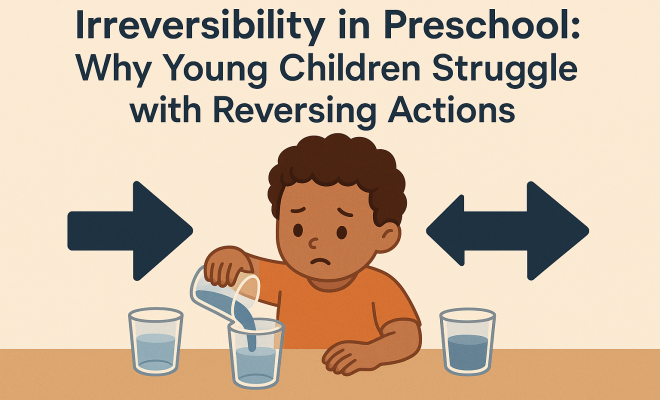
To grasp the concept of irreversibility, it’s essential first to recognize the idea of object permanence, which is the understanding that objects continue to exist even when they are not visible. Young children develop this understanding gradually. Through play and exploration, they learn that actions can affect objects in reversible or irreversible ways. This foundational concept influences how children perceive change and understand the permanence of certain transformations. For instance, when they pour water from one cup to another, they might not realize that the amount remains the same, leading to confusion about the original state of the water.
Common Examples of Irreversibility in Actions
Real-life scenarios abound where irreversibility in preschool manifests. Here are a few examples:
- Play Dough Manipulation: When children shape and mold play dough, they often struggle to understand that they can reform it into its original form after it has been altered.
- Food Preparation: If a child watches their parent slice a fruit like an apple, they may not grasp that the apple can be put back together, reinforcing the idea of irreversibility.
- Puzzle Completion: As children place pieces in a jigsaw puzzle, they might resist the idea of removing and re-adding pieces, not understanding that it’s a reversible action.
These everyday activities serve as critical teaching moments and offer insight into the cognitive limitations of preschool-aged children.
The Role of Cognitive Development Stages
Understanding irreversibility in preschool also requires an exploration of Piaget’s cognitive development stages. The preoperational stage is characterized by symbolic thinking, egocentrism, and a lack of logical reasoning. These attributes hinder children’s ability to conceptualize processes like reversibility. During this stage, children are primarily focused on the immediate outcomes of their actions rather than the broader implications, which can lead to misconceptions about changes in their environment.
For instance, a child might engage in pouring activities, but their understanding is limited to the immediate visual changes rather than the underlying principle that quantities remain the same despite appearance alterations. Educators and parents can guide children through these stages by providing experiences that promote curiosity and questioning, encouraging them to explore concepts further.
Encouraging Understanding of Reversibility
So, how can parents and educators help children overcome the challenges posed by irreversibility? Here are several strategies:
- Hands-On Activities: Engage children in activities that explicitly demonstrate reversibility. Simple experiments with water, clay, or even baking can create opportunities for children to see actions that can be undone.
- Storytelling: Use stories that feature themes of transformation and return. For example, tales where characters rebuild or restore items can help children grasp the concept of reversibility.
- Positive Reinforcement: When children demonstrate an understanding of reversibility, reinforce this knowledge with praise and further exploration opportunities.
By providing diverse experiences that illustrate reversibility, caregivers can gradually help children develop their cognitive skills in this area.
Real-World Implications of Irreversibility
The implications of irreversibility in preschool extend beyond simple cognitive exercises. Understanding this limitation can inform educational practices, parenting strategies, and policy decisions in early childhood education. Children who grapple with irreversibility may express frustration, leading to behavioral challenges in classroom settings or at home. Recognizing this struggle allows educators and parents to adopt a more empathetic approach, fostering an environment where children feel safe to explore and express their confusion.
Moreover, acknowledging the cognitive limitations of preschoolers can guide curriculum development. Educators can create lesson plans that account for these challenges and introduce concepts in a way that aligns with children’s developmental stages. (See: understanding of object permanence.)
Expert Perspectives on Irreversibility
To gain deeper insights into irreversibility in preschool, we consulted child development experts. Dr. Emily Harper, a child psychologist specializing in early childhood education, emphasizes the significance of play in overcoming these cognitive challenges. “Children learn best through active exploration. Engaging them in play that involves transformation—like building with blocks and then deconstructing them—has profound benefits for their understanding of reversibility,” she explains.
Furthermore, Dr. Harper suggests that caregivers should model reversible actions in everyday life. For instance, demonstrating how to unbake a cake by mixing the ingredients back into a bowl can reinforce the concept of change and transformation.
The Connection Between Irreversibility and Emotional Development
Interestingly, irreversibility in preschool isn’t solely a cognitive issue; it can also intersect with emotional development. Young children often experience strong feelings of attachment to their creations and changes in their environment. When they perceive an action as irreversible, they might feel anxiety or distress. Understanding these emotional responses can help caregivers provide adequate support. For instance, acknowledging a child’s feelings about a broken toy or a mess can validate their experience while guiding them toward the realization that such situations can often be remedied.
Encouraging resilience in children as they navigate these feelings can bolster their emotional intelligence, equipping them with skills they’ll rely on throughout their lives.
Long-Term Effects of Irreversibility in Early Education
The long-term effects of irreversibility in preschool can influence children’s approach to problem-solving and critical thinking as they progress through their educational journey. Children who learn to navigate these concepts develop a more profound capacity for abstract thinking and logical reasoning, which are crucial skills in later schooling.
Failure to address these early cognitive challenges may lead to persistent difficulties in later academic pursuits. For example, students may struggle with complex mathematics concepts that require an understanding of reversibility or formulas that depend on sequential logic.
Investing in early childhood education that emphasizes cognitive development through hands-on and interactive learning experiences can pave the way for a lifetime of learning and adaptability.
Strategies for Parents and Educators to Foster Reversibility Understanding
To support preschoolers in mastering the concept of reversibility, parents and educators can adopt specific strategies that cater to their developmental stages. Here are a few effective approaches:
1. Use Reversible Materials
Encouraging the use of materials that can be easily transformed and re-transformed can provide children with hands-on experience that solidifies their understanding. For example, using blocks that can be stacked and then unstacked allows children to visualize and physically manipulate the concept of change. Similarly, crafting with clay provides a tactile experience that can help illustrate both creation and destruction.
2. Introduce Games Highlighting Reversibility
Games can be a fun and engaging way for children to learn about reversibility. Simple board games that require players to “undo” an action or “go back” can help reinforce this concept. For instance, a game where children have to retrace their steps to find a lost item can solidify their understanding of how actions can be reversed. Educational apps and digital games also increasingly incorporate concepts of reversibility, and these can be integrated into screen time in a constructive way.
3. Encourage Problem-Solving Through Discussion
Encouraging discussions about experiences where reversibility plays a role can be beneficial. Ask children questions about their day-to-day activities, such as, “What happens if we take this apart? Can we put it back together?” Such open-ended questions promote critical thinking and help children verbalize their understanding, making the concept clearer.
4. Foster an Experimental Mindset
Encouraging children to experiment is key to their understanding of reversibility. When children can try different methods of transforming materials—like mixing colors and seeing if they can go back to the original colors or trying to put together a broken toy—they learn through trial and error. This not only aids comprehension of material properties but also builds confidence in their problem-solving abilities.
Real-World Applications of Understanding Reversibility
The understanding of irreversibility also has practical implications beyond educational settings. In everyday life, children face situations that require them to grasp the concept of change and consequence. For example, when they spill a drink, they learn about the importance of taking responsibility for their actions and the need for cleanup. Parents can take advantage of such moments to explain how cleaning up is a reversible action that restores order. (See: learning and cognitive development.)
In social situations, understanding that conflicts can be resolved and relationships can be mended also ties back to the concept of reversibility. Teaching children that arguments can be addressed and friendships can be repaired fosters emotional resilience and healthy interpersonal skills, critical for their development.
Supporting Diverse Learning Needs
Not all children progress through cognitive development stages at the same rate. Some may exhibit more pronounced challenges with understanding irreversibility, particularly those with learning disabilities or developmental disorders. It’s essential for educators and parents to recognize these variances and adapt strategies accordingly.
For instance, children on the autism spectrum may need explicit teaching and repeated reinforcement to grasp concepts like reversibility. Visual supports, such as charts or story sequences, can be beneficial in illustrating these ideas. Tailoring learning experiences to meet diverse needs not only aids in their understanding but also promotes inclusivity and acceptance in educational settings.
Developing a Tailored Curriculum for Teaching Reversibility
Creating a curriculum that focuses on teaching the concept of reversibility can be pivotal for preschool educators. Incorporating a variety of teaching methods—such as visual, auditory, and kinesthetic approaches—can cater to different learning styles. A well-rounded curriculum might include:
- Interactive Learning Stations: Set up stations with different materials that children can manipulate and experiment with.
- Storytime with Discussion: Select books that illustrate the theme of change and engage children in discussions afterward.
- Group Projects: Encourage teamwork in projects where children can build, transform, and restore items together.
- Reflection Journals: Have children draw or write about their experiences with reversibility, helping them articulate their understanding.
Frequently Asked Questions about Irreversibility in Preschool
What age do children start to understand reversibility?
Typically, children begin to grasp the concept of reversibility during the later stages of the preoperational phase, around ages 5 to 7. However, the understanding can vary significantly among children, influenced by their experiences and developmental pace.
How can I tell if my child is struggling with irreversibility?
Signs include frustration when attempting to reverse actions, difficulty understanding the consequences of their actions, and resistance to participating in activities that involve undoing or restoring something.
Are there specific games that can help children learn about reversibility?
Yes, games like “Simon Says” or simple board games where players can go back a step can help. Puzzles that require removing pieces to reconstruct an image are also effective. Look for games that incorporate the idea of undoing actions.
Can irreversibility affect emotional development?
Absolutely. Children who struggle with understanding irreversibility may experience frustration or anxiety during play and learning. This can impact their emotional well-being. Supporting them through these feelings is essential for healthy emotional development.
What’s the role of play in learning about reversibility?
Play is essential as it allows children to explore and experiment in a safe environment. Through play, they can test their understanding of reversibility by manipulating materials and observing outcomes, which reinforces their learning in a natural way.
Long-Term Strategies to Address Irreversibility
It’s not enough just to address irreversibility in the moment; long-term strategies can further enhance understanding and support cognitive development. Here are some approaches to consider:
1. Regularly Review Concepts
Revisiting the concept of reversibility on a consistent basis can solidify understanding. This can be done through regular activities that highlight reversible actions, such as science experiments or art projects. For example, children can paint pictures and then wash them off to see the process of restoration. This cyclical exposure reinforces their understanding over time.
2. Create a Reversibility Challenge
Make learning about reversibility exciting by introducing challenges. Set up tasks where children must think critically about how to reverse an action or restore something. For instance, present them with a puzzle where pieces are mixed up and challenge them to put it back together. This encourages them to actively engage with the concept while having fun.
3. Use Technology Wisely
Incorporating educational apps that target cognitive skills can be beneficial. Many apps are designed to engage children in problem-solving scenarios that require thinking about reversibility. While screen time should be balanced, these resources can serve as modern tools to reinforce traditional learning approaches.
4. Collaborate with Other Parents and Educators
Building a community of support can enrich learning experiences. Parents and educators can share resources, strategies, and insights about teaching reversibility. Group discussions or workshops focusing on cognitive development can provide additional perspectives and techniques that benefit everyone involved.
Encouraging a Growth Mindset
Fostering a growth mindset in children—an understanding that abilities and intelligence can be developed—can greatly influence their approach to learning about reversibility. Encouraging children to view challenges as opportunities for growth helps them to be more resilient in the face of difficulty.
For instance, celebrate their effort when they try to reverse a mistake, even if they fail. This not only reinforces their understanding but also builds confidence in their problem-solving abilities. When children learn that mistakes are part of the learning process, they are more likely to engage with concepts like reversibility with enthusiasm rather than fear.
Conclusion: A Path Forward
Understanding irreversibility in preschool is crucial for parents and educators alike. By recognizing the cognitive limitations of young children and fostering environments that promote exploration, curiosity, and play, we can support their development during this formative stage. It’s not just about teaching children academic skills; it’s about equipping them with the ability to understand their world, make connections, and embrace challenges.
As we nurture young minds, let’s remember that every small step they take toward understanding reversibility represents a significant leap in their overall cognitive and emotional development.
“`
Trending Now
Frequently Asked Questions
What is irreversibility in preschool?
Irreversibility in preschool refers to a cognitive limitation where young children struggle to understand that some actions can be reversed. This concept is rooted in developmental psychology and is particularly evident in children aged 2 to 7, as they often fail to recognize that changes made to objects can be undone.
Why do young children struggle with understanding reversibility?
Young children struggle with understanding reversibility due to their cognitive development stage, known as the preoperational stage. According to Jean Piaget, children in this stage have difficulty grasping that certain processes can be undone, which affects their perception of changes in objects.
How does object permanence relate to irreversibility?
Object permanence is crucial for understanding irreversibility, as it involves recognizing that objects continue to exist even when not visible. As children develop this understanding through play, they learn how actions can affect objects, influencing their grasp of reversible and irreversible changes.
Can you give examples of irreversibility in preschool activities?
Common examples of irreversibility in preschool include manipulating play dough, where children may not realize that flattening it can be reversed, or pouring water from one cup to another without understanding that the amount remains the same, leading to confusion about the original state.
How can parents and educators support children with irreversibility?
Parents and educators can support children struggling with irreversibility by engaging them in activities that promote exploration and experimentation. Encouraging play that involves reversible actions, like building and deconstructing, can help children develop a better understanding of how certain changes can be undone.
Have you experienced this yourself? We’d love to hear your story in the comments.