Conscious Discipline: Fostering Emotional Regulation in Young Children
“`html
In recent years, the importance of teaching emotional regulation to young children has gained increasing recognition among educators and parents alike. One framework that has emerged as particularly effective is Conscious Discipline. This comprehensive approach not only focuses on emotional intelligence but also equips children with the skills they need to manage their feelings and behavior. In this article, we’ll explore how Conscious Discipline teaches emotional regulation to young children, its foundational principles, practical applications, and its current relevance in education.
Understanding Conscious Discipline
Conscious Discipline is a trauma-informed approach that prioritizes social-emotional learning, discipline, and self-regulation. Developed by Dr. Becky Bailey in the 1990s, the program is designed to create safe, connected, and problem-solving classrooms. At its core, Conscious Discipline views discipline not just as a means of control but as a way to teach children how to manage their emotions and actions.
Dr. Bailey emphasizes that emotional regulation is not merely about stopping negative behaviors, but about guiding children towards understanding and expressing their emotions in healthy ways. This approach aligns with the growing recognition of the impact of emotional intelligence on overall success, both in school and in life.
The Importance of Emotional Regulation in Early Childhood
Emotional regulation refers to the ability to manage and respond to emotional experiences effectively. For young children, developing this skill is crucial as it lays the groundwork for future social interactions and academic success. Research indicates that children who struggle with emotional regulation may face difficulties in relationships and learning.
According to the National Institutes of Health, early childhood is a critical period for emotional development. Children begin to form their understanding of emotions and how they relate to the world around them. As such, teaching emotional regulation through frameworks like Conscious Discipline can significantly enhance their capacity for empathy, resilience, and problem-solving.
Core Principles of Conscious Discipline
At the heart of Conscious Discipline are several core principles that guide educators and caregivers in fostering emotional regulation:
- Safety: Creating a safe environment is paramount. Children need to feel secure to express their emotions without fear of judgment.
- Connection: Building relationships is fundamental. Connection with caring adults helps children feel understood and valued.
- Problem-Solving: Rather than imposing consequences, the focus shifts to teaching children how to resolve conflicts and handle emotions constructively.
These principles establish a foundation for effective emotional regulation practices within the classroom and at home.
Strategies for Teaching Emotional Regulation
Conscious Discipline offers several practical strategies that educators and parents can use to teach children how to regulate their emotions:
1. The Feelings Wheel
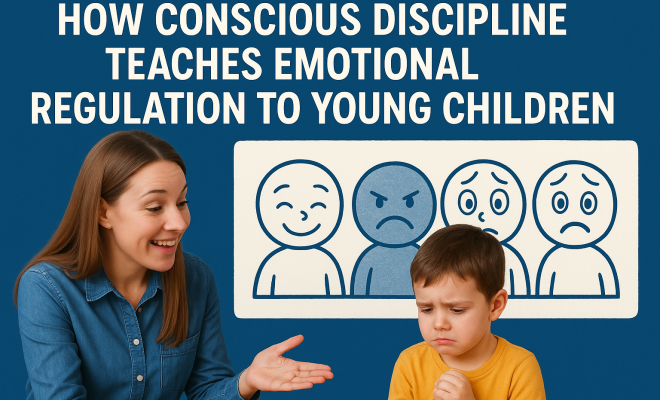
The Feelings Wheel is a valuable tool that helps children identify and articulate their emotions. By providing a visual representation of various feelings, children can learn to recognize their emotional states, which is a crucial first step in regulation. Educators can introduce the Feelings Wheel during circle time or incorporate it into daily activities.
2. The Safe Place
Creating a designated “Safe Place” in classrooms or homes provides children with a physical space to retreat when they feel overwhelmed. This area can include calming items such as soft pillows, books, or sensory objects. In these moments, children can practice self-soothing techniques and reflect on their feelings.
3. Breathing Techniques
Teaching children simple breathing techniques can significantly enhance their ability to calm down when experiencing strong emotions. For instance, the “Smell the Flower, Blow out the Candle” technique encourages children to inhale deeply through their nose and exhale slowly through their mouth, mimicking the act of smelling a flower and blowing out a candle.
4. Role-Playing Scenarios
Role-playing allows children to practice emotional regulation in a supportive and safe environment. Educators can create scenarios where children might feel angry, frustrated, or sad, and guide them in exploring appropriate responses. This hands-on approach reinforces learning through experience. (See: CDC resources on children's mental health.)
Building a Connected Classroom
A key aspect of Conscious Discipline is the emphasis on creating a connected classroom. The relationships fostered between educators and students are vital for effective emotional regulation. When children feel connected to their teachers and peers, they are more likely to engage in positive behavior and seek help when needed.
Connection can be cultivated through daily rituals, such as morning greetings, sharing circles, or team-building activities. These practices not only foster a sense of belonging but also teach children the importance of empathy and collaboration.
The Role of Educators in Modeling Emotional Regulation
Educators play a crucial role in modeling emotional regulation. Children are keen observers and often mimic the behaviors and attitudes of adults in their lives. When teachers demonstrate healthy emotional regulation—by expressing their feelings, practicing self-care, and handling conflicts gracefully—they provide a living example for students to emulate.
Professional development programs focused on Conscious Discipline emphasize the importance of self-regulation for educators as well. Training allows teachers to reflect on their emotional responses and develop strategies to manage their feelings effectively. This not only benefits educators but also creates a more positive and supportive classroom environment.
Challenges and Critiques of Conscious Discipline
While Conscious Discipline has received praise for its innovative approach to emotional regulation, it is not without challenges and critiques. Some educators may feel overwhelmed by the comprehensive nature of the program, questioning how to implement it amidst other curriculum demands.
Moreover, there are concerns about the scalability of Conscious Discipline in diverse educational settings. It requires a substantial commitment from staff, parents, and the broader school community. Critics argue that without adequate training and support, the effectiveness of the program may be limited.
However, proponents argue that the long-term benefits of fostering emotional regulation and resilience in children far outweigh the initial challenges. They emphasize that schools adopting Conscious Discipline can experience transformative changes in student behavior, academic performance, and overall school climate.
Current Relevance and Future Implications
The relevance of Conscious Discipline has only grown in our current climate, particularly in light of increasing mental health concerns among children. The COVID-19 pandemic magnified the challenges faced by young learners, including heightened anxiety, isolation, and disrupted routines.
Conscious Discipline provides a framework that can help children cope with the emotional fallout of such unprecedented experiences. Schools and parents alike are recognizing the importance of emotional regulation in fostering resilience in children, making the principles of Conscious Discipline more relevant than ever.
Looking to the future, the continuing integration of social-emotional learning in educational practices seems promising. As educators embrace frameworks like Conscious Discipline, they are not only equipping children with vital emotional regulation skills but also fostering a generation that values empathy, connection, and mental well-being.
Expanding on Emotional Regulation Skills
Emotional regulation is not just about managing distressing emotions but also about fostering positive feelings and responses. Here are some additional skills that fall under the umbrella of emotional regulation which can be taught through Conscious Discipline:
1. Recognizing Triggers
Understanding what triggers emotional responses is a vital skill for children. By helping them identify specific situations, people, or events that lead to frustration or anger, they can develop strategies to cope before emotions escalate. For instance, a child might recognize that loud noises trigger anxiety and can learn ways to cope, such as using noise-canceling headphones or deep breathing when they anticipate being in a loud environment.
2. Expressing Emotions Appropriately
Teaching children how to express their feelings using words instead of actions is another crucial aspect of emotional regulation. Children can learn to use “I” statements like, “I feel sad when my toy is taken” instead of resorting to physical reactions. This not only promotes healthier communication but also helps them build vocabulary around their feelings.
3. Building Empathy
Incorporating activities that foster empathy can enhance children’s emotional regulation skills. When children learn to consider others’ perspectives and feelings, they become more adept at managing their emotional responses. Role-playing scenarios where they have to think about how someone else might feel in a given situation can be particularly beneficial. (See: NIH on behavior management in children.)
Statistics and Research Supporting Emotional Regulation
Numerous studies highlight the importance of emotional regulation in childhood development, indicating that children equipped with these skills are more likely to succeed academically and socially. For example, a study published in the Journal of School Psychology found that students with higher emotional regulation abilities exhibited better academic performance and enhanced behavior in school settings.
Statistics show that children who struggle with emotional regulation are at a higher risk for developing behavioral problems. According to the American Psychological Association, children with poor emotional regulation often face challenges like increased anxiety, lower academic achievement, and difficulty forming relationships. By teaching emotional regulation, programs like Conscious Discipline not only address these issues but also promote overall mental health and well-being.
Expert Perspectives on Conscious Discipline
Many educators and psychologists advocate for the implementation of Conscious Discipline in schools. Dr. Daniel Goleman, author of the influential book on emotional intelligence, has emphasized the necessity of teaching emotional skills in schools. He notes that emotional intelligence, which encompasses emotional regulation, is as critical as cognitive intelligence in determining success in life.
According to Dr. Goleman, schools that adopt frameworks like Conscious Discipline can cultivate environments where children learn to navigate their emotions effectively. This can lead to a decrease in behavioral issues and an increase in students’ ability to focus on learning.
FAQ: Common Questions About Conscious Discipline and Emotional Regulation
Q1: What age is appropriate to start teaching emotional regulation through Conscious Discipline?
A1: Emotional regulation can start as early as preschool. Young children are capable of understanding basic emotions, and Conscious Discipline provides age-appropriate tools and strategies to help them learn how to manage their feelings effectively.
Q2: How can parents incorporate Conscious Discipline at home?
A2: Parents can implement Conscious Discipline by creating a safe space for their children to express emotions, using tools like the Feelings Wheel, and modeling healthy emotional responses. Consistent communication and emotional check-ins can also enhance the practice.
Q3: Are there specific training programs for educators interested in implementing Conscious Discipline?
A3: Yes, there are various training options available for educators, including workshops, online courses, and certification programs. These opportunities equip teachers with the necessary skills to integrate Conscious Discipline into their classrooms effectively.
Q4: Can Conscious Discipline be used in high school settings?
A4: While Conscious Discipline is primarily designed for younger children, its principles can be adapted for older students. High school educators can focus on developing emotional intelligence and self-regulation by facilitating discussions and activities that resonate with older adolescents.
Q5: What long-term benefits can be expected from teaching emotional regulation through Conscious Discipline?
A5: Long-term benefits of teaching emotional regulation through Conscious Discipline include improved academic performance, better social skills, reduced behavioral issues, and enhanced mental health. Students who learn to manage their emotions are often more resilient and capable of handling life’s challenges as they grow.
Benefits of Emotional Regulation Beyond the Classroom
Teaching emotional regulation through Conscious Discipline goes beyond academic settings. The skills children acquire can have far-reaching effects in their personal lives as well. For instance:
1. Improved Relationships
Children who learn to regulate their emotions tend to have healthier interactions with peers and family members. They are better equipped to navigate conflicts and express their feelings without resorting to aggression or withdrawal. This results in stronger, more supportive relationships as they grow older.
2. Better Coping Mechanisms
Emotional regulation skills lead to enhanced coping strategies for stress and adversity. When children learn to identify and manage their emotions, they are more likely to face challenges head-on rather than avoiding them. This proactive approach can foster a healthy mindset and resilience throughout their lives.
3. Enhanced Academic Engagement
Emotionally regulated children are more engaged learners. When they are in control of their emotions, they are less likely to be distracted by anxiety or frustration, allowing them to focus on their studies and participate in classroom discussions. This engagement often translates into better academic outcomes.
Implementing Conscious Discipline in Diverse Settings
One of the strengths of Conscious Discipline is its adaptability to various educational environments. Whether in urban, suburban, or rural settings, the principles can be tailored to meet the unique needs of different populations.
For example, teachers in high-stress urban schools may find that the focus on emotional safety and connection resonates deeply with their students, who may experience trauma and instability outside of school. By incorporating Conscious Discipline, these educators can create a nurturing environment that counters the challenges these children face.
In contrast, in more affluent suburban settings, the emphasis on emotional skills can help children who may struggle with anxiety related to high expectations and competitive pressures. This flexibility ensures that Conscious Discipline can make a meaningful impact regardless of the context.
Future Directions for Conscious Discipline
The future of Conscious Discipline looks promising, with growing interest in its application across educational levels and settings. As mental health awareness continues to rise, more schools are likely to adopt frameworks that prioritize emotional well-being alongside academic achievement.
Additionally, technology is paving the way for innovative ways to implement Conscious Discipline. Apps and online platforms providing resources, training, and community support can enhance the reach of the program, allowing educators and parents to connect and share best practices.
As research in emotional intelligence and regulation evolves, updates and enhancements to the Conscious Discipline framework will likely emerge, ensuring it remains relevant and effective in addressing the needs of children, educators, and families in a rapidly changing world.
Conclusion: A Foundation for Lifelong Success
In conclusion, the significance of Conscious Discipline emotional regulation cannot be overstated. By teaching children how to understand and manage their emotions, we empower them to navigate life’s challenges more effectively. Through the principles and strategies of Conscious Discipline, educators and parents can create supportive environments that nurture emotional intelligence.
As we continue to prioritize emotional regulation in early childhood education, we not only enhance children’s academic success but also contribute to their overall well-being as they grow into empathetic, resilient adults. The journey towards fostering emotional regulation is one worth taking, and Conscious Discipline provides a compelling roadmap for achieving this vital goal.
“`
Trending Now
- this guide on 3 steam projects that build a better tomorrow
- How Semantic Language Disorders Affect Reading…
- Teaching Syntax to Elementary School Students with Language Delays
- this guide on why fine motor skills matter for kindergarten readiness
- our breakdown of the role of hand-eye coordination in handwriting development
Frequently Asked Questions
What is Conscious Discipline?
Conscious Discipline is a trauma-informed approach developed by Dr. Becky Bailey that emphasizes social-emotional learning, discipline, and self-regulation. It aims to create safe and connected classrooms, teaching children to manage their emotions and behaviors rather than simply controlling them.
How does Conscious Discipline help children?
Conscious Discipline helps children by equipping them with emotional regulation skills. It teaches them to understand and express their emotions in healthy ways, which is essential for their social interactions and academic success.
Why is emotional regulation important for young children?
Emotional regulation is crucial for young children as it lays the foundation for future relationships and learning. Children who can manage their emotions effectively are more likely to succeed academically and socially.
What are the key principles of Conscious Discipline?
The key principles of Conscious Discipline include creating a safe environment, fostering connections, and teaching problem-solving skills. It focuses on guiding children to understand their emotions rather than merely controlling their behavior.
What impact does emotional intelligence have on children?
Emotional intelligence significantly impacts children's overall success in school and life. Children with strong emotional regulation skills tend to have better relationships, improved learning outcomes, and greater resilience in facing challenges.
What’s your take on this? Share your thoughts in the comments below — we read every one.