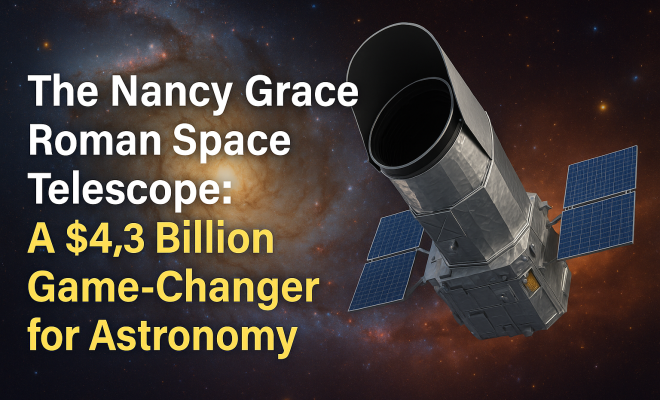
The Nancy Grace Roman Space Telescope: A $4.3 Billion Game-Changer for Astronomy
“`html
Introduction: A New Era in Astronomy
The universe is vast, mysterious, and full of surprises, and a new instrument is set to revolutionize our understanding of it—the Nancy Grace Roman Space Telescope. With a staggering budget of $4.3 billion, this cutting-edge telescope is more than just a technological marvel; it’s a gateway to uncovering the secrets of dark energy, dark matter, and the countless galaxies that populate the cosmos. Scheduled for launch on August 30, 2026, aboard a SpaceX Falcon Heavy rocket, the Roman Space Telescope promises to see a hundred times more than its predecessor, the Hubble Space Telescope. But what exactly can we expect from this ambitious project? Let’s dive in.
The Birth of the Roman Space Telescope
The Nancy Grace Roman Space Telescope is named after one of NASA’s pioneering astronomers, Nancy Grace Roman, who was instrumental in the development of the Hubble Space Telescope. Roman was a visionary who advocated for space-based astronomical observations, and her legacy continues through this ambitious project. NASA announced the telescope’s development in 2016, recognizing the need for a new instrument that could complement Hubble’s capabilities while providing unprecedented insights into the universe.
Unlike Hubble, which primarily observes in visible light, the Roman Telescope will utilize infrared technology, allowing it to peer deeper into the cosmos. This approach enhances its ability to study distant galaxies, cosmic formations, and elusive exoplanets. The telescope’s development is a collaborative effort, with key contributions from institutions like NASA Goddard Space Flight Center and BAE Systems, which developed its state-of-the-art Wide Field Instrument.
The Revolutionary Wide Field Instrument
At the heart of the Nancy Grace Roman Space Telescope is its Wide Field Instrument (WFI), an advanced piece of technology specifically designed to capture images of vast areas of the sky. This instrument has a field of view that is 100 times larger than that of Hubble, allowing it to survey galaxies and cosmic phenomena at an unprecedented scale. With the capability to map billions of galaxies in just a few months, the WFI will revolutionize our approach to astronomical research.
The WFI operates in infrared wavelengths, enabling it to see through cosmic dust that often obscures visible light. This is crucial for studying star formation, galactic evolution, and the cosmic web—the large-scale structure of the universe. With its enhanced sensitivity and resolution, the Roman Telescope is poised to provide clear insights into the formation of stars and galaxies throughout cosmic history.
The Quest for Dark Energy and Dark Matter
One of the primary missions of the Nancy Grace Roman Space Telescope is to investigate dark energy and dark matter, two of the universe’s biggest mysteries. Together, they make up about 95% of the universe, yet their true nature remains elusive. Dark energy is hypothesized to be responsible for the accelerated expansion of the universe, while dark matter is believed to exert gravitational forces that affect visible matter.
Using techniques like weak gravitational lensing, the Roman Telescope aims to map the distribution of dark matter across vast expanses of the universe. By observing how light from distant galaxies is distorted by the gravitational field of dark matter, scientists can create a detailed map of its presence and influence. This research could fundamentally alter our understanding of cosmic evolution and provide crucial insights into the fate of the universe.
The Search for Exoplanets
In addition to its mission to study dark energy and dark matter, the Nancy Grace Roman Space Telescope will also focus on the search for exoplanets—planets outside our solar system. One of the key techniques it will employ is gravitational microlensing, a method that takes advantage of the bending of light by massive objects.
When a massive object, such as a star, passes in front of a distant star and its planets, its gravitational field can magnify the light from the background star, creating a temporary increase in brightness. By monitoring these events, the Roman Telescope can infer the presence of exoplanets, even those that are far away. This capability opens the door to discovering potentially habitable worlds and expanding our understanding of planetary systems beyond our own.
The Journey to Lagrange Point 2
Once the Nancy Grace Roman Space Telescope is launched, it will travel approximately 1.5 million kilometers to the Sun-Earth Lagrange Point 2 (L2). This point is a gravitational balance point between the Earth and the Sun, making it an ideal location for space observatories. Being positioned at L2 allows the telescope to maintain a stable environment, minimizing interference from the Earth’s atmosphere and providing a clear, unobstructed view of the cosmos.
The L2 point is also an advantageous location for thermal stability, as the telescope will be able to keep its instruments at optimal temperatures, crucial for infrared observations. This strategic positioning ensures that the Roman Telescope can operate efficiently and effectively, maximizing its scientific output. (See: Nancy Grace Roman Space Telescope overview.)
Cost and Funding: Is It Worth It?
The ambitious budget of $4.3 billion for the Nancy Grace Roman Space Telescope has sparked conversations about funding for space exploration. Critics often argue that such massive expenditures could be redirected towards pressing issues on Earth. However, proponents emphasize that investments in space exploration yield tangible benefits that extend beyond astronomical research.
Space missions like the Roman Telescope drive technological advancements, inspire education, and foster international collaboration. They also contribute to our understanding of fundamental questions about existence, the universe, and humanity’s place within it. The discoveries made by the Roman Telescope could lead to breakthroughs that enhance our understanding of physics, energy, and even potential future technologies.
The Excitement of the Scientific Community
Since the announcement of the Nancy Grace Roman Space Telescope, excitement has been palpable within the scientific community. Researchers across various fields—astrophysics, cosmology, and planetary science—are eagerly anticipating the insights that this mission will provide. The telescope’s ability to observe distant galaxies and map dark matter stands to contribute significantly to ongoing debates about the universe’s structure and evolution.
Moreover, the potential for discovering new exoplanets has captured the imagination of many. As humanity seeks to understand whether life exists beyond Earth, the prospect of potentially habitable worlds fuels scientific curiosity and public interest. The Roman Telescope’s mission is not just about science; it’s about answering questions that have lingered for millennia.
Public Engagement and Education
NASA has made it clear that the Nancy Grace Roman Space Telescope will not just be a scientific instrument but also a platform for public engagement and education. As the telescope prepares for its launch, NASA plans to involve the public in various activities, including educational outreach programs, live-streamed observations, and opportunities for citizen scientists to contribute.
By fostering a sense of connection between the public and the cosmos, NASA hopes to inspire the next generation of astronomers and scientists. Engaging young minds in space science can lead to increased interest in STEM fields, essential for addressing tomorrow’s challenges. The telescope’s findings will be shared widely, ensuring that the excitement of discovery reaches beyond the scientific community.
Comparative Analysis: Roman vs. Hubble
When discussing the Nancy Grace Roman Space Telescope, it’s important to highlight how it compares to its predecessor, the Hubble Space Telescope. While both telescopes are designed for astronomical research, their capabilities and missions are distinct.
Hubble, launched in 1990, has been a workhorse of astronomy for over three decades, providing stunning images and invaluable data across a multitude of wavelengths. Its primary focus has been on visible light and ultraviolet observations. In contrast, the Roman Space Telescope’s emphasis on infrared observations allows it to look deeper into the universe, potentially uncovering hidden phenomena that Hubble cannot see.
Additionally, the Roman Telescope boasts a much larger field of view. Hubble captures images of a much smaller area, requiring multiple observations to cover large sections of the sky. This difference means that the Roman Telescope can survey vast areas quickly, making it exceptionally well-suited for projects like the Wide Field Survey, which aims to map billions of galaxies.
Statistics indicate that while Hubble has observed over 1.4 million astronomical objects, the Roman Telescope is designed to capture data from approximately 100 million stars and galaxies over its mission lifetime. This extraordinary capacity can lead to a deeper understanding of the universe’s evolution, including the formation of galaxies and the role of dark matter.
Scientific Goals and Expected Discoveries
The Nancy Grace Roman Space Telescope has a set of ambitious scientific goals that extend beyond simply mapping galaxies and searching for exoplanets. One of the key objectives is to better understand the rate of expansion of the universe. By observing distant supernovae and the cosmic microwave background, the Roman Telescope will help refine measurements of the universe’s expansion rate, which remains a subject of intense debate among cosmologists.
Another significant goal is to study the properties of dark energy. Understanding dark energy is vital for addressing fundamental questions about the universe’s fate, including whether it will continue to expand indefinitely or eventually contract. The data collected by the Roman Telescope will provide insights that could either support or challenge current models of cosmology.
Furthermore, the telescope is expected to discover thousands of new exoplanets, including those in the habitable zones of their parent stars. This information will deepen our understanding of the diversity of planetary systems and the potential for life beyond Earth. (See: NASA's Roman Space Telescope launch details.)
What to Expect After Launch
Once the Nancy Grace Roman Space Telescope launches, a period of commissioning will follow, during which scientists will calibrate its instruments and ensure everything operates as expected. This phase is crucial for optimizing the telescope’s performance, and it usually takes several months.
Following commissioning, the telescope will begin its science operations. The first observations are expected to provide a wealth of data that will be analyzed by astronomers worldwide. An open-access policy means that data collected will be available to the global scientific community, ensuring that the discoveries made by the Roman Telescope will benefit not just a select few but will inspire scientists and enthusiasts around the world.
In the years following its launch, the Roman Telescope is anticipated to deliver new findings that could challenge existing paradigms in astronomy and astrophysics. Each discovery will contribute to the ongoing quest for knowledge and understanding of our universe, encouraging further exploration and inquiry.
Frequently Asked Questions about the Nancy Grace Roman Space Telescope
What is the launch date for the Nancy Grace Roman Space Telescope?
The Roman Space Telescope is scheduled to launch on August 30, 2026.
Where will the Nancy Grace Roman Space Telescope be positioned?
The telescope will be stationed at the Sun-Earth Lagrange Point 2 (L2), approximately 1.5 million kilometers from Earth.
What are the main scientific objectives of the Roman Space Telescope?
The primary scientific objectives include studying dark energy and dark matter, searching for exoplanets, and refining measurements of the universe’s expansion rate.
How does the Wide Field Instrument work?
The Wide Field Instrument captures images in infrared wavelengths across a much larger field of view than Hubble, allowing it to survey large areas of the sky efficiently.
What impact will this telescope have on public engagement in science?
The Roman Telescope aims to engage the public through educational outreach and citizen science programs, inspiring interest in astronomy and STEM fields.
How will the data from the Roman Telescope be shared with the scientific community?
Data collected by the Roman Telescope will be made available openly to the global scientific community, promoting collaboration and further research.
Future Collaboration and International Partnerships
The Nancy Grace Roman Space Telescope is not just a national endeavor; it invites collaboration on an international scale. Countries around the world are eager to participate in the scientific investigations that the telescope will facilitate. Collaborations with organizations such as the European Space Agency (ESA) and other national space agencies are likely to enhance the quality and scope of research.
These partnerships will allow for shared data, technology exchange, and joint research initiatives. For instance, astronomers from Europe and Asia may use Roman’s findings to complement their own observations, thereby fostering a global network of scientific inquiry. This collaboration will also help in addressing challenges like light pollution and atmospheric conditions, ensuring the best possible data collection. (See: Wikipedia page on Roman Space Telescope.)
The Role of Artificial Intelligence in Analyzing Data
The vast amount of data generated by the Nancy Grace Roman Space Telescope will require sophisticated analysis techniques. Enter artificial intelligence (AI). Machine learning algorithms are being developed to sift through the enormous datasets that Roman will produce, identifying patterns and anomalies in ways that human researchers alone could not.
For example, AI can help in classifying galaxies, detecting exoplanets, and even understanding transient events like supernovae. By automating parts of the analysis process, scientists will be able to focus their efforts on interpreting results and formulating hypotheses rather than getting bogged down in data management.
Additionally, AI can aid in predictive modeling, helping scientists forecast the types of discoveries that may arise from specific observational programs. This proactive approach could lead to more efficient use of telescope time and resources.
Comparing Current Astrophysical Tools
While the Nancy Grace Roman Space Telescope is poised to be one of the most powerful astronomical instruments, it’s essential to consider it within the context of existing tools. Telescopes like the James Webb Space Telescope (JWST) and ground-based observatories like the Very Large Telescope (VLT) play significant roles in current astronomical research.
The JWST, launched in late 2021, focuses primarily on infrared observations as well but has a different design and set of objectives than the Roman Telescope. While JWST will conduct deep and focused observations of specific celestial objects, the Roman Telescope is designed for wide-field surveys, making it complementary to JWST’s capabilities.
Ground-based observatories, while subject to atmospheric interference, remain crucial for certain types of observations. However, as technology advances, the role of space-based telescopes is becoming increasingly critical. The Roman Telescope will likely collaborate with these observatories, utilizing their strengths to create a more comprehensive view of the universe.
Conclusion: A Bold Step into the Unknown
The Nancy Grace Roman Space Telescope represents a bold step into the unknown, promising to illuminate the darkest corners of the universe while answering fundamental questions about existence. With its unprecedented capabilities, the Roman Telescope could reshape our understanding of cosmic evolution, dark energy, and dark matter.
As we look towards its 2026 launch, the anticipation builds—not just within the scientific community, but among anyone who has ever gazed up at the stars and wondered about the mysteries beyond. The journey of discovery awaits, and the Roman Telescope stands ready to lead the way.
“`
Trending Now
Frequently Asked Questions
What is the Nancy Grace Roman Space Telescope?
The Nancy Grace Roman Space Telescope is a groundbreaking astronomical instrument set to launch on August 30, 2026. With a budget of $4.3 billion, it aims to enhance our understanding of dark energy, dark matter, and distant galaxies, utilizing advanced infrared technology to see a hundred times more than the Hubble Space Telescope.
When will the Nancy Grace Roman Space Telescope be launched?
The Nancy Grace Roman Space Telescope is scheduled for launch on August 30, 2026, aboard a SpaceX Falcon Heavy rocket. This mission marks a significant step forward in astronomical research and exploration.
How does the Roman Space Telescope differ from the Hubble Space Telescope?
Unlike the Hubble Space Telescope, which primarily observes visible light, the Nancy Grace Roman Space Telescope utilizes infrared technology. This allows it to delve deeper into the cosmos and study distant galaxies, cosmic formations, and exoplanets more effectively.
Who is the Nancy Grace Roman Space Telescope named after?
The Nancy Grace Roman Space Telescope is named after Nancy Grace Roman, a pioneering astronomer and advocate for space-based observations. Her contributions were instrumental in the development of the Hubble Space Telescope, and this project continues her legacy in astronomical exploration.
What is the purpose of the Wide Field Instrument on the Roman Space Telescope?
The Wide Field Instrument (WFI) is the core technology of the Nancy Grace Roman Space Telescope, designed to capture images of vast areas of the sky. This advanced instrument enhances the telescope's ability to study large cosmic structures and gather data on various astronomical phenomena.
What’s your take on this? Share your thoughts in the comments below — we read every one.