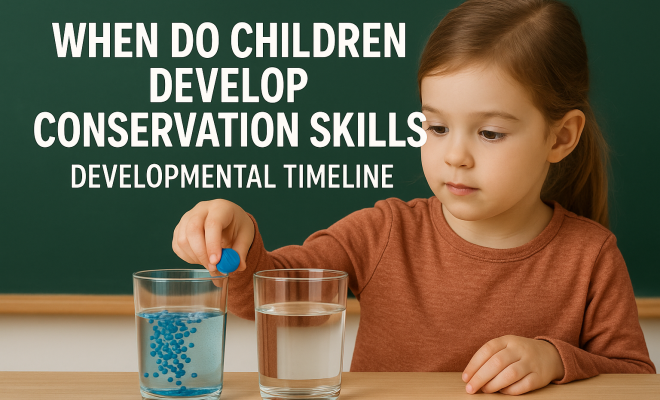
When Do Children Develop Conservation Skills? Developmental Timeline
“`html
The development of conservation skills is a crucial milestone in a child’s cognitive growth. Understanding when children conservation skills development occurs can significantly impact educational strategies, parenting approaches, and early childhood development practices. Conservation skills refer to a child’s ability to understand that certain properties of objects, such as volume, mass, or number, remain constant even when their shapes or arrangements change. This article will explore the developmental timeline of conservation skills, the factors influencing these skills, practical insights for parents and educators, and the broader implications for child development.
Understanding Conservation Skills
Before delving into the timeline of conservation skills development, it’s essential to grasp what these skills entail. The concept of conservation was first introduced by Swiss psychologist Jean Piaget, who categorized cognitive development into stages. Conservation skills typically manifest in children around the concrete operational stage, which Piaget proposed occurs between the ages of 7 and 11 years.
Conservation skills can be observed in several contexts, including:
- Number: Recognizing that the quantity of items remains the same even if they are rearranged.
- Volume: Understanding that a liquid’s volume remains unchanged despite being poured into a differently shaped container.
- Mass: Grasping that the amount of a substance stays constant regardless of its shape.
- Length: Knowing that two equal lengths remain the same, even if one is bent or curved.
These skills are not just academic; they are foundational to a child’s ability to reason logically and interact meaningfully with the world around them.
The Developmental Timeline of Conservation Skills
Children conservation skills development occurs in various stages. While individual differences exist—some children may develop these skills earlier or later than others—the general milestones can provide a helpful framework.
Pre-Operational Stage: Ages 2 to 7
During the pre-operational stage, children, typically between 2 and 7 years old, exhibit a lack of conservation skills. At this stage, children are egocentric and focus on their own perceptions. For instance, if presented with two identical balls of clay and one is flattened, a child in this stage might argue that the flat piece has less clay because they cannot grasp that the amount remains the same.
In this period, children are primarily engaged in symbolic play and are beginning to develop language and imagination. While they may not demonstrate conservation skills, they exhibit other cognitive advances, such as the ability to categorize objects and engage in pretend play.
Concrete Operational Stage: Ages 7 to 11
As children enter the concrete operational stage around age 7, they begin to grasp conservation. They can perform mental operations on concrete objects and understand that certain properties remain constant despite changes in form or appearance. This newfound ability allows them to reason logically about physical objects and their attributes.
For example, if you take a tall, narrow glass of water and pour it into a short, wide glass, a child at this stage will recognize that the amount of water remains the same, despite the change in shape. This realization is a significant cognitive leap that occurs during this developmental phase.
Formal Operational Stage: Age 11 and Beyond
By age 11, children enter the formal operational stage, according to Piaget. In this stage, they can think abstractly and reason logically about hypothetical situations. While conservation skills are already established, this stage refines a child’s ability to apply those skills in more complex scenarios.
For instance, children can now relate conservation concepts to abstract mathematical problems, which is crucial for further academic achievements in mathematics and science. They can also solve problems involving multiple variables, allowing for more sophisticated reasoning and analysis.
Factors Influencing Conservation Skills Development
While age plays a significant role in children conservation skills development, several other factors can influence when and how these skills emerge. (See: Understanding conservation in psychology.)
Language Development
Language skills are intertwined with cognitive development. Children who have a rich vocabulary and are encouraged to articulate their thoughts may exhibit conservation skills earlier. Language provides the means to describe and analyze the properties of objects, aiding cognitive processes.
Social Interaction
Engagement with peers and adults can also affect conservation skills development. Collaborative play and problem-solving activities encourage children to view situations from different perspectives. For example, working together to measure ingredients while cooking can foster an understanding of volume and quantity, reinforcing conservation concepts.
Educational Practices
The role of educators and teaching methods is crucial. Hands-on learning experiences that emphasize exploration and experimentation can enhance a child’s understanding of conservation. Activities that involve sorting, classifying, and experimenting with materials provide practical contexts for children to apply their emerging conservation skills.
Practical Insights for Parents and Educators
Understanding when children conservation skills development occurs is vital for parents and educators. Here are some practical insights to support this development:
Encourage Play-Based Learning
Children learn best through play. Engage them in activities that involve sorting, measuring, and manipulating materials. For example, using building blocks to construct different structures allows children to explore concepts of volume and mass while having fun.
Provide Real-Life Experiences
Incorporate everyday experiences that reinforce conservation skills. Simple activities, such as cooking, gardening, or shopping, can provide opportunities for children to practice skills like measuring and comparing quantities. Ask questions like, “Is there more water in this cup or that cup?” to prompt critical thinking about conservation.
Encourage Dialogue
Engage in conversations about observations. Discussing the properties of objects and asking open-ended questions encourages children to articulate their reasoning. Phrases like, “What do you think will happen if we pour this liquid into a different container?” invite children to think critically and express their understanding.
The Importance of Conservation Skills
Why should we care about children conservation skills development? These skills are foundational not just for academic success, but for everyday decision-making and problem-solving. They encourage logical thinking and reasoning, which are vital components of effective communication and critical analysis.
Moreover, understanding conservation skills can lead to improved mathematical abilities. For instance, recognizing that the number of objects remains constant despite their arrangement forms the basis for understanding addition and subtraction. As children progress in their education, these foundational skills will serve them well in more advanced topics.
Real-World Applications
The implications of strong conservation skills extend beyond the classroom. In real-life situations, these abilities help children make informed decisions. For example, recognizing that a larger container does not always hold more than a smaller one can guide them in making choices about liquid consumption or food portions.
Future Academic Success
Conservation skills are closely tied to success in subjects like math and science. A solid understanding of conservation concepts allows children to grasp more complex mathematical ideas as they grow. This proficiency can lead to better performance in school, increased confidence, and a greater interest in STEM subjects.
Current Relevance: Conservation Skills in the Digital Age
In today’s digital world, where technology permeates every facet of life, it’s essential to consider how conservation skills apply in this context. With the rise of interactive learning platforms and educational apps, there are new avenues to explore for children conservation skills development.
Utilizing Technology for Learning
Educational games and apps often incorporate elements that challenge children’s understanding of conservation. For instance, games that involve virtual cooking or building can simulate real-world scenarios where conservation concepts apply. These interactive platforms can make learning engaging and fun while reinforcing essential cognitive skills.
The Role of Parents in a Digital Learning Environment
Parents can play an active role in guiding their children through these digital experiences. Encourage discussions about the game mechanics and ask questions that prompt critical thinking. For example, after playing a game that involves measuring ingredients, ask, “How much more do we need to add to make it equal?” This approach helps bridge the gap between digital play and real-world understanding. (See: Early learning and child development.)
The Connection Between Conservation Skills and Emotional Development
Beyond cognitive abilities, the development of conservation skills can also play an important role in emotional development. Children who are better at understanding conservation are often more adept at managing frustration and anxiety, particularly when faced with tasks that require patience and persistence.
For example, when a child understands that a certain quantity of sand remains the same whether it’s molded into a castle or a flat pile, they may also learn to navigate their emotions when things don’t go as planned during play. This understanding encourages resilience, as they can apply logical reasoning to their feelings, leading to healthier emotional responses.
Common Misconceptions About Conservation Skills Development
When discussing children conservation skills development, there are several misconceptions that can arise. Here are a few common ones and the realities that counter them:
Misconception 1: All Children Develop Conservation Skills at the Same Age
While Piaget’s theory suggests a general timeline, it’s important to recognize the individual differences among children. Some may demonstrate conservation skills earlier due to varied experiences, while others may take a bit longer. Factors such as cultural background, educational opportunities, and personal interests all play a significant role.
Misconception 2: Conservation Skills Are Only Important for Math
While these skills are crucial for mathematical understanding, they also apply to science, art, and everyday decision-making. For instance, in art, understanding volume and mass can help children create three-dimensional sculptures, while in science, they can apply these principles in experiments involving liquids or solids.
Misconception 3: Conservation Skills Are Not Relevant in a Digital World
In a tech-driven society, it’s easy to think that traditional conservation skills are obsolete. However, digital platforms often include activities that require the application of these skills. Whether it’s through interactive games or virtual simulations, children can practice and reinforce their understanding of conservation in innovative ways.
FAQs About Children Conservation Skills Development
What age do children typically start to develop conservation skills?
Children usually start to show signs of conservation skills around age 7 when they enter the concrete operational stage of development. However, it can vary by individual.
How can I support my child in developing conservation skills at home?
Engage your child in play-based learning activities that involve measuring, sorting, and experimentation. Real-life experiences, such as cooking or gardening, can also help reinforce these skills.
Are there specific games or activities that can enhance conservation skills?
Yes! Board games that involve counting, measuring, or resource management, as well as interactive apps, can be beneficial. Simple activities like playing with building blocks or engaging in cooking tasks can also enhance these skills.
Why are conservation skills important beyond the classroom?
Conservation skills teach logical reasoning and critical analysis, which are valuable in everyday life. They help children make informed decisions and improve their problem-solving abilities, which are essential skills in adulthood.
Can conservation skills be developed later in life?
While early childhood is a critical period for developing these skills, it’s possible to enhance logical reasoning and conservation understanding at any age through practice and exposure to problem-solving situations.
New Insights on the Role of Culture in Conservation Skills Development
Culture plays a significant part in how children develop conservation skills. Different cultures emphasize different values, which can influence learning styles and cognitive development. For example, children from cultures that prioritize communal tasks may develop conservation skills through group activities earlier than those from more individualistic cultures.
Cultural Practices and Cognitive Development
In certain communities, children are involved in cooperative tasks that require sorting and measuring, such as preparing traditional meals or participating in harvests. These activities not only hone conservation skills but also integrate social bonding and cultural education. Such experiences can enhance children’s understanding of volume and number in practical contexts.
The Impact of Bilingualism
Research has shown that bilingual children often exhibit enhanced cognitive flexibility compared to their monolingual peers. This cognitive advantage can extend to areas like conservation skills, as bilingual children may develop better problem-solving strategies and a deeper understanding of abstract concepts due to their exposure to different linguistic frameworks.
The Link Between Play and Conservation Skill Development
Play is one of the most effective ways for children to develop conservation skills. Through various forms of play, children explore their environment and test their understanding of concepts such as volume, mass, and number.
Types of Play that Foster Conservation Skills
Both structured and unstructured play can enhance conservation skills. Constructive play, such as building with blocks or creating structures with clay, allows children to experiment with shapes and sizes, reinforcing their understanding of mass and volume. Similarly, role-playing games that involve trading or counting money can strengthen their grasp of numerical conservation.
The Role of Outdoor Play
Outdoor play can also be beneficial. Activities such as digging, pouring water, or sorting natural objects like rocks and leaves give children a hands-on approach to understanding conservation. For instance, when children fill different containers with the same amount of sand, they can visually and physically compare quantities, reinforcing their conservation concepts.
Strategies for Educators to Enhance Conservation Skills
Educators can play a vital role in promoting children’s conservation skills development. Here are some effective strategies:
Integrating Math into Everyday Activities
Incorporating math concepts into daily routines helps children see the relevance of conservation skills. Counting steps while walking, measuring ingredients during cooking, or comparing heights of plants in a garden can emphasize the importance of these skills in real life.
Using Visual Aids and Manipulatives
Visual aids such as charts, diagrams, and physical manipulatives can help children visualize conservation concepts. For example, using measuring cups to demonstrate volume can provide tangible experiences that facilitate understanding. Hands-on activities reinforce learning by allowing children to manipulate materials and see the results of their actions.
Final Thoughts: Nurturing the Future
Understanding when children develop conservation skills is a critical aspect of nurturing their cognitive growth. By recognizing the developmental timeline, cultural influences, and the importance of both play and educational practices, parents and educators can create supportive environments that foster these vital abilities. As children navigate the complexities of their world, strong conservation skills will empower them to think logically, solve problems, and engage meaningfully with their surroundings. Whether through play, real-life experiences, or digital learning, the journey toward mastering conservation skills is one of the most important stepping stones in a child’s growth and education.
“`
Trending Now
Frequently Asked Questions
What are conservation skills in child development?
Conservation skills refer to a child's understanding that certain properties of objects, such as number, volume, mass, and length, remain constant despite changes in their shape or arrangement. These skills are essential for logical reasoning and meaningful interactions with the environment.
At what age do children typically develop conservation skills?
Children generally develop conservation skills during the concrete operational stage, which occurs between the ages of 7 and 11 years, according to Swiss psychologist Jean Piaget's theory of cognitive development.
How do conservation skills impact learning?
Conservation skills are foundational for logical reasoning and problem-solving abilities. They enhance a child's understanding of mathematical concepts and scientific principles, making them essential for effective learning in school and everyday situations.
What factors influence the development of conservation skills?
The development of conservation skills can be influenced by various factors, including individual differences in cognitive growth, educational practices, parenting approaches, and social interactions that provide opportunities for children to explore and reason about their environment.
Why are conservation skills important for children?
Conservation skills are crucial as they help children understand the permanence of quantities and properties. This understanding supports logical thinking, enhances academic performance, and fosters meaningful interactions with the world, contributing to overall cognitive development.
What’s your take on this? Share your thoughts in the comments below — we read every one.