Associative Play vs. Cooperative Play: Understanding the Difference
“`html
Play is a fundamental part of human development, serving as a means through which children learn not only about their environment but also about social interactions and relationships. Two common forms of play, associative play and cooperative play, often come into discussion among educators and child development experts. Understanding the differences between these two types of play can enhance our approach to fostering social skills in children, guiding their interactions, and ultimately promoting effective learning experiences. In this article, we will explore the fundamental aspects of associative play vs cooperative play, their unique characteristics, developmental significance, and implications for both parents and educators.
1. Defining Associative Play
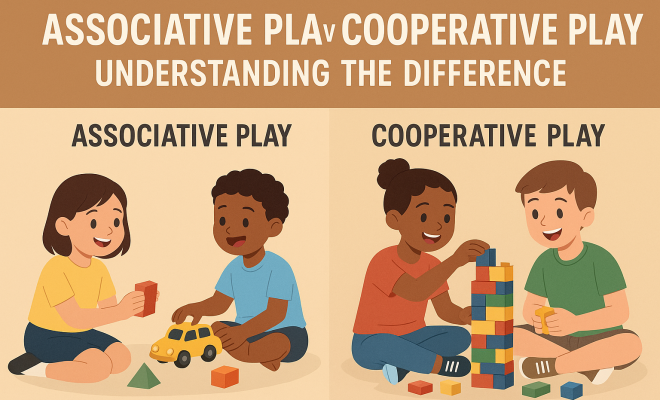
Associative play is a form of play that occurs when children engage in similar activities, sharing materials and resources, without a structured plan or defined roles. This type of play typically emerges around the age of three and continues to evolve as children grow. During associative play, children demonstrate a willingness to interact with peers, exchanging ideas and items, but they do not work toward a single shared goal.
For instance, if a group of children plays with building blocks, they may each build their own structure but discuss their creations, trade blocks, and occasionally help each other without a clear collaborative outcome. This interaction reflects the essence of associative play, where the social engagement is more significant than the specific activity being undertaken.
2. Understanding Cooperative Play
In contrast, cooperative play involves children working together towards a common objective, often requiring teamwork and communication. This type of play typically emerges around the age of four to five and is critical for developing advanced social skills, such as negotiation, problem-solving, and empathy. In cooperative play, children assume specific roles, create rules, and share responsibilities, all contributing to the success of the activity.
An example of cooperative play can be observed during a game of soccer, where children must collaborate, strategize, and support one another to score goals. The focus on collective achievement highlights the importance of cooperation and social cohesion in this form of play, making it essential for fostering deeper social connections among peers.
3. Key Differences Between Associative and Cooperative Play
While both associative and cooperative play involve interaction with peers, several key differences set them apart. One primary distinction is the level of organization involved. Associative play is more spontaneous and flexible, lacking defined roles and objectives, whereas cooperative play is structured, demanding clear communication and collaboration.
Another difference lies in the social skills being developed. Associative play mainly enhances social interaction skills, such as sharing and turn-taking, while cooperative play promotes teamwork and conflict resolution. Understanding these differences can help caregivers and educators tailor their approaches to support children’s developmental needs appropriately.
4. Developmental Significance of Associative Play
Associative play plays a critical role in early childhood development. As children engage in this form of play, they begin to explore their social environment, learning how to interact with peers in a less structured manner. This form of play encourages children to develop communication skills, express their feelings, and establish friendships, laying the groundwork for more complex social interactions.
Furthermore, associative play fosters creativity, allowing children to explore various ideas and solutions while collaborating with peers. This type of play can also build confidence as children navigate social dynamics at their own pace. In essence, associative play serves as a foundational experience that shapes children’s social competencies.
5. Developmental Significance of Cooperative Play
Cooperative play serves as another essential aspect of child development, particularly as children approach school age. By participating in cooperative play, children learn to work collaboratively, which is vital in educational settings and later in life. Skills such as negotiation, compromise, and leadership are cultivated during cooperative play, preparing children for successful interactions in various contexts.
This type of play also enhances problem-solving abilities, as children must work together to achieve their goals. Whether constructing a fort or engaging in a group game, children learn to navigate challenges collectively, which fosters resilience and adaptability. The social skills acquired through cooperative play are not just relevant in childhood; they serve as building blocks for future relationships and teamwork in adulthood. (See: CDC on play and child development.)
6. Practical Insights for Parents and Educators
Understanding the dynamics of associative play vs cooperative play can significantly impact how parents and educators facilitate play experiences for children. One practical insight is to provide a variety of play materials and opportunities that encourage both types of play. For instance, providing blocks or art supplies allows children to engage in associative play, while structured games can promote cooperative play.
Moreover, observing children’s play and intervening appropriately can guide them toward deeper interactions. For example, if children are engaged in associative play, caregivers can encourage them to collaborate by suggesting shared projects or challenges. Alternatively, when children are engaged in cooperative play, adults can help them navigate conflicts or enhance communication skills, ensuring a positive play experience.
7. Encouraging Balance Between Both Play Types
Striking a balance between associative and cooperative play is vital for comprehensive social development. While both play types are important, children may benefit from varied experiences that allow them to develop a broad range of skills. For instance, group projects in school settings can incorporate elements of both play types, allowing children to explore creativity while also learning to work collaboratively.
Parents can encourage this balance at home by providing opportunities for both individual and group play. Activities such as solo crafting sessions can foster associative play, while family board games or team sports can promote cooperative play. By valuing both forms of play, caregivers can support a holistic approach to social skill development.
8. Current Relevance in Educational Settings
The discussion of associative play vs cooperative play holds significant relevance in contemporary educational settings. As educators strive to create engaging and effective learning environments, understanding these play types can inform curriculum design and teaching strategies. For instance, incorporating play-based learning can enhance children’s engagement and motivation, fostering a love for learning while developing critical social skills.
Moreover, recognizing the role of play in overall development can lead to more inclusive and supportive classroom environments. Educators who prioritize play as a learning tool can create spaces where children feel comfortable exploring their social abilities, ultimately leading to improved academic performance and emotional wellbeing.
9. Challenges and Considerations
Despite the clear benefits of both associative and cooperative play, certain challenges may arise. For example, some children may struggle with social interactions and feel overwhelmed during group activities. Understanding individual differences in social development is essential for creating inclusive play experiences that cater to diverse needs.
Additionally, caregivers must navigate the balance between providing guidance and allowing children to lead their play experiences. Over-intervention can stifle creativity and independence, while too little guidance may lead to conflicts or frustration. Striking this balance requires awareness and adaptability from adults, ensuring that play remains a positive and enriching experience.
10. The Future of Play: Embracing Both Types
As we look to the future, the importance of understanding associative play vs cooperative play will continue to shape how we approach child development. With increasing recognition of the value of play in learning, parents and educators alike must adapt their strategies to embrace both forms of play. By fostering environments that support associative and cooperative play, we can nurture children’s social development and prepare them for future success.
Ultimately, play is not just a pastime; it’s a vital component of growth that shapes our relationships, skills, and experiences. As we champion play in its various forms, we contribute to a generation of children who are not only skilled in social interactions but also equipped to face the complexities of life.
11. Examples of Play Activities That Encourage Associative and Cooperative Play
To better understand how to facilitate associative and cooperative play, let’s look at specific activities that can be implemented in various settings. These activities not only promote play but also help children develop essential social skills.
- Associative Play Activities:
- Art and Craft Stations: Creating an art station where children can draw, paint, or craft together without a specific outcome encourages them to share materials while expressing their creativity.
- Block Building: Providing a variety of building materials allows children to construct their own projects while interacting with peers, sharing ideas and materials.
- Imaginative Play: Setting up a dress-up corner with various costumes encourages children to engage in role play independently while interacting with others in imaginative scenarios.
- Cooperative Play Activities:
- Team Sports: Organizing team-based sports activities such as soccer or basketball requires children to work together, strategize, and communicate effectively.
- Group Projects: Assigning group projects in the classroom, such as science experiments or presentations, encourages children to collaborate, delegate tasks, and support one another.
- Building Challenges: Creating challenges where children must work together to build a structure or solve a puzzle promotes teamwork and collective problem-solving.
12. Statistics on Play and Child Development
Research highlights the pivotal role of play in child development. According to the American Academy of Pediatrics, children learn best through play, which is crucial for developing cognitive, social, and emotional skills. A study published in the journal Child Development found that children who engage in more play-related activities perform better in school settings. Here are some noteworthy statistics:
- Children aged 3-5 years who participate in structured play have shown a 40% increase in cooperative skills.
- Research indicates that children who engage in both associative and cooperative play demonstrate better problem-solving abilities, with a 25% improvement in group tasks.
- According to a survey by the National Association for the Education of Young Children, 89% of early childhood educators agree that play is essential for learning.
13. Expert Perspectives on Play Dynamics
Experts in child development emphasize the importance of balancing associative and cooperative play. Dr. Laura Jana, a pediatrician and child development expert, notes that “play is a child’s most important work. It’s essential not only for learning but for building the social fabric of their lives.” She advocates for structured play opportunities that also allow for spontaneous interactions, which can enhance both associative and cooperative play. (See: NIH on types of play.)
Additionally, Dr. David Elkind, an author and child psychologist, argues that “children need time to play without adult direction. This free play is where they learn to negotiate, share, and resolve conflicts, which is foundational for cooperative play.” His insights emphasize the need for children to explore both play types independently while also guiding them when necessary.
14. Common Misconceptions About Associative and Cooperative Play
There are several misconceptions about associative and cooperative play that can affect how adults facilitate these experiences for children. Addressing these misconceptions is essential for promoting healthy play interactions.
- Misconception 1: Associative play is less valuable than cooperative play.
Reality: While cooperative play is crucial for teamwork, associative play fosters creativity and individual expression, both of which are necessary for holistic development. - Misconception 2: Children should only engage in structured play.
Reality: Unstructured play allows children to create their own rules and narratives, fostering independence and social skills that structured play may not fully develop. - Misconception 3: Children naturally gravitate towards cooperative play as they grow.
Reality: While many children do transition towards cooperative play, some may prefer associative play for longer periods. It’s important to provide opportunities for both.
15. FAQs About Associative Play vs Cooperative Play
What is associative play?
Associative play is characterized by children engaging in similar activities or play without a common goal, sharing materials, and interacting socially in a spontaneous manner.
What is cooperative play?
Cooperative play occurs when children work together towards a shared objective, requiring teamwork, communication, and the establishment of rules and roles among participants.
At what age do children generally start to engage in associative play and cooperative play?
Associative play typically starts around age three, while cooperative play usually emerges between ages four and five.
How can parents encourage both forms of play in their children?
Parents can provide diverse play opportunities, such as solo art projects for associative play and team sports or group activities for cooperative play. Allowing children the freedom to choose their play style is essential.
Why is it important to understand the difference between associative and cooperative play?
Recognizing the differences helps caregivers tailor their support to foster children’s social skills effectively, ensuring they develop a well-rounded set of competencies.
Can children exhibit both types of play simultaneously?
Yes, children can engage in both types of play within the same play session. For instance, they may start with associative play and then move into cooperative play as their interactions evolve.
How do cultural differences impact play styles?
Cultural contexts can influence the types of play children engage in, with some cultures emphasizing cooperative play more strongly, while others may favor associative play. Understanding local cultural norms can help caregivers foster suitable play environments.
What should educators do if children struggle with cooperative play?
Educators can provide guided support, teaching social skills explicitly such as communication and conflict resolution, while also creating structured opportunities for cooperative play to build confidence and competence.
16. Enhancing Social Skills Through Play
Both associative and cooperative play contribute significantly to the enhancement of social skills in children. Through associative play, children learn to navigate social norms and develop vital skills such as sharing, taking turns, and engaging in conversation. These skills are foundational for forming friendships and interacting positively with peers.
On the other hand, cooperative play takes these skills a step further by introducing concepts such as mutual respect and understanding different perspectives. When children work together towards a common goal, they practice negotiation and conflict resolution skills. This is essential as they learn that differing opinions can lead to stronger solutions when combined. Such skills are not only applicable in play but also in classroom settings and future professional environments.
17. Impact of Technology on Play Dynamics
In today’s increasingly digital world, the dynamics of associative and cooperative play are evolving. Technology can serve both as a tool for enhancing play and as a barrier to traditional forms of interaction. Online gaming, for instance, can foster cooperative play among children who may not be physically present. However, it can also hinder associative play, as digital interactions often lack the rich, nuanced social cues present in face-to-face engagements.
Caregivers should be aware of these shifts and strive to create a balanced play environment that includes both digital and physical play opportunities. Setting boundaries around screen time while encouraging active, in-person play can help children benefit from both associative and cooperative experiences.
18. The Role of Educators in Facilitating Play
Educators play a crucial role in facilitating both associative and cooperative play in the classroom. They can create environments that promote exploration and collaboration, ensuring that children have ample opportunities to engage in both types of play. This might include designing classroom layouts that encourage free movement and group activities.
Additionally, educators can introduce specific games and projects that require teamwork and interaction, guiding children in setting rules and understanding the importance of cooperation. Observing children during play provides insight into their social dynamics, allowing educators to intervene when necessary to support healthy interactions. This proactive approach fosters an environment where all children feel valued and included.
19. Conclusion: The Importance of Play in Child Development
Understanding the differences between associative play vs cooperative play helps shape how we nurture children’s social development. Both forms of play are critical for equipping children with the skills they need to navigate relationships throughout their lives. By fostering environments that support both types of play, we empower children to develop into socially competent, empathetic adults.
As we reflect on the significance of play in child development, it’s clear that creating opportunities for both associative and cooperative interactions is essential for holistic growth. By prioritizing play, we can help children thrive not only in their childhood years but also as they transition into adulthood.
By expanding our understanding of associative play vs cooperative play, we can create richer, more inclusive environments for children to thrive socially and emotionally, ultimately supporting their overall development.
“`
Trending Now
Frequently Asked Questions
What is associative play?
Associative play is a form of play where children engage in similar activities, share materials, and interact socially without a structured plan or defined roles. It typically begins around age three, allowing children to exchange ideas and items while focusing on social engagement rather than a shared goal.
How does cooperative play differ from associative play?
Cooperative play involves children working together towards a common objective, often requiring teamwork and communication. Unlike associative play, which is more about social interaction without a goal, cooperative play typically emerges around ages four to five and fosters advanced social skills like negotiation and empathy.
What age do children start associative play?
Associative play usually begins around the age of three. At this stage, children start to engage with peers in similar activities while sharing materials, marking an important phase in their social development.
What are the benefits of cooperative play?
Cooperative play helps children develop essential social skills such as teamwork, negotiation, and problem-solving. By working towards a common goal, children learn to communicate effectively and understand the importance of collaboration in social interactions.
Why is understanding play types important for parents and educators?
Understanding the differences between associative and cooperative play is crucial for parents and educators as it enhances their approach to fostering children's social skills. This knowledge helps guide interactions and promotes effective learning experiences that support overall development.
Agree or disagree? Drop a comment and tell us what you think.