Pragmatics, Semantics & Syntax: Decoding Language
“`html
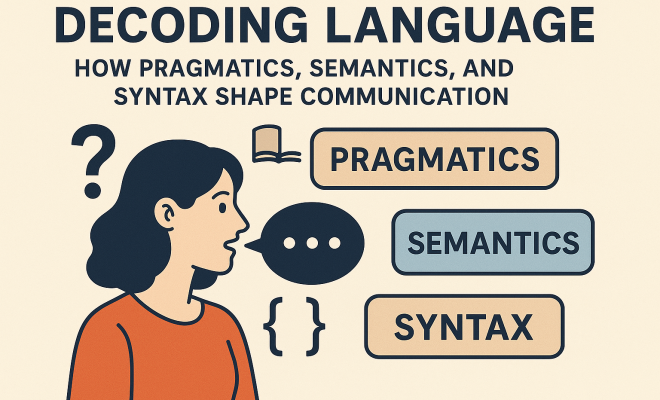
Language is one of the most fascinating aspects of human interaction, and at its core, it rests on three fundamental pillars: pragmatics, semantics, and syntax. Understanding these elements is crucial for anyone interested in linguistics, communication, or even artificial intelligence. Each of these components plays a distinct role in how we construct meaning, convey intent, and interpret messages. Let’s explore these three pillars more deeply, highlighting their differences, interconnections, and relevance in our daily communication.
1. What is Syntax?
Syntax refers to the rules that govern the structure of sentences in a language. It’s all about how words are arranged to create coherent statements. For instance, in English, the typical sentence structure follows a Subject-Verb-Object order, as seen in the sentence, “The cat (subject) chased (verb) the mouse (object).” Understanding syntax is vital because it allows speakers and writers to construct sentences that are grammatically correct and easily understood by listeners and readers.
However, syntax isn’t just a rigid set of rules; it also varies across languages. For example, while English uses the Subject-Verb-Object structure, languages like Latin or Japanese might have different arrangements. This variability points to how syntax reflects cultural and linguistic diversity, making it a complex subject in the study of linguistics.
In addition to language-specific structures, syntax can also change based on formality, dialect, or social context. For instance, the sentence “Where are you going?” can also be expressed as “Where to?” in a more casual setting. This flexibility shows how syntax can adapt to different communicative situations while still conveying the same fundamental meaning.
Additionally, the study of syntax has implications in the field of computational linguistics. For example, syntax trees are used in natural language processing to help machines understand sentence structure, which is critical for tasks like machine translation and speech recognition. This highlights the practical application of syntactical knowledge beyond theoretical study.
2. The Role of Semantics
Semantics delves into the meaning of words, phrases, and sentences. It examines how language conveys meaning and the relationships between different concepts. For instance, the word “bank” can refer to a financial institution or the side of a river, demonstrating how context is crucial in defining meaning. Semantics helps in clarifying these ambiguities and understanding the nuances of language.
Moreover, semantics encompasses various aspects such as lexical semantics, which deals with word meanings and their interrelations, and compositional semantics, which studies how meanings combine in sentences. This level of analysis is essential for comprehending how individuals interpret language and how meaning can change based on context, tone, or even cultural factors.
One interesting aspect of semantics is the idea of semantic fields, which refer to groups of words that share a common meaning. For example, words like “happy,” “joyful,” and “cheerful” belong to the same semantic field related to positive emotions. Understanding these connections helps deepen our appreciation of language and how meanings are constructed and related.
Furthermore, recent studies in semantics emphasize the role of metaphor and analogy in shaping our understanding of complex concepts. For instance, the phrase “the economy is on the upswing” uses a spatial metaphor to describe economic growth, demonstrating how semantics is not just about literal meanings but also about the imagery and associations words evoke.
3. The Importance of Pragmatics
While syntax and semantics focus on structures and meanings, pragmatics is concerned with context and the practical aspects of language use. It studies how people understand and produce language in real-world situations. For instance, if someone says, “Can you pass the salt?” in a dinner setting, they’re not merely asking about your ability to pass the salt; they’re making a polite request. This highlights how pragmatics goes beyond literal meanings to encompass intentions and social cues.
Pragmatics also involves the concepts of implicature, speech acts, and deixis. Implicature refers to what is suggested in an utterance even if it isn’t explicitly stated, while speech acts focus on what we do with language (like making promises or asking questions). Deixis, on the other hand, relates to words that require contextual information for interpretation, such as “here” or “you.” Understanding pragmatics is essential for effective communication since it allows speakers to navigate social interactions and convey meanings accurately.
It’s fascinating to see how misunderstandings can arise when pragmatics is not considered. For instance, in a professional setting, a direct statement like “I need this report by Friday” can be interpreted as a straightforward deadline. However, if the statement is made with a tone of uncertainty or hesitation, it might imply that the speaker is open to negotiations about the timeline. Recognizing these cues can significantly influence how messages are received and acted upon. (See: Understanding syntax in linguistics.)
Research in pragmatics also highlights the importance of politeness strategies in different cultures. For example, what is considered polite in one culture may be seen as overly formal or distant in another. This awareness is crucial for effective intercultural communication and for fostering respectful international relationships.
4. How Pragmatics, Semantics, and Syntax Interact
The interplay between pragmatics, semantics, and syntax is crucial for effective communication. Syntax provides the framework within which semantics operates, while pragmatics adds a layer of meaning that goes beyond the literal interpretation of words. This interconnectedness can be illustrated through simple examples. Consider the sentence, “It’s cold in here.” Semantically, it might indicate a drop in temperature, but pragmatically, it could serve as a request to close a window or turn up the heat, depending on the context.
The complexity of this relationship is what makes language rich and dynamic. Speakers often rely on a combination of all three elements to convey their messages effectively. Understanding how these pillars interact enables learners, linguists, and communicators to grasp the full depth of language use.
Another illustrative example can be seen in figurative language, such as metaphors. When someone says, “Time is a thief,” the syntax presents a clear structure, semantics implies a meaning connected to loss or fleeting moments, and pragmatics invites listeners to consider the emotional weight and context behind the expression. This combination of elements illustrates how language can be both structured and fluid in its expression of complex ideas.
In written communication, such as emails or texts, this interaction often becomes even more pronounced due to the lack of non-verbal cues. Understanding the intended meaning can hinge on syntax and semantics, but without the pragmatic context (like the relationship between the correspondents), misunderstandings can easily occur. This makes it essential to cultivate an awareness of how these elements work together, especially in digital communication.
5. Pragmatics in Everyday Communication
In daily interactions, pragmatics plays a vital role in ensuring that our messages are conveyed and understood as intended. For example, consider the common phrase, “It’s getting late.” While the literal meaning communicates the time, pragmatically it often serves as a hint that it’s time to leave a gathering or event. This layer of meaning reflects social norms and expectations that guide our interactions.
Moreover, understanding pragmatics can also help avoid miscommunication. For instance, using sarcasm relies heavily on contextual cues and shared knowledge between speakers. Recognizing these subtleties can prevent misunderstandings and enhance relationship dynamics in both personal and professional settings.
Situational humor is another area where pragmatics shines. Jokes often hinge on shared experiences or cultural references that require a nuanced understanding of the context. A joke that’s funny in one cultural setting might completely miss the mark in another, showing how pragmatics shapes our interactions and the effectiveness of humor.
Also, in cross-cultural communications, the role of pragmatics becomes even more pronounced. Different cultures have varying norms when it comes to politeness, directness, and conversational pacing, which can all influence how messages are constructed and received. Understanding these differences is key to navigating global interactions effectively.
Furthermore, pragmatics plays a significant role in teaching languages. In language education, focusing on pragmatics helps learners to understand how to use language appropriately in different contexts, enhancing their ability to communicate effectively across various social situations. Activities that simulate real-life scenarios can be particularly beneficial.
6. Examples of Syntax, Semantics, and Pragmatics in Action
Here are a few examples that illustrate how syntax, semantics, and pragmatics function together in language:
- Syntax Example: “The dog chased the cat.” vs. “The cat chased the dog.” The meaning drastically changes based on the syntactical arrangement.
- Semantics Example: The word “light” can mean illumination or something that is not heavy. Context determines its meaning.
- Pragmatics Example: During a meeting, if someone says, “This might be a little challenging,” they’re often indicating that the situation is much more serious without stating it directly.
These examples showcase the importance of understanding each pillar in its own right while also recognizing how they contribute to effective communication. Furthermore, the practice of analyzing real-world examples can enhance our linguistic competence. By breaking down everyday conversations, we can gain insight into how syntax, semantics, and pragmatics work together to create contextually rich interactions.
In educational settings, teachers can use specific examples to highlight how varying each pillar affects understanding. For instance, take a simple phrase like “I’m sorry.” Depending on the syntax, semantics, and pragmatics applied, it could range from a genuine apology to a sarcastic remark.
7. Theories and Approaches in Linguistics
Many theories and frameworks in linguistics explore pragmatics, semantics, and syntax. For instance, generative grammar, developed by Noam Chomsky, emphasizes syntax and its role in the innate structures of language. Meanwhile, theories like relevance theory focus on pragmatics and how context influences comprehension. (See: How language shapes the way we think.) vocabulary activities for students offers useful background here.
In semantics, truth-conditional semantics is a prominent approach that relates the meaning of sentences to the conditions under which they can be considered true. Understanding these theories provides valuable insights into how linguists view language and its components, leading to further exploration in fields like artificial intelligence and natural language processing.
Additionally, cognitive linguistics offers an interesting perspective by examining how human cognition affects language use and understanding. This approach asserts that our mental processes shape how we perceive meanings, rendering semantics a deeply experiential matter that involves our interactions with the world.
Furthermore, sociolinguistics examines how language varies and changes in social contexts, demonstrating the relevance of pragmatics. This field looks at how factors like region, ethnicity, and social class affect language usage, enriching our understanding of the interplay between linguistic structures and social dynamics.
8. Current Relevance of Pragmatics, Semantics, and Syntax
The exploration of pragmatics, semantics, and syntax is not just an academic endeavor; it’s relevant in today’s technology-driven world. For instance, advancements in artificial intelligence, particularly in natural language processing, rely heavily on these linguistic pillars. Systems like chatbots and virtual assistants must understand not only the syntax of sentences but also the meanings and the context behind them to interact effectively with users.
Additionally, in our globalized society, understanding these linguistic elements can aid in cross-cultural communication. Different cultures may interpret meanings, social cues, and sentence structures differently, leading to potential misunderstandings. Being aware of these differences can facilitate more effective and meaningful intercultural exchanges.
For example, in international business negotiations, misinterpretations can arise if one party relies on a direct communication style while another utilizes indirect approaches. This can lead to frustration and conflict. By recognizing the pragmatics at play and adapting communication strategies accordingly, parties can foster collaboration and understanding.
Moreover, the rise of social media has transformed the landscape of communication, emphasizing the importance of understanding pragmatics. Shortened sentences, emojis, and visual elements can carry significant meaning that goes beyond traditional linguistic structures, reflecting the evolving nature of language in the digital age. Understanding how these new forms of communication fit within the realms of syntax, semantics, and pragmatics is essential for effective engagement in modern discourse.
Interestingly, studies suggest that the use of emojis can enhance clarity in digital communication, serving as a form of pragmatic context that helps convey emotions and intentions that may otherwise be lost in text. This highlights how language continues to evolve and adapt, illustrating the dynamic nature of syntax, semantics, and pragmatics in action.
9. Learning and Teaching Language: The Role of Pragmatics, Semantics, and Syntax
For educators and learners, understanding pragmatics, semantics, and syntax is essential in the language learning process. Language programs that incorporate these elements can provide students with a more comprehensive understanding of communication. For instance, teaching syntax helps students construct correct sentences, while semantics aids in vocabulary acquisition and meaning comprehension.
Moreover, teaching pragmatics equips students with the skills to understand context and social nuances, which are crucial for real-life conversations. Activities that promote role-playing or real-world problem-solving can enhance learners’ abilities to navigate social interactions effectively.
Additionally, integrating technology into language education can further reinforce these concepts. For example, using language learning apps that incorporate interactive dialogues can help students practice syntactical structures while also exploring the semantics and pragmatics of various conversational contexts. This blended approach encourages students to engage with language dynamically and contextually.
Furthermore, assessment methods that measure understanding across these three pillars can offer more holistic evaluations of language proficiency. Instead of relying solely on grammar tests, assessments that examine communicative competence in real-world scenarios can better reflect a learner’s abilities. (See: The science of language and the brain.)
Finally, fostering metalinguistic awareness in students—helping them think about how language works—can empower learners to become more adept communicators. By providing explicit instruction about how pragmatics, semantics, and syntax interrelate, educators can equip students with the tools they need for effective communication in diverse contexts.
10. FAQ: Understanding Pragmatics, Semantics, and Syntax
What are the differences between pragmatics, semantics, and syntax?
Syntax is the study of sentence structure and the rules that govern how words combine to form sentences. Semantics focuses on the meanings of words, phrases, and sentences, while pragmatics examines how context influences the interpretation of language in real-life situations.
How do pragmatics and semantics work together?
Pragmatics and semantics are interconnected in that semantics provides the meaning of words and phrases, while pragmatics considers how those meanings may change based on context, speaker intent, and social conventions. For instance, a statement may have a straightforward semantic meaning, but its pragmatic interpretation may suggest something entirely different.
Can you give an example of how pragmatics can change meaning?
Sure! If someone says, “It’s hot in here,” literally, it indicates the temperature. However, depending on the context, the speaker might be implying a need to adjust the thermostat or expressing discomfort. The pragmatic interpretation hinges on the context in which the statement is made.
Why is understanding these concepts important in communication?
Grasping pragmatics, semantics, and syntax is crucial for effective communication. These concepts help individuals understand language beyond the literal meanings, facilitating better interaction, reducing misunderstandings, and fostering more profound connections in both personal and professional relationships.
How can I improve my understanding of pragmatics, semantics, and syntax?
Engaging with various forms of communication—such as reading literature, participating in discussions, and observing conversations—can deepen your understanding. Additionally, studying linguistic theory and taking part in language learning activities that emphasize these elements can further enhance your skills.
What role do cultural contexts play in pragmatics, semantics, and syntax?
Cultural contexts are integral to understanding pragmatics, semantics, and syntax. They shape how meaning is constructed and interpreted, influencing everything from politeness strategies to syntactical preferences. Awareness of these cultural variations can improve communication and reduce the likelihood of misunderstandings in diverse settings.
11. Final Thoughts on Language’s Three Pillars
Pragmatics, semantics, and syntax are integral to understanding how language functions. Each pillar plays a distinct role, yet they interconnect to form the intricate web of communication that we navigate daily. By delving into the nuances of these linguistic elements, we gain a deeper appreciation for the complexity of human interaction. This builds on communication apps for educators.
Whether you’re a linguist, a student, or simply someone interested in how language works, grasping these concepts opens up a world of understanding. As technology continues to evolve and our society becomes more interconnected, the relevance of these linguistic pillars will persist, shaping how we communicate and understand each other.
“`
Trending Now
- this guide on unlocking student potential: how scaffolding in competency-based education transforms learning
- this guide on unlocking communication: essential strategies for teaching pragmatics to students with autism
- this guide on how scaffolding executive function can transform learning for kids
- Unlocking the Power of Pragmatics in…
Frequently Asked Questions
What is the difference between semantics and pragmatics?
Semantics deals with the meaning of words and sentences in isolation, focusing on the literal interpretation. Pragmatics, on the other hand, considers context and the social aspects of language use, such as intentions and implications beyond the literal meaning. Together, they help us understand the full scope of communication.
How does syntax affect communication?
Syntax affects communication by governing the structure of sentences, which determines clarity and coherence. Proper syntax ensures that sentences are grammatically correct and easily understood. Variations in syntax can also convey different levels of formality or dialect, impacting how messages are interpreted.
Why is understanding pragmatics important?
Understanding pragmatics is crucial because it helps us grasp how context influences meaning in communication. This includes recognizing implied meanings, social cues, and the speaker's intent, which are essential for effective interaction in both personal and professional settings.
What role does syntax play in artificial intelligence?
In artificial intelligence, syntax plays a vital role in natural language processing. Syntax trees help machines analyze sentence structure, enabling computers to understand and generate human language more effectively. This understanding is essential for applications like chatbots and language translation services.
How do semantics and syntax work together?
Semantics and syntax work together by combining meaning and structure to create coherent sentences. While syntax dictates how words are arranged, semantics provides the meanings of those words. Together, they enable effective communication by ensuring that sentences are both grammatically correct and meaningful.
Agree or disagree? Drop a comment and tell us what you think.