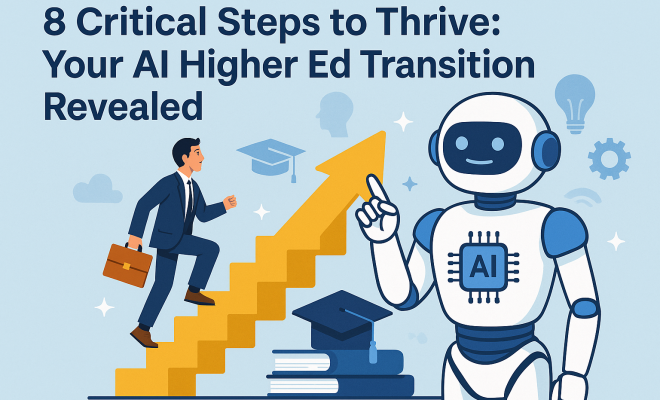
8 Critical Steps to Thrive: Your AI Higher Ed Transition Revealed
“`html
Alright, let’s talk brass tacks about what’s really happening in higher education. For decades, it felt like university administrative staff just kept growing, almost like kudzu in the summer. We saw non-teaching personnel expanding at a faster clip than both faculty and student numbers, a trend that seemed unstoppable. But now? We’re seeing a dramatic pivot, thanks in large part to artificial intelligence. This isn’t just a ripple; it’s a seismic shift, and if you’re in an administrative role, you’ve probably felt the ground shaking.
A recent survey from the College and University Professional Association for Human Resources (CUPA-HR) laid it bare: a 6.6% reduction in full-time staff and a whopping 23.9% decrease in part-time staff in 2025 compared to the year prior. That’s not just a statistic; that’s real people, real jobs, and a real reversal of those long-standing increases. Universities are facing tough times – declining enrollment, funding cuts – and they’re turning to AI to automate tasks that used to be squarely in the human domain. We’re talking research support, event planning, even donor relations. This isn’t just about efficiency; it’s about survival for some institutions, and it means the landscape for administrative professionals is rapidly changing. So, how do you make a successful transition from administrative roles to AI higher education? Let’s dive into some actionable steps.
1. Embrace the AI Mindset: Understand the New Paradigm
First things first: you’ve got to shift your perspective. AI isn’t just another software update; it’s a fundamental change in how work gets done. It’s moving from a world where human effort is the primary driver of routine tasks to one where intelligent systems handle much of that heavy lifting. This doesn’t mean humans are obsolete, far from it. It means our roles are evolving, demanding different skills and a different way of thinking about our contributions.
Think about it like this: when word processors first came out, typists didn’t disappear; their jobs transformed. They became document specialists, editors, and proofreaders, focusing on higher-level tasks. The same is true now. You need to stop seeing AI as a threat to your current job and start seeing it as a powerful tool that can augment your capabilities and allow you to focus on more strategic, creative, and human-centric aspects of your work. This psychological shift is crucial for anyone looking to make a successful transition from administrative roles to AI higher education.
2. Identify Your Transferable Skills: What You Already Bring to the Table
You’ve spent years in administrative roles, and that experience isn’t suddenly worthless. Far from it! You’ve developed a treasure trove of transferable skills that are incredibly valuable in an AI-driven environment. Think about your problem-solving abilities, your organizational prowess, your communication skills, your understanding of institutional processes, and your knack for stakeholder management. These are foundational.
For instance, if you’ve been managing complex event logistics, you understand dependencies, timelines, and resource allocation. AI can automate many of the repetitive aspects, but a human still needs to define the parameters, interpret the output, and handle the inevitable exceptions or creative problem-solving. Your ability to understand the ‘why’ behind the ‘what’ of university operations is irreplaceable. Document these skills, articulate them clearly, and start thinking about how they apply to new, AI-enhanced roles.
3. Deep Dive into AI Fundamentals: Building a New Knowledge Base
You don’t need to become a machine learning engineer, but you absolutely need to understand the basics of AI. What is it? How does it work? What are its capabilities and limitations? This isn’t about coding; it’s about literacy. You wouldn’t drive a car without understanding what the gas pedal and brake do, would you? The same applies here.
Look for introductory courses on AI, machine learning, and data science. Many universities and online platforms like Coursera, edX, or even LinkedIn Learning offer excellent, accessible programs. Focus on understanding concepts like natural language processing (NLP), predictive analytics, and automation. Knowing these fundamentals will not only help you speak the language of AI but also identify opportunities where AI can genuinely add value within your institution. This foundational knowledge is a non-negotiable step in your transition from administrative roles to AI higher education.
4. Specialize in AI-Enhanced Areas: Targeting New Roles
As AI automates routine tasks, new roles are emerging that require a blend of administrative experience and AI proficiency. Think about positions like ‘AI Project Manager,’ ‘Data Steward,’ ‘AI Adoption Specialist,’ or ‘Automated Workflow Designer.’ These roles aren’t just about using AI; they’re about strategically implementing and managing AI solutions to optimize university operations.
For example, a Data Steward in an AI-driven environment ensures the quality, integrity, and security of the data that AI systems feed on. Your administrative background gives you an intimate understanding of where that data comes from and how it’s used. An AI Adoption Specialist helps faculty and staff integrate AI tools into their daily workflows, requiring strong communication and training skills. Identify areas where your current administrative expertise intersects with AI applications and start focusing your upskilling efforts there.
5. Network Strategically: Connecting with the AI Community
Your network is always your net worth, and that’s especially true during a career transition. Start connecting with professionals who are already working with AI in higher education, or even in other sectors that have adopted AI. Attend webinars, virtual conferences, and local meetups focused on AI and education technology. LinkedIn is your friend here; seek out people in roles you aspire to and respectfully ask for informational interviews. For more context, see the impact of AI on academic integrity.
Don’t just ask for a job; ask for insights. What skills do they value? What challenges are they facing? How did they get where they are? These conversations will not only provide invaluable guidance but also expand your professional circle, potentially leading to mentorship opportunities or even job leads down the road. Building these connections is vital for a smooth transition from administrative roles to AI higher education.
6. Build a Portfolio or Showcase Projects: Demonstrating Your Skills
Talking about skills is one thing; demonstrating them is another entirely. As you gain new AI-related knowledge, look for opportunities to apply it. Can you volunteer to help a department optimize a process using an AI tool? Can you take a project from an online course and adapt it to a hypothetical university scenario?
Even small projects can show initiative and a practical understanding of AI’s potential. Maybe you use an AI writing assistant to draft a new policy document more efficiently, or you analyze a dataset using an AI-powered tool to identify trends in student retention. Document these experiences. Create a portfolio that highlights how you’ve used AI to solve problems, improve efficiency, or drive better outcomes. This practical experience will make you stand out when you’re ready to apply for new roles.
7. Leverage Internal Opportunities: Grow Where You’re Planted
Before looking externally, explore what opportunities might exist within your current institution. As universities increasingly adopt AI, they’ll need internal champions and specialists. Speak with your supervisors, HR department, or IT leadership about your interest in AI and your desire to contribute to the institution’s AI initiatives.
Perhaps there’s a pilot program for a new AI tool you can join. Maybe you can take on a special project that involves data analysis or process automation. Express your willingness to learn and adapt. Being proactive internally can not only secure your position but also allow you to lead the charge in your department’s AI integration, making you an indispensable asset during this period of change. This is often the most direct path for many in the transition from administrative roles to AI higher education.
8. Develop Your ‘Human’ Skills: The Irreplaceable Edge
While AI takes over routine tasks, the demand for uniquely human skills will only increase. We’re talking about critical thinking, creativity, emotional intelligence, complex problem-solving, ethical reasoning, and effective communication. These are the skills that AI struggles to replicate, and they will be at the core of future administrative and leadership roles.
Focus on honing these competencies. Engage in activities that challenge your creative thinking, practice empathy in your interactions, and seek out opportunities to solve ambiguous, complex problems. Your ability to collaborate, innovate, and provide a human touch in an increasingly automated world will be your most valuable asset. The future of work isn’t about competing with AI; it’s about collaborating with it, and that collaboration requires strong, distinctly human capabilities.
9. Understanding the AI Landscape in Higher Ed: Beyond Automation
It’s important to grasp that AI in higher education isn’t just about cutting costs by automating routine tasks, though that’s a significant part. It’s also about enhancing the student experience, improving research capabilities, and making administrative processes more intelligent. Think about personalized learning platforms powered by AI that adapt to a student’s pace and style, or AI tools that help researchers sift through vast amounts of data to uncover new insights. Even in areas like student recruitment, AI can analyze prospective student data to identify those most likely to succeed, allowing admissions staff to focus their outreach more effectively.
For administrative professionals, this means understanding the broader strategic goals behind AI adoption. It’s not just about “how do I use this AI tool?” but “how does this AI tool fit into our institution’s larger mission to serve students, faculty, and the community?” When you can articulate this bigger picture, you become a strategic partner rather than just an operator. For instance, an administrative professional in student affairs might use AI to predict student dropout risks, allowing advisors to intervene proactively. This shifts their role from reactive problem-solving to proactive student support, a far more impactful and rewarding contribution. This deeper understanding of the ecosystem is key for a successful transition from administrative roles to AI higher education.
10. Ethical Considerations and AI Governance: A New Responsibility
As AI becomes more ingrained in university operations, new ethical dilemmas and governance challenges emerge. Who is responsible when an AI makes a biased decision in student admissions? How do we ensure data privacy when AI systems process sensitive student information? These aren’t technical questions for IT alone; they are institutional questions that require input from people who understand policy, human impact, and administrative processes.
Administrative professionals, with their deep understanding of university policies and ethical guidelines, are uniquely positioned to contribute to AI governance frameworks. Taking courses or certifications in AI ethics, data privacy, or responsible AI development can equip you with the knowledge to lead these crucial conversations. Imagine being part of a committee that drafts your university’s AI usage policy or helps implement safeguards against algorithmic bias. This isn’t just a job; it’s about shaping the future of education responsibly. Your administrative background gives you an invaluable perspective on the human element, making you an essential voice in ensuring AI is used fairly and ethically. This is a critical area for those making the transition from administrative roles to AI higher education. For more context, see student loan forgiveness and its implications.
11. Continuous Learning and Adaptability: The Only Constant is Change
The field of AI is evolving at an incredible pace. What’s cutting-edge today might be standard practice tomorrow, or even obsolete. Therefore, a commitment to continuous learning and adaptability isn’t just a recommendation; it’s a prerequisite for staying relevant. This isn’t a “one-and-done” training session; it’s a lifelong journey.
Subscribe to industry newsletters, follow thought leaders in AI and education technology, and regularly seek out new courses or workshops. Be curious. Experiment with new AI tools as they emerge. The ability to quickly learn new technologies and adapt to new workflows will be one of your most valuable assets. Universities will prioritize individuals who demonstrate a proactive approach to learning and a willingness to embrace change. This mindset of continuous growth is absolutely fundamental to a successful and sustained transition from administrative roles to AI higher education.
12. Case Studies: AI in Action in Higher Education Administration
Let’s look at some tangible examples of how AI is being used in higher education administration right now, giving you a clearer picture of potential new roles and responsibilities:
- Admissions and Recruitment: Many institutions use AI-powered chatbots to answer prospective student questions 24/7, reducing the workload on admissions staff and providing instant information. AI also analyzes applicant data to predict enrollment likelihood and identify students who might thrive in specific programs. Administrative staff in admissions are now focused on refining AI algorithms, interpreting data insights, and providing personalized human interaction for high-priority applicants.
- Student Support and Retention: AI tools track student engagement, academic performance, and even mental health indicators to flag students at risk of struggling or dropping out. This allows academic advisors and student support staff to intervene proactively, offering targeted resources. Administrators might be involved in managing these systems, training staff on their use, and designing intervention strategies based on AI insights.
- Financial Aid and Bursar Services: AI can automate the processing of financial aid applications, identify discrepancies, and even answer common student questions about billing and payments. This frees up financial aid counselors to handle complex cases, provide personalized financial planning advice, and resolve unique student situations. Roles here might involve overseeing automated workflows and ensuring compliance.
- Facilities Management: AI optimizes energy consumption, predicts maintenance needs for campus buildings, and even manages room scheduling more efficiently. Administrative staff in facilities are moving towards managing predictive maintenance systems and using data analytics to make smarter resource allocation decisions.
- Research Administration: AI helps researchers find relevant literature faster, analyze large datasets, and even assist with grant writing by identifying funding opportunities. Research administrators might support faculty in leveraging these tools, managing data repositories for AI analysis, and ensuring ethical AI use in research.
These examples show a clear pattern: AI handles the repetitive, data-heavy tasks, while human administrators pivot to roles requiring judgment, strategy, empathy, and complex problem-solving. It’s about augmentation, not replacement, for those willing to adapt.
FAQ: Navigating Your Transition from Administrative Roles to AI Higher Education
Making a significant career shift can bring up a lot of questions. Here are some common ones about transitioning to AI-enhanced roles in higher education:
Q1: Will my administrative experience actually be valued in an AI-driven role?
Absolutely! Your administrative experience is incredibly valuable. You understand the “how” and “why” of university operations, the institutional culture, and the needs of students and faculty. AI tools are powerful, but they need human guidance and context. Your knowledge of existing processes, pain points, and stakeholder relationships will be crucial in effectively implementing and managing AI solutions. You’ll be the bridge between technical capabilities and practical application.
Q2: Do I need to learn to code to work with AI in higher education?
Not necessarily. While a basic understanding of programming logic can be helpful, most AI-enhanced administrative roles don’t require you to be a software developer. The focus is more on understanding AI concepts, how to use AI tools, interpret their outputs, and manage AI projects. Think of it like using advanced spreadsheet software – you don’t need to program Excel, but you need to know how to use its functions effectively. There are many “no-code” or “low-code” AI platforms emerging that make AI accessible to non-technical users. For more context, see developing critical thinking skills in the age of AI.
Q3: What’s the best way to get started with learning about AI?
Start with accessible online courses. Platforms like Coursera, edX, LinkedIn Learning, and even YouTube offer excellent introductory courses on AI, machine learning fundamentals, and data science for non-technical audiences. Look for courses specifically designed for business professionals or those in non-tech fields. Focus on understanding the core concepts, common AI applications, and ethical considerations. Reading articles and listening to podcasts from reputable sources in edtech and AI will also keep you informed.
Q4: How can I convince my current institution to invest in my AI upskilling?
Frame it as a benefit to the institution. Highlight how your new skills will help solve existing problems, improve efficiency, or enhance student services. Propose specific projects where you can apply AI knowledge. Show initiative by doing some self-study first. Many institutions offer professional development budgets or tuition reimbursement programs; research these options and present a clear case for how your AI training aligns with the university’s strategic goals.
Q5: What if my university isn’t actively adopting AI yet?
This is a great opportunity to be a pioneer! Your institution might be slower to adopt, but AI is coming. By proactively gaining AI literacy, you can become an internal advocate and expert. You could identify pilot projects, research successful AI implementations at other universities, and help build a case for adoption. Even if you eventually need to look externally, having AI skills will make you highly marketable to institutions that are further along in their AI journey.
Q6: Will AI completely replace administrative jobs in higher education?
While some routine, repetitive tasks will definitely be automated by AI, complete replacement of administrative jobs is unlikely. Instead, roles will evolve. AI will take over the “robots’ work,” freeing up humans to focus on tasks requiring critical thinking, creativity, emotional intelligence, complex problem-solving, and human interaction. The future is about human-AI collaboration, not competition. Your goal should be to adapt and augment your skills to work effectively alongside AI.
Q7: How important are “soft skills” in an AI-driven administrative role?
Extremely important! In fact, they become even more critical. As AI handles more technical and data-crunching tasks, the demand for uniquely human skills like communication, collaboration, empathy, ethical reasoning, and leadership will soar. You’ll need to communicate effectively with both technical and non-technical colleagues, lead teams that include AI tools, and apply ethical judgment to AI outputs. These human skills are your irreplaceable edge.
The shift we’re seeing in higher education administration isn’t just a blip; it’s a fundamental reshaping of the workforce. While it’s natural to feel a sense of unease or even fear about job security, especially with reports of significant staff reductions, it’s also an incredible opportunity. By proactively embracing AI, understanding its applications, and strategically reskilling, administrative professionals can not only secure their futures but also become leaders in this exciting new era of higher education. The time to act isn’t tomorrow; it’s now. Your transition from administrative roles to AI higher education is a journey, and every step you take today builds a stronger future.
“`
Trending Now
Frequently Asked Questions
What are the critical steps for transitioning to AI in higher education?
Transitioning to AI in higher education involves several critical steps, including embracing an AI mindset, understanding the evolving role of administrative staff, and developing new skills to adapt to automated processes. It's essential to view AI as an opportunity for growth rather than a threat to job security.
How is AI changing administrative roles in universities?
AI is significantly altering administrative roles in universities by automating routine tasks such as research support, event planning, and donor relations. This shift is leading to a reduction in staff numbers while requiring existing employees to adapt and acquire new skills to remain relevant in the changing landscape.
What challenges are universities facing that are driving AI adoption?
Universities are facing challenges such as declining enrollment and funding cuts, which are prompting them to adopt AI technologies. These tools help streamline operations, reduce costs, and improve efficiency, making them essential for survival in a competitive educational environment.
Why is there a reduction in university staff in 2025?
The reduction in university staff in 2025, including a 6.6% decrease in full-time and a 23.9% decrease in part-time staff, can be attributed to the increasing use of AI. As institutions automate more tasks, the need for traditional administrative roles diminishes, forcing a reevaluation of staffing needs.
How can administrative staff prepare for AI integration in their roles?
Administrative staff can prepare for AI integration by embracing a proactive mindset, seeking training in new technologies, and developing skills that complement AI capabilities. This preparation will enable them to adapt to the evolving demands of their roles and enhance their contributions to their institutions.
Have you experienced this yourself? We'd love to hear your story in the comments.