10 Scaffolding Strategies to Transform Your Math Classroom
“`html
Understanding Scaffolding in Mathematics Education
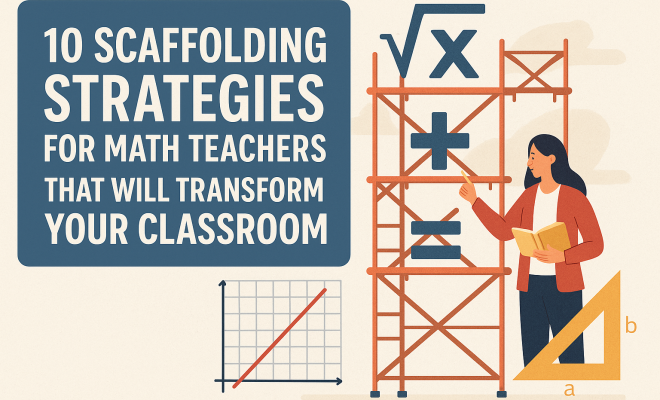
Scaffolding in education refers to a method where teachers provide successive levels of temporary support to help students achieve higher levels of understanding and independence in learning. This approach is especially crucial in mathematics, where concepts often build on one another. For high school math teachers, implementing effective scaffolding strategies can significantly enhance student learning and engagement.
The Importance of Scaffolding Strategies for Math Teachers
Why should math teachers prioritize scaffolding strategies? Many students struggle with math due to its cumulative nature—each new concept often relies on the understanding of previous ones. Effective scaffolding strategies for math teachers not only help students grasp complex concepts but also foster a growth mindset. When students receive the right support at the right time, they become more confident learners.
Research indicates that scaffolding strategies enhance student performance and motivation. According to a study published in the Journal of Educational Psychology, students who received scaffolded instruction showed significantly higher levels of engagement and academic success compared to those who did not. This approach is not just beneficial for struggling students; even those who excel can benefit from additional layers of support that challenge them to think critically.
1. Assessing Student Readiness
Before implementing scaffolding strategies, teachers must first assess their students’ readiness. Understanding where each student stands in terms of their mathematical skills and knowledge is crucial. This can be achieved through pre-assessments, quizzes, or informal observations. By identifying gaps in understanding, teachers can tailor their scaffolding strategies accordingly.
For instance, if a teacher finds that most students struggle with basic algebraic concepts, they can provide additional resources, such as interactive tutorials or peer tutoring sessions, to help bridge those gaps. This targeted approach ensures that all students have the foundational knowledge necessary to tackle more complex topics.
2. Chunking Information
One effective scaffolding strategy for math teachers is chunking information into manageable pieces. Instead of presenting a full lesson in one go, break it down into smaller, more digestible segments. This not only helps students focus better but also reduces cognitive overload. For example, when teaching a new concept such as quadratic equations, a teacher can start with an introduction to basic algebraic principles before gradually moving on to the specific characteristics of quadratic equations.
Chunking can also be applied to problem-solving. Presenting one type of problem at a time, allowing students to practice, and then gradually increasing complexity will help them gain confidence and competency.
3. Providing Visual Aids
Visual aids are an excellent way to scaffold learning in math. Graphs, charts, diagrams, and interactive tools can help students visualize complex problems and concepts. For instance, when explaining functions, using graphical representations can help students understand how different functions behave. Teachers can also integrate technology, like mathematical software or apps, which can provide dynamic visualizations and allow students to experiment with mathematical concepts interactively.
Utilizing visual aids not only supports comprehension but also accommodates different learning styles. Some students may grasp concepts better through visual stimuli, while others might benefit from hands-on activities. By incorporating a mix of visual and kinesthetic methods, teachers can cater to a broader range of learners.
4. Modeling Problem-Solving Strategies
Modeling is a crucial scaffolding strategy for math teachers. By demonstrating problem-solving methods explicitly, teachers provide students with a clear framework for tackling similar problems independently. For instance, when working on geometry proofs, a teacher can walk students through the process step-by-step, highlighting key reasoning and strategies used at each stage.
Additionally, think-aloud strategies can be particularly effective. By verbalizing their thought processes, teachers can demonstrate how they approach a problem, making the abstract process of problem-solving more concrete and accessible. This not only aids understanding but also teaches students to articulate their reasoning, which is essential for mastering mathematical concepts.
5. Encouraging Collaborative Learning
Collaboration can be an effective scaffolding strategy in math classrooms. Group work fosters peer learning, allowing students to explain concepts to each other, which can reinforce their understanding. For instance, assigning students to work in pairs to solve a math problem encourages discussion and critical thinking. (See: Scaffolding in education.)
Teachers can facilitate collaborative learning by creating structured group activities or projects, carefully assigning roles based on students’ strengths. This approach not only helps students tackle challenging problems together but also builds a classroom community that supports diverse learning needs.
6. Gradual Release of Responsibility
The gradual release of responsibility model is a proven scaffolding strategy that shifts the onus of learning from the teacher to the student. This approach typically follows a sequence: the teacher models the skill, students practice with guidance, and finally, they work independently. For example, when teaching a new mathematical operation, a teacher might demonstrate the process, then guide students through practice problems, and ultimately allow them to attempt problems on their own.
This method not only empowers students but also reinforces their ownership of learning—an essential component of developing self-efficacy in math. It encourages students to take risks and learn from mistakes, which is vital in math education.
7. Using Formative Assessments
Continuous assessment is a key component of effective scaffolding strategies for math teachers. Formative assessments, such as exit tickets, quizzes, or observational assessments, provide teachers with ongoing feedback about student understanding. These assessments can help identify areas where students may need additional support and inform future instruction.
By understanding where students are struggling, teachers can adjust their scaffolding techniques, whether that means re-teaching a concept, providing targeted interventions, or offering advanced challenges to those who have mastered the material. The quick feedback loop established through formative assessments allows for a more responsive teaching approach.
8. Differentiating Instruction
Every classroom is composed of students with varying abilities, learning styles, and paces. Differentiation is a vital scaffolding strategy that involves tailoring instruction to meet these diverse needs. High school math teachers can differentiate by offering a range of activities or problems at varying levels of difficulty.
For example, while introducing a new concept, a teacher could provide basic practice problems for struggling students, while simultaneously offering more complex, open-ended problems for advanced students. This ensures all learners are engaged and challenged appropriately, allowing them to succeed at their own levels.
9. Leveraging Technology
In today’s digital age, leveraging technology can enhance scaffolding strategies for math teachers. Online platforms, interactive software, and educational apps can provide personalized learning experiences that are tailored to individual student needs. For instance, platforms like Khan Academy or IXL offer tailored exercises that adapt to a student’s performance, providing immediate feedback and support.
Utilizing these tools not only engages students but can also free teachers to focus on providing targeted assistance to those who need it most. Integrating technology into the classroom can transform traditional learning into a dynamic experience that promotes exploration and deeper understanding of mathematical concepts.
10. Building a Supportive Classroom Environment
Creating a supportive classroom environment is the foundation upon which effective scaffolding strategies rest. A classroom culture that encourages risk-taking, values mistakes as learning opportunities, and fosters collaboration empowers students to engage more deeply with math. Establishing norms that promote respect and inclusivity ensures that all students feel safe to express their thoughts and questions.
Additionally, providing positive reinforcement and celebrating successes—both big and small—can motivate students and encourage them to pursue challenging tasks with confidence. The emotional and psychological aspects of learning are as important as the cognitive skills being developed.
11. The Role of Reflection in Learning
Reflection is an often-overlooked aspect of the learning process. Scaffolding strategies should include opportunities for students to reflect on their learning experiences. By encouraging students to think about what they learned, how they approached problems, and what strategies were most effective, teachers can help students develop metacognitive skills that are essential for lifelong learning.
For example, after completing a unit on geometry, a teacher might ask students to write a brief reflection on their understanding and any challenges they encountered. This not only reinforces their learning but also allows the teacher to gather insights about their students’ experiences, which can inform future lessons. (See: Scaffolding strategies for learning.)
12. Examples of Effective Scaffolding Strategies in Action
Let’s look at some real-world scenarios that demonstrate effective scaffolding strategies in action. In a high school algebra class, a teacher introduced the concept of linear equations by first reviewing the foundational skills necessary for solving them, such as manipulating variables and understanding slopes. After chunking the information, the teacher used visual aids, including graphs to showcase the relationship between variables, before guiding students through practice problems together. As students gained confidence, they were gradually released to solve problems independently.
In another scenario, a teacher used collaborative learning by forming small groups where students could share their thought processes while tackling a complex word problem. Each group member was responsible for explaining their reasoning, which not only solidified their understanding but also allowed them to learn from each other’s perspectives.
13. Incorporating Real-World Applications
Another effective scaffolding strategy is to incorporate real-world applications into math lessons. Connecting mathematical concepts to real-life scenarios helps students see the relevance of what they’re learning and can increase engagement. For instance, a teacher might ask students to calculate the costs of a road trip, including fuel, food, and lodging, which requires them to apply addition, multiplication, and even algebraic reasoning.
Additionally, discussing current events or local community problems that require mathematical solutions can further enhance students’ understanding of the material. This not only scaffolds the learning but also builds critical thinking skills as students learn to analyze and solve problems within context.
14. FAQs about Scaffolding Strategies for Math Teachers
Q: What is the best way to assess student readiness for scaffolding?
A: The best way to assess student readiness is through a combination of pre-assessments, informal observations, and quizzes. Understanding students’ current knowledge and skills allows teachers to tailor their instruction effectively.
Q: How can I ensure that my scaffolding strategies are effective?
A: Continuously gather feedback through formative assessments and student reflections. This feedback will help you understand what’s working and where adjustments are needed.
Q: Can scaffolding strategies be used for all math topics?
A: Yes, scaffolding strategies can and should be adapted for all math topics. The key is to understand the specific challenges and prerequisites associated with each topic.
Q: How can I implement technology in my scaffolding strategies?
A: Incorporate educational apps and online resources that provide interactive problem-solving experiences. These tools can provide immediate feedback and allow for differentiated instruction.
Q: What if students prefer to work independently rather than in groups?
A: While collaborative learning is beneficial, it’s important to respect individual learning preferences. Offer a mix of both collaborative and independent activities to cater to all students.
15. Advanced Scaffolding Techniques
As teachers become more skilled in implementing scaffolding strategies, they can explore advanced techniques to further enhance their students’ learning experience. These methods can provide deeper engagement and understanding.
Using Socratic Questioning
Socratic questioning involves prompting students to think critically and articulate their thoughts. Instead of providing direct answers, teachers can ask guiding questions that encourage students to explore the underlying principles of a mathematical concept. For example, rather than telling students how to approach a problem, a teacher might ask, “What happens if we change this variable?” or “Can you explain why you chose that method?” This technique not only encourages deeper thinking but also helps students make connections between concepts.
Peer Teaching Opportunities
Creating opportunities for peer teaching can significantly enhance understanding. When students explain concepts to their classmates, they reinforce their own learning and gain confidence in their understanding. Math teachers can designate specific times for students to teach each other, whether through formal presentations or informal study groups. This strategy not only empowers students but also fosters a cooperative learning environment where they learn from one another.
Integrating Game-Based Learning
Incorporating game-based learning into math instruction can make scaffolding more engaging. Educational games can help students practice skills in a fun and interactive way. For instance, a math teacher might use online platforms that gamify problem-solving or create classroom-based competitions that challenge students to solve math problems under time constraints. These activities not only motivate students but also allow them to apply their skills in low-stakes environments.
16. Data-Driven Scaffolding
Using data to inform scaffolding strategies is increasingly important in educational settings. By analyzing student performance data, teachers can identify trends and adjust their teaching methods accordingly. For instance, if a significant number of students struggle with a particular concept on assessments, the teacher can revisit that concept using different scaffolding strategies. Furthermore, data can help teachers track individual student progress and tailor support to meet their specific needs.
17. Creating a Scaffolding Framework
Establishing a scaffolding framework can help teachers systematically implement these strategies within their curriculum. This framework might include specific goals for different mathematical units, outlining the scaffolding techniques to be used at each stage. By having a clear plan, teachers can ensure they are providing coherent support throughout the learning process, making it easier to adjust their methods based on student feedback and performance.
18. Building Relationships with Students
Effective scaffolding isn’t solely about instructional strategies; it’s also about building strong relationships with students. When students feel valued and understood, they are more likely to engage with the material and take risks in their learning. High school math teachers should take the time to get to know their students, understand their individual learning preferences, and provide personalized support. This connection fosters a trusting environment where students feel comfortable asking questions and expressing difficulties.
19. The Impact of Scaffolding on Student Success
The impact of effective scaffolding strategies extends beyond immediate academic performance. Research shows that students who receive scaffolded instruction exhibit improved problem-solving skills, greater mathematical reasoning, and an enhanced ability to apply their knowledge in various contexts. They also tend to develop a more positive attitude toward learning math, which can translate into success in higher-level math courses and related fields.
For instance, a study by the National Council of Teachers of Mathematics found that students who experienced focused scaffolding interventions not only improved their test scores but also reported increased enjoyment in math. This highlights the long-term benefits of effective scaffolding strategies, affirming their importance in shaping students’ educational journeys.
Conclusion
Implementing effective scaffolding strategies for math teachers not only enhances student understanding but also builds a classroom culture of collaboration, independence, and confidence. From assessing student readiness to leveraging technology and creating a supportive environment, these strategies can transform the learning experience for high school math students. By carefully considering how to structure instruction and support, teachers can equip their students with the skills they need to succeed in mathematics and beyond.
“`
Trending Now
Frequently Asked Questions
What are scaffolding strategies in math education?
Scaffolding strategies in math education are methods that provide temporary support to students, helping them achieve higher levels of understanding and independence. These strategies are essential as math concepts often build on one another, enabling teachers to enhance student learning and engagement.
Why is scaffolding important for math teachers?
Scaffolding is crucial for math teachers because it addresses the cumulative nature of math, where each new concept relies on previous knowledge. Effective scaffolding not only helps struggling students grasp complex ideas but also fosters confidence and a growth mindset in all learners.
How can teachers assess student readiness for scaffolding?
Teachers can assess student readiness for scaffolding through pre-assessments, quizzes, and informal observations. By understanding where each student stands in their mathematical skills, teachers can tailor their scaffolding strategies to address specific gaps in understanding.
What are some examples of scaffolding strategies for math?
Examples of scaffolding strategies for math include breaking down complex problems into smaller, manageable steps, using visual aids, providing guided practice, and encouraging collaborative learning. These methods help students build their understanding progressively and gain confidence in their abilities.
How does scaffolding improve student performance in math?
Research indicates that scaffolding improves student performance by increasing engagement and motivation. Students who receive scaffolded instruction demonstrate higher academic success, as these strategies cater to their individual needs and help them tackle challenging concepts more effectively.
Agree or disagree? Drop a comment and tell us what you think.