Differentiate Instruction with Bloom’s Taxonomy
“`html
Understanding Bloom’s Taxonomy in Education
Bloom’s Taxonomy is a foundational framework in education, developed by Benjamin Bloom and his colleagues in the 1950s. It provides a structured classification of learning objectives, which has been an essential tool for educators to design curricula and assess student understanding. The taxonomy categorizes cognitive skills into six levels: Knowledge, Comprehension, Application, Analysis, Synthesis, and Evaluation. Each of these levels builds on the previous one, creating a hierarchy that promotes higher-order thinking skills.
This educational framework not only helps teachers structure lessons but also facilitates differentiation, an essential strategy for addressing the diverse needs of students in today’s classrooms. Particularly, Bloom’s Taxonomy serves as a guiding principle for catering to both gifted learners—who require more challenging material—and struggling learners—who need more support and scaffolding.
Bloom’s Taxonomy: A Tool for Differentiation
Differentiation involves tailoring instruction to meet the varying needs of students. This can be accomplished through adjustments in content, process, products, and learning environment. Bloom’s Taxonomy in education provides a clear roadmap for differentiation by allowing educators to create learning experiences that are appropriately challenging for different ability levels.
For instance, a lesson on the Civil War might involve basic recall questions for struggling learners while encouraging gifted students to analyze primary sources or create their own historical narratives. This differential approach ensures that each student is working within their zone of proximal development, engaging both gifted and struggling learners at their respective levels.
The Six Levels of Bloom’s Taxonomy
Bloom’s Taxonomy consists of six levels, which educators can leverage for differentiation:
- Knowledge: Recall facts and basic concepts.
- Comprehension: Understand and interpret information.
- Application: Use information in new situations.
- Analysis: Draw connections among ideas.
- Synthesis: Create new products or ideas.
- Evaluation: Justify a decision or course of action.
Each level requires increasingly complex thinking, which can be tailored for both gifted and struggling learners. For example, a teacher might ask struggling students to identify key terms related to a subject (Knowledge) while prompting gifted students to evaluate different perspectives or create a presentation on the topic (Evaluation).
Application of Bloom’s Taxonomy in Differentiated Instruction
Using Bloom’s Taxonomy in education to differentiate instruction involves creating tiered assignments based on the six levels of the taxonomy. This approach allows educators to set clear expectations for all students while offering varied paths to mastery. Here are some practical strategies for implementing this approach:
- Tiered Assignments: Design assignments that align with each level of Bloom’s Taxonomy, ensuring that students can choose tasks that match their skill level.
- Flexible Grouping: Group students by ability or interest, allowing them to work together on tasks that require similar levels of understanding.
- Choice Boards: Create menus of activities that students can select from, ensuring that tasks address different levels of the taxonomy.
For example, in a unit on ecosystems, struggling learners might focus on identifying organisms in a food web (Knowledge), while gifted learners could be tasked with evaluating the impact of environmental changes on these ecosystems (Evaluation).
Creating an Inclusive Learning Environment
Effective differentiation also requires fostering an inclusive classroom environment. Educators can utilize Bloom’s Taxonomy in education to promote dialogue between gifted and struggling learners, encouraging peer-to-peer learning and collaboration. When students work together, they can share insights and strategies that benefit all participants, allowing gifted students to mentor and support their peers while building confidence.
To create an inclusive atmosphere, consider implementing the following strategies:
- Encourage Collaborative Learning: Group students with varying abilities to work on projects or problem-solving tasks, enhancing their understanding through discussion and collaboration.
- Build a Culture of Acceptance: Promote a classroom culture that values diverse perspectives and recognizes that all students have unique strengths and challenges.
- Utilize Formative Assessments: Regularly assess student progress using formative assessments, providing feedback that helps to inform instructional decisions and support differentiated approaches.
By establishing an inclusive learning environment, educators can empower both gifted and struggling learners to engage meaningfully with the material.
Addressing the Needs of Gifted Learners
Gifted learners often require more complex and challenging material to stay engaged. Bloom’s Taxonomy in education is particularly valuable here, as it allows teachers to create advanced tasks that stimulate critical thinking. For example, instead of merely summarizing a text, gifted students might analyze characters’ motivations or create alternative endings to a story. (See: Bloom's Taxonomy overview.)
To effectively meet the needs of gifted learners, educators can:
- Encourage Independent Projects: Allow gifted students to explore topics of interest further, developing independent research or creative projects that challenge their thinking.
- Introduce Advanced Content: Provide access to advanced materials or resources that align with the higher levels of Bloom’s Taxonomy, such as research articles or case studies.
- Facilitate Peer Teaching: Empower gifted students to teach their peers about complex concepts, reinforcing their own learning while supporting classmates.
By customizing instruction for gifted learners through Bloom’s Taxonomy, educators can help them reach their full potential and maintain engagement in learning.
Supporting Struggling Learners
Struggling learners face unique challenges that require tailored support. Bloom’s Taxonomy provides a framework for scaffolding lessons to help these students build their understanding step by step. This could involve breaking down complex tasks into manageable components, allowing students to grasp foundational concepts before moving on to higher-order thinking.
Strategies for supporting struggling learners include:
- Scaffolding Instructions: Break down tasks into smaller, more manageable steps, providing support as needed.
- Visual Aids: Incorporate visuals, such as charts and diagrams, to help students better understand complex ideas.
- Provide Feedback: Offer constructive feedback that highlights areas for improvement while also celebrating successes.
These strategies not only promote understanding but also build confidence in struggling learners, enabling them to tackle more complex tasks as they progress.
The Role of Technology in Differentiated Instruction
In the digital age, technology plays a crucial role in facilitating differentiated instruction through Bloom’s Taxonomy. Online resources and educational technology tools can provide personalized learning experiences tailored to individual student needs. For instance, adaptive learning platforms can adjust the difficulty of content based on a student’s performance, ensuring that each learner is challenged appropriately.
Additionally, technology allows for varied instructional methods, such as:
- Interactive Learning Modules: Use interactive simulations and games to engage students at different levels of Bloom’s Taxonomy.
- Online Collaboration Tools: Facilitate group projects and discussions through platforms like Google Classroom or Microsoft Teams, enabling students to collaborate regardless of ability.
- Access to Resources: Provide students with access to a wealth of online resources, including videos, articles, and research databases, to support their learning.
By integrating technology into instruction, educators can enhance student engagement and provide more opportunities for both gifted and struggling learners to thrive.
Measuring Success: Assessing Learning with Bloom’s Taxonomy
To ensure that differentiated instruction is effective, it’s essential to assess student learning. Bloom’s Taxonomy provides a structured way to design assessments that measure various cognitive skills. This can include traditional assessments like tests and quizzes, as well as more innovative methods like portfolios and presentations.
Effective assessment strategies based on Bloom’s Taxonomy may involve:
- Performance Tasks: Design assessments that require students to demonstrate their understanding through projects or presentations that require higher-order thinking skills.
- Rubrics: Create clear rubrics that outline expectations for various levels of cognitive skills, allowing for consistent and fair grading.
- Self-Assessment: Encourage students to reflect on their learning and assess their understanding against set criteria.
These assessment strategies not only inform instruction but also empower students to take ownership of their learning journey.
Current Relevance of Bloom’s Taxonomy in Education
As education continues to evolve, the relevance of Bloom’s Taxonomy in education remains strong. With a growing emphasis on personalized learning, critical thinking, and preparing students for a complex world, this framework provides educators with a valuable tool for effective instruction and assessment.
The recent shift towards hybrid and remote learning environments further underscores the importance of differentiation. Educators are now tasked with finding innovative ways to reach students with varied needs, making the application of Bloom’s Taxonomy more important than ever.
In light of these changes, educators must continually refine their understanding and application of Bloom’s Taxonomy to best support all learners, ensuring that they can thrive in an increasingly complex educational landscape.
In summary, Bloom’s Taxonomy in education offers a comprehensive framework for differentiating instruction, catering to the diverse needs of gifted and struggling learners alike. By leveraging this powerful tool, educators can create inclusive, engaging, and effective learning experiences that inspire all students to reach their fullest potential.
Bloom’s Taxonomy: Historical Context and Evolution
To fully appreciate Bloom’s Taxonomy, it’s important to understand its historical context and the evolution of the taxonomy itself. Developed as a response to the educational needs of the mid-20th century, Bloom’s Taxonomy aimed to provide a clear framework for educators to establish learning objectives and assessments.
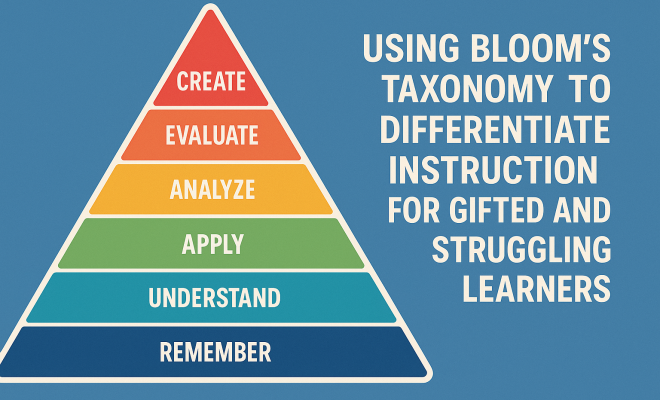
The original taxonomy, which emphasized knowledge-based learning, underwent a revision in the 1990s. This revised version, led by Lorin Anderson and David Krathwohl, restructured the levels to focus on active learning and included a new emphasis on skills and knowledge categories. The revised taxonomy includes the following levels: Remember, Understand, Apply, Analyze, Evaluate, and Create. The switch from “Synthesis” to “Create” emphasizes the importance of creativity in the learning process, aligning well with contemporary education that values innovation and problem-solving.
Practical Examples of Bloom’s Taxonomy in Different Subjects
Bloom’s Taxonomy can be applied across various disciplines in education. Here are a few practical examples of how it plays out in different subject areas:
- Mathematics: In a math class, a teacher could start with a knowledge check on basic formulas (Knowledge), move on to solving equations using those formulas (Application), analyze the steps taken to solve a problem (Analysis), and finally, create a new problem that utilizes the learned formulas (Synthesis).
- Science: In a biology class, students could learn to identify parts of a cell (Knowledge), explain the functions of each part (Comprehension), use models to demonstrate cell processes (Application), compare plant and animal cells (Analysis), design an experiment to test cell function (Synthesis), and critique a research paper on cellular biology (Evaluation).
- Literature: In a literature course, students might recall key themes (Knowledge), summarize a chapter (Comprehension), apply literary theories to a text (Application), analyze character development (Analysis), write an alternative ending (Synthesis), and evaluate the author’s writing style (Evaluation).
These examples illustrate how Bloom’s Taxonomy can guide educators in creating lessons and assessments that encourage deeper learning and critical thinking.
The Importance of Teacher Training and Professional Development
For Bloom’s Taxonomy to be effectively implemented in the classroom, ongoing teacher training and professional development are crucial. Educators need to be well-versed not only in the theoretical aspects of the taxonomy but also in practical strategies for applying it in their teaching. Professional development workshops focusing on Bloom’s Taxonomy can help teachers develop skills in creating differentiated lessons, designing assessments that reflect higher-order thinking, and collaborating with peers to refine instructional practices.
Schools and districts can foster a culture of continuous improvement by establishing professional learning communities that encourage teachers to share their experiences and challenges in using Bloom’s Taxonomy. This collaborative approach can amplify the effectiveness of the taxonomy in daily instruction.
Challenges and Critiques of Bloom’s Taxonomy
While Bloom’s Taxonomy has been widely adopted, it is not without its challenges and critiques. Some educators argue that the framework may oversimplify the complexity of learning and teaching. Critics point out that the taxonomy can encourage a rigid approach to instruction that may overlook the nuances of individual student learning styles and the dynamic nature of the learning process.
Others have raised concerns about the overemphasis on assessment, suggesting that the pressure to meet specific cognitive levels might lead to a checklist mentality, where the joy of learning is diminished. To counter these critiques, educators can embrace a more flexible interpretation of Bloom’s Taxonomy, applying its principles without rigid constraints and adapting them to fit the unique context of their classrooms.
Frequently Asked Questions About Bloom’s Taxonomy
What is the purpose of Bloom’s Taxonomy in education?
The primary purpose of Bloom’s Taxonomy is to provide educators with a framework for developing learning objectives that promote higher-order thinking skills. It helps teachers design assessments and lessons that cater to a range of cognitive skills, from basic knowledge recall to complex analysis and evaluation.
How can I use Bloom’s Taxonomy to create lesson plans?
To create lesson plans using Bloom’s Taxonomy, start by identifying the learning objectives you want your students to achieve. Then, design activities and assessments that align with each level of the taxonomy. For example, incorporate recall questions to address knowledge, discussion prompts for comprehension, problem-solving tasks for application, and projects for synthesis and evaluation.
Is Bloom’s Taxonomy applicable to all grade levels and subjects?
Yes, Bloom’s Taxonomy is versatile and can be applied across all grade levels and subjects. While the specific content will vary depending on the subject matter and age group, the cognitive levels of the taxonomy provide a universal framework that can guide instruction and assessment in diverse educational contexts.
How can technology support the implementation of Bloom’s Taxonomy?
Technology can enhance the implementation of Bloom’s Taxonomy by providing interactive and adaptive learning tools that cater to individual student needs. Online platforms can facilitate collaborative projects, offer a variety of resources for different cognitive levels, and enable personalized learning experiences that align with the taxonomy.
What are some strategies for assessing student learning using Bloom’s Taxonomy?
Assessing student learning through Bloom’s Taxonomy can include a mix of traditional and innovative methods. Use performance tasks that require students to demonstrate understanding through projects or presentations, develop rubrics that outline expectations for each cognitive level, and encourage self-assessment to foster reflection on learning.
How can educators overcome the challenges of using Bloom’s Taxonomy?
Educators can overcome challenges associated with Bloom’s Taxonomy by remaining flexible in their implementation. They should be open to adapting the taxonomy to fit the unique needs of their students and classrooms, engage in continual professional development, and collaborate with peers to share effective practices and insights.
Impact of Bloom’s Taxonomy on Educational Outcomes
Research indicates that the use of Bloom’s Taxonomy can lead to improved educational outcomes. According to studies published in various educational journals, students exposed to learning environments structured around Bloom’s levels tend to exhibit higher levels of engagement and critical thinking skills. For instance, a 2019 study found that students who participated in activities designed using Bloom’s framework scored an average of 15% higher on standardized assessments compared to those who received traditional instruction.
Moreover, the clear progression from lower to higher-order thinking skills helps students develop confidence in their abilities. When students can see their progress and mastery of increasingly complex skills, they are more likely to take ownership of their learning, which can lead to a deeper understanding of the subject matter.
Bloom’s Taxonomy in the Age of Inclusive Education
The push for inclusive education means that teachers must account for a variety of learning styles, backgrounds, and needs within their classrooms. Bloom’s Taxonomy is particularly useful in this context as it fosters an educational environment where every student can succeed. By aligning learning objectives with students’ individual needs, teachers can ensure that all students, including those with disabilities or language barriers, can engage with the material.
For example, a science teacher might use Bloom’s Taxonomy to design a lesson on the water cycle where students at different levels can participate. Struggling students might focus on identifying the stages (Knowledge) while more advanced students could create a model demonstrating the cycle (Synthesis). This approach not only supports diverse learners but also cultivates a classroom culture that values each student’s contributions.
Assessing the Long-term Benefits of Bloom’s Taxonomy
Evaluating the long-term benefits of integrating Bloom’s Taxonomy into teaching practices reveals that students not only perform better academically but also develop skills that are essential for lifelong learning. Critical thinking, problem-solving, and creativity are among the competencies emphasized in Bloom’s Taxonomy that are highly sought after in today’s workforce.
Additionally, as students progress through educational systems that utilize this framework, they are better prepared for future academic challenges. Studies have shown that students who engage in higher-order thinking throughout their education are more likely to pursue advanced studies and careers that require analytical and creative skills.
Bloom’s Taxonomy in education offers a robust framework for differentiating instruction and fostering higher-order thinking skills. By understanding its historical context, practical applications, and current relevance, educators can better support their students’ diverse learning needs and help them thrive in an increasingly complex educational landscape.
“`
Trending Now
Frequently Asked Questions
How can Bloom's Taxonomy help differentiate instruction?
Bloom's Taxonomy helps differentiate instruction by providing a structured framework that categorizes learning objectives into six cognitive levels. Educators can tailor lessons to meet the diverse needs of students, ensuring that both gifted learners and struggling learners engage with content appropriate for their skill levels.
What are the six levels of Bloom's Taxonomy?
The six levels of Bloom's Taxonomy are Knowledge, Comprehension, Application, Analysis, Synthesis, and Evaluation. Each level builds on the previous one, promoting higher-order thinking skills and allowing educators to create varied learning experiences suited to different ability levels.
How can teachers use Bloom's Taxonomy for gifted students?
Teachers can use Bloom's Taxonomy for gifted students by providing challenging tasks that encourage higher-order thinking. For example, while struggling learners may focus on basic recall, gifted students can analyze complex materials or create original projects that deepen their understanding of the subject matter.
What is differentiation in education?
Differentiation in education refers to tailoring instruction to meet the varying needs of students. This involves adjusting content, processes, products, and learning environments to support both gifted and struggling learners, ensuring that all students can engage and succeed in their learning.
Why is Bloom's Taxonomy important for educators?
Bloom's Taxonomy is important for educators because it provides a clear roadmap for designing curricula and assessments. It promotes structured learning objectives, which help teachers create lesson plans that cater to varied learning levels, fostering an inclusive classroom environment.
What did we miss? Let us know in the comments and join the conversation.