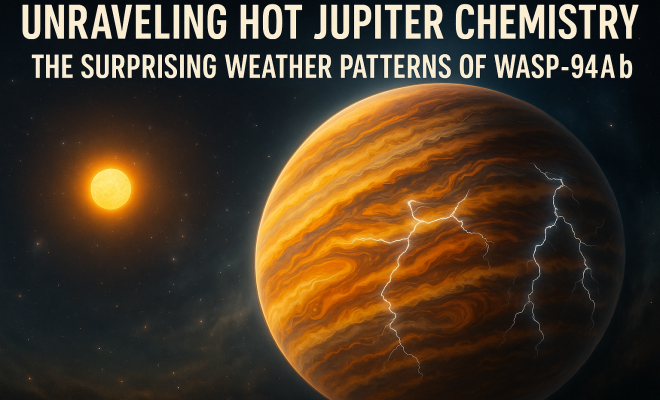
WASP-94A b: Unraveling the Surprising Weather of a Hot Jupiter
“`html
When we think about the weather on distant planets, the imagination often conjures up images of swirling storms, thick atmospheres, and extreme temperatures. But what if those images are not just fantastical notions but glimpses of real phenomena occurring light-years away? Recent discoveries about the exoplanet WASP-94A b, located about 700 light-years from Earth, challenge our understanding of planetary atmospheres, especially the hot Jupiter chemistry that governs them. This gas giant showcases a peculiar atmospheric cycle that may change how scientists approach the study of exoplanetary atmospheres.
The Basics of Hot Jupiters
Hot Jupiters are a class of exoplanets that are gas giants similar in composition to Jupiter but orbit very close to their host stars. This proximity causes them to experience extreme temperatures, often exceeding 1,000 degrees Celsius (1,832 degrees Fahrenheit). These planets are typically tidally locked, meaning one side constantly faces the star while the other side remains in perpetual darkness. The result is a dramatic temperature gradient between the two hemispheres, which creates intriguing weather patterns.
WASP-94A b: A Closer Look
Found in the constellation Eridanus, WASP-94A b is one of many hot Jupiters identified since the first exoplanets were discovered in the mid-1990s. What sets WASP-94A b apart is the discovery of its unique atmospheric cycle, where clouds accumulate only on the morning terminator— the line dividing day from night— while the evening side stays clear. This phenomenon raises questions about the underlying chemistry at play in its atmosphere.
The Mystery of Cloud Formation
The research team utilized advanced weather forecasting techniques akin to those used on Earth to study this strange weather pattern. They found that clouds are comprised largely of magnesium silicates, a discovery that pushes the boundaries of what we thought we knew about hot Jupiter chemistry. Instead of forming low in the atmosphere, these clouds were discovered floating much higher, above the stratosphere, with particles that are surprisingly large.
Why Does This Matter?
Understanding the cloud composition and distribution on WASP-94A b allows astronomers to better interpret the planet’s atmospheric conditions. Previous models suggested a more uniform distribution of clouds across hot Jupiters, but the findings from this exoplanet suggest a more chaotic and unpredictable atmosphere. This is significant because it brings into question long-standing theories regarding the formation and behavior of clouds in extreme environments.
Implications for Hot Jupiter Chemistry
The atmospheric chemistry of hot Jupiters is vital for several reasons. First, it influences how these planets interact with their host stars, affecting their brightness and the amount of radiation they absorb. Second, understanding the chemistry can provide insights into planet formation and evolution. WASP-94A b’s unique cloud cycle could be a key piece of the puzzle, shedding light on how similar planets evolve in various stellar environments.
Comparative Studies: WASP-39 b and WASP-17 b
The exploration of WASP-94A b also opened doors to understanding other similar exoplanets. Notably, similar atmospheric patterns were observed in two additional hot Jupiters, WASP-39 b and WASP-17 b. The revelation that these planets exhibit analogous weather conditions suggests that the phenomenon of morning-cloud builds and clear evenings may not be unique to WASP-94A b, indicating that these atmospheric behaviors could be widespread among hot Jupiters.
Gathering Data: The Role of Advanced Astronomy
These groundbreaking discoveries didn’t happen by chance. Technological advancements in telescopes and observational methods have allowed astronomers to gather extensive data about distant exoplanets. Instruments capable of analyzing light spectra, such as the James Webb Space Telescope, have been critical in revealing the atmospheric compositions of these planets.
Future Research Directions
As research continues, scientists will likely focus on gathering more data from WASP-94A b and its counterparts. Future missions are expected to provide further insights into the atmospheric phenomena observed, potentially revealing new elements and compounds present in these alien atmospheres. Understanding these chemistries could lead to revolutionary findings not just about hot Jupiters but about planetary systems in general. (See: Hot Jupiter overview on Wikipedia.)
The Bigger Picture: What This Means for Exoplanet Studies
The study of hot Jupiter chemistry, particularly through the lens of WASP-94A b, is not just an academic pursuit; it connects to broader questions about the universe and our place within it. How do planets form? What governs their atmospheric conditions? These questions resonate deeply as we seek to comprehend the mechanics of our solar system and beyond. The peculiar weather patterns observed on WASP-94A b serve as a reminder of the complexities of planetary atmospheres and the unforeseen intricacies that await discovery.
Hot Jupiter Chemistry: Key Elements and Compounds
In the atmospheres of hot Jupiters like WASP-94A b, several key elements and compounds play crucial roles in determining chemical processes. Hydrogen and helium are the primary constituents due to their abundance in the universe. However, other compounds such as water vapor, methane, carbon monoxide, and even complex hydrocarbons can form in these extreme environments.
Recent studies have suggested the presence of sodium and potassium in the atmospheres of some hot Jupiters, linked to their unique thermal profiles. These metals can contribute to the distinctive spectral signatures observed during transit events when a planet passes in front of its star, allowing for a detailed analysis of atmospheric composition.
Temperature Inversions and Their Impact
Another fascinating aspect of hot Jupiter chemistry is the concept of temperature inversions, where temperature increases with altitude in certain atmospheric layers. This phenomenon can lead to the formation of unique cloud structures and alter the thermal dynamics of the atmosphere. The inversion layers can trap heat, leading to increased brightness and unique weather patterns that are different from cooler gas giants.
Case Studies: WASP-121 b and HAT-P-32 b
WASP-121 b and HAT-P-32 b are other notable hot Jupiters that provide further insights into hot Jupiter chemistry. WASP-121 b has shown evidence of a temperature inversion and the presence of metals in its upper atmosphere. On the other hand, HAT-P-32 b’s atmosphere is rich in water vapor and demonstrates the complex interplay between temperature, pressure, and chemical reactions.
Such studies emphasize the diversity among hot Jupiters and highlight the importance of targeted research to unravel their unique characteristics. Understanding these differences is essential for modeling their atmospheres accurately and predicting their behaviors.
Statistical Insights: Distribution of Hot Jupiters
According to recent surveys, hot Jupiters constitute about 1% of all known exoplanets, but they provide invaluable data due to their ease of observation. Statistically, about 80 hot Jupiters have been confirmed, with ongoing missions expected to identify more. The distribution of these planets varies significantly with host star characteristics, with many found orbiting stars that are larger and hotter than our Sun.
Expert Perspectives on Hot Jupiter Chemistry
Experts in planetary science have commented on the implications of recent findings regarding hot Jupiter chemistry. Dr. Sarah K. Johnson, an astrophysicist specializing in exoplanet atmospheres, stated, “The discovery of unique cloud patterns in hot Jupiters could dramatically change our understanding of planetary atmospheres. It’s a reminder that the universe often behaves in ways we do not expect, pushing us to rethink our models.”
Dr. Mark Thompson, an atmospheric chemist, added, “The complexity of chemical processes at play in these extreme environments is a treasure trove for researchers. Each new insight adds to our collective knowledge and helps us refine our understanding of planetary formation across the galaxy.”
Frequently Asked Questions about Hot Jupiter Chemistry
What defines a hot Jupiter?
A hot Jupiter is a gas giant that orbits very close to its parent star, resulting in high surface temperatures and often unique atmospheric conditions. They are similar in composition to Jupiter but are typically much larger and more massive. (See: NASA's Kepler mission overview.)
Why are hot Jupiters important for scientific study?
Hot Jupiters serve as crucial testing grounds for theories of planetary formation and atmospheric science. They allow scientists to explore extreme weather patterns, chemical compositions, and interactions with stellar radiation, enhancing our understanding of planetary systems.
How do astronomers study the atmospheres of hot Jupiters?
Astronomers study hot Jupiters primarily through transit observations, where the planet passes in front of its star, causing dips in brightness. By analyzing the light that filters through the planet’s atmosphere, they can determine its composition and temperature.
What challenges do researchers face when studying hot Jupiters?
The extreme conditions of hot Jupiters present significant challenges. High temperatures can lead to rapid chemical reactions, and the thick atmospheres may obscure important data. Additionally, the vast distances involved often limit the precision of measurements.
Are there any known locations where hot Jupiters are more likely to be found?
Hot Jupiters are generally found around stars that are more massive and hotter than the Sun. Their distribution can be influenced by the star’s characteristics, with many orbiting in systems that can be subjected to different gravitational influences.
The Future of Hot Jupiter Studies
As technology advances, the future of hot Jupiter studies looks promising. The upcoming missions, such as the European Space Agency’s ARIEL (Atmospheric Remote-sensing Infrared Exoplanet Large-survey) mission, aim to study the atmospheres of a wide range of exoplanets, including hot Jupiters. Such missions will enhance our understanding of atmospheric chemistry and provide a clearer picture of how these planets fit into the broader context of planetary systems.
In addition, advancements in ground-based observatories equipped with adaptive optics will allow astronomers to study hot Jupiters in greater detail. This could lead to significant discoveries about their chemical makeup, weather patterns, and interactions with stellar radiation.
Comparative Analysis: Hot Jupiters vs. Cold Jupiters
Hot Jupiters and their colder counterparts, often called cold Jupiters, showcase stark differences in their atmospheric compositions and chemical behaviors. Cold Jupiters typically reside much farther from their stars, allowing for more stable weather patterns and a higher likelihood of hosting a diverse array of compounds. The distance from a star moderates the temperature, which can result in the presence of water clouds and potentially even the conditions necessary for life.
In contrast, the extreme heat of hot Jupiters affects the chemical equilibrium significantly. For instance, while water vapor might dominate the atmosphere of a cold Jupiter, hot Jupiters can exhibit high levels of dissociation, leading to the presence of more complex molecules and metals. This can result in dramatic and rapid changes to their weather patterns and cloud formations, making their atmospheres decidedly more dynamic.
Environmental Conditions and Spectral Analysis
The environmental conditions experienced by hot Jupiters also lead to unique spectral features that can provide insights into their atmospheric compositions. During a transit, when the planet passes in front of its star, part of the starlight filters through the planet’s atmosphere. This process can reveal the presence of specific elements and compounds based on their absorption spectra. For example, sodium and potassium are often detectable during such events, which can help astronomers understand the thermal structure of the atmosphere. (See: Scientific article on exoplanet atmospheres.)
Moreover, researchers have noted that the presence of particular molecules can indicate not only temperature but also pressure conditions within the atmosphere. This relationship between temperature, pressure, and chemical makeup is critical for understanding the unique evolution of these exoplanets.
Technological Innovations in Exoplanet Research
Recent advancements in technology have dramatically transformed how scientists study hot Jupiters. For instance, the advent of high-resolution spectrographs has allowed researchers to dissect the light from stars with unprecedented detail. The ESPRESSO (Echelle SPectrograph for Rocky Exoplanet and Stable Spectroscopic Observations) instrument, recently deployed on the Very Large Telescope in Chile, is one such innovation. It enables astronomers to detect even subtle signatures of atmospheric components, further enhancing our understanding of hot Jupiter chemistry.
Moreover, machine learning and artificial intelligence are beginning to play a role in exoplanet research. These technologies can analyze vast datasets from telescopes, identifying patterns that might lead to new discoveries. This capability could streamline the identification of planets and sharpen our focus on those that exhibit intriguing chemical signatures.
Emerging Theories on Planetary Formation
The findings surrounding hot Jupiter chemistry and their extreme atmospheric conditions challenge traditional theories of planetary formation. The common belief was that gas giants formed further out in the colder regions of a protoplanetary disk and gradually migrated inward. However, discoveries of hot Jupiters in configurations that seem too close to their stars to have formed there have led to new theories about the complex gravitational dynamics at play.
Some researchers propose that interactions with other celestial bodies—like a gravitational pull from nearby stars or planets—can lead to the migration of hot Jupiters into closer orbits. This dynamic and chaotic environment could significantly influence their atmospheric chemistry, leading to the unique weather patterns and chemical signatures observed today.
Conclusion: The Journey Continues
The findings surrounding WASP-94A b’s atmospheric cycle are both astonishing and enlightening. They demonstrate that our understanding of exoplanets and their chemistry is still in its infancy, and there’s so much more to uncover. As we continue to push the boundaries of space exploration and technology, who knows what mind-blowing revelations await us in the cosmos? The universe is vast and full of mysteries, and each new discovery brings us one step closer to unraveling the secrets of these distant worlds.
“`
Trending Now
Frequently Asked Questions
What is a hot Jupiter?
A hot Jupiter is a type of exoplanet that is a gas giant similar in composition to Jupiter but orbits very close to its host star. This proximity leads to extreme temperatures, often exceeding 1,000 degrees Celsius, and unique atmospheric conditions, including tidal locking.
What makes WASP-94A b unique?
WASP-94A b is unique because it exhibits an unusual atmospheric cycle where clouds form only on the morning side of the planet, while the evening side remains clear. This phenomenon offers new insights into the chemistry of hot Jupiters.
How do clouds form on WASP-94A b?
Clouds on WASP-94A b are primarily composed of magnesium silicates. Researchers used advanced weather forecasting techniques to understand this formation, revealing new aspects of atmospheric chemistry on hot Jupiters.
What are the weather patterns like on WASP-94A b?
The weather patterns on WASP-94A b are characterized by a significant temperature gradient due to its tidal locking, resulting in unique cycles where clouds accumulate only on the morning terminator, leading to intriguing meteorological phenomena.
Why is the study of hot Jupiter chemistry important?
Studying hot Jupiter chemistry is crucial because it challenges our understanding of planetary atmospheres and can provide insight into the formation and evolution of exoplanets, enhancing our knowledge of the universe.
What did we miss? Let us know in the comments and join the conversation.