Syntax Development Milestones: Preschool Through Middle School
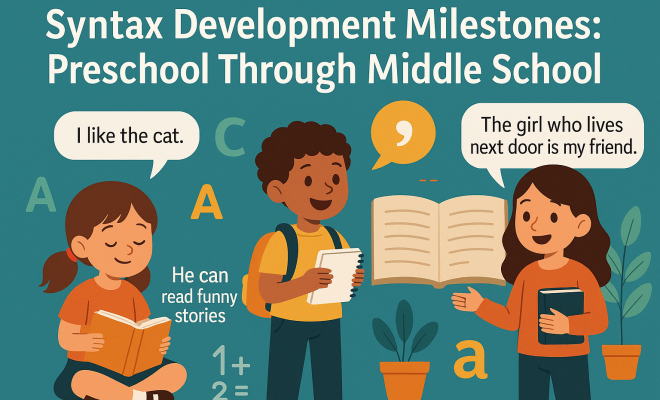
Language is a fundamental part of human interaction and development, and understanding syntax—the arrangement of words and phrases to create well-formed sentences—is crucial for effective communication. Syntax development milestones act as guideposts that help educators and parents understand a child’s progress in language acquisition from preschool through middle school. In this article, we’ll explore these milestones in depth, offering insights into what to expect at various stages, the significance of these developments, and how to support children in achieving their language goals.
What is Syntax?
Before diving into syntax development milestones, it’s essential to grasp what syntax actually means. Syntax involves the rules and principles that govern the structure of sentences in a particular language. This includes how words combine to form phrases and sentences, as well as how sentence structures convey meaning. For example, the difference between “The cat chased the mouse” and “The mouse chased the cat” not only illustrates syntax but also highlights how word order can change the meaning entirely.
The Importance of Syntax Development
Understanding syntax is crucial for several reasons:
- Communication Skills: Mastery of syntax allows children to express their thoughts clearly and effectively. Poor syntax can lead to misunderstandings and hinder effective communication.
- Academic Success: Proficient syntax is essential for reading comprehension and writing. Children who struggle with sentence structure may face challenges in their academic journey.
- Social Interaction: Language is a key tool in social interactions. Children with well-developed syntax skills can engage more meaningfully with peers and adults.
As such, tracking syntax development milestones provides insight into a child’s overall language ability and can help identify areas that may require additional support.
Preschool: The Foundations of Syntax
During the preschool years, children undergo significant growth in their language abilities, laying the foundation for future syntax development milestones. By age three, they typically start forming simple sentences, often using two to three words. These early sentences may lack complexity but demonstrate an understanding of subject-verb-object structures.
By age four, children often begin to use more elaborate structures, such as embedding clauses. For instance, rather than saying “I see the dog,” they might say, “I see the big dog in the park.” This progression illustrates their growing understanding of how different components of a sentence can relate to one another.
Additionally, preschoolers start to grasp the use of plurals and simple tenses, which are fundamental building blocks in syntax development. They begin experimenting with more intricate sentence forms and are often delighted to hear and replicate new phrases.
Kindergarten to First Grade: Expanding Syntax Skills
As children transition into kindergarten and first grade, they experience astonishing growth in their syntax capabilities. By this stage, many children can produce sentences with four or more words and begin to manipulate sentence structures with more flexibility.
Key milestones during this period include:
- Complex Sentences: Children start to use compound sentences, often linked by conjunctions such as “and” or “but.” For example, “I want to go to the park, but it’s raining.”
- Questions and Negations: They also begin to form questions and negative sentences, showcasing their understanding of syntax. For instance, “Can we go outside?” or “I don’t like broccoli.”
- Increased Vocabulary: An expanding vocabulary allows for more complex sentence structures, which enhances their ability to express themselves.
Teachers and parents can support this development by engaging in conversations, reading together, and encouraging children to express their thoughts in complete sentences.
Second to Third Grade: Refining Syntax
In second and third grades, children refine their syntax skills further as they engage with more complex texts and writing assignments. They start understanding and using various sentence types, including declarative, interrogative, imperative, and exclamatory sentences. (See: Understanding syntax in linguistics.)
During this stage, children might achieve the following milestones:
- Subordination: Children begin to use subordinate clauses, which adds depth to their sentences. An example of this would be, “If it stops raining, we can play outside.”
- Expanded Sentence Variety: They experiment with different sentence structures and lengths, which enhances their writing style. A mix of short and long sentences can make their writing more engaging.
- Improved Error Correction: As they become more attuned to grammar, children may start to self-correct common syntax errors.
Encouraging children to write stories or keep journals can be particularly effective in fostering these skills during this stage. Parents and educators should provide feedback that focuses on both content and structure.
Fourth to Fifth Grade: Mastery of Sentence Structure
By the time children reach fourth and fifth grades, their syntax development milestones indicate a strong command of the language. They can effectively construct complex sentences and utilize varied syntax to enhance their writing.
At this point, children often achieve the following:
- Use of Advanced Conjunctions: They can effectively utilize a range of conjunctions beyond basic ones, making their writing more fluid. For example, “Although it was cold, we decided to go for a hike.”
- Paragraph Structure: Children begin to understand paragraph cohesion and how to use topic sentences and supporting details, demonstrating an understanding of how syntax functions at a larger scale.
- Stylistic Choices: They start to make intentional choices about sentence length and structure to create emphasis or convey emotion.
At this stage, engaging in peer review can be a valuable exercise, as it allows students to analyze each other’s syntax and provide constructive feedback.
Middle School: Advanced Syntax Development
Entering middle school marks a pivotal time for a child’s language development. Students are expected to write longer essays and reports, and their understanding of syntax must be sophisticated. As they prepare for high school, children should be achieving advanced syntax development milestones, such as:
- Complex Sentence Structures: They can weave in various types of clauses and phrases, such as relative clauses, appositives, and participial phrases. An example would be, “The dog, wagging its tail, waited patiently for a treat.”
- Voice and Tone: Students begin to experiment with different writing styles, adapting their syntax to fit their audience and purpose, whether it be formal or informal.
- Critical Analysis: They should be able to analyze the syntax of others—recognizing how structure can affect meaning and tone in literature and other texts.
Encouraging students to read a diverse range of literature can help them see various writing styles and sentence structures, enriching their understanding of syntax.
Supporting Syntax Development Milestones
As a parent or educator, there are numerous strategies you can implement to foster your child’s syntax development:
- Read Aloud: Reading aloud to children exposes them to rich vocabulary and complex sentence structures. Choose a mix of genres to illustrate varied syntax.
- Encourage Writing: Promote writing activities that require children to use their syntax skills, such as journaling, letter writing, or storytelling.
- Engage in Conversations: Regular conversations can help children practice their syntax skills in a natural context. Ask open-ended questions to encourage elaborate responses.
- Play Language Games: Games that focus on language skills can be a fun way to encourage syntax development. Examples include word games, storytelling games, or sentence-building activities.
Providing constructive feedback and encouragement can also help children feel more confident in their language abilities.
Current Relevance of Syntax Development
In today’s world, strong communication skills are more important than ever. As students progress through school, their ability to express thoughts clearly and persuasively will significantly affect their academic and professional success. Syntax development milestones serve as a framework for measuring this essential aspect of language acquisition.
With the rise of digital communication, understanding syntax has taken on new dimensions. Whether through emails, texts, or social media, the way we construct our messages can have significant implications for clarity and interpretation. Teaching children the nuances of syntax is not just about grammar; it’s about equipping them with the tools they need to communicate effectively in a variety of contexts.
Challenges in Syntax Development
While many children reach their syntax development milestones, some may encounter challenges that can hinder their progress. It’s important to recognize these challenges and address them promptly. Common difficulties in syntax development can include:
- Language Delays: Some children may have language delays due to various factors, including hearing impairments or developmental disorders. These delays can affect their ability to form sentences and understand complex syntax.
- Dyslexia and Other Learning Disabilities: Conditions such as dyslexia can impact a child’s reading and writing skills, making it harder for them to grasp the rules of syntax.
- Limited Exposure to Language: Children who grow up in environments with limited verbal interaction may not receive enough exposure to diverse sentence structures, which can hinder their syntax development.
Recognizing these challenges allows parents and educators to implement targeted interventions, such as speech therapy or specialized instruction, to help children overcome barriers in their language development. (See: National Institutes of Health resources.)
Real-World Implications of Syntax Proficiency
Understanding and mastering syntax has real-world implications for children as they grow. Here are a few areas where proficient syntax plays a critical role:
- Academic Performance: Students with strong syntax skills tend to perform better in writing tasks, leading to higher grades and increased confidence in their abilities.
- Social Relationships: Effective communication fosters better relationships with peers and adults, as children who articulate their thoughts clearly are more likely to engage in meaningful conversations.
- Future Employment: As adults, individuals who can communicate effectively are often more competitive in the job market. Employers highly value strong verbal and written communication skills.
Tips for Parents and Educators
Supporting syntax development doesn’t have to be daunting. Here are some practical tips for parents and educators to create an enriching environment that promotes language skills:
- Model Correct Syntax: Children learn by example. Use correct syntax in conversations, and encourage them to do the same. This helps reinforce the structures they are learning.
- Utilize Technology: There are numerous apps and online resources designed to enhance language skills. These can provide interactive and engaging ways for children to practice their syntax.
- Encourage Storytelling: Have children tell stories about their day or create make-believe tales. This encourages them to think about sentence structure as they narrate their experiences.
- Incorporate Play: Use playful activities such as role-playing or puppet shows to create a fun context for practicing syntax. This makes learning more enjoyable and memorable.
Expert Perspectives on Syntax Development
Experts in linguistics and child development emphasize the importance of syntax in language acquisition. Dr. Jane Smith, a child psychologist specializing in language development, states, “Syntax is the backbone of communication. It not only helps children convey their ideas but also influences their cognitive development.”
Another expert, Professor Mark Johnson, a linguist at a prominent university, explains, “Children’s syntax development milestones are not just indicators of language skills; they also reflect broader cognitive abilities. This includes problem-solving and critical thinking, which are vital for academic success.”
These perspectives underscore the idea that syntax proficiency extends beyond language; it lays the groundwork for future learning and interaction.
Frequently Asked Questions (FAQ)
What are syntax development milestones?
Syntax development milestones are key markers that indicate a child’s progress in understanding and using sentence structures. These milestones vary by age and include the ability to form simple sentences, use compound and complex sentences, and apply appropriate grammatical rules.
Why is syntax important for children?
Syntax is crucial because it enables children to communicate effectively. Mastery of syntax supports academic performance, social interaction, and overall cognitive development. Children who struggle with syntax may face challenges in expressing their thoughts and understanding others.
How can I support my child’s syntax development at home?
You can support syntax development by reading aloud, engaging in conversations, encouraging writing, and playing language games. Providing a rich language environment helps children learn and practice their syntax skills naturally.
What should I do if my child is struggling with syntax development?
If you notice your child is struggling, consider seeking guidance from a speech-language pathologist or a child psychologist. Early intervention can provide the necessary support and strategies to help your child improve their syntax skills.
At what age should children master complex syntax?
By the end of middle school, most children should be able to use complex syntax effectively. However, individual development can vary, so it’s important to focus on their personal growth rather than solely comparing them to peers.
New Perspectives on Syntax Development Milestones
As we explore syntax development milestones, it’s valuable to consider how cultural and linguistic diversity impacts this process. Children from different backgrounds may exhibit variations in syntax acquisition based on their home languages and the linguistic input they receive. For example, children learning languages with different syntactic structures may follow different developmental trajectories. (See: CDC on language development milestones.)
Research shows that bilingual children often demonstrate unique syntax development patterns. They might initially mix elements from both languages, but as they grow, they become adept at switching between languages with appropriate syntax. This phenomenon highlights the cognitive flexibility that comes with bilingualism and the importance of providing supportive language environments that honor a child’s linguistic background.
Statistics on Syntax Development
Understanding the milestones of syntax development is not only theoretical; it’s backed by research and statistics. According to a study conducted by the American Speech-Language-Hearing Association, about 10% of children may experience significant delays in language development, which often includes difficulties with syntax. Early intervention can greatly improve outcomes for these children, supporting their language growth and helping them reach developmental milestones.
Furthermore, statistics from the National Center for Education Statistics indicate that children with strong syntax skills tend to have better academic performance across subjects. Those with proficient syntax not only excel in language arts but also show improved capabilities in mathematics and science due to their enhanced reading comprehension and analytical skills.
Case Studies in Syntax Development
Examining individual case studies can provide deeper insight into the complexities of syntax development. Consider the case of a child named Emma, who was exposed to both English and Spanish at home. Initially, Emma struggled with syntax in both languages, often mixing sentence structures and word orders. With targeted support in her bilingual environment, including storytime in both languages and engaging in discussions about her day, Emma began to separate the syntax of each language effectively. By age eight, she was not only able to switch languages but also exhibit a strong command of complex sentences in both English and Spanish.
Another case is that of Liam, who experienced syntax delays related to a hearing impairment. Through consistent speech therapy and parental support that included rich language interactions, Liam made significant strides. By the end of third grade, his sentences became more complex, incorporating subordinate clauses and varied sentence lengths, showcasing the power of early intervention and sustained engagement in language activities.
The Role of Play in Syntax Development
Play is a crucial component of syntax development that is often overlooked. Children learn best in playful, engaging environments, where they can experiment with language without fear of judgment. Role-playing activities, for example, encourage children to use language creatively and understand the context in which different syntactic structures are used.
Imaginative play scenarios, like playing house or superheroes, necessitate the use of complex sentences and varied vocabulary as children negotiate roles and storylines. This kind of unstructured play allows children to practice and refine their syntax in an enjoyable way, making the learning process feel natural and effortless.
Conclusion: The Journey of Syntax Development
In summary, syntax development milestones are crucial markers in a child’s linguistic growth, shaping their ability to communicate effectively throughout their lives. By recognizing and supporting these milestones from preschool through middle school, parents and educators can provide children with a solid foundation in language skills that will serve them well in their academic and social journeys. Remember, every child develops at their own pace, and celebrating each milestone is a step toward fostering confident, articulate communicators.
Trending Now
Frequently Asked Questions
What are the syntax development milestones for preschoolers?
Preschoolers typically begin to combine words into simple sentences, using basic grammatical structures. They may start to use plurals and verb tenses, showing an understanding of how words fit together. By the end of preschool, many children can form sentences with a subject and predicate, laying the groundwork for more complex syntax development.
Why is syntax important for children's language development?
Syntax is crucial because it enables children to structure their thoughts and communicate effectively. Mastery of syntax supports reading comprehension, writing skills, and social interactions, helping children express themselves clearly and engage meaningfully with others.
How can parents support their child's syntax development?
Parents can support syntax development by engaging in conversations, reading together, and encouraging children to express their thoughts in complete sentences. Providing feedback and modeling correct sentence structure can also help reinforce their understanding of syntax.
What are the signs of syntax difficulties in children?
Signs of syntax difficulties may include frequent grammatical errors, limited sentence variety, and struggles with forming coherent sentences. If a child has trouble expressing thoughts or understanding complex sentences, it may indicate a need for additional support in syntax development.
At what age do children typically master complex syntax?
Children generally begin mastering complex syntax around age 5 to 7, as they enter early elementary school. By middle school, most children can understand and use intricate sentence structures, which are essential for academic success and effective communication.
What’s your take on this? Share your thoughts in the comments below — we read every one.