Semantics, Syntax & Pragmatics: Language Components Explained
“`html
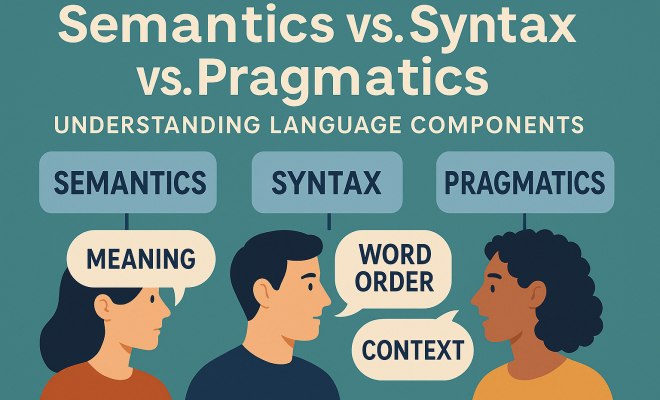
Language is an intricate system that allows us to communicate our thoughts, feelings, and ideas. At its core, understanding how we convey meaning involves three critical components: semantics, syntax, and pragmatics. These concepts, often discussed in linguistic studies, play a crucial role in effective communication. In this comprehensive exploration, we will delve into the distinctions and interactions among these elements, shedding light on how they contribute to our understanding of language.
1. Defining Semantics: What It Means to Understand Meaning
Semantics is the study of meaning in language. It explores how words, phrases, and sentences convey meaning, focusing on the relationships between signifiers—like words or symbols—and what they signify. Semantics encompasses various aspects, including the meanings of individual words (lexical semantics), the meanings of phrases and sentences (compositional semantics), and how context influences the interpretation of meanings.
For example, let’s consider the word “dog.” Semantically, it refers to a domesticated mammal belonging to the species Canis lupus familiaris. However, the meaning of “dog” can shift based on context. In a sentence like “The dog barked,” the semantics indicates not just the existence of a dog but also that it performed the action of barking, triggering certain images and associations in the mind of the listener.
Moreover, semantics also delves into the complexities of polysemy, where a single word can have multiple meanings based on different contexts, such as “bank” (financial institution vs. the side of a river). This aspect of semantics is crucial in fields like law, where precise meanings can significantly affect interpretations and outcomes.
Another critical aspect of semantics is the study of denotation and connotation. While denotation refers to the literal meaning of a word, connotation encompasses the emotional and cultural associations that may accompany it. For instance, the word “snake” denotes a legless reptile but connotes deceit or danger in many cultures. Understanding these layers of meaning enriches our communication and comprehension.
2. Diving into Syntax: The Structure of Language
Syntax refers to the set of rules, principles, and processes that govern the structure of sentences in a given language. It focuses on how words combine to form phrases and sentences, determining the proper order and relationship between words. Without syntax, our communication would lack clarity and coherence.
Consider the difference in meaning between the sentences “The cat chased the mouse” and “The mouse chased the cat.” Here, the syntax rearranges the subject and object, leading to entirely different interpretations. The arrangement of words is crucial, as incorrect syntax can create confusion or change the intended message. Syntax not only defines sentence structure but also influences readability and comprehension in both spoken and written language.
In addition, syntax can be influenced by the stylistic choices of the speaker or writer. For instance, employing complex syntactic structures in literature can evoke particular emotional responses, while simpler syntax might be used for clarity in technical writing. This flexibility in syntax showcases its role not just in grammar, but also in the art of communication.
Another fascinating aspect of syntax is its variation across languages. Each language has its own syntactical rules that can lead to interesting translations. For example, in Japanese, the subject-object-verb order contrasts with the subject-verb-object order in English. Understanding these differences is crucial for effective cross-linguistic communication.
3. Understanding Pragmatics: Context in Communication
While semantics and syntax focus on meaning and structure, pragmatics considers the context in which language is used. It examines how the situational context, speaker intentions, and listener interpretations affect communication. Pragmatics helps us understand that language is not only about the literal meanings of words but also about how those meanings are influenced by context.
For instance, if someone says, “Can you pass the salt?” at dinner, the pragmatic interpretation goes beyond the literal question about the ability to pass the salt. It conveys a request for action based on the social context. Pragmatics reveals that language is a dynamic tool shaped by social interactions and shared experiences.
Additionally, understanding the concept of implicature is crucial within pragmatics. Implicature refers to what someone suggests or implies in a conversation without stating it outright. For example, if someone responds to an invitation with “I have to wash my hair,” the pragmatic understanding is that they are likely declining the invitation without directly saying so.
Pragmatics also incorporates the study of speech acts, which are actions performed via speaking. For example, when someone says, “I apologize,” they are not just stating something; they are performing the act of apologizing. This layer of pragmatics is essential in understanding how language operates beyond the surface level. (See: Wikipedia article on semantics.)
4. Comparing Semantics, Syntax, and Pragmatics: Key Differences Explained
The interplay of semantics, syntax, and pragmatics is essential in understanding language. While semantics deals with meaning, syntax focuses on structure, and pragmatics emphasizes context. They each fulfill unique roles in communication, but they also overlap significantly.
For example, consider the phrase “It’s cold in here.” Semantically, it indicates a low temperature. Syntactically, it follows standard English sentence structure (subject, verb, complement). However, pragmatically, it might be interpreted as a request to close a window or turn up the heat, depending on the context and the relationship between the speaker and listener. Understanding this interplay is crucial for effective communication.
Another example involves politeness strategies, which often sit at the intersection of these three components. A statement like “Could you open the window?” is polite and serves to soften the request, showcasing how pragmatics can influence the reception of a message while still adhering to syntactical and semantic norms.
The nuances of sarcasm further illustrate the interplay among these components. A sarcastic remark can be syntactically correct and semantically sound yet convey an entirely different meaning due to pragmatic cues like tone of voice and facial expressions. This complexity adds depth to our understanding of how language works.
5. The Role of Semantics in Everyday Language
Semantics plays a vital role in how we interpret and convey our thoughts daily. From the way we use metaphors to the nuances of idioms, semantics enriches our communication. For instance, the phrase “It’s raining cats and dogs” is understood semantically as a heavy downpour, despite its literal meaning being nonsensical.
Additionally, semantics helps in language learning. When individuals study a new language, grasping the meanings behind vocabulary and phrases is fundamental. Understanding cultural references and idiomatic expressions, which are often semantically rich, can significantly enhance one’s ability to communicate effectively.
Furthermore, the study of semantics includes examining how connotations—associated meanings or emotions tied to a word—shape our understanding. For example, the word “home” conjures feelings of warmth and safety, while “house” is more neutral and refers strictly to a physical structure. This emotional layer plays a huge role in how we communicate and connect with others.
Research shows that semantics influences our decision-making processes. For instance, the way options are framed—using positive or negative semantics—can affect people’s choices in marketing and advertising. A product described as “90% fat-free” may be more appealing than one labeled as “contains 10% fat,” demonstrating how semantics can shape consumer behavior.
6. The Importance of Syntax in Professional Communication
In professional settings, clear syntax is essential for conveying complex ideas. Businesses and academic writers must adhere to syntactical norms to ensure their messages are understood. For example, scientific papers and legal documents often rely on precise syntax to avoid ambiguity and misinterpretation.
Moreover, effective syntax can enhance persuasiveness. A well-structured argument with clear syntax can lead to more compelling writing. For instance, using parallel structures can elevate the rhythm and clarity of sentences, making the message more impactful and easier to remember.
Syntax also plays a critical role in digital communication. With the rise of social media and instant messaging, the way syntax is employed can significantly influence the effectiveness of communication. Shortened phrases and informal syntax can convey familiarity and ease, while more formal syntax might establish professionalism or seriousness, depending on the context.
In addition, syntax helps in developing language skills in children. Educators often emphasize the importance of teaching syntax to foster literacy and comprehension. Children who understand the rules of syntax are better equipped to construct sentences and engage in meaningful communication.
7. Pragmatics in Action: Everyday Examples of Contextual Meaning
Pragmatics manifests in countless everyday scenarios. Consider a conversation where one person says, “It’s really hot in here,” while pointing to a thermostat. The literal meaning may suggest discomfort, but pragmatically, it could imply that the speaker is asking for a change in temperature. Understanding the social dynamics and context is crucial for interpreting the intended message.
Moreover, pragmatics is essential in understanding humor and sarcasm. When someone says, “Great job!” in a certain tone after a mistake, the pragmatic interpretation would differ significantly from a straightforward compliment. This highlights how context dramatically alters the meaning of statements. (See: CDC document on semantics in communication.)
Another interesting application of pragmatics is in conflict resolution. The way language is used can either escalate or de-escalate tensions in a disagreement. Utilizing a pragmatic approach, speakers might choose words carefully to maintain respect and understanding, which can lead to more fruitful discussions and resolutions.
In business negotiations, pragmatics plays a vital role. The ability to read between the lines and understand implied meanings can lead to successful outcomes. Recognizing when a colleague’s tone suggests frustration or agreement can help navigate complex discussions more effectively.
8. Applications of Semantics, Syntax, and Pragmatics: Real-World Implications
Understanding the differences among semantics, syntax, and pragmatics has practical implications in various fields. In artificial intelligence, for instance, natural language processing relies on these elements to improve human-computer interactions. Machines must understand not just the words but also their meanings and the context in which they are used.
In education, teaching semantics and syntax can enhance literacy, while understanding pragmatics can improve students’ social communication skills. Language therapists often use these principles to assist individuals struggling with language comprehension and production, making it critical for effective intervention.
Additionally, the fields of marketing and advertising heavily utilize these linguistic elements. Crafting a marketing message requires an understanding of semantics to convey the right brand message, syntax to ensure clarity and engagement, and pragmatics to resonate with the target audience’s cultural context and expectations.
Healthcare communication also benefits from a nuanced understanding of these components. Medical professionals must clearly convey information (syntax), ensure the patient understands the meaning (semantics), and interpret any non-verbal cues or emotional responses (pragmatics) to provide effective care.
9. The Interconnectedness of Language Components: A Holistic Approach
While semantics, syntax, and pragmatics are distinct components, they are inherently interconnected. Language operates as a cohesive system where each part influences the others. For effective communication, one must consider all three aspects, as overlooking any one of them could lead to miscommunication.
For example, in writing, a well-constructed sentence (syntax) that conveys a clear meaning (semantics) may still fall flat if it lacks the appropriate context or tone (pragmatics). This interconnectedness underscores the importance of a holistic approach to language study, one that considers how these components work together to produce meaningful communication.
This holistic nature can be observed in language acquisition as well. Children learn language by interacting with their environment, where they gradually grasp semantic meanings, construct syntactic sentences, and navigate pragmatic contexts. Each of these components aids in developing their overall linguistic competence.
Furthermore, understanding this interconnectedness can enhance cross-cultural communication. When interacting with speakers from diverse linguistic backgrounds, recognizing how semantics, syntax, and pragmatics vary can foster better understanding and prevent potential misunderstandings.
10. Current Relevance and Future Directions: The Evolving Nature of Language
The fields of semantics, syntax, and pragmatics continue to evolve, especially in response to advancements in technology and changes in societal communication practices. The rise of digital communication, for example, has introduced new syntactical structures, such as emojis and abbreviations, which impact how meanings are constructed and understood.
As societies become more interconnected, the nuances of pragmatics will also likely expand. Understanding culturally specific pragmatics is increasingly important in a globalized world where language and meaning can vary significantly across cultures. Future research and study in linguistics will undoubtedly explore these evolving dynamics, emphasizing the ongoing significance of semantics vs syntax vs pragmatics in our understanding of communication. (See: Harvard University resources.)
Moreover, the advent of artificial intelligence and machine learning has sparked discussions about the future of language use. As AI systems become more adept at processing language, the distinctions between semantics, syntax, and pragmatics may be re-evaluated, leading to new approaches in linguistics and communication theory. This evolution may also inspire new educational methodologies that incorporate these advancements into language learning.
11. FAQ: Common Questions about Semantics, Syntax, and Pragmatics
What is the difference between semantics and pragmatics?
Semantics deals with the meaning of words and sentences in isolation, while pragmatics focuses on how context influences the interpretation of those meanings in actual conversations. For example, the phrase “It’s cold in here” can have a semantic meaning of low temperature but can pragmatically imply a request depending on the situation.
How does syntax affect meaning?
Syntax affects meaning by determining how words are arranged in a sentence. The order of words can change the message significantly. For instance, “The dog chased the cat” conveys a different meaning than “The cat chased the dog,” highlighting how syntax is critical for clarity and understanding.
Can you give an example of implicature in everyday conversation?
Sure! If someone asks, “Do you want to go to the movies?” and the response is, “I have a lot of work to do,” the implicature here is that the person is not interested in going to the movies, even though they haven’t explicitly stated it. This is an example of how pragmatics reveals hidden meanings based on context and social norms.
Why is it important to study pragmatics in today’s communication?
Studying pragmatics is crucial today because communication increasingly occurs in diverse contexts, particularly with the rise of global interactions and digital communication. Understanding pragmatics allows us to navigate cultural differences, interpret subtle meanings, and foster effective communication in various situations.
How do semantics, syntax, and pragmatics interact in language learning?
In language learning, semantics helps learners grasp the meanings of words, syntax teaches them sentence structure, and pragmatics equips them to use language appropriately in different social contexts. Effective language education integrates all three components to ensure that learners become proficient communicators.
What role do semantics, syntax, and pragmatics play in artificial intelligence?
In artificial intelligence, semantics is essential for understanding the meaning of language, syntax is crucial for processing and generating grammatical sentences, and pragmatics helps in interpreting the context of conversations. These elements work together to create more effective AI systems that can interact with humans more naturally.
How can understanding semantics, syntax, and pragmatics improve interpersonal relationships?
Understanding these components can enhance interpersonal relationships by improving communication. Recognizing how semantics shape meaning, how syntax can clarify or obfuscate messages, and how pragmatics influence interpretation can help individuals express themselves more clearly and understand others better, fostering positive interactions.
In summary, the distinctions and connections among semantics, syntax, and pragmatics are foundational to our understanding of language and communication. As language continues to evolve, so too will our exploration of these concepts, making it a field rich with ongoing discovery and significance.
“`
Trending Now
Frequently Asked Questions
What is the difference between semantics and syntax?
Semantics refers to the study of meaning in language, focusing on how words and sentences convey meaning. In contrast, syntax deals with the structure and rules that govern how words are arranged to form sentences. While semantics is about meaning, syntax is about the organization of language.
What is pragmatics in language?
Pragmatics is the study of how context influences the interpretation of meaning in communication. It considers factors like speaker intention, social context, and implied meanings, which can significantly affect how messages are understood beyond their literal interpretation.
How do semantics and pragmatics interact?
Semantics and pragmatics interact in that semantics provides the basic meanings of words and sentences, while pragmatics adds context and nuance. Understanding a statement fully often requires both semantic knowledge and pragmatic insight to grasp implied meanings or intentions.
Why is understanding semantics important?
Understanding semantics is crucial because it helps clarify how language conveys meaning. It aids in effective communication by allowing individuals to interpret words and phrases accurately, which is especially important in fields like law, literature, and everyday conversation.
What are examples of semantics in language?
Examples of semantics include the meanings of individual words, such as 'dog' referring to a domesticated animal, and the implications of phrases like 'kick the bucket,' which can mean to die. Semantics also explores polysemy, where a word has multiple meanings based on context.
Agree or disagree? Drop a comment and tell us what you think.