The Edvocate

Top Menu

Main Menu

  • Start Here
    • Our Brands
    • Governance
      • Lynch Education Consulting, LLC.
      • Dr. Lynch’s Personal Website
      • Careers
    • Write For Us
    • Books
    • The Tech Edvocate Product Guide
    • Contact Us
    • The Edvocate Podcast
    • Edupedia
    • Pedagogue
    • Terms and Conditions
    • Privacy Policy
  • PreK-12
    • Assessment
    • Assistive Technology
    • Best PreK-12 Schools in America
    • Child Development
    • Classroom Management
    • Early Childhood
    • EdTech & Innovation
    • Education Leadership
    • Equity
    • First Year Teachers
    • Gifted and Talented Education
    • Special Education
    • Parental Involvement
    • Policy & Reform
    • Teachers
  • Higher Ed
    • Best Colleges and Universities
    • Best College and University Programs
    • HBCU’s
    • Diversity
    • Higher Education EdTech
    • Higher Education
    • International Education
  • Advertise
  • The Tech Edvocate Awards
    • The Awards Process
    • Finalists and Winners of The 2025 Tech Edvocate Awards
    • Finalists and Winners of The 2024 Tech Edvocate Awards
    • Finalists and Winners of The 2023 Tech Edvocate Awards
    • Finalists and Winners of The 2021 Tech Edvocate Awards
    • Finalists and Winners of The 2022 Tech Edvocate Awards
    • Finalists and Winners of The 2020 Tech Edvocate Awards
    • Finalists and Winners of The 2019 Tech Edvocate Awards
    • Finalists and Winners of The 2018 Tech Edvocate Awards
    • Finalists and Winners of The 2017 Tech Edvocate Awards
    • Award Seals
  • Apps
    • GPA Calculator for College
    • GPA Calculator for High School
    • Cumulative GPA Calculator
    • Grade Calculator
    • Weighted Grade Calculator
    • Final Grade Calculator
  • The Tech Edvocate
  • Post a Job
  • AI Powered Personal Tutor

logo

The Edvocate

  • Start Here
    • Our Brands
    • Governance
      • Lynch Education Consulting, LLC.
      • Dr. Lynch’s Personal Website
        • My Speaking Page
      • Careers
    • Write For Us
    • Books
    • The Tech Edvocate Product Guide
    • Contact Us
    • The Edvocate Podcast
    • Edupedia
    • Pedagogue
    • Terms and Conditions
    • Privacy Policy
  • PreK-12
    • Assessment
    • Assistive Technology
    • Best PreK-12 Schools in America
    • Child Development
    • Classroom Management
    • Early Childhood
    • EdTech & Innovation
    • Education Leadership
    • Equity
    • First Year Teachers
    • Gifted and Talented Education
    • Special Education
    • Parental Involvement
    • Policy & Reform
    • Teachers
  • Higher Ed
    • Best Colleges and Universities
    • Best College and University Programs
    • HBCU’s
    • Diversity
    • Higher Education EdTech
    • Higher Education
    • International Education
  • Advertise
  • The Tech Edvocate Awards
    • The Awards Process
    • Finalists and Winners of The 2025 Tech Edvocate Awards
    • Finalists and Winners of The 2024 Tech Edvocate Awards
    • Finalists and Winners of The 2023 Tech Edvocate Awards
    • Finalists and Winners of The 2021 Tech Edvocate Awards
    • Finalists and Winners of The 2022 Tech Edvocate Awards
    • Finalists and Winners of The 2020 Tech Edvocate Awards
    • Finalists and Winners of The 2019 Tech Edvocate Awards
    • Finalists and Winners of The 2018 Tech Edvocate Awards
    • Finalists and Winners of The 2017 Tech Edvocate Awards
    • Award Seals
  • Apps
    • GPA Calculator for College
    • GPA Calculator for High School
    • Cumulative GPA Calculator
    • Grade Calculator
    • Weighted Grade Calculator
    • Final Grade Calculator
  • The Tech Edvocate
  • Post a Job
  • AI Powered Personal Tutor
  • 7 Diverse Texts to Bolster Reading Lessons

  • 7 Teacher Ideas for Supporting Students Who Aren’t Doing Any Work at All

  • 7 Traits of an Ineffective Teacher

  • 7 Teacher-on-Teacher Pranks

  • 7 Steps to Boost Your Leadership Self-Confidence

  • 7 Tips for Moving Learning Outside

  • 7 Common Parenting Myths We Have Believed For Generations

  • 7 Effective Steps When Teenager Is Not Listening To Parents

  • 7 Ideas from Reggio Emilia That Any Early Childhood Teacher Can Use

  • 7 Tips To Parenting Teens With Ease

Policy & ReformTrending Topics
Home›Policy & Reform›Why global education rankings don’t reveal the whole picture

Why global education rankings don’t reveal the whole picture

By Matthew Lynch
June 3, 2017
0
Spread the love

Daniel Caro, University of Oxford and Jenny Lenkeit, University of Oxford

Country rankings in international education tests – such as PISA and TIMSS – are often used to compare and contrast education systems across a range of countries. But it isn’t always an even playing field.

This is because countries with very different social and economic realities participate, so countries such as Norway, Russia, Chile, Lebanon and Thailand are all being compared against each other. And this is without the difference in socio-economic backgrounds of these different countries being taken into account.

If the latest world education rankings are anything to go by, Turkey and Thailand perform poorly when it comes to their students’ achievement in science. But our analysis shows that if you look at the rankings differently (from an even starting point), both Thailand and Turkey may in fact be just as good as some of the high performing Asian countries.

Our analysis is a much fairer comparison, as it allows for the differences in wealth and social development in which students learn and teachers teach. It builds upon our previous work, where we produced and analysed an indicator of “effectiveness”. The effectiveness indicator ranks performance of countries as if they all had similar socio-economic conditions – thus levelling the playing field.

This makes it easier to see which countries are actually the most effective at educating their students, with social economic factors like wealth taken into account.

New style rankings

The graph below shows how countries are ranked in their effectiveness. At the top of the effectiveness ranking, we find education systems such as Singapore and Japan, which are also generally high performing in PISA and TIMSS.
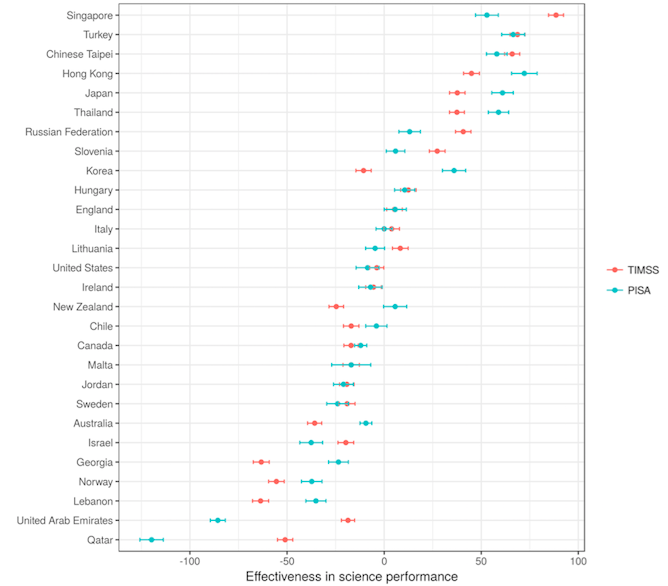
TIMSS-PISA 2015. Values higher than zero (towards the right-hand side) indicate that students in those education systems perform above expectations, meaning the education system is effective. Those values below zero, to the left, indicate ineffective education systems.
Author provided

But our analysis also revealed that countries such as Turkey and Thailand are actually highly effective and perform above expectations in terms of education. This is despite both countries having an overall lower performance score in the global education rankings.

As the graph shows, the performance of education systems in Turkey and Thailand is underestimated if guided by country rankings alone. This is because although these countries perform below average and rather poorly in PISA, they are as effective as high performing Asian countries.

This means that Turkey and Thailand would be ranked among the highest performing countries in the world – if there was no socio-economic differences between countries.

TIMSS-PISA 2015. Effectiveness vs performance according to rankings. The horizontal line at 0 separates effective from ineffective systems and the vertical line at 500 indicates average performance for TIMSS and OECD education systems.
Author provided

Our analysis also shows education systems in Norway are ineffective, and the same was found to be true of Australia. So while these countries are ranked highest in human development in the world, they are not among the highest performing in these international tests when we level the playing field.

On the lower end of the effectiveness ranking, we find Qatar and the United Arab Emirates. These countries are also among the lowest performing in PISA rankings and could be doing much better for their high income per capita levels.

Fair comparison

It is clear then that overall performance rankings alone do not make a fair comparison when it comes to judging the quality of education in different countries. And our analysis shows how the socioeconomic conditions of a country are vitally important when comparing global performance in education rankings.

The ConversationUsing our data, there would certainly be a case for countries like Chile, Malta, Georgia, the United Arab Emirates and Qatar to look to Turkey and Thailand to work out how to improve their education systems. And as our analysis shows, global education rankings are probably not the best measure of educational performance after all.

Daniel Caro, Research Fellow, Oxford University Centre for Educational Assessment, University of Oxford and Jenny Lenkeit, Research Fellow, Oxford University Centre for Educational Assessment, University of Oxford

This article was originally published on The Conversation. Read the original article.

Tagsedchatedleadershipedreformschool reformteachers
Previous Article

Does it pay to get a double ...

Next Article

What is Digital Literacy?

Matthew Lynch

Related articles More from author

  • Black Boys in CrisisEquityTrending Topics

    Black Boys in Crisis: Dismantling “Separate but Equal”

    June 27, 2017
    By Matthew Lynch
  • Policy & Reform

    Do school vouchers improve results? It depends on what we ask

    March 14, 2016
    By Matthew Lynch
  • Teachers

    Is superstar teacher sharing a good idea?

    January 20, 2016
    By Matthew Lynch
  • Uncategorized

    Grading Obama on Education Reform

    September 19, 2016
    By Matthew Lynch
  • Best Colleges and UniversitiesHigher Education

    2023 Best Colleges and Universities in New Mexico

    May 2, 2019
    By Matthew Lynch
  • First Year TeachersTeachersTrending Topics

    5 Things That an Effective Teacher Should Know

    November 27, 2017
    By Matthew Lynch

Search

Registration and Login

  • Register
  • Log in
  • Entries feed
  • Comments feed
  • WordPress.org

Newsletter

Signup for The Edvocate Newsletter and have the latest in P-20 education news and opinion delivered to your email address!

RSS Matthew on Education Week

  • Au Revoir from Education Futures November 20, 2018 Matthew Lynch
  • 6 Steps to Data-Driven Literacy Instruction October 17, 2018 Matthew Lynch
  • Four Keys to a Modern IT Approach in K-12 Schools October 2, 2018 Matthew Lynch
  • What's the Difference Between Burnout and Demoralization, and What Can Teachers Do About It? September 27, 2018 Matthew Lynch
  • Revisiting Using Edtech for Bullying and Suicide Prevention September 10, 2018 Matthew Lynch

About Us

The Edvocate was created in 2014 to argue for shifts in education policy and organization in order to enhance the quality of education and the opportunities for learning afforded to P-20 students in America. What we envisage may not be the most straightforward or the most conventional ideas. We call for a relatively radical and certainly quite comprehensive reorganization of America’s P-20 system.

That reorganization, though, and the underlying effort, will have much to do with reviving the American education system, and reviving a national love of learning.  The Edvocate plans to be one of key architects of this revival, as it continues to advocate for education reform, equity, and innovation.

Newsletter

Signup for The Edvocate Newsletter and have the latest in P-20 education news and opinion delivered to your email address!

Contact

The Edvocate
910 Goddin Street
Richmond, VA 23230
(601) 630-5238
[email protected]
  • situs togel online
  • dentoto
  • situs toto 4d
  • situs toto slot
  • toto slot 4d
Copyright (c) 2025 Matthew Lynch. All rights reserved.