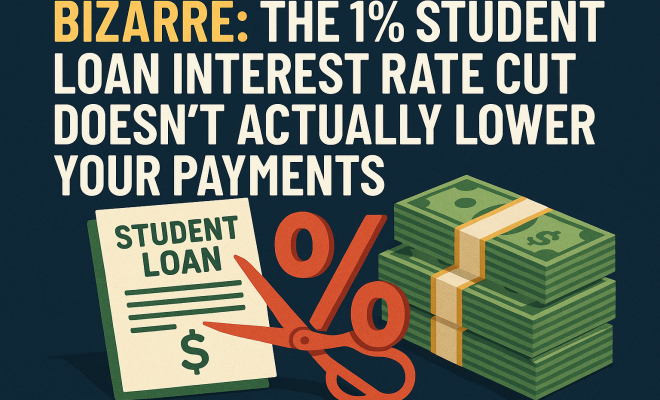
Bizarre: The 1% Student Loan Interest Rate Cut Doesn’t Actually Lower Your Payments
The Head-Scratching Truth About the 1% Student Loan Interest Rate Cut Explained
As someone who’s spent years in education, both as a teacher in K-12 and later as a Dean, I’ve seen firsthand the financial tightrope many students and their families walk. So when the news broke about a temporary 1% student loan interest rate reduction, I bet a lot of you, like me, thought, “Finally, some relief!” It sounds great on paper, doesn’t it? A 1% cut, potentially saving you a decent chunk of change over the life of your loan. But here’s where things get a little… well, bizarre. The truth about this particular student loan interest rate cut explained clearly reveals a disconnect between what borrowers expect and what they actually get. It turns out this 1% reduction, while certainly a positive step in some ways, isn’t going to lower your monthly payment by a single dime.
That’s right. You read that correctly. The Education Department recently extended the enrollment deadline for this temporary 1% interest rate reduction to December 31, 2026. To snag this benefit, you absolutely have to enroll in auto-pay, and the reduction itself will stick around until June 30, 2028. Sounds straightforward, right? But as attorney Adam Minsky, a sharp legal mind in the student loan space, pointed out, there’s a crucial detail that’s often missed, or perhaps, not communicated as clearly as it should be. This 1% rate cut doesn’t actually reduce the amount you owe each month. Instead, what happens is that a larger portion of your existing monthly payment is applied directly to your loan’s principal balance. It’s a subtle but profoundly important distinction, one that has left many borrowers scratching their heads and, frankly, feeling a bit misled.
This isn’t just a minor administrative quirk; it’s a significant point of confusion amidst an already turbulent period for federal student loan borrowers. We’ve seen the much-discussed SAVE plan get vacated, and now new income-driven repayment options like the Repayment Assistance Plan (RAP) and the Tiered Standard Plan are entering the fray. Combine this with what feels like a lack of clear, consistent communication from the Education Department, and you’ve got a recipe for widespread frustration. Social media is buzzing with borrowers trying to make sense of conflicting deadlines and understanding how these changes truly impact their financial futures. It’s a mess, and it’s one that directly impacts millions of people who are simply trying to manage their debt responsibly.
Understanding the Mechanics: What the 1% Student Loan Interest Rate Cut Actually Does
Let’s break down exactly what this 1% student loan interest rate cut explained means for your loan, because it’s not what most people assume. When you make a payment on an amortized loan, like a student loan, a portion of that payment goes towards the interest accrued since your last payment, and the remainder goes towards reducing your principal balance. In the early stages of a loan, a larger percentage of your payment typically goes to interest. Over time, as your principal decreases, more of your payment shifts towards reducing that principal.
With this 1% interest rate reduction, your actual interest rate drops by one percentage point. So, if your rate was 6%, it becomes 5%. If it was 7%, it’s now 6%. That’s a real reduction, and it’s certainly a good thing. However, your scheduled monthly payment amount, which is calculated based on your original interest rate, loan term, and principal, remains unchanged. What changes is the internal allocation of that payment. Because less interest is accruing each month, a larger slice of your fixed monthly payment can now be directed to your principal. This is the core of how the student loan interest rate cut explained works in practice.
Imagine your monthly payment is $200. Before the cut, perhaps $100 went to interest and $100 to principal. With the 1% cut, maybe now only $90 goes to interest, and $110 goes to principal. Your $200 payment hasn’t budged, but you’re chipping away at the core debt faster. This accelerates the repayment process, potentially leading to you paying off your loan sooner and saving you money over the long haul. It’s akin to finding an extra gear on a bicycle – you’re still pedaling at the same rhythm, but you’re covering more ground with each rotation. It’s a benefit, yes, but it’s not the immediate cash flow relief many borrowers desperately need.
The Auto-Pay Requirement: A Mandate for the Benefit
To qualify for this 1% student loan interest rate cut, there’s one non-negotiable condition: you must be enrolled in auto-pay. This isn’t just a suggestion; it’s a firm requirement. The Education Department has made it clear that this benefit is tied directly to automated payments. For many borrowers, this isn’t a huge hurdle. Auto-pay is convenient, often helps avoid missed payments, and in the past, some loan servicers offered a small interest rate deduction (usually 0.25%) for enrolling in it anyway. So, for those already using auto-pay, it’s a seamless transition. (See: U.S. Department of Education.)
However, for borrowers who prefer to manually manage their payments, perhaps due to irregular income, a desire for greater control, or past negative experiences with automated systems, this requirement could be a point of contention. It forces a change in behavior to access a benefit that many feel should be more universally applied. While the administrative logic for the Education Department is clear – auto-pay reduces delinquency rates and streamlines operations – it does create an additional barrier for some. It also means you need to ensure your bank account has sufficient funds on the scheduled payment date, or you risk overdraft fees and potentially losing the auto-pay benefit, which would then negate the 1% interest rate cut.
The deadline to enroll in auto-pay and secure this 1% reduction is December 31, 2026. This isn’t a date to take lightly. Missing it means missing out on the benefit entirely. The reduction, once secured, is set to last until June 30, 2028. This temporary nature adds another layer of complexity. Borrowers need to be aware that this isn’t a permanent change to their loan terms, and their interest rate will revert to its original figure after that date, unless other policy changes are implemented. So, while it’s a good short-term boost, it’s not a long-term solution for the systemic issues of student debt. For more context, see the future of education financing.
The Psychological Impact: Expectation vs. Reality
Think about it. When you hear “interest rate cut,” what’s the first thing that comes to mind? For most people, it’s a lower monthly bill. It’s a direct, tangible reduction in the amount of money leaving their bank account each month. This is the common understanding, the widely held expectation. So, when borrowers learn that the 1% student loan interest rate cut explained doesn’t actually translate into a smaller monthly payment, it can be incredibly frustrating. It feels like a bait-and-switch, even if it’s technically a beneficial change in the long run.
This psychological disconnect is crucial. Many borrowers are struggling financially, stretched thin by inflation and other economic pressures. For them, every dollar counts. The promise of an “interest rate cut” offers a glimmer of hope for some immediate breathing room. To then discover that the relief isn’t in their monthly budget but rather in a more efficient allocation of their existing payment can be a bitter pill to swallow. It doesn’t put more money in their pocket today, which is often what people are truly looking for when they hear about such initiatives.
This discrepancy can also erode trust in the institutions meant to help them. When communication isn’t crystal clear, and the reality deviates significantly from the initial perception, it fosters cynicism. Borrowers might start questioning other announcements or programs, wondering if there are hidden caveats or obscured details that will fundamentally alter the perceived benefit. In an environment already rife with confusion surrounding repayment plans and policy changes, this kind of miscommunication only exacerbates an already challenging situation for millions.
The Broader Context: SAVE Plan Vacated and New Repayment Options
The 1% student loan interest rate cut isn’t happening in a vacuum. It’s unfolding against a backdrop of significant turbulence and uncertainty in the federal student loan landscape. A major piece of this puzzle is the recent vacating of the SAVE plan. For many borrowers, the SAVE plan offered substantial relief, particularly through its lower payment calculations and its interest subsidy, which prevented balances from growing due to unpaid interest. Its sudden disappearance has left millions in limbo, scrambling to understand their options and adjust their financial planning.
Now, we’re seeing the introduction of new income-driven repayment (IDR) options: the Repayment Assistance Plan (RAP) and the Tiered Standard Plan. While these are designed to provide alternatives, the transition period is proving to be incredibly messy. Borrowers who were on SAVE are often unclear about which new plan they’re being transitioned to, what their new payment amounts will be, and what deadlines they need to meet. This lack of clarity creates immense stress and anxiety. Imagine trying to budget for your family when you don’t know what your largest monthly expense will be next month.
The overlapping and sometimes conflicting deadlines for these various programs are adding to the chaos. Borrowers are trying to navigate the auto-pay enrollment for the 1% interest rate cut while simultaneously figuring out their new IDR plan and avoiding potential default. It’s a bureaucratic labyrinth, and the average borrower, who isn’t a student loan expert, is left feeling overwhelmed and frustrated. This is where the Education Department needs to step up its game, providing not just information, but truly clear, actionable guidance. (See: Centers for Disease Control and Prevention.)
The Real Benefit: Accelerated Principal Reduction and Long-Term Savings
Despite the initial disappointment for those expecting lower monthly payments, the 1% student loan interest rate cut does offer a genuine financial advantage: accelerated principal reduction. As we discussed, with less of your fixed payment going towards interest, more goes directly to chipping away at the loan’s core balance. Why is this a big deal?
First, it means you’ll pay off your loan faster than you would have otherwise, assuming you continue making your regular payments. If you’re able to eliminate your debt even a few months or a year earlier, that’s a significant win. Think about the psychological freedom that comes with being debt-free sooner. Second, and perhaps even more impactful, is the total amount of interest you’ll save over the life of the loan. While your monthly payment isn’t changing, the total interest paid will be lower because your principal is being reduced more quickly, meaning less interest accrues overall. This is where the true long-term savings lie. For more context, see the impact of AI on student performance.
Let’s consider an example: Say you have a $30,000 loan at 6% interest with a 10-year term, and your payment is around $333. Over the life of that loan, you’d pay roughly $9,975 in interest. If that rate drops to 5% for, say, two years (the period of the benefit), and you continue paying $333, a larger portion of that $333 goes to principal. When the rate reverts to 6%, your principal balance will be lower than it would have been, meaning future interest accrues on a smaller amount. While the math can get complex depending on your specific loan details, the net effect is a reduction in total interest paid and an earlier payoff date. It’s a quiet benefit, but a powerful one for those who understand it.
The Communication Breakdown: Why Borrowers Feel Misled
The core issue here, beyond the technicalities of the 1% student loan interest rate cut explained, is a profound communication breakdown. The Education Department, in its efforts to announce a benefit, seems to have overlooked the critical importance of clearly setting borrower expectations. The headline-grabbing news of an “interest rate cut” is naturally interpreted by the public as a reduction in their immediate financial burden – a lower monthly payment.
However, the devil, as they say, is in the details, and those details haven’t been adequately highlighted. When official announcements and press releases don’t explicitly state that monthly payments will remain unchanged, it creates a significant gap between perception and reality. This isn’t just a minor oversight; it’s a fundamental failure to connect with the lived experience of borrowers. They aren’t financial analysts parsing complex amortization schedules; they’re individuals trying to pay their bills and keep their heads above water.
This lack of transparency or, at minimum, a failure to proactively address the most common misconception, contributes to the widespread frustration currently seen across social media and in borrower forums. When people feel like crucial information is being withheld or obscured, it breeds distrust. For an agency responsible for managing trillions in student debt, fostering trust and clarity should be paramount, especially during periods of significant policy changes and transitions. Without it, even well-intentioned programs can backfire in terms of public perception and borrower morale.
Actionable Advice for Borrowers: Don’t Miss These Deadlines
Given the current state of affairs, with the 1% student loan interest rate cut explained, new repayment plans, and confusing deadlines, what should you, the borrower, actually do? My advice is always to be proactive and to verify everything. Don’t rely solely on what you hear in the news or on social media. Go directly to the source, or at least to reliable, expert interpretations. For more context, see the downsides of AI tutors on student grades. (See: New York Times on student loans.)
First, if you want to take advantage of the 1% interest rate cut, mark your calendar for December 31, 2026. This is the absolute deadline to enroll in auto-pay to receive this benefit. Don’t procrastinate. Contact your loan servicer directly and ensure you are set up for auto-pay well before this date. Double-check that it’s active and that your bank account information is correct. This benefit, though it doesn’t lower your monthly payment, will save you money in the long run by reducing the total interest paid and accelerating your principal reduction until June 30, 2028.
Second, stay vigilant about your repayment plan status. If you were on the SAVE plan, you need to understand where you’re being transitioned. Contact your servicer and ask explicitly about the Repayment Assistance Plan (RAP) or the Tiered Standard Plan. Understand your new monthly payment obligations, the terms, and any deadlines for making changes or re-certifying your income. Document all communications, including dates, times, and the names of the representatives you speak with. This is crucial if discrepancies arise later. The bottom line is: stay informed, ask questions, and verify everything.
The Long-Term View: Beyond the 1% Cut
While the 1% student loan interest rate cut is a welcome (if somewhat confusing) temporary relief, it’s essential to maintain a long-term perspective on your student debt. This isn’t a silver bullet for the broader student loan crisis. It’s a small, time-limited adjustment within a much larger, complex system that desperately needs more comprehensive reform.
The real challenge for many borrowers isn’t just the interest rate, but the sheer size of their principal balances, the length of their repayment terms, and the often-insufficient income to manage those payments comfortably. This 1% cut, by accelerating principal reduction, is a step in the right direction for long-term savings, but it doesn’t address the immediate affordability issues many face. This is why the discussions around income-driven repayment plans, loan forgiveness programs, and more fundamental changes to how higher education is funded are so vital. We need solutions that genuinely lighten the monthly burden and provide a clearer path to debt freedom for all graduates.
As an educator, I believe in empowering students with knowledge. And right now, the knowledge about student loans needs to be clearer, more accessible, and more directly applicable to borrowers’ real-world financial situations. We need less ambiguity and more straightforward guidance from the Education Department. This 1% interest rate cut, while having a positive impact on your principal, underscores the need for greater transparency and more meaningful relief for millions of Americans.
Trending Now
Frequently Asked Questions
Does the 1% student loan interest rate cut lower my monthly payments?
No, the 1% interest rate cut does not lower your monthly payments. Instead, it allows a larger portion of your existing payment to go toward the principal balance of your loan, which can be confusing for borrowers.
How can I benefit from the 1% student loan interest rate reduction?
To benefit from the 1% student loan interest rate reduction, you must enroll in auto-pay. This temporary reduction is available until June 30, 2028, and you need to enroll by December 31, 2026.
What is the significance of the 1% student loan interest rate cut?
The significance of the 1% cut lies in its potential to reduce the overall interest you pay over time, but it does not directly reduce your monthly payment amount, which can lead to misconceptions among borrowers.
Why is the 1% interest rate cut considered misleading?
The 1% interest rate cut is considered misleading because it creates the impression that monthly payments will decrease, while in reality, it only shifts how payments are allocated, with no change in the total monthly payment amount.
What should borrowers know about changes to student loan repayment plans?
Borrowers should be aware that recent changes, like the 1% interest rate cut, might not provide the expected relief. It's important to understand how these adjustments affect payment distribution rather than the total amount due monthly.
Agree or disagree? Drop a comment and tell us what you think.