The Silent Revolution: Why Traditional Degrees Are Crumbling Against This Unstoppable Force
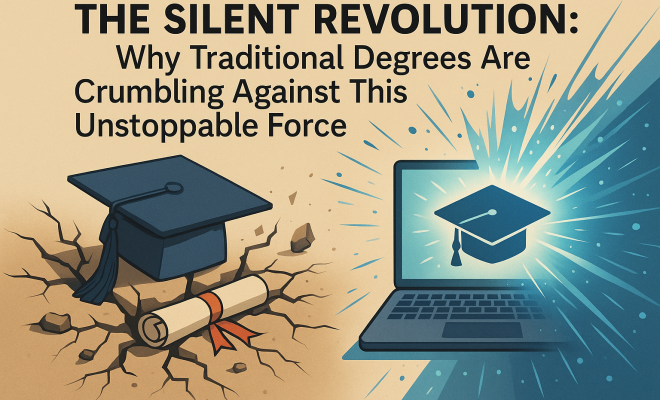
The air on college campuses feels different these days, doesn’t it? There’s an undercurrent of anxiety, a low hum of uncertainty that wasn’t quite so palpable a decade ago. It’s not just the usual pre-exam jitters or the stress of student loan debt; it’s something far more foundational. What we’re really grappling with is the seismic shift brought on by artificial intelligence, and how it’s rapidly reshaping the job market. This isn’t just about a few tech jobs here or there; we’re talking about a fundamental redefinition of what ‘work’ even means, and it’s forcing institutions of higher learning to confront some uncomfortable truths about how they’re preparing students.
For a long time, the path was clear: get a four-year degree, secure a good job, build a career. That narrative is now fraying at the edges, largely thanks to AI in education and beyond. Recent graduates are finding themselves in a challenging landscape, one where the skills they spent years acquiring might already be partially automated or, at the very least, augmented by intelligent systems. Universities, once bastions of tradition, are scrambling to adapt their curricula, much like the discussions highlighted in an October 1, 2026, article detailing how institutions are preparing students for this brave new world. It’s a race against time, as technology often moves much faster than academic committees.
The AI Tsunami and Its Impact on University Curricula
It’s no secret that AI is everywhere. From the personalized recommendations on our streaming services to the sophisticated algorithms powering medical diagnostics, AI’s reach is expanding at an astonishing pace. For universities, this isn’t just a trend to observe; it’s a force demanding a complete overhaul of how they approach education. The traditional model, often criticized for its slow pace of change, simply can’t keep up with the exponential growth of AI capabilities.
Consider the core disciplines. English majors are now grappling with AI tools that can draft entire essays or generate compelling marketing copy. Business students are learning that financial analysis, once a human-intensive task, is increasingly being handled by sophisticated AI. Even creative fields aren’t immune, with AI generating art, music, and even screenplays. This isn’t about replacing humans entirely, but rather about transforming job roles. The emphasis is shifting from rote tasks to critical thinking, problem-solving, and, crucially, the ability to collaborate with AI tools. Universities are now tasked with teaching students not just how to use these tools, but how to think critically about their outputs, understand their limitations, and leverage them ethically and effectively.
This means a significant push towards interdisciplinary studies. A computer science degree alone might not be enough; students need to understand the ethical implications of AI, the societal impact, and how it intersects with fields like law, humanities, and design. Many institutions are developing new courses, creating AI ethics committees, and integrating AI literacy across various departments. It’s a massive undertaking, requiring faculty retraining and significant investment in new infrastructure and software. The goal is to produce graduates who are not just users of AI, but thoughtful architects and navigators of an AI-powered future.
Legislative Bodies Grapple with AI in Education
It’s not just universities feeling the pressure; lawmakers are also scrambling to get a handle on the rapid proliferation of AI. The legislative landscape around AI in education is incredibly dynamic, with new bills and regulations emerging seemingly every other week. As of October 2, 2026, we saw further updates detailing legislative actions concerning AI system procurement in postsecondary institutions and the integration of AI into computer science standards. This isn’t surprising, really. When a technology has such profound implications for public services and future generations, governments are naturally going to step in.
On one hand, there’s a push to ensure that educational institutions are adopting AI tools responsibly. This means addressing concerns around data privacy, algorithmic bias, and equitable access. Legislators want to make sure that the AI systems being purchased and deployed aren’t inadvertently perpetuating existing inequalities or compromising student data. On the other hand, there’s a recognition that students need to be proficient in AI. This leads to efforts to update computer science curricula, ensuring that students are learning about machine learning, neural networks, and prompt engineering from an early age. It’s a delicate balancing act, trying to foster innovation while also safeguarding against potential harms.
The challenge for lawmakers is immense. The pace of technological change often outstrips the legislative process. By the time a bill is drafted, debated, and passed, the technology it aims to regulate might have already evolved significantly. This constant game of catch-up means that regulations need to be flexible and forward-thinking, focusing on principles rather than specific technologies. It also means ongoing collaboration between government, industry, and academia is more critical than ever to ensure that policies are both effective and relevant. (See: AI's impact on the job market.)
The K-12 Conundrum: Is AI Actually Helping Students Learn?
While universities and legislatures are trying to figure out the best way forward, there’s a different kind of debate brewing at the K-12 level. A recent report really threw a wrench into the narrative by indicating a striking lack of evidence that AI features in K-12 instructional materials actually improve student learning. Now, that’s a pretty significant finding, isn’t it? For all the hype and investment, are we really seeing tangible benefits where it matters most – in the classroom?
This report raises some critical questions about the efficacy of rapid AI integration. Are schools just jumping on the bandwagon, adopting AI tools without rigorous evaluation? Is the focus too much on the ‘wow’ factor of the technology itself, rather than its pedagogical impact? It’s easy to get excited about AI chatbots that can answer student questions or adaptive learning platforms that personalize content. But if these tools aren’t leading to demonstrably better learning outcomes, then we need to pause and re-evaluate our approach. For more context, see the AI skill secret college isn’t telling you.
Part of the problem might lie in how these tools are designed and implemented. Without proper teacher training, adequate technical support, and a clear understanding of learning objectives, even the most sophisticated AI can fall flat. There’s also the risk that some AI features are simply glorified digital textbooks rather than truly transformative learning aids. This report isn’t necessarily a condemnation of AI in K-12 altogether, but rather a powerful call for more evidence-based decision-making and a more cautious, measured approach to adoption. We need to ask ourselves: are we using AI because it’s new and shiny, or because it genuinely enhances the educational experience?
The Surprising Resurgence of Skilled Trades
Here’s where things get really interesting, and perhaps a little counterintuitive. While the traditional four-year degree path faces unprecedented disruption from AI, we’re seeing a significant and sustained increase in demand for skilled trades. We’re talking about fields like construction, welding, HVAC, and cybersecurity. These aren’t the careers that typically get glamorous portrayals in Hollywood, but they offer high-paying jobs, often with less debt, and significantly shorter training periods. It’s a surprising alternative, isn’t it?
Why this shift? Well, for one, these are jobs that are inherently difficult to automate. You can program a robot to weld, sure, but can it troubleshoot a complex HVAC system in a historic building? Can it navigate the unpredictable environment of a construction site? The nuanced problem-solving, manual dexterity, and on-the-spot critical thinking required in many trades still largely necessitate a human touch. Moreover, as infrastructure ages and technology advances, the demand for skilled technicians to build, maintain, and secure our physical and digital worlds only grows.
Think about it: an aging population means more need for home maintenance and repairs. The push for green energy requires skilled electricians and solar panel installers. And with every company moving online, the need for cybersecurity experts to protect against ever-evolving threats is exploding. These aren’t just ‘backup’ careers; they are front-line, essential roles that offer excellent remuneration and a clear path to employment. It’s a compelling argument against the often crushing debt load of a four-year degree, especially when the job market for those degrees feels increasingly precarious.
Cybersecurity: A High-Tech Trade for the Digital Age
Within the broader category of skilled trades, cybersecurity stands out as a particularly compelling example of a high-tech field experiencing explosive growth. It perfectly illustrates how some ‘trades’ have evolved to meet the demands of our digital society. While it might not involve a wrench or a welding torch, the practical, hands-on problem-solving and immediate application of skills make it very much a trade in the modern sense.
Every single day, businesses, governments, and individuals face an onslaught of cyber threats. From ransomware attacks that cripple hospitals to data breaches that expose millions of personal records, the digital frontier is a constant battleground. Who stands on the front lines? Cybersecurity professionals. These are the people who design secure networks, detect intrusions, respond to incidents, and educate users on best practices. Their skills are in incredibly high demand, and the supply simply isn’t keeping up.
What makes cybersecurity so attractive is that you don’t necessarily need a traditional four-year degree to get started. Many successful cybersecurity experts begin with certifications, boot camps, and hands-on experience. These shorter, more focused training programs can get individuals job-ready in a fraction of the time and at a fraction of the cost of a university degree. It’s a field that values practical competence and continuous learning above all else, making it an ideal choice for those looking for a direct path to a high-paying, future-proof career. (See: AI's role in reshaping education.)
The Debt Dilemma: Four-Year Degrees vs. Vocational Training
Let’s talk about the elephant in the room: student debt. It’s a burden that weighs heavily on millions of graduates, often dictating their career choices, delaying major life decisions like buying a home or starting a family. The average student loan debt in the United States is staggering, and for many, the return on investment for a four-year degree is becoming increasingly questionable, especially in a job market reshaped by AI in education and industry.
Compare that to vocational training. A welding program, for example, might cost a few thousand dollars and take six to eighteen months to complete. Graduates often step into jobs with starting salaries that can quickly outpace those of many entry-level positions requiring a bachelor’s degree. An HVAC certification can be obtained relatively quickly, leading to immediate employment in a field with consistent demand. The math is compelling: less time in school, significantly less debt, and often a faster path to financial independence. For more context, see why AI certification might outshine your traditional degree.
This isn’t to say that four-year degrees are obsolete – far from it. For certain professions like medicine, law, or advanced research, they remain absolutely essential. But for a growing segment of the population, especially those seeking practical, hands-on careers, vocational training offers a far more financially prudent and direct route to a stable, well-compensated future. It forces us to re-evaluate the ingrained societal belief that a bachelor’s degree is the *only* path to success. Perhaps it’s time we broadened our definition of what constitutes a valuable education.
The Anxiety Epidemic: Job Security in the Age of AI
The widespread anxiety about job security is completely understandable, isn’t it? Every news cycle seems to bring another story about AI automating tasks, displacing workers, or fundamentally changing industries. It’s enough to make anyone wonder about their future, whether they’re a seasoned professional or a student just starting out. This anxiety is a major reason why the topic of AI and the future of work has gone so viral.
The fear isn’t just about losing a job; it’s about the uncertainty of what skills will be valuable tomorrow, what careers will even exist. Will my profession be obsolete in five years? Will I be able to adapt quickly enough? These are legitimate concerns, and they speak to a broader societal unease about the rapid pace of technological change. It’s not just about learning new software; it’s about a constant need for upskilling and reskilling, a perpetual state of learning that can feel exhausting.
This anxiety is pushing people to seek out tangible solutions and reliable career paths. It’s driving the renewed interest in skilled trades, which offer a sense of stability and a clear value proposition in a turbulent world. And it’s also fueling the demand for new skills in areas directly related to AI, like prompt engineering or AI ethics, as people seek to be part of the solution rather than victims of the disruption. The conversation isn’t just academic anymore; it’s deeply personal and impacts everyone’s livelihood.
Preparing for the Future: A Multi-faceted Approach
So, what’s the takeaway from all this? How do we best prepare ourselves, our children, and our institutions for a future so heavily influenced by AI? It’s clear that a multi-faceted approach is absolutely essential. There’s no single silver bullet, no one-size-fits-all solution, because the challenges are diverse and interconnected.
For individuals, it means embracing lifelong learning. The idea that you graduate once and you’re done with education is a relic of the past. We need to continuously acquire new skills, whether through formal education, online courses, certifications, or self-study. Developing ‘soft skills’ like critical thinking, creativity, emotional intelligence, and complex problem-solving becomes even more important, as these are areas where humans still largely outperform AI. For more context, see 7 AI courses college students are using to conquer the job market. (See: Research on AI in education.)
For educational institutions, it requires radical agility. Universities must be willing to overhaul curricula more frequently, integrate AI literacy across all disciplines, and forge stronger connections with industry to understand real-world needs. K-12 schools need to focus on foundational skills and digital literacy, but also critically evaluate AI tools to ensure they genuinely enhance learning. And crucially, we need to destigmatize and champion vocational training as a legitimate, valuable, and often superior path to career success for many.
Finally, for policymakers, it means creating frameworks that encourage innovation while protecting workers and consumers. It involves investing in retraining programs, supporting workforce development initiatives, and ensuring equitable access to the education and tools needed to thrive in an AI-driven economy. The future of work isn’t something that just happens to us; it’s something we actively shape through our choices, our education, and our collective efforts.
The Path Forward: Adapt, Learn, and Diversify
The rapid evolution of AI isn’t just a technological phenomenon; it’s a societal one, forcing us to rethink deeply held beliefs about education, career paths, and economic security. The traditional four-year degree, while still valuable in many contexts, is no longer the undisputed golden ticket it once was. The rise of AI in education and industry has created a landscape where adaptability, continuous learning, and a willingness to explore diverse educational and career paths are paramount.
The resurgence of skilled trades isn’t a step backward; it’s a pragmatic and forward-thinking response to real-world demand and the changing nature of work. These professions offer stability, good pay, and a clear return on investment, often without the crushing burden of student debt. And within the tech sector itself, specialized, certification-based training in areas like cybersecurity provides a direct route to high-demand, high-paying jobs.
Ultimately, navigating this new era means being open-minded. It means challenging old assumptions about what constitutes a ‘good’ education or a ‘successful’ career. It means empowering individuals with the skills they need, whether they come from a university lecture hall or a vocational workshop. The future belongs to those who are willing to learn, adapt, and build new pathways for themselves, embracing the blend of cutting-edge technology and time-honored practical skills that will define the decades to come.
Trending Now
Frequently Asked Questions
Why are traditional degrees becoming less relevant?
Traditional degrees are losing relevance due to the rapid advancement of artificial intelligence, which is reshaping the job market. Graduates find that the skills they've learned may be automated or augmented, leading to a fundamental redefinition of work and prompting universities to rethink their curricula.
How is AI affecting university education?
AI is impacting university education by necessitating a complete overhaul of curricula. As technology evolves faster than academic institutions can adapt, universities are challenged to equip students with relevant skills that align with the demands of an AI-driven job market.
What challenges do recent graduates face today?
Recent graduates are facing a challenging landscape where their acquired skills may already be partially automated. This creates uncertainty in job prospects, highlighting the need for educational institutions to adapt to the changing demands of employers influenced by AI technologies.
Are universities adapting to the changes brought by AI?
Yes, universities are scrambling to adapt their curricula in response to the changes brought by AI. They recognize the need to prepare students for a rapidly evolving job market, which requires a shift from traditional educational models to more dynamic, relevant training.
What does the future of work look like with AI?
The future of work is likely to be heavily influenced by AI, which will redefine job roles and the skills required. As automation becomes more prevalent, workers will need to adapt by acquiring new skills that complement AI, leading to a more collaborative relationship between humans and technology.
What did we miss? Let us know in the comments and join the conversation.