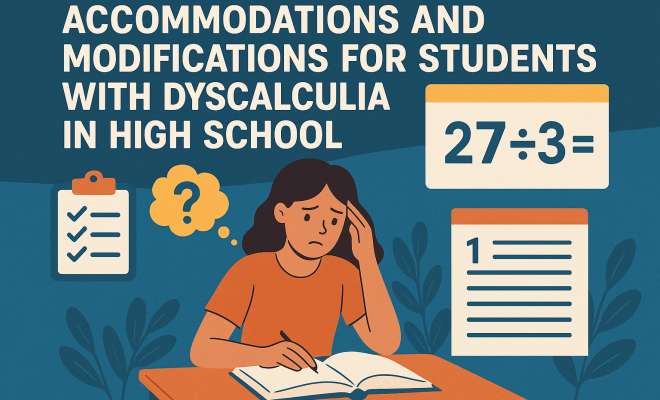
“Accommodations and Modifications for Students with Dyscalculia in High School”
“`html
For students with dyscalculia, navigating the demands of high school can feel like solving a complex puzzle without all the right pieces. Dyscalculia, often described as a learning disability in math, impacts how individuals perceive and process numerical information. It’s not just about poor math skills; it’s a neurological condition that affects a person’s ability to understand numbers and learn math facts. This can lead to significant challenges in academic performance, self-esteem, and overall school experience. Fortunately, with the right dyscalculia accommodations in high school, these students can thrive, gaining confidence and skills that will serve them well beyond the classroom.
Understanding Dyscalculia
Dyscalculia affects approximately 5-7% of the population, but it’s often overshadowed by more widely recognized learning disabilities like dyslexia. The condition can manifest in various ways, including difficulty with number sense, arithmetic, and mathematical reasoning. Students may struggle to grasp basic concepts such as counting, understanding time, or managing money.
It’s crucial to recognize that dyscalculia varies from person to person. Some may excel in verbal areas but find quantitative subjects daunting, while others might struggle across multiple disciplines. This variability poses a unique challenge for educators who need to tailor their approaches to meet individual needs effectively.
The Importance of Accommodations
Accommodations are adjustments that help level the playing field for students with dyscalculia. They aren’t designed to alter academic standards but rather to provide equitable access to learning opportunities. In high school, where math becomes increasingly complex, understanding and implementing effective dyscalculia accommodations is vital for ensuring that these students can progress alongside their peers.
Accommodations promote an inclusive educational environment, supporting not only academic success but fostering a sense of belonging. When schools actively work to accommodate students with dyscalculia, they send a powerful message: every student deserves the chance to succeed, regardless of their challenges.
Types of Accommodations
There are various types of accommodations that can be applied in high schools to support students with dyscalculia. These include:
- Instructional Accommodations: Adjustments in teaching methods or content delivery to enhance understanding.
- Assessment Accommodations: Modifications to how students are tested to better reflect their knowledge.
- Environmental Accommodations: Changes in the classroom setting to minimize distractions and optimize learning.
- Assistive Technology: Tools and software designed to aid students in completing assignments and learning new skills.
Instructional Accommodations
Instructional accommodations can significantly enhance the learning experience for students with dyscalculia. One effective strategy is the use of visual aids, such as charts, graphs, and manipulatives. These tools can help students visualize mathematical concepts, making them easier to grasp. For example, using physical objects like blocks to demonstrate addition can provide a concrete understanding of abstract ideas.
Another important accommodation is individualized instruction. Teachers should consider implementing small group sessions or one-on-one tutoring to offer personalized support and address specific challenges. This targeted approach allows for more intensive skill development and fosters a deeper understanding.
Additionally, providing extended time on assignments and tests can alleviate pressure and allow students to work at their own pace. This accommodation can lead to improved performance, as students can focus on comprehension rather than racing against the clock.
Assessment Accommodations
When it comes to assessing knowledge, students with dyscalculia often face unique challenges. Traditional testing methods may not accurately reflect their understanding of the material. To counter this, schools can implement a variety of assessment accommodations. For instance, oral exams or alternative formats can provide students with the opportunity to demonstrate their knowledge without the added stress of written calculations.
Another option is to allow the use of calculators or math software during assessments. While this might seem controversial, it’s important to recognize that the goal is to measure understanding rather than rote calculation skills. By enabling the use of technology, educators can give students the chance to showcase their mathematical reasoning without being hindered by their specific difficulties.
Environmental Accommodations
The physical learning environment can significantly impact the ability of students with dyscalculia to focus and succeed. A cluttered or noisy classroom can lead to distractions that make learning even more challenging. To support these students, schools should consider implementing environmental accommodations such as providing a quiet space for tests and assignments.
Seating arrangements can also play a role in minimizing distractions. For instance, placing students near the front of the classroom can help them concentrate better and engage with the lessons. Additionally, using flexible seating options, such as standing desks or bean bags, can cater to various learning styles and promote comfort during instruction. (See: National Institutes of Health on Dyscalculia.)
Incorporating Assistive Technology
In today’s digital age, assistive technology can be a game-changer for students with dyscalculia. Various tools and applications are specifically designed to help students manage their learning processes more effectively. For instance, software like Mathway or Photomath allows students to solve complex problems by breaking them down into manageable steps. This not only assists with homework but also fosters independence.
Other technologies, such as interactive whiteboards or educational apps, can make learning more engaging and interactive. These tools can provide immediate feedback and enable students to explore mathematical concepts in a hands-on manner. Integrating such technology in the classroom empowers students with dyscalculia to take control of their learning journey.
Promoting a Supportive Culture
Creating a supportive culture within the school is essential for the success of students with dyscalculia. This begins with professional development for teachers and staff to raise awareness about dyscalculia and its impact. Educators who understand the condition are better equipped to implement effective accommodations and create a nurturing environment.
Peer support programs can also play a significant role in fostering inclusivity. By pairing students with dyscalculia with mentors or peer buddies, schools can provide emotional support and practical guidance. This not only benefits the students with dyscalculia but also promotes empathy and understanding among the student body.
Engaging Parents and Guardians
Collaboration between home and school is vital for the success of students with dyscalculia. Parents and guardians need to be actively involved in the accommodation process. Schools should provide regular updates on their child’s progress and encourage open communication. Workshops for parents on dyscalculia can empower them with strategies to support their child’s learning at home.
Encouraging a growth mindset is particularly important. When parents focus on effort rather than outcomes, it helps children understand that improvement is possible. Celebrating small successes, even in the face of challenges, can motivate students and reinforce their self-esteem.
Measuring Success and Adjusting Accommodations
It’s essential to regularly evaluate the effectiveness of accommodations and make necessary adjustments. Schools should collect data on student performance and engagement to determine which strategies are working and which need refining. This may involve regular check-ins with students, teachers, and parents to gather feedback and insights.
Flexibility is key. As students progress, their needs may change. What works well in one semester might not yield the same results the next. Continuously adapting accommodations ensures that students with dyscalculia receive the support they need to thrive academically.
Looking Forward: The Future of Dyscalculia Accommodations
The conversation around dyscalculia accommodations is evolving. Educational leaders are increasingly recognizing the importance of catering to diverse learning needs. As awareness grows, there’s hope for developing more comprehensive strategies at local, state, and national levels. This shift will ultimately benefit not just students with dyscalculia but all learners, fostering a more inclusive educational setting.
In conclusion, implementing effective dyscalculia accommodations in high school is not merely a compliance issue but an ethical imperative. Every student deserves the right to learn and succeed, regardless of their challenges. By equipping educators with the right tools, fostering a supportive environment, and engaging parents, we can empower students with dyscalculia to unlock their potential and thrive in school and beyond.
Common Challenges Faced by Students with Dyscalculia
Understanding the specific challenges that come with dyscalculia is crucial for tailoring effective accommodations. Students often experience anxiety when faced with math tasks, leading to a negative association with the subject altogether. This anxiety can manifest in various ways, such as avoidance behaviors or decreased participation during math-related activities.
Additionally, many students with dyscalculia struggle with working memory, which affects their ability to remember steps in a calculation or retain information long enough to apply it. This can hinder their performance not only in math but also in subjects that require numerical literacy, like science or economics.
Another common challenge is time management. Students with dyscalculia may find it difficult to estimate how long tasks will take, leading to poor planning and rushed assignments. This continual pressure can exacerbate their struggles and impact their overall academic experience.
Statistics on Dyscalculia in High School Students
Research indicates that students with dyscalculia often underperform academically compared to their peers. For instance, a study showed that students with dyscalculia are twice as likely to fail math courses compared to their non-dyscalculic peers. Furthermore, standardized tests frequently reveal significant gaps in math performance, with dyscalculic students scoring an average of 1-2 standard deviations below the mean. (See: CDC's Overview of Learning Disabilities.)
Another concerning statistic is that approximately 30% of students with dyscalculia drop out of high school, citing math difficulties as a primary reason. This highlights the urgent need for effective accommodations and support systems to help these students succeed and reduce dropout rates.
Expert Perspectives on Dyscalculia Accommodations
Experts in the field of special education emphasize the need for tailored accommodations. Dr. Jennifer Choi, an educational psychologist, states, “Students with dyscalculia require specific interventions that address their unique challenges. It’s not just about making adjustments; it’s about understanding the underlying issues that contribute to their difficulties.” This perspective reinforces the importance of ongoing training for educators and the need for individualized education programs (IEPs) that reflect each student’s specific struggles and strengths.
Moreover, a growing body of research suggests that integrating multi-sensory teaching methods can be particularly beneficial. Dr. Mark Johnson, a leading researcher in learning disabilities, points out that “using a combination of visual, auditory, and kinesthetic learning strategies not only aids in comprehension but also boosts student confidence.” Such insights underline the importance of adopting varied instructional approaches to meet the diverse needs of students with dyscalculia.
Creating a Positive Math Culture
Creating a positive culture around math can significantly impact students with dyscalculia. Schools can work to change the narrative around math as being inherently difficult. This can involve celebrating mathematical successes, no matter how small, and promoting math as a valuable skill across various fields.
Organizing math clubs or competitions that focus on fun and creativity can help students engage with math in a low-pressure environment. For example, incorporating games that require strategic thinking and problem-solving can facilitate learning without the direct stress of traditional math problems.
FAQ About Dyscalculia Accommodations in High School
What accommodations are most effective for students with dyscalculia?
Some of the most effective accommodations include the use of visual aids, extended time for tests and assignments, individualized instruction, and the use of assistive technology like calculators or math apps.
How can teachers assess the needs of students with dyscalculia?
Teachers can assess the needs through one-on-one conversations, observational assessments, and standardized testing. Collaborating with special education professionals can also provide insights into effective strategies tailored to individual student needs.
Can students with dyscalculia succeed in higher-level math courses?
Yes, with the right accommodations and support, students with dyscalculia can succeed in higher-level math courses. It is crucial to provide ongoing support and to scaffold learning as they progress through their education.
How can parents support their children with dyscalculia at home?
Parents can support their children by creating a positive learning environment, encouraging practice with math-related tasks, and utilizing educational resources. They should also communicate with teachers to ensure consistent support between home and school.
Are there any resources available for students and parents?
Yes, many organizations offer resources for students and parents, including the National Center for Learning Disabilities, Understood.org, and the International Dyslexia Association. These resources provide information, support networks, and strategies to navigate educational challenges.
Collaboration in Developing Accommodations
It’s essential for educators, parents, and specialists to work together when developing accommodations for students with dyscalculia. This collaboration can take many forms, such as IEP meetings, regular communication, and shared goal setting. This team approach ensures that everyone involved is on the same page regarding a student’s specific needs and progress.
For example, a teacher might notice that a student struggles with certain types of problems during class, while a parent could provide insight on homework struggles at home. When both perspectives are combined, it leads to a more comprehensive understanding of the student’s challenges and strengths, allowing for better-targeted accommodations. This can culminate in a more cohesive learning experience that is tailored specifically to promote success.
Individualized Education Plans (IEPs) and 504 Plans
For students with dyscalculia, having an Individualized Education Plan (IEP) or a 504 Plan can be crucial in obtaining the necessary accommodations. An IEP is designed for students who require specialized instruction, while a 504 Plan is intended for students who may not need specialized instruction but still require accommodations to access the general education curriculum.
It’s important for parents to understand their rights and the process involved in obtaining these plans. This may include assessments by educational psychologists or other specialists who can formally diagnose dyscalculia. Once a plan is in place, regular reviews should be conducted to assess the effectiveness of the accommodations and make any necessary adjustments.
Real-Life Success Stories
Hearing success stories from individuals who have overcome dyscalculia challenges can be incredibly motivating for students currently struggling. For instance, consider the story of Sarah, a high school student diagnosed with dyscalculia at a young age. With the support of her teachers and the use of accommodations such as extended time on tests and the use of calculators, she was able to not only complete her math courses but also go on to pursue a degree in engineering. Her journey exemplifies how effective accommodations can lead to success in traditionally challenging subjects.
Another inspiring story is of James, who struggled significantly with math during his early years of schooling. Through personalized tutoring, visual aids, and the encouragement of both his parents and educators, he developed a strategy that worked for him. Now, James not only excels in math but also mentors younger students facing similar challenges, showing how overcoming difficulties can lead to helping others.
Transitioning to College: Continued Support for Students with Dyscalculia
As students with dyscalculia transition from high school to college, the conversation around accommodations continues. Many colleges and universities offer support services tailored specifically for students with learning disabilities. It’s important for students to advocate for themselves by understanding their rights under the Americans with Disabilities Act (ADA) and seeking the accommodations they need to succeed.
Colleges might provide services such as accessible math software, tutoring centers, and specialized workshops focused on study skills and time management. Students should be encouraged to connect with these resources from the outset to establish a foundation for success in their higher education journey.
Resources and Tools for Students with Dyscalculia
For students and parents looking for additional support, a wealth of resources is available. Websites such as Understood.org offer a variety of tools, tips, and parenting advice for navigating dyscalculia. There are also apps designed specifically for learning math, such as ModMath, which simplifies written calculations for students with dyscalculia.
Local and online support groups can also provide a community for both students and parents. Sharing experiences and strategies can build a network of support that enriches the learning experience. This collaborative community can help alleviate some of the feelings of isolation that often accompany learning disabilities.
Final Thoughts on Dyscalculia Accommodations
Understanding and implementing effective dyscalculia accommodations in high school is an ongoing learning process for educators, students, and families alike. With the right accommodations, awareness, and support systems in place, students with dyscalculia can not only succeed academically but also grow into confident individuals capable of tackling challenges in all areas of life.
“`
Trending Now
Frequently Asked Questions
What are some common accommodations for students with dyscalculia?
Common accommodations for students with dyscalculia include extended time on tests, use of calculators, providing visual aids, and allowing verbal responses instead of written ones. These adjustments help students access the curriculum without altering the academic standards, ensuring they can demonstrate their understanding effectively.
How does dyscalculia affect high school students?
Dyscalculia affects high school students by making it challenging for them to understand numerical concepts, perform arithmetic, and engage in mathematical reasoning. This can lead to difficulties in managing time, handling money, and keeping up with increasingly complex math courses, impacting both academic performance and self-esteem.
What strategies can teachers use to support students with dyscalculia?
Teachers can support students with dyscalculia by implementing differentiated instruction, using multi-sensory teaching methods, providing additional practice with basic math concepts, and utilizing technology like math software. Building a supportive classroom environment also encourages students to express their difficulties and seek help.
Is dyscalculia recognized as a learning disability?
Yes, dyscalculia is recognized as a specific learning disability that affects an individual's ability to understand and work with numbers. It is important for educators and parents to understand this condition to provide appropriate support and accommodations that help students succeed academically.
How can parents help their child with dyscalculia at home?
Parents can help their child with dyscalculia by creating a supportive home environment that encourages practice with math concepts, using games to make learning fun, and collaborating with teachers to reinforce strategies used in school. Additionally, emphasizing strengths in other areas can boost confidence and motivation.
What’s your take on this? Share your thoughts in the comments below — we read every one.