Cosmic Volcano: Black Hole Erupts After 100 Million Years
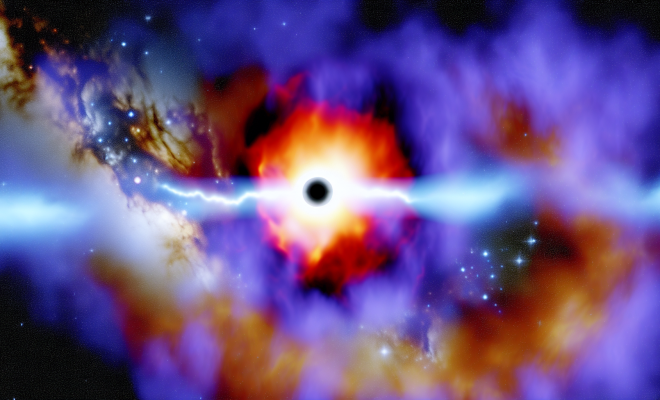
In a groundbreaking discovery, astronomers have observed a supermassive black hole in the galaxy J1007+3540 reactivating after a staggering 100 million years of dormancy. This remarkable event has been likened to a cosmic volcano erupting, unleashing powerful jets that stretch nearly one million light-years and interact with the extreme hot gas pressure surrounding the galaxy cluster. The research, led by Shobha Kumari from Midnapore City College in India, has provided new insights into the dynamics of active galactic nuclei (AGN) and the environment in which they operate.
Understanding the Phenomenon
Active galactic nuclei are regions at the center of galaxies that emit vast amounts of energy, often associated with supermassive black holes. These black holes can alternate between periods of inactivity and intense activity, known as episodic AGN activity. The recent findings concerning J1007+3540 illustrate this phenomenon vividly, as it displays signs of reactivation reminiscent of a long-dormant giant awakening from its slumber.
The Eruption of J1007+3540
According to Kumari, the black hole’s reawakening has resulted in the emission of a bright inner jet of plasma and a cloud of distorted older plasma, creating a dazzling display of cosmic energy. The jets produced by this supermassive black hole interact significantly with the hot gas present in the galaxy cluster, leading to fascinating and complex dynamics.
The Cosmic Volcano Analogy
Kumari’s analogy of the black hole as a ‘cosmic volcano’ emphasizes the dramatic change in activity levels. Just as a volcano can remain dormant for centuries, only to erupt with devastating force, so too can supermassive black holes lie inactive for eons before suddenly becoming active again. This eruption is not only a spectacle of immense energy but also serves as a crucial indicator of the underlying processes occurring within the galaxy cluster.
The Impact of Jet-Cluster Interactions
The jets emitted by J1007+3540 are not merely a byproduct of the black hole’s activity; they play a significant role in shaping the surrounding environment. The interaction between these jets and the hot gas within the cluster can lead to a variety of outcomes, including:
- Heating of the Surrounding Gas: The energetic jets can transfer their energy to the hot gas, increasing its temperature and altering the dynamics of the cluster.
- Influence on Star Formation: The pressure from the jets can suppress or enhance star formation in the surrounding areas, depending on the balance of forces at play.
- Shaping the Cluster’s Structure: The outflows from the black hole can help sculpt the morphology of the galaxy cluster, influencing its overall evolution.
This interplay between the black hole and its environment is critical for understanding the lifecycle of galaxies and the role of supermassive black holes in cosmic evolution.
Significance of the Discovery
The findings regarding J1007+3540 have been published in the Monthly Notices of the Royal Astronomical Society, adding to the growing body of evidence regarding the episodic nature of AGN activity. Understanding these cycles is vital for astronomers, as they provide insights into how galaxies evolve over time and how supermassive black holes influence their host galaxies.
Furthermore, this research underscores the importance of observing and studying black holes and their interactions with their surroundings. With advancements in observational technologies, astronomers are increasingly able to monitor these dynamic processes, shedding light on the workings of the universe.
Future Research Directions
The reactivation of J1007+3540 opens new avenues for exploration in the field of astrophysics. Future studies may focus on:
- Long-Term Monitoring: Continuous observation of J1007+3540 and similar AGN can provide data on the duration and nature of their activity cycles.
- Comparative Studies: Examining other galaxies with similar characteristics may reveal patterns in AGN behavior and their environmental interactions.
- Advanced Modeling: Developing simulations that incorporate the complex interactions between black holes and their environments can improve our understanding of galaxy formation and evolution.
In conclusion, the eruption of the supermassive black hole in galaxy J1007+3540 serves as a poignant reminder of the dynamic nature of the universe. As researchers continue to unravel the mysteries surrounding these cosmic giants, we gain a deeper appreciation for the intricate processes that govern the cosmos.