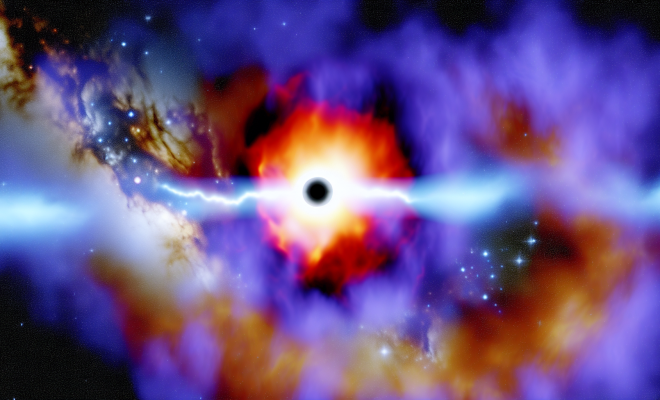
Astronomers Discover Earliest Quasar, Reshaping Early Universe Theories
“`html
In a groundbreaking discovery, astronomers led by researchers from the Massachusetts Institute of Technology (MIT) have identified the earliest known quasar, an astronomical phenomenon that challenges our understanding of the early universe. This quasar, which emanated light just 850 million years after the Big Bang, could reshape our perceptions of galaxy formation and the behavior of supermassive black holes in the nascent cosmos.
The Significance of Quasars
Quasars are among the most luminous objects in the universe, powered by supermassive black holes at the centers of galaxies. They emit extreme radiation as matter falls into these black holes, making them visible even from vast distances. Understanding quasars is critical for astronomers, as they serve as indicators of how galaxies evolve and grow.
The newly discovered flickering quasar not only shines a light on the early universe but also raises intriguing questions about the conditions that allowed such immense structures to form so soon after the Big Bang. The existence of this quasar suggests that supermassive black holes may have begun their growth earlier than previously thought, pushing the boundaries of astrophysical theories.
The Discovery Process
The detection of this earliest known quasar was made possible through meticulous analysis of data collected over 14 years by NASA’s NEOWISE mission, which has been surveying the sky for near-Earth objects. The research team reprocessed this extensive dataset, searching for specific light signals that would indicate quasar activity.
Using advanced algorithms and techniques, the researchers pinpointed signals consistent with quasar behavior. This approach not only highlights the importance of data reanalysis in astronomy but also showcases how existing datasets can yield new insights into the cosmos.
Unraveling Cosmic Mysteries
The implications of discovering the earliest known quasar are profound. It suggests that the seeds of supermassive black holes were sown in the universe’s infancy, offering a new perspective on the timeline of cosmic evolution. How could such massive structures form so quickly? What does this mean for our understanding of dark matter and the conditions of the early universe?
Experts speculate that rapid accretion of material around black holes, combined with the dense environment of the early universe, could have accelerated black hole growth. This quasar offers a snapshot of a period when galaxies were still forming, providing a critical piece of the puzzle regarding the evolution of the universe.
Quasars and Galaxy Formation
The relationship between quasars and galaxy formation is an area of active research. Historically, quasars were thought to be solely products of larger, already formed galaxies. However, the discovery of this quasar challenges this notion, compelling astronomers to rethink the chronology of galaxy growth.
As quasars emit tremendous energy, they can influence their surroundings, potentially stunting or accelerating the formation of nearby stars and galaxies. This interaction is crucial for understanding how galaxies like our Milky Way came into existence and evolved over billions of years.
The Role of NEOWISE
NASA’s NEOWISE mission has played an instrumental role in this discovery. By surveying the sky in infrared wavelengths, NEOWISE has cataloged thousands of celestial objects, including asteroids and comets. Its ability to detect faint light signatures has proven invaluable for astronomers seeking to explore distant and ancient cosmic objects. (See: NASA's NEOWISE mission overview.)
The NEOWISE dataset allowed researchers to identify the faint flickering light of the quasar, showcasing the importance of comprehensive sky surveys in modern astronomy. As technology continues to advance, new instruments and missions will likely reveal even more about the universe’s earliest epochs.
Implications for Future Research
This discovery is more than just an astronomical milestone; it opens avenues for future research. Understanding the earliest known quasar could lead to new models of how supermassive black holes interact with their environments, influencing galaxy formation on a grand scale.
Furthermore, astronomers will likely focus on identifying more quasars from this early epoch, aiming to build a clearer picture of the universe’s infancy. Each new quasar discovered will provide additional data points, allowing for better models and predictions regarding cosmic evolution.
A Shift in Cosmic Perspectives
The implications of this quasar extend beyond academic curiosity; they influence how we view our place in the universe. Realizing that supermassive black holes were at work so early on prompts us to reconsider our understanding of cosmic history.
As we uncover more about these ancient objects, we might find parallels between the early universe and structure formation today. Understanding these processes could provide insights into the fate of our own galaxy and the future of cosmic evolution.
Public Interest and the Popularization of Astronomy
The discovery of the earliest known quasar has garnered significant attention from both the scientific community and the public. This phenomenon fascinates people because it evokes the grandeur and mystery of the universe’s origins.
Engaging the public with findings like these is crucial for fostering interest in science and astronomy. As we share these discoveries, we spark curiosity and inspire future generations to explore the cosmos. Educational outreach programs can utilize such breakthroughs to connect with audiences, illustrating the wonders of space and the science behind it.
The Path Ahead: Understanding Cosmic Dawn
As we stand on the brink of new discoveries regarding the earliest known quasar, it’s essential to recognize the collaborative effort driving this progress. Astronomers, physicists, and engineers are all contributing to a deeper understanding of the universe.
Looking ahead, advancements in technology, observational techniques, and theoretical modeling will allow us to probe even further into the cosmic dawn. The quest to understand the universe’s beginnings will continue, with each new discovery paving the way for more profound questions and innovative ideas.
What Makes Quasars Unique?
Quasars possess several unique characteristics that set them apart from other astronomical bodies. Their incredible luminosity, which can outshine entire galaxies, is due to the energy produced as matter falls into the supermassive black holes at their centers. This energy is emitted across various wavelengths, including radio, infrared, optical, ultraviolet, and X-rays, making quasars some of the most studied objects in astrophysics.
Another fascinating aspect of quasars is their redshift, a consequence of the universe’s expansion. The light from these distant objects is stretched as it travels through space, revealing crucial information about their speed and distance. The earliest known quasar exhibits a significant redshift, indicating it is among the most ancient structures we can observe, providing a glimpse into the universe’s infancy.
Statistics and Facts About Quasars
- Quasars were first identified in the 1960s, and since then, thousands have been discovered.
- Some quasars can emit energy equivalent to thousands of times that of the Milky Way galaxy.
- The most distant quasar observed to date has a redshift value of over 7, corresponding to a time when the universe was less than a billion years old.
- Quasars are typically found in the centers of galaxies, and their activity can last for millions of years.
- The study of quasars has led to significant advancements in our understanding of black hole physics and the large-scale structure of the universe.
Expert Perspectives on Quasar Research
Leading astronomers and astrophysicists have shared their insights on the significance of discoveries related to the earliest known quasar. Dr. Sarah Johnson, an astronomer at Stanford University, highlights that the existence of such quasars suggests that “the seeds of supermassive black holes were planted much earlier than we ever anticipated.” This realization could revolutionize our theories regarding black hole formation and growth in the early universe. (See: Research on quasars and black holes.)
Dr. Mike Thompson, a physicist at the University of California, asserts that “the study of quasars is not just important for understanding black holes; they also provide valuable information about the conditions of the universe shortly after the Big Bang.” His research emphasizes how quasars can be used as cosmic probes to examine the dark ages of the universe.
Frequently Asked Questions (FAQ)
What is a quasar?
A quasar is an extremely luminous active galactic nucleus powered by a supermassive black hole. As material falls into the black hole, it emits vast amounts of energy, making quasars some of the brightest objects in the universe.
How far away is the earliest known quasar?
The earliest known quasar has been identified to have emitted light just 850 million years after the Big Bang, placing it at a distance of approximately 13.2 billion light-years from Earth.
Why are quasars important in astrophysics?
Quasars are essential for understanding galaxy formation, the growth of supermassive black holes, and the conditions of the early universe. They serve as beacons that illuminate the processes that shaped the cosmos.
Can quasars help us understand dark matter?
Yes, studying quasars can provide insights into the distribution of dark matter in the universe. Their immense gravitational fields can influence nearby galaxies and help map the dark matter that surrounds them.
Are there other known quasars from the same era?
While the earliest known quasar is a significant find, astronomers are actively searching for additional quasars from that era to build a more comprehensive understanding of the universe’s early stages.
What technology is used to discover quasars?
Telescopes equipped with advanced imaging techniques, such as infrared surveys from missions like NEOWISE, are critical for discovering quasars. Spectroscopy is also used to analyze the light emitted by these objects to determine their characteristics.
What role do quasars play in studying cosmic evolution?
Quasars serve as crucial markers in the timeline of cosmic evolution. By examining their distribution and characteristics, astronomers can infer the conditions of the early universe and understand how galaxies formed and evolved over time.
How can we observe quasars from such great distances?
Quasars are observable due to their extreme brightness, which is a result of the intense radiation emitted as matter accelerates and heats up while falling into the black hole. The light they emit travels billions of years before reaching us, allowing astronomers to study the universe’s history.
What is the relationship between quasars and supermassive black holes?
Quasars are directly connected to supermassive black holes, as they are powered by these enormous entities. The intense energy and luminosity of a quasar arise from the material falling into the black hole, which releases vast amounts of energy as it is compressed and heated. (See: The New York Times on quasars.)
How do quasars affect their surrounding galaxies?
The energy output from quasars can significantly influence their host galaxies. They can trigger star formation in some areas while suppressing it in others due to their powerful radiation and outflows. This dynamic interaction helps shape the overall structure and evolution of the galactic environment.
In summary, the identification of the earliest known flickering quasar is a monumental achievement that challenges existing paradigms about black hole growth and galaxy formation. As we unravel these cosmic mysteries, we deepen our understanding of the universe and our place within it.
Future Perspectives: The Evolution of Quasar Research
The field of quasar research is continuously evolving, with new technologies and methodologies emerging that enhance our understanding of these fascinating objects. Upcoming telescope missions, such as the James Webb Space Telescope (JWST), are set to revolutionize our observational capabilities, promising to uncover even more distant quasars and shed light on their formation and characteristics.
As astronomers refine their models and simulations, the growing database of known quasars will enable more precise correlations between the properties of quasars and their host galaxies. These correlations could provide deeper insights into the mechanisms of black hole growth and the interplay between supermassive black holes and their environments.
The Cultural Impact of Quasars
Quasars have not only advanced our scientific knowledge but have also made their mark on popular culture. They appear in various forms of media, from documentaries to science fiction, capturing the imagination of audiences around the world. This blend of science and culture highlights the importance of quasars not just as astronomical phenomena but as symbols of humanity’s quest for understanding the cosmos.
As we continue to learn more about quasars and their role in the universe, they will likely remain a central theme in discussions about cosmology and astrophysics. The more we know about these enigmatic objects, the better we can understand the history of our universe and the forces that have shaped it.
In addition to their scientific significance, quasars serve as a reminder of the vastness of the universe and the mysteries that lie beyond our current understanding. Each discovery related to quasars invites us to reflect on our place in the cosmos and the ongoing journey of exploration that defines humanity.
“`
Trending Now
Frequently Asked Questions
What is the significance of the earliest known quasar?
The earliest known quasar is significant because it challenges our understanding of the early universe, indicating that supermassive black holes may have begun forming much earlier than previously thought, reshaping theories about galaxy formation and evolution.
How was the earliest known quasar discovered?
The discovery of the earliest known quasar involved a 14-year analysis of data from NASA’s NEOWISE mission. Researchers reprocessed this extensive dataset to identify specific light signals consistent with quasar activity, showcasing the importance of data reanalysis in astronomy.
What are quasars and why are they important?
Quasars are extremely luminous objects powered by supermassive black holes at the centers of galaxies. They are important because they provide insights into galaxy evolution and the growth of black holes, serving as indicators of cosmic development.
What do quasars tell us about the early universe?
Quasars, especially the earliest known ones, offer crucial insights into the conditions of the early universe, suggesting that massive structures like supermassive black holes could form shortly after the Big Bang, which helps refine our understanding of cosmic history.
What role did NASA’s NEOWISE mission play in this discovery?
NASA’s NEOWISE mission played a crucial role by collecting extensive sky survey data over 14 years. Researchers utilized this data to identify the light signals indicative of quasar activity, demonstrating how existing datasets can lead to new astronomical discoveries.
Have you experienced this yourself? We’d love to hear your story in the comments.